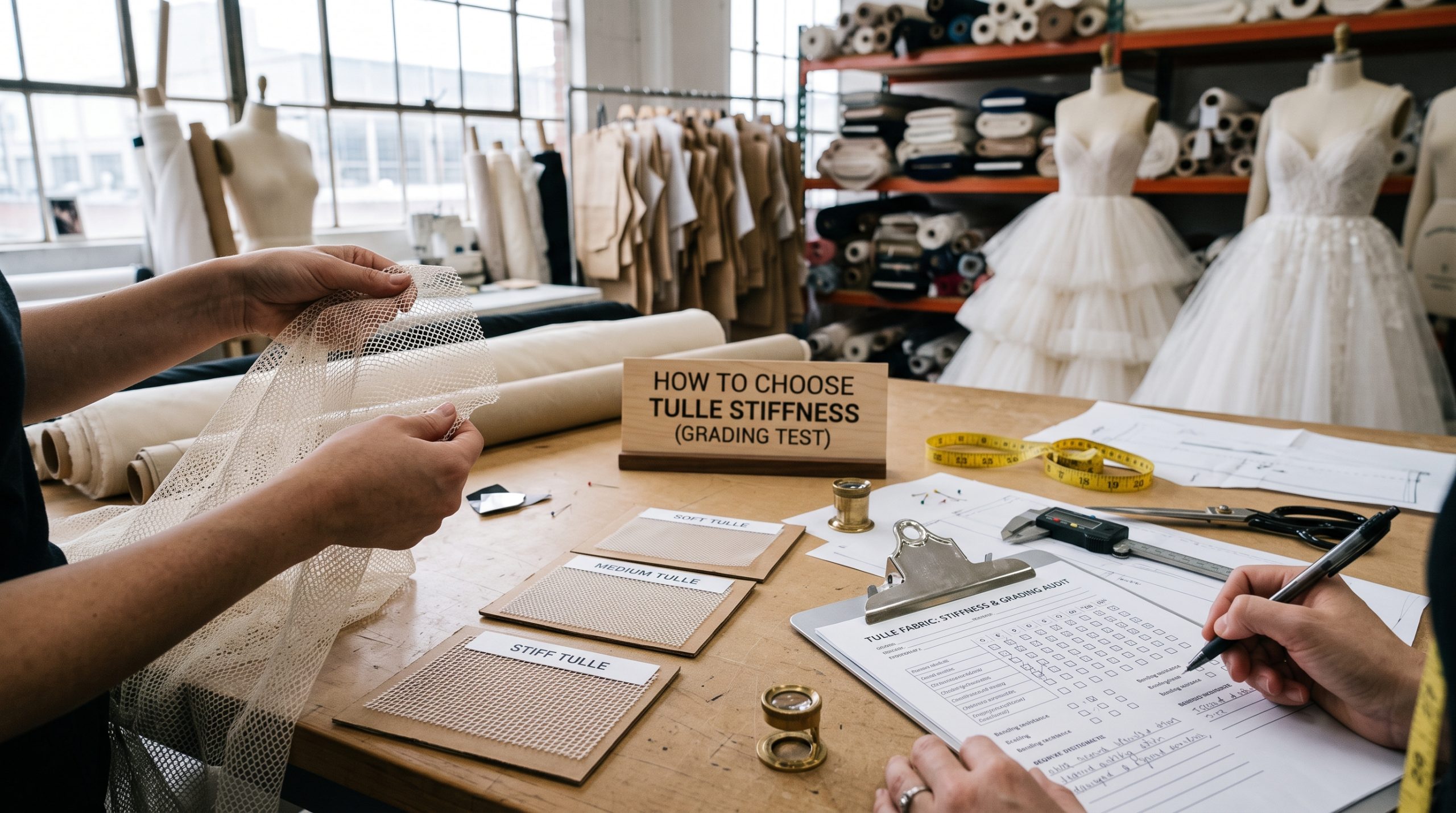
Selecting appropriate tulle rigidity depends on balancing your silhouette volume, skin contact requirements, and fabric weight. When garment manufacturers source netting for bridalwear or theatrical dance costumes, stiff netting frequently causes painful skin abrasion. Conversely, limp netting collapses under heavy surface beading, ruining costly gown outlines and sparking production cancellations. Mastering how to choose tulle stiffness eliminates these production errors through controlled resin finishes, exact yarn selections, and verified mechanical stability.
Why Learn How to Choose Tulle Stiffness for Gowns?
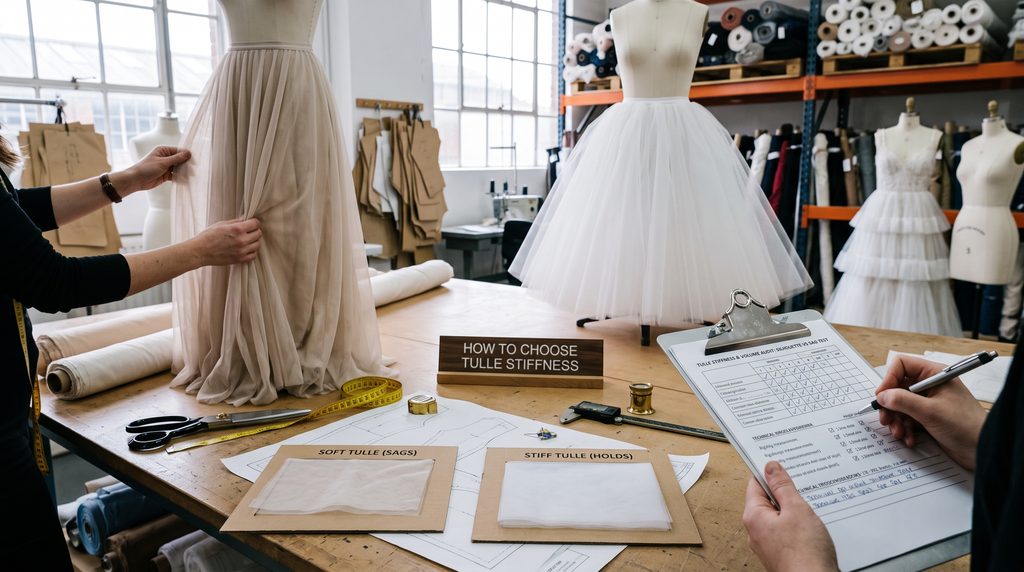
You must master how to choose tulle stiffness because structural memory dictates whether a ballgown maintains its silhouette or sags. Proper rigidity selection prevents uncomfortable garment friction while safeguarding your aesthetic vision.
Incorrect netting choices disrupt garment balance during manufacturing. Skirts either droop lifelessly or stand awkwardly away from body curves.
Can Wrong Rigidity Ruin Garment Silhouettes?
Weak netting fails to lift heavy satin face fabrics, causing voluminous ballgowns to flatten within hours. Here is the kicker: using excessively rigid netting makes hem edges scratch sensitive calves during movement.
- Under-specified netting collapses under heavy sequin embroidery
- Overly stiff netting creates rigid folds rather than graceful cascades
- Improper tier stiffness creates unwanted bulk around narrow waistlines
Balanced selection guarantees stable foundation support without compromising comfort.
How Does Stiffness Impact Production Efficiency?
Firm netting cuts cleanly under electric cutting blades without pulling or snagging delicate threads. Think about it: limp netting crawls during automated fabric spreading, creating uneven hem lengths across bulk production bundles.
- Resilient netting stacks smoothly across multi-layer cutting tables
- Firm cut edges feed evenly through high-speed overlock machines
- Stable netting structures reduce workshop sewing defects
Key Takeaway: Determining stiffness requirements beforehand speeds garment assembly and prevents expensive cutting errors.
| Fabric Grade | Primary Function | Tactile Characteristic | Assembly Risk |
| Ultra-Soft | Skin contact panels | Fluid, draping | Fabric slippage |
| Medium Firm | Tiered skirt ruffles | Bouncy, resilient | Minimal |
| Hard Crinoline | Foundation petticoats | Rigid, architectural | Needle deflection |
Analyzing your structural requirements upfront keeps production lines running smoothly.
How to Choose Tulle Stiffness by Fabric Drape?
Evaluating bending resistance determines how to choose tulle stiffness for flowing skirts versus architectural garments. Drape coefficient measurements reveal how freely fabric falls under its own weight.
Soft netting yields low bending resistance, creating fluid ripples around walking bodies. Firm netting pushes outward, establishing crisp silhouettes that hold their geometry.
What Controls Fabric Bending Modulus?
Yarn thickness and thermal finishing treatments govern how netting responds to gravitational pull. What does this mean for you? Micro-denier filaments bend with zero resistance, creating soft gathers on illusion sleeves.
- Thicker filament diameters create high flexural resistance
- Thermoset finishing resins lock yarn crossings into rigid configurations
- Open hexagonal apertures reduce bending resistance across garment bias
Matching yarn diameter to your design intent guarantees fluid motion.
Why Does Silhouette Architecture Demand High Drape Memory?
Architectural gowns require netting that snaps back when compressed by seated wearers. What is the real story? Without high drape memory, your dramatic runway gowns lose their flare after shipping transit.
- High-memory netting recovers instant volume after packaging compression
- Springy mesh fibers push outer fabrics outward horizontally
- Dense netting foundations maintain shape without heavy wire hoops
Key Takeaway: Testing bending flexibility protects your garment designs from premature sagging during retail display.
| Drape Category | Bending Resistance (mg/cm) | Visual Appearance | Target Garment |
| Cascading Drape | Under 15 | Liquid, clingy | Cathedral veils |
| Structured Drape | 25 to 60 | Crisp, buoyant | A-line party dresses |
| Architectural | Over 90 | Self-supporting | Haute couture gowns |
Evaluating bending resistance numbers ensures your silhouettes maintain intended flare angles.
How to Choose Tulle Stiffness for Bridal Veils?
Bridal veils require ultra-soft netting with low surface roughness to prevent facial abrasion and static cling. Knowing how to choose tulle stiffness for bridal designs keeps brides comfortable through twelve-hour wedding celebrations.
Bridal illusion netting features delicate polyamide filaments that frame facial features like morning mist. Coarser netting snags delicate lace borders, spoiling heirloom bridal ensembles.
Which Netting Grade Protects Sensitive Facial Skin?
Illusion netting uses fifteen-denier yarns that bend under soft breath without irritating bare shoulders. Ready for the good part? Premium bridal tulle receives gentle washing baths that strip abrasive spinning oils completely.
- Micro-filament polyamides prevent allergic skin reactions
- Smooth yarn loops avoid snagging delicate pearl earrings
- Pliable cell borders float softly across styled bridal hair
Selecting premium soft meshes guarantees zero-scratch wearability around brides’ necks.
Can Veil Blushers Retain Lift Without Scratchiness?
Two-tier veils require soft blusher layers that hold gentle crest height above hair pins. Here is the kicker: you can use medium-soft netting on crown gather points while keeping veil ends supple.
- Dense gather stitches create natural lift at hair attachment combs
- Light steam shaping sets crown volume without chemical stiffeners
- Flowing tail sections drift weightlessly behind moving brides
Key Takeaway: Choosing verified skin-contact netting grades protects bridal brands from uncomfortable scratch complaints.
| Veil Style | Recommended Softness | Yarn Specification | Primary Trait |
| Drop Veil | Ultra-Soft Illusion | 15D Polyamide | Cloud-like drape |
| Tiered Blusher | Semi-Soft Bridal | 20D Polyamide | Subtle crest height |
| Mantilla Veil | Soft Honeycomb | 20D Poly-Nylon | Lace edge support |
Verifying yarn softness numbers secures optimal bride comfort on wedding days.
Does Volume Dictate How to Choose Tulle Stiffness?
Garment volume directly determines how to choose tulle stiffness for multi-tiered underskirts and dramatic theatrical skirts. Massive skirts require rigid crinoline netting to counteract downward gravity from dense exterior fabrics.
Using soft netting for heavy skirts requires thirty cumbersome layers, adding unnecessary sewing labor and weight. Four tiers of firm crinoline generate equal volume with far less bulk.
How Does Crinoline Netting Support Heavy Gowns?
Stiff crinoline features wide honeycomb cells coated with baked thermosetting resin to withstand crushing weights. Think about it: heavy duchess satin drags weak underskirts flat, turning flared skirts into shapeless tubes.
- Heavy resin coatings prevent cell collapse under silk weights
- Coarse synthetic threads resist permanent folding during packing
- Broad mesh walls push exterior dress layers away from feet
Sturdy crinoline underpinnings maintain skirt geometry through active evening dances.
Can Designers Eliminate Heavy Steel Hoops?
Layering graded crinoline tiers builds dome-like volume without clunky metal hoop cages. What does this mean for you? Your clients sit comfortably in cars because flexible crinoline folds inward and bounces back.
- Graduated mesh tiers distribute skirt weight around hips
- Eliminating metal cages prevents embarrassing silhouette popping
- Resilient mesh loops recover spherical shapes when wearers stand
Key Takeaway: Specifying firm crinoline foundations delivers magnificent volume while keeping garments lightweight and flexible.
| Underskirt Construction | Number of Tiers | Required Netting Stiffness | Weight Support Capacity |
| Ballgown Petticoat | 4 to 6 Tiers | Heavy Crinoline | Up to 4.5 kg satin |
| Mermaid Hem Flare | 2 Tiers | Medium Stiff | Up to 1.5 kg crepe |
| Tutu Foundation | 8 to 12 Tiers | Rigid Theatrical | Self-supporting horizontal |
Selecting high-memory crinoline guarantees that voluminous dress tiers never flatten during transit.
How to Choose Tulle Stiffness via Fiber Content?
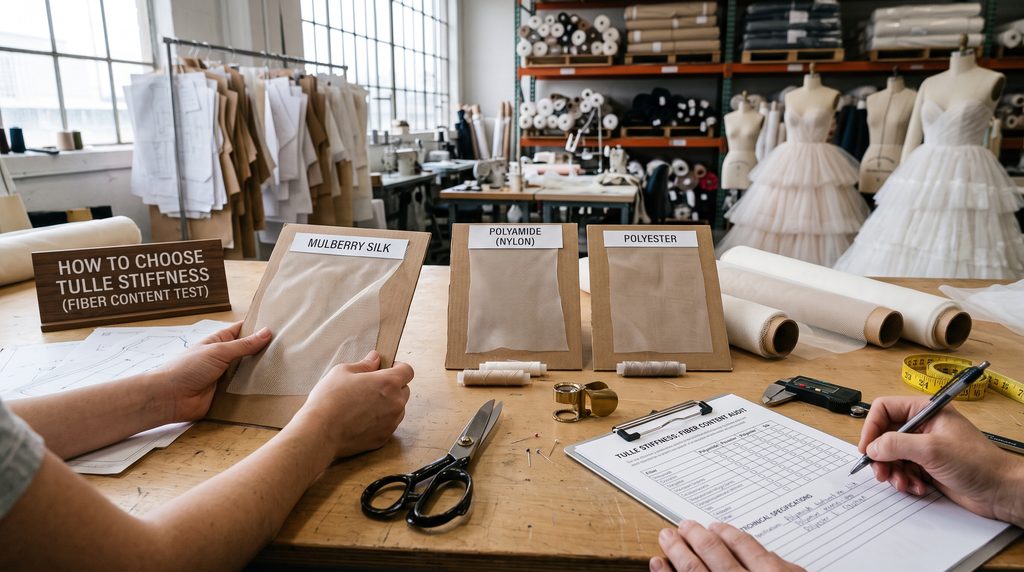
Fiber chemistry dictates base elasticity, softness, and thermal stability when learning how to choose tulle stiffness for garment lines. Polyamide yarns yield flexible resilience, while polyester filaments provide crisp stability at economical prices.
Mulberry silk netting delivers natural stiffness that softens beautifully with body warmth. Your fiber choice establishes base textile properties before chemical finishes enter production.
How Does Nylon Compare Against Polyester Mesh?
Nylon filaments absorb small moisture amounts, creating silkier touch profiles on bare human skin. What’s the real story? Polyester fibers repel water completely and accept high heat-setting temperatures, yielding permanent crispness.
- Polyamide netting stretches comfortably around active elbows
- Polyester meshes resist heat deformation during industrial pressing
- Synthetic nylon fibers offer superior tensile tear strength
Balancing fiber benefits against garment retail price points maximizes profit margins.
When Is Pure Silk Netting Worth the Investment?
Couture fashion ateliers specify silk hexagonal netting for heritage appeal and crisp hand feel. Ready for the good part? Silk fibers provide natural body without synthetic chemical coatings, decomposing safely after garment retirement.
- Natural protein fibers breathe cleanly in warm conditions
- Organic filament luster reflects stage lights without plastic glare
- Delicate silk mesh molds to tailored bodice foundations
Key Takeaway: Selecting proper fiber chemistry ensures finished garments balance manufacturing budgets with high performance.
| Fiber Chemistry | Inherent Stiffness | Moisture Regain | Tensile Elongation |
| Polyamide 6,6 | Low to Moderate | 4.5% | 25% to 30% |
| Polyester (PET) | Moderate to High | 0.4% | 15% to 20% |
| Mulberry Silk | Moderate (Crisp) | 11.0% | 18% to 22% |
Matching fiber traits to your garment specifications guarantees reliable long-term wearability.
Can Fabric Weight Guide How to Choose Tulle Stiffness?
Fabric weight measured in grams per square meter serves as a reliable metric for how to choose tulle stiffness across wholesale netting bolts. Heavier netting incorporate thicker yarns that resist deflection under physical pressure.
Lightweight netting under fifteen grams per square meter offers gossamer drape. Structural netting exceeding thirty-five grams provides firm architectural resistance for crinolines.
How Does Fabric Weight Correlate with Stiffness?
Higher fabric weight introduces more synthetic polymer mass per square centimeter of open netting. Here is the kicker: denser mesh walls increase flexural rigidity, stopping delicate garment sections from sagging.
- 12 to 16 GSM nets deliver weightless surface draping
- 20 to 28 GSM fabrics balance moderate volume with softness
- 35 to 50 GSM textiles produce rigid structural underskirts
Monitoring fabric weight metrics ensures consistency across recurring seasonal production runs.
What Prevents Garments from Becoming Excessively Heavy?
Using ultra-stiff light netting delivers structural height without burdening wearers with excess weight. Think about it: brides cannot enjoy long receptions when their wedding dresses weigh twelve kilograms.
- Efficient resin finishes add rigidity without adding physical yarn weight
- Wide hexagonal apertures lower total garment mass
- Strategic tier placement concentrates volume where skirts flare
Key Takeaway: Tracking fabric weight metrics prevents heavy garment fatigue while guaranteeing desired silhouette volume.
| Weight Bracket | GSM Range (g/m²) | Rigidity Index | Primary Application |
| Featherweight | 10 to 15 | 1.0 (Ultra-Supple) | Veils, illusion necklines |
| Intermediate | 18 to 26 | 2.5 (Medium Body) | Party dresses, overlays |
| Heavy Structural | 35 to 50 | 5.0 (Very Rigid) | Tutus, petticoat layers |
Tracking fabric weight specifications guarantees steady structural support without adding unwanted mass.
How to Choose Tulle Stiffness for Breathability?
Assessing open-cell pore geometry clarifies how to choose tulle stiffness without trapping body warmth inside multi-layered skirts. Open hexagonal voids permit vertical convective airflow, venting body heat during summer celebrations.
Stiff netting holds garment layers apart, creating natural ventilation chimneys between skirt tiers. Packed soft layers cling together, trapping humid air against wearer legs.
How Does Pore Openness Regulate Air Permeability?
Loom needle spacing determines whether netting apertures measure half a millimeter or three millimeters wide. What does this mean for you? Wide hexagonal openings allow ambient air breezes to pass through unrestrained.
- Broad cell openings provide superior air circulation rates
- Open-cell knits stop sweat condensation around waistbands
- Synthetic filaments resist moisture absorption to maintain airflow
Verifying airflow ratings keeps complex ballgowns fresh through hot outdoor receptions.
Can Rigid Netting Enhance Undergarment Ventilation?
Rigid crinoline netting acts as an internal spacer that keeps heavy outer silks away from bare skin. Ready for the good part? This separation establishes air circulation cavities that keep dancers comfortable during active performances.
- Crisp mesh loops prevent exterior fabrics from sticking to skin
- Internal air gaps speed evaporation of dancer sweat
- Springy netting walls preserve chimney ventilation during motion
Key Takeaway: Sourcing open-pore stiff netting keeps voluminous formalwear cool and comfortable under hot event lights.
| Aperture Class | Pore Diameter (mm) | Airflow (cm³/cm²/s) | Heat Retention Risk |
| Micro-Fine Mesh | 0.5 to 0.8 | 400 to 520 | Low |
| Standard Honeycomb | 1.0 to 1.5 | 550 to 680 | Extremely Low |
| Wide Crinoline Net | 2.0 to 3.2 | 700 to 850 | Negligible |
Selecting open-pore netting guarantees steady ventilation across dense multi-tiered garments.
Does Mesh Structure Show How to Choose Tulle Stiffness?
Comparing knit architectures explains how to choose tulle stiffness when specifying fabrics for activewear dance skirts versus athletic team jerseys. Sheer tulle relies on open hexagonal interlocking loops, whereas birdseye mesh fabric features a textured micro-hole surface.
Tulle delivers three-dimensional silhouette flare, but birdseye mesh drapes smoothly along muscular contours while wicking sweat during rigorous sports.
How Does Hexagonal Tulle Differ from Birdseye Mesh?
Warp-knitted tulle holds open geometric pores that maintain dimensional stability in every direction. What is the real story? Birdseye mesh knits incorporate tuck stitches that create moisture channels rather than self-supporting walls.
- Tulle netting maintains three-dimensional architectural shapes
- Birdseye knits stretch fluidly across torso contours
- Tulle apertures provide complete sheer optical transparency
Understanding these knit patterns directs smart procurement choices for dancewear lines.
Which Fabric Delivers Superior Surface Comfort?
Birdseye mesh provides smooth polyester surfaces that glide over sweat-dampened skin without friction. Here is the kicker: using stiff tulle for base layers causes chafing, requiring soft knit liners.
- Birdseye mesh protects skin from high-speed athletic friction
- Tulle netting provides outer visual volume without skin abrasion
- Combining both textiles builds functional performance dance costumes
Key Takeaway: Pairing structural tulle netting over smooth knit linings balances dramatic volume with skin comfort.
| Structural Property | Hexagonal Tulle Mesh | Birdseye Mesh Fabric | Performance Distinction |
| Cell Geometry | Hexagonal / Honeycomb | Textured Micro-Pores | Visual sheer versus solid |
| Structural Rigidity | High (When Resin-Treated) | Very Low (Fluid Drape) | Stand-off volume versus contour |
| Skin Contact Feel | Crisp to Ultra-Soft | Silky, Moisture-Wicking | Outer fullness versus inner liner |
Comparing knit geometries helps apparel developers select the right mesh for dynamic applications.
How to Choose Tulle Stiffness Versus Pique Knits?
Analyzing structural firmness clarifies how to choose tulle stiffness when creating hybrid athleisure designs like tennis dresses with tutu ruffles. Double-knit pique fabric features raised geometric textures that provide dimensional stability for collars and plackets.
Tulle supplies lightweight sheer ruffles, while pique knit provides opaque support across garment bodies.
How Do Pique Knit Structures Compare to Sheer Netting?
Pique textiles employ double-knit constructions with alternating tuck and float stitches to form honeycomb surfaces. Think about it: pique knit holds its structure through yarn density, while tulle derives stiffness from chemical resin finishes.
- Pique fabrics provide substantial opaque body for athletic polo shirts
- Tulle netting delivers lightweight volume without thermal weight
- Pique structures resist edge rolling during industrial sewing
Integrating both textiles allows sportswear designers to merge athletic performance with fashion flair.
When Should Designers Combine Both Fabrics?
Modern sports apparel blends pique bodice panels with firm tulle hem tiers for functional fashion skirts. Ready for the good part? The pique section absorbs torso moisture while the stiff tulle tier maintains flare during high-speed court sprints.
- Pique panels absorb sweat across upper torso zones
- Stiff tulle ruffles bounce outward without adding clingy warmth
- Contrasting textures elevate retail value across specialty sportswear
Key Takeaway: Combining structured pique knits with bouncy tulle ruffles creates striking athleisure garments that perform reliably.
| Attribute | Double-Knit Pique Fabric | Structural Tulle Netting | Functional Role |
| Fabric Opacity | Completely Opaque | Transparent / Sheer | Bodice shell versus flare ruffles |
| Structural Mechanism | Dense Interlocking Loops | Resin-Cured Open Cells | Stretch recovery versus shape hold |
| Primary Market | Golf and Tennis Apparel | Evening Wear and Costumes | Performance comfort versus volume |
Evaluating knit differences ensures garment components work together in performance wear.
How to Choose Tulle Stiffness from Fabric Mills?
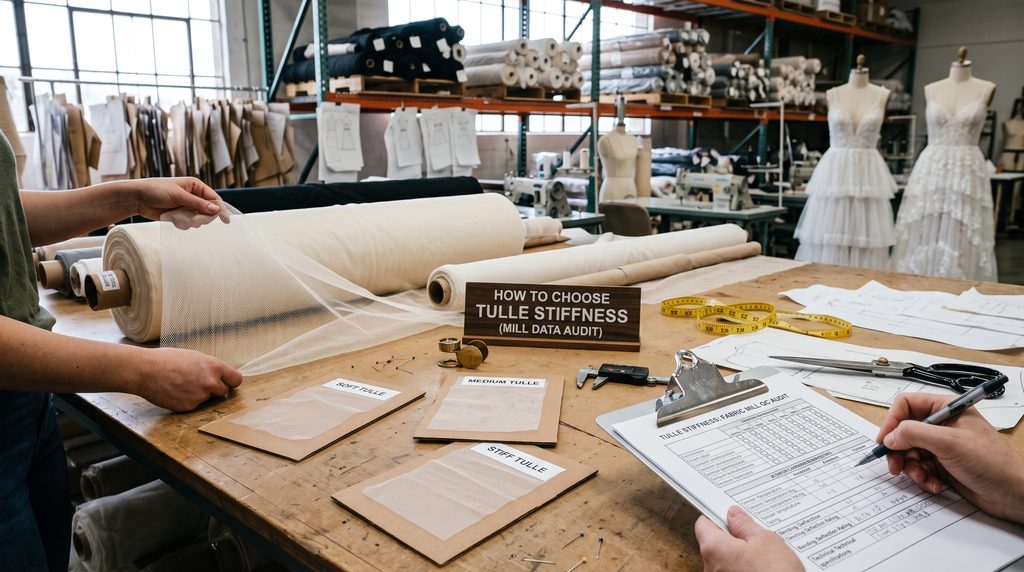
Auditing supplier test data shows you how to choose tulle stiffness with reliable roll-to-roll consistency across wholesale containers. Experienced textile mills control stenter curing temperatures to secure identical flexural stiffness from sample swatches to bulk bolts.
Inconsistent heat setting causes color shading and patchy softness across large yardage rolls.
What Laboratory Reports Verify Netting Rigidity?
Professional mills verify stiffness using ASTM circular bend tests or cantilever deflection testing equipment. What does this mean for you? Standardized stiffness certificates prevent receiving soft shipments when your factory needs rigid crinoline.
- Cantilever test ratings confirm uniform bending length across rolls
- Colorfastness testing verifies that resin baths do not bleed during washing
- Heat-setting certificates prove dimensional stability under garment pressing
Demanding certified laboratory data stops defective fabric bolts from reaching your cutting tables.
How Does Mill Equipment Guarantee Stable Rigidity?
Textile mills running automated warp knitting machines maintain constant yarn tension across wide fabric widths. Here is the kicker: computer-controlled stenter frames bake chemical stiffeners at exact temperatures, avoiding brittle fiber spots.
- Electronic feed rollers stop tension variations across wide bolts
- Digital stenter chambers eliminate patchy stiffness variations
- Real-time optical inspection cameras flag broken mesh threads instantly
Key Takeaway: Partnering with accredited textile mills prevents unexpected variations in fabric firmness across seasonal orders.
| Mill Inspection Parameter | Target Standard | Verification Protocol | Production Protection |
| Bending Length Tolerance | ± 5% Across Width | ASTM D1388 Cantilever Test | Uniform flare across dress tiers |
| Resin Cure Stability | Zero Wash-Out Loss | 40°C Launderometer Audit | Permanent volume after dry cleaning |
| Width Consistency | Full 150 cm to 300 cm | Automated Roller Gauge | Zero fabric waste on cutting tables |
Reviewing mill quality control standards ensures received yardage matches your production specifications.
Strategic Sourcing Summary and Next Steps
Selecting proper tulle stiffness requires balancing silhouette volume, wearer comfort, fiber chemistry, and structural airflow across garment designs. This sourcing guide demonstrated how bending resistance affects drape, how crinoline foundations support heavy ballgowns, and how warp-knit mesh differs from athletic knits like birdseye and pique fabrics. By reviewing laboratory cantilever test data and GSM weight brackets, your production team avoids scratchy necklines and collapsed silhouettes.
Our manufacturing mills produce high-grade warp-knitted meshes and performance athletic textiles, offering precise custom resin finishing, certified skin-friendly softness, and reliable roll consistency for global garment brands. Whether you require cloud-soft illusion veil netting or self-supporting crinoline for theatrical gowns, we provide tested wholesale solutions that protect your design standards. To request verified fabric swatches or discuss tailored netting specifications with our textile engineers, contact us today.
Frequently Asked Questions
Q1: Can I soften stiff netting by washing finished garments?
No, domestic washing will not soften industrial thermoset netting safely. High-temperature water washes break down resin finishes unpredictably, causing patchy wrinkles rather than silky drape.
Q2: What’s the best netting choice for sensitive bridal skin?
Choose fifteen-denier polyamide illusion netting with certified low-friction finishing. Micro-filament nylon fibers bend under light pressure, avoiding facial scratchiness and neck chafing.
Q3: How do I know if my skirt tiers will collapse?
Check the bending stiffness and total fabric weight of your outer layers. If exterior fabrics exceed two kilograms, specify heavy crinoline netting rated above thirty-five grams per square meter.
Q4: Can I substitute birdseye mesh for structural petticoats?
No, birdseye mesh lacks the three-dimensional rigidity needed to lift heavy gowns. Birdseye knits provide fluid drape and sweat-wicking comfort, making them suited for linings rather than petticoats.
Q5: What’s the best method to evaluate netting resilience?
Perform a manual crush-recovery test by squeezing sample swatches into tight balls for ten seconds. High-quality structural netting bounces back immediately to its original flat geometry without creases.