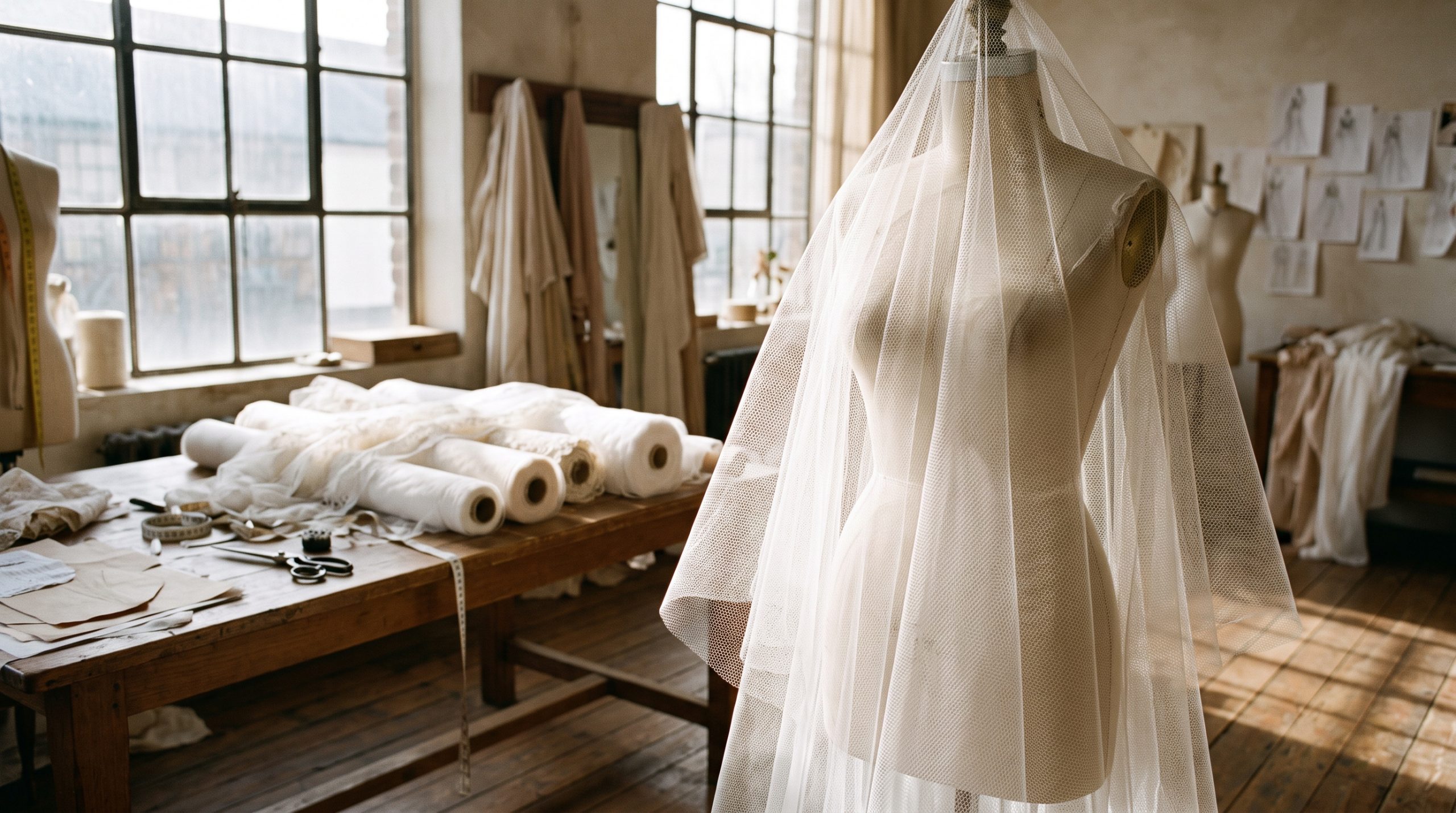
Selecting the finest bridal veil fabric depends on matching your gown silhouette, neckline embellishment, and preferred drapery across fine tulle, English net, and organza. Bridal designers frequently encounter stiff, scratchy netting that clashes with delicate wedding silk. Flimsy yardage collapses under heavy lace borders, ruining dramatic ceremonies and frustrating discerning couture clients. Specifying laboratory-tested bridal veil fabric from specialized warp-knitting manufacturers secures fluid motion, soft skin contact, and pristine visual clarity.
Why Does Selecting the Right Bridal Veil Fabric Matter?
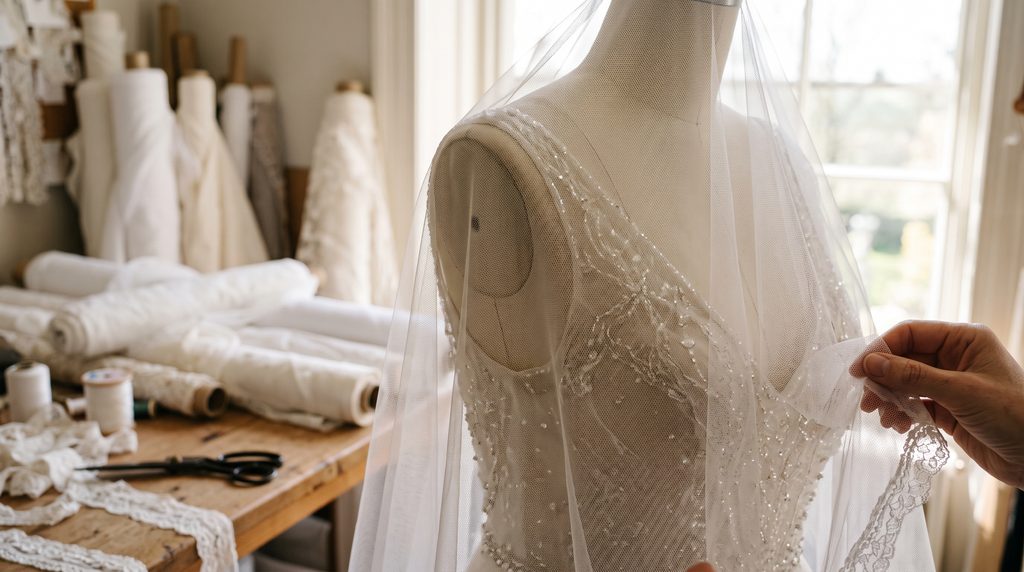
Choosing the proper bridal veil fabric directly dictates veil silhouette loft, face transparency, and bride comfort throughout lengthy ceremonies. Substandard netting snags against beaded bodices and produces unsightly static cling. Sourcing engineered bridal veil fabric prevents edge tearing during precision cutting and lace border embroidery.
What Structural Flaws Ruin Substandard Veil Yardage?
Low-grade synthetic netting features irregular pore spacing that distorts bridal photography under flash lighting. Coarse monofilaments abrade delicate bare shoulders during active movement.
Here is the deal: precision warp knitting stabilizes hexagonal cells against mechanical distortion.
- Irregular knitting loops cause wavy veil hemlines.
- Coarse surface knots scratch bare bridal skin.
- Loose mesh apertures snag on bodice crystal beadwork.
How Does Veil Drape Complement Gown Silhouettes?
Veil drapery must balance gown structure without obscuring intricate back button detailing. Lightweight netting floats gracefully behind moving brides while heavier weaves hang straight downward.
What is the real story? Matching veil weight to train length prevents awkward neck pulling during processionals.
- Fluid textiles enhance slinky mermaid silhouettes.
- Medium-body netting balances voluminous ballgown skirts.
- Sheer weaves display detailed illusion lace back designs.
| Fabric Parameter | Low-Tier Veil Mesh | Engineered Bridal Net |
| Pore Uniformity | Irregular aperture drift | Strict hexagonal precision |
| Skin Friction Value | High surface roughness | Cashmere-soft glide finish |
| Tensile Tear Limit | Fails under 12 N force | Resists 28 N pull tension |
This comparative benchmark confirms that precision-knitted netting withstands heavy decorative borders without ripping delicate cell walls.
Key Takeaway: Testing tensile strength and skin friction before volume production protects your atelier against costly hem failures and client discomfort.
How Does Soft Nylon Tulle Perform as a Bridal Veil Fabric?
Soft nylon tulle performs as the most versatile bridal veil fabric because its micro-denier yarns yield weightless volume and ethereal translucency. Warp-knitted nylon filaments bend effortlessly around headpieces without creating harsh creases. Ateliers specify this fine bridal veil fabric for multi-tier cathedral veils that float like mist.
Why Do Milliners Choose Micro-Denier Nylon Yarns?
Micro-denier nylon filaments measure between fifteen and twenty denier to deliver featherlight mass. These slender threads bend smoothly under finger pressure and eliminate prickly fiber ends.
Think about this: fine filament gauges allow multi-layered blusher veils without obscuring bridal smiles.
- Fifteen denier yarns yield mist-like transparency.
- High thread flexibility eliminates abrasive cut borders.
- Hexagonal warp interlooping stops ladder runs during stitching.
Can Nylon Tulle Support Intricate Lace Appliques?
Fine nylon tulle possesses sufficient tensile cohesion to bear corded Alençon lace edging without sagging. Heat-stabilized knit nodes anchor embroidery needle penetrations cleanly.
Look at the facts: balanced two-way stretch absorbs embroidery tension without puckering straight borders.
- Heat-set nodes resist dense satin needle punching.
- Elastic recovery keeps veil perimeters completely flat.
- Uniform cell structure distributes heavy lace mass evenly.
| Nylon Tulle Grade | Filament Denier | Average Mass (GSM) | Best Veil Application |
| Ultra-Fine Illusion | 12D – 15D | 14 – 18 GSM | Drop veils, sheer blushers |
| Standard Bridal Soft | 18D – 20D | 20 – 24 GSM | Fingertip and cathedral tiers |
| Semi-Structured Net | 25D – 30D | 26 – 32 GSM | Tiered horsehair hem styles |
This specification spread shows how selecting fifteen to twenty denier nylon achieves balanced opacity while carrying embroidered motifs securely.
Key Takeaway: Specifying twenty-denier nylon tulle delivers dependable needle support for heavy lace appliques without compromising ethereal softness.
What Makes English Net a Standout Bridal Veil Fabric?
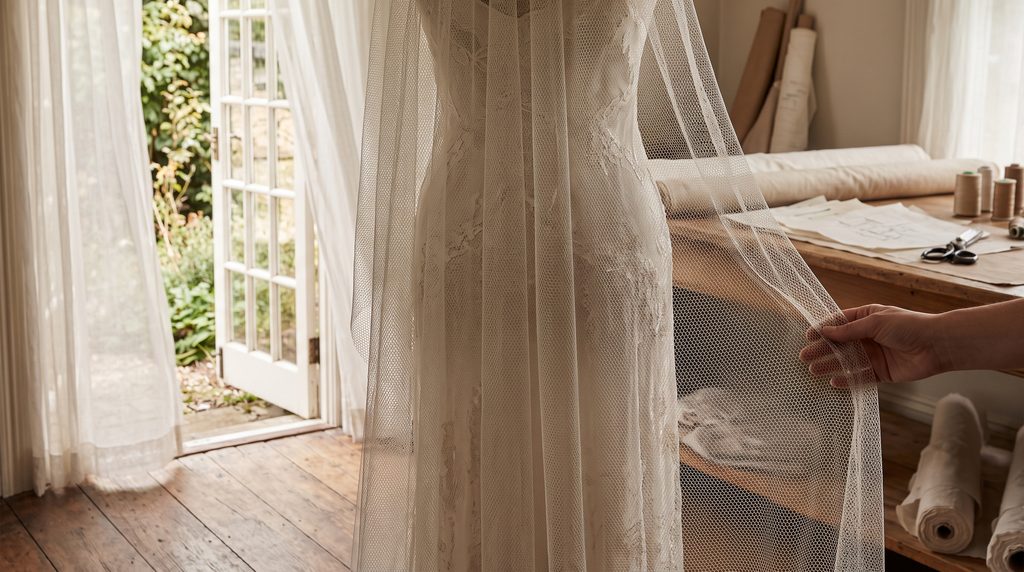
English net stands out as an exceptional bridal veil fabric due to its weighted drape, liquid fall, and authentic cotton-like softness. Its distinct hexagonal bobbinet-inspired structure drops straight toward the floor without ballooning outward in outdoor breezes. Designers choose this luxurious bridal veil fabric when pairing accessories with flowing column gowns.
How Does English Net Achieve Its Fluid Drape?
English net utilizes heavier yarn deniers and open mesh apertures that generate natural downward momentum. The textile hugs torso curves closely instead of standing away from wedding dress skirts.
You might wonder: why does this weave feel noticeably heavier than standard tulle?
- Open hexagonal geometry reduces wind billowing outdoors.
- Relaxed yarn tension produces supple liquid cascades.
- Natural gravity pulls hem borders into neat vertical folds.
Is English Net Resilient Against Wrinkling?
The substantial yarn construction of English net resists stubborn travel wrinkles far better than stiff synthetics. Ambient bathroom steam releases packing creases in minutes without intense ironing.
Ready for the good part? You avoid melted synthetic fibers because English net tolerates moderate steam temperatures gracefully.
- Supple filament bundles relax quickly under steam vapor.
- Low bending stiffness prevents sharp packing creases.
- Weighty vertical pull smooths wrinkles naturally on hangers.
| Performance Trait | English Netting | Standard Bridal Tulle |
| Drape Profile | Columnar and heavy | Fluffy and expanding |
| Ambient Wind Reaction | Remains close to body | Catches breeze and lifts |
| Steaming Recovery | Relaxes in two minutes | Requires delicate low heat |
This performance breakdown highlights how English net provides weighted stability for outdoor weddings where wind gusts disrupt lightweight accessories.
Key Takeaway: Choosing English net guarantees a sleek vertical silhouette that stays grounded during windy outdoor garden and seaside ceremonies.
Is Pure Silk Tulle the Most Luxurious Bridal Veil Fabric?
Pure silk tulle remains the ultimate luxury bridal veil fabric because natural protein fibers deliver incomparable gossamer softness and vintage elegance. Woven on antique looms in France and England, authentic silk net wraps brides in weightless luxury. Discerning ateliers invest in this royal bridal veil fabric for bespoke heirloom headpieces.
What Distinguishes Silk Net from Synthetic Fibers?
Natural silk filaments exhibit a matte luster and organic touch that synthetic petrochemical yarns cannot replicate. The hexagonal cells drape with unrivaled softness that settles gently around bridal hair.
Here is the bottom line: authentic silk net absorbs ambient moisture so static cling never occurs during ceremonies.
- Natural fibroin proteins eliminate static cling charges.
- Soft organic texture feels weightless against skin.
- Muted matte reflection photographs without harsh glare.
How Should Ateliers Handle Fragile Silk Netting?
Silk tulle demands meticulous manual cutting with micro-serrated shears to prevent pulling delicate silk threads. Artisans sew raw edges by hand using ultra-fine silk threads to avoid puckering.
What is the real story? Silk yarns tear easily under aggressive sewing machine needles so manual basting remains mandatory.
- Use brand-new size 60 microtex needles for stitching.
- Avoid alcohol sprays that spot natural protein fibers.
- Store finished veils in acid-free archival tissue boxes.
| Fabric Metric | Pure Silk Tulle | High-Grade Synthetic Tulle |
| Fiber Origin | Mulberry silk protein | Extruded nylon/polyester |
| Surface Luster | Subtle soft matte | Semi-matte to glossy sheen |
| Production Yield | Limited vintage looms | High-speed modern warp knits |
This evaluation explains why pure silk commands premium bespoke pricing while synthetic knits provide durable efficiency for volume bridal production.
Key Takeaway: Reserving silk tulle for top-tier couture clients justifies luxury price points while delivering unmatched royal heritage appeal.
How Do Birdseye and Pique Knits Compare as Bridal Veil Fabric?
Birdseye and pique knits compare distinctly as bridal veil fabric variations because their knit structures create completely different surface textures, breathability levels, and opacities. Birdseye provides micro-perforated smoothness with swift airflow while pique delivers a raised geometric waffle grid. Sourcing engineered bridal veil fabric with distinct knit structures allows designers to craft avant-garde fashion statements.
What Defines the Structural Difference in Knit Loops?
Birdseye knitting utilizes alternating tuck stitches that form microscopic circular eyelets across a smooth plane. Pique knitting locks floating yarn loops into a pronounced three-dimensional diamond honeycomb grid.
Here is the deal: birdseye surfaces glide smoothly whereas pique textures generate tactile friction and structural firmness.
- Birdseye tuck loops create microscopic ventilation pores.
- Honeycomb pique builds raised geometric ribs for body.
- Flat birdseye faces eliminate catching against lace trims.
Which Structure Wins for Airflow and Hand Feel?
Birdseye mesh wins for sheer tactile smoothness and rapid heat dissipation during summer receptions. Pique fabric excels in holding tailored architectural folds for modern bridal capes and sculptural headwear.
Look at the facts: birdseye fabric weighs less per square yard, making it gentler for extended hair placement.
- Birdseye delivers cashmere-soft touch across skin.
- Pique provides firm tensile resistance against wind gusts.
- Micro-eyelet spacing speeds perspiration evaporation.
| Structural Parameter | Birdseye Mesh Knit | Honeycomb Pique Knit |
| Surface Topography | Microscopic circular dimples | Raised geometric waffle grid |
| Air Permeability (cfm) | 185 – 220 cfm | 110 – 145 cfm |
| Bending Rigidity | Low and flexible | Moderate to structured |
This structural data proves that birdseye structures deliver superior skin comfort and cooling while pique creates crisp geometric silhouettes.
Key Takeaway: Select birdseye structures for lightweight breathable comfort or choose pique weaves when designing sculptural architectural headwear.
How Does Chiffon Drape Differ in a Bridal Veil Fabric?
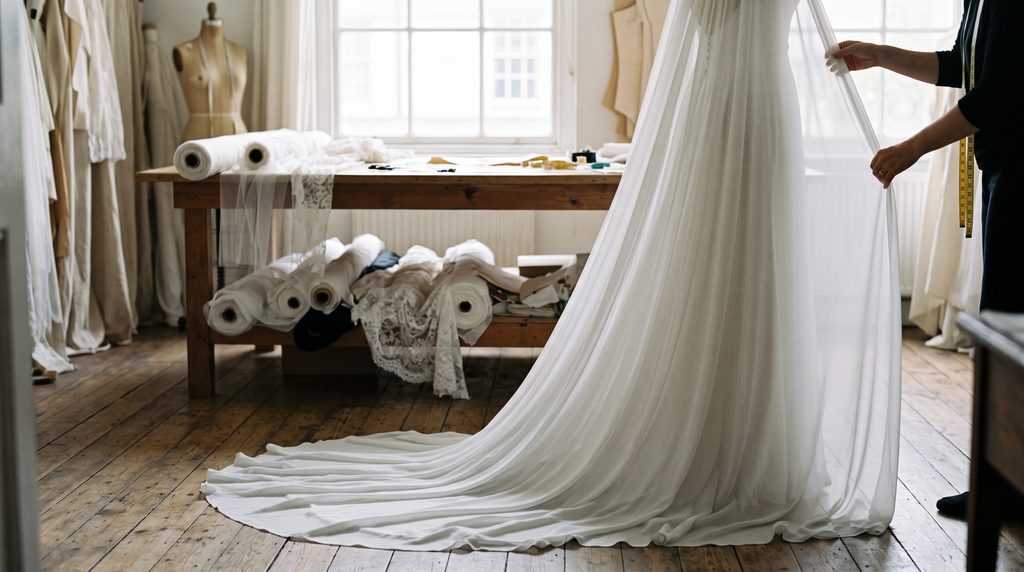
Chiffon drape differs dramatically in a bridal veil fabric because its plain-woven twisted yarns deliver dense opacity, liquid weight, and romantic ripple movement. Unlike open hexagonal netting that stands aloft, woven chiffon falls close along gown contours like a royal cape. Brides seeking bohemian elegance frequently choose this poetic bridal veil fabric.
Why Do Crepe-Twist Yarns Create Unique Movement?
Chiffon weavers use tightly twisted crepe yarns in alternating directions to produce a pebble-grained surface. When brides walk forward, these twisted filaments ripple fluidly without catching static charges.
Think about this: the natural grain creates a lovely non-reflective matte finish that complements crepe gowns.
- S-twist and Z-twist yarns create subtle matte creping.
- Dense weave hides intricate hair combs beneath veils.
- Heavy draping avoids flyaway static clinging outdoors.
When Should You Pair Chiffon Veils with Dresses?
Pair chiffon veils with unembellished crepe or satin slip dresses to maintain visual balance and understated luxury. Avoid placing heavy chiffon over voluminous ballgowns because excess fabric weight overwhelms wide silhouettes.
What is the real story? Chiffon wings and cowl back attachments showcase this textile far better than traditional hair combs.
- Complements minimalist silk crepe bridal gowns.
- Functions beautifully as shoulder wings and capes.
- Anchors breezy beach weddings without flyaway flutter.
| Styling Attribute | Silk / Poly Chiffon | Fine Hexagonal Tulle |
| Fabric Opacity | Semi-opaque milky coverage | Translucent crystal sheer |
| Silhouette Style | Fluid column ripple drape | Expanded buoyant cloud loft |
| Attachment Method | Shoulder draping or wings | Metal wire comb attachment |
This styling matrix confirms that chiffon accessories belong with sleek modern silhouettes rather than traditional wide skirts.
Key Takeaway: Recommending chiffon veils for modern slip gowns gives your bridal collection an ethereal cape aesthetic that appeals to contemporary brides.
Why Choose Crisp Organza as a Sculpted Bridal Veil Fabric?
Ateliers choose crisp organza as a sculpted bridal veil fabric because its plain-weave construction and natural stiffness hold three-dimensional architectural shapes flawlessly. Organza provides translucent sheen combined with crisp body that will not wilt under atmospheric humidity. Selecting this structured bridal veil fabric allows milliners to form dramatic bows and petal ruffles.
What Delivers Organza Its Signature Crisp Hand?
Organza yarns undergo specialized combing and twist stabilization that retain stiff structural body. Individual yarn intersections resist bending, which keeps dramatic folded hemlines projecting outward firmly.
You might wonder: how does organza compare to soft netting when constructing oversized headpieces?
- Stiff plain weave maintains dramatic bow contours.
- Glass-like transparency lets light shine through folds.
- Heat-pressed pleats remain sharp through long celebrations.
Can Organza Hold Voluminous Statement Edges?
Organza supports fluted horsehair braiding and structured rolled hems without collapsing into limp curves. Milliners shape expansive wavy borders that frame brides with editorial fashion presence.
Ready for the good part? You can craft dramatic oversized hair bows that stay upright all day without internal wires.
- Supports wide horsehair braid along outer edges.
- Retains crisp pressed pleating through dance movement.
- Blocks harsh sunlight to cast soft facial shadows.
| Fabric Parameter | Plain Woven Organza | Soft Bridal Tulle |
| Fabric Rigidity | High flexural stiffness | Ultra-low bending resistance |
| Hem Body Style | Fluted, wavy, sculpted | Feathery, wispy, floating |
| Humidity Resistance | Holds shape in 85% humidity | Softens under moisture |
This comparison proves that organza remains the premier textile for high-fashion sculptural accessories requiring unwavering architectural shape.
Key Takeaway: Incorporating organza into your bridal accessory line creates editorial statement pieces that maintain dramatic shape in any climate.
How Does Mesh Weight and Density Define Bridal Veil Fabric?
Mesh weight and density define bridal veil fabric performance by dictating sheer transparency, drape behavior, and complete headpiece comfort. Textiles measuring twelve to eighteen grams per square meter provide airy blushers, while thirty grams per square meter supports structured petticoat veils. Sourcing precisely calibrated bridal veil fabric prevents headaches caused by heavy headpieces.
Which GSM Ranges Suit Different Veil Lengths?
Calibrating fabric weight against veil length prevents neck strain and comb slippage during processions. Cathedral lengths require ultra-low GSM weights so long trains glide across carpets without resistance.
Here is the deal: selecting eighteen GSM netting keeps a three-meter cathedral veil under one hundred grams total.
- 12 to 16 GSM: Ideal for fingertip drop veils.
- 18 to 22 GSM: Standard for cathedral and chapel lengths.
- 25 to 32 GSM: Perfect for tiered vintage birdcage styles.
How Does Aperture Gauge Influence Photography?
Aperture gauge determines whether camera lenses register invisible mist or distracting honeycomb patterns. Fine fifty-gauge knitting creates microscopic pore walls that diffuse camera flash into a soft bridal glow.
What is the real story? Coarse net meshes create moiré optical distortions in digital wedding portrait albums.
- Fine gauge loops eliminate digital camera moiré patterns.
- Microscopic cell boundaries produce flattering soft-focus light.
- Tight pore matrices obscure stray hairs beneath blushers.
| Fabric Density Tier | Weight Range (GSM) | Gauge Classification | Best Portrait Use |
| Ultra-Fine Sheer | 12 – 16 GSM | 44G – 50G Warp Knit | Close-up face blushers |
| Medium Standard | 18 – 24 GSM | 36G – 40G Warp Knit | Flowing chapel trains |
| Structured Net | 28 – 35 GSM | 28G – 32G Warp Knit | Vintage fascinator nets |
This density benchmark illustrates how fifty-gauge knitting guarantees flawless photographic transparency without distracting pattern lines.
Key Takeaway: Specifying fifty-gauge warp-knitted textiles prevents camera moiré distortions while keeping long veils featherlight for brides.
What Color and Dye Precision Dictates Bridal Veil Fabric?
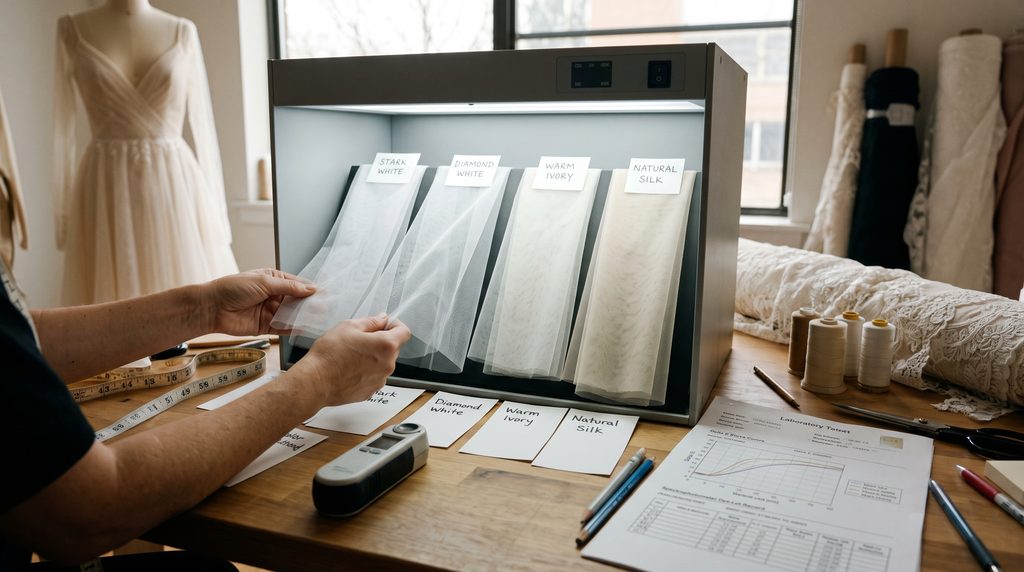
Color and dye precision dictates bridal veil fabric quality because even slight tonal mismatches ruin visual harmony against ivory and silk wedding dresses. Synthetic fibers must undergo rigorous spectrophotometer audits to eliminate harsh fluorescent whitening that clashes with warm silk gowns. Premium bridal veil fabric maintains consistent dye lots under both indoor bulbs and outdoor sunlight.
Why Does Optical Brightener Flare Ruin Photos?
Excessive optical brightening agents absorb ultraviolet rays and emit a blueish tint that looks synthetic in photos. High-end dyehouses calibrate whitening formulas so ivory tones appear rich, warm, and natural.
Look at the facts: flash photography turns cheap over-brightened veils into glowing blue shields beside natural silk.
- Low OBA formulations match untreated mulberry silk tones.
- Controlled dye recipes avoid blue ultraviolet flare.
- Natural ivory hues blend seamlessly with warm satins.
How Do Mills Maintain Strict Dye Lot Consistency?
Knitting mills utilize computerized dyebaths and spectrophotometers to keep batch variances within Delta E zero point five. This rigorous color control confirms sample swatches match bulk roll deliveries identically.
Here is the bottom line: tight color calibration prevents expensive sample rework when ordering bulk bolts months apart.
- Automated dye dispensers guarantee recipe repeatability.
- Delta E monitoring holds color variance below 0.5 points.
- Standardized D65 light boxes confirm indoor-outdoor match.
| Bridal Shade Name | Recommended Gown Match | Spectrophotometer Target |
| Pure Bright White | Stark bleached crepe gowns | High L-value, zero yellow |
| Soft Diamond White | Natural silk, raw white satin | Neutral undertone balance |
| Warm Bridal Ivory | Rich antique satin, champagne | Slight warm yellow curve |
This color calibration matrix helps bridal accessories harmonize perfectly with varying gown silks across differing venue lighting conditions.
Key Takeaway: Enforcing strict Delta E tolerances guarantees your veil production rolls match designer sample swatches every single production season.
How Do You Source Bulk Yardage for Bridal Veil Fabric?
Sourcing bulk yardage for bridal veil fabric requires vetting textile mills for warp-knitting precision, flexible minimum orders, and certified environmental compliance. Collaborating directly with specialized textile manufacturers gives ateliers access to custom widths, soft resin hand-finishes, and factory pricing. Securing dependable bridal veil fabric streamlines atelier cutting lines and eliminates raw material bottlenecks.
What Widths Improve Atelier Cutting Efficiency?
Specifying wide three-meter fabric bolts allows pattern cutters to lay out expansive cathedral veils without piecing seams. Wider rolls reduce fabric scrap waste by up to thirty percent during nesting.
Think about this: seamless veils look dramatically cleaner than panels joined by visible machine marrow seams.
- 150 cm bolts suit standard shoulder and fingertip styles.
- 300 cm wide rolls accommodate seamless royal trains.
- Wide selvages eliminate unsightly center connecting seams.
How Do Mill Audits Prevent Production Delays?
Auditing knitting facilities verifies machine maintenance records, defect tracking logs, and OEKO-TEX Standard 100 certifications. Direct mill partnerships secure reliable lead times and eliminate third-party importer markups.
Ready for the good part? Dedicated mills provide physical lab dip swatch cards and test yardage within forty-eight hours.
- OEKO-TEX certification guarantees skin-safe chemistry.
- Low defect rates below 1% prevent cutting line waste.
- Direct manufacturer pricing improves profit margins.
| Sourcing Channel | Minimum Order Size | Production Lead Time | Custom Width Option |
| Fabric Wholesaler | Single bolt (50m) | Immediate stock pull | Limited standard widths |
| Direct Knitting Mill | 100m – 300m Flexible | 10 to 14 business days | Full custom up to 300cm |
| Retail Jobber | Cut yardage | Variable availability | Fixed pre-cut widths |
This procurement comparison proves that partnering directly with specialized knitting mills secures custom roll widths while expanding profit margins.
Key Takeaway: Partnering directly with certified warp-knitting manufacturers eliminates seam joints on cathedral veils and increases workshop profit margins.
Strategic Sourcing for Bridal Veil Collections
Selecting the ideal textile across soft nylon tulle, English net, silk weaves, and structured organza resolves common atelier challenges regarding stiff netting, camera glare, and seam puckering. Specifying laboratory-tested knit architectures protects your accessories against static cling, unsightly tearing, and color mismatch against bridal silks. Our specialized manufacturing facility produces ultra-soft warp-knit netting, flexible widths up to three meters, and certified eco-friendly textiles tailored to your exact atelier specifications.
Empower your atelier with dependable luxury yardage that inspires bridal elegance and streamlines workshop assembly. Reach out to our textile engineering specialists and contact us today to request custom swatch cards, lab dips, and competitive wholesale yardage quotes for your upcoming bridal collection. We believe every bride deserves flawless, weightless elegance that transforms cherished moments into unforgettable memories.
Frequently Asked Questions
Q1: Can I steam nylon bridal veil fabric directly?
Yes, you can steam nylon netting using low heat settings held five inches away from the fabric. High temperatures melt synthetic filaments, so gentle indirect steam safely releases shipping folds without damaging delicate hexagonal apertures.
Q2: What is the best bridal veil fabric for cathedral veils?
Soft nylon tulle in eighteen to twenty denier is the best choice for cathedral veils. This lightweight textile floats gracefully behind walking brides without pulling headpieces backward during long church processionals.
Q3: How do I know if a veil textile will clash with ivory silk?
Check fabric swatches under natural D65 daylight alongside the bridal gown silk. Synthetic nets containing excessive optical brightening agents cast an unflattering blue hue, whereas warm ivory dyes harmonize with rich natural silks.
Q4: Can I sew heavy beaded lace borders onto fine tulle?
Yes, you can sew heavy lace trims by selecting warp-knitted nylon netting rather than woven tulle. Locked warp-knit intersections distribute needle tension evenly, preventing rips along the gathered hem perimeter.
Q5: What is the best veil fabric to prevent static cling?
Pure silk tulle and English net are the best options for eliminating static cling entirely. Natural protein fibers and weighted open meshes do not accumulate electrical charges, keeping veil tiers from adhering awkwardly to wedding dresses.