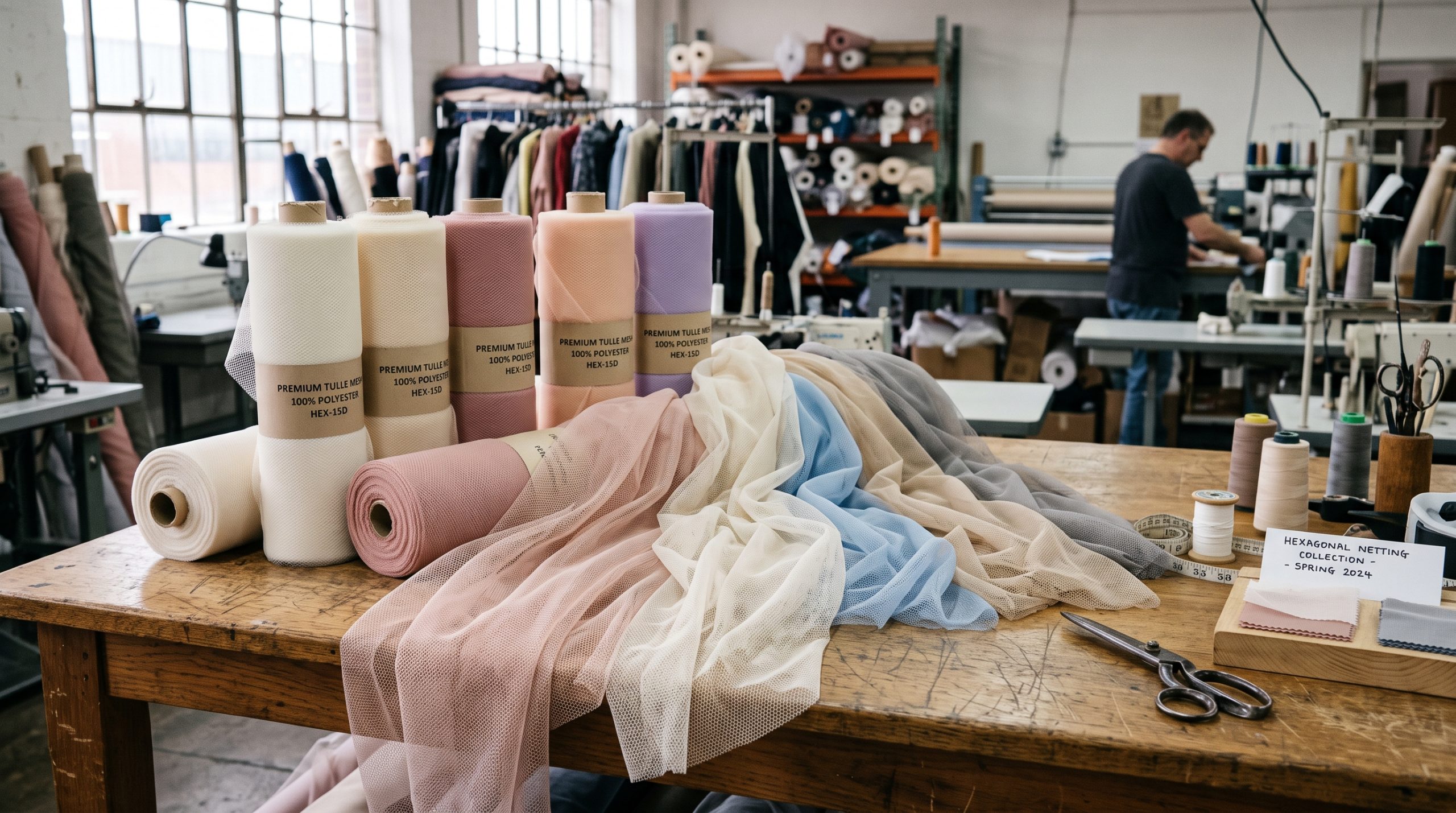
Tulle fabric is a sheer warp-knitted hexagonal netting crafted to deliver graceful drape, volume, and steady airflow across modern garments. When sourcing lightweight textiles for bridalwear or evening collections, you often encounter scratchy textures that irritate sensitive skin. Flimsy netting also collapses under heavy embroidery, ruining garment silhouettes and driving costly client returns. Partnering with reputable tulle mesh fabric manufacturers solves these production hurdles through precision yarn selection, controlled resin finishing, and consistent roll quality.
What Do Tulle Mesh Fabric Manufacturers Define as Tulle?
Tulle mesh fabric manufacturers classify tulle as an open-mesh textile formed by looping yarns into stable hexagonal cells on warp looms. This interlacing system prevents edge fraying when pattern makers cut multiple garment layers simultaneously.
Standard utility nets feature rectangular pores, but authentic tulle maintains uniform hexagonal geometry that holds three-dimensional volume without excess bulk.
What Defines the Hexagonal Knit Geometry?
Modern warp knitting looms produce rows of interlocking loops that create uniform hexagonal openings across wide fabric bolts. Here’s the deal: machines twist parallel yarn strands diagonally, so raw cut borders never unravel during rapid factory assembly.
- Interlocking loop geometry prevents edge fraying during precision cutting
- Uniform cell distribution balances outward tension across voluminous skirt tiers
- Diagonal yarn paths preserve shape memory under garment stress
This balanced geometry gives designers reliable structural predictability during garment assembly.
How Does Tulle Differ from Standard Netting?
Athletic netting uses thick polyester yarns for heavy utility wear, whereas fine tulle incorporates slender synthetic filaments for translucent softness. Think about it: you cannot substitute coarse sports mesh for delicate bridal veils without sacrificing graceful movement.
- Tulle relies on lightweight filaments ranging between 15 and 30 denier
- Industrial utility netting uses thick cords exceeding 100 denier
- Fine bridal mesh offers delicate skin contact unlike abrasive sportswear knits
Key Takeaway: Understanding mesh geometry helps you pick stable netting that speeds up garment cutting while eliminating fabric waste.
| Fabric Variety | Primary Cell Geometry | Typical Yarn Denier | Primary Application |
| Bridal Tulle | Hexagonal | 15D – 20D | Veils, overlays, sheer sleeves |
| Structural Tulle | Honeycomb | 30D – 50D | Tutus, petticoats, underskirts |
| Industrial Netting | Square / Diamond | 100D – 300D | Bags, sportswear, pocket linings |
Selecting proper cell geometry guarantees clean cutting edges for swift workshop assembly.
How Do Tulle Mesh Fabric Manufacturers Evaluate Hand Feel?
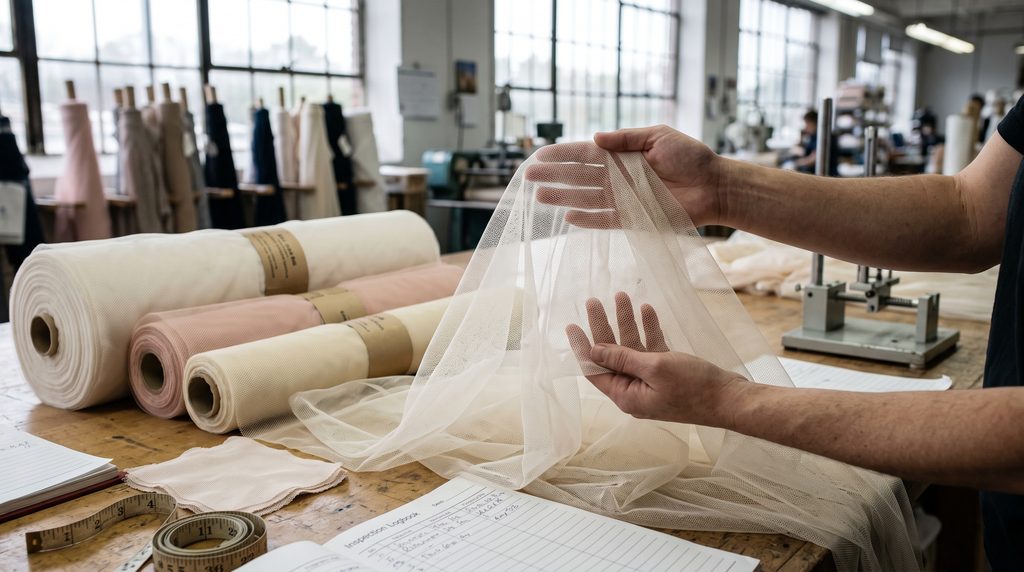
Professional tulle mesh fabric manufacturers evaluate hand feel by measuring surface softness, bending resistance, and skin friction on finished netting rolls. These tactile evaluations ensure dresses feel silky rather than scratchy against bare skin.
Skilled technicians perform tactile touch audits alongside mechanical flex testing to confirm every fabric batch satisfies strict luxury fashion specifications.
How Do Mills Measure Fabric Surface Friction?
Specialized testing frames pull fabric swatches across tactile sensors to track friction coefficients before rolls depart the factory. What does this mean for you? Low surface friction guarantees that multi-layered skirts glide effortlessly against inner satin linings without snagging.
- Mechanical probes assess micro-roughness along individual knit ridges
- Tactile friction audits identify abrasive yarn knots before shipment
- Heat-setting calibrations smooth synthetic fibers for soft skin contact
Standardized friction scores prevent uncomfortable garment abrasion during extended wedding receptions.
Why Does Drape Rigidity Dictate Wearer Comfort?
Stiff netting creates magnificent silhouette fullness, yet rough edges can scratch bare wrists or delicate necklines. Ready for the good part? You can layer soft nylon netting directly over skin while reserving stiffer meshes for interior support panels.
- Flexible yarns bend naturally around moving arms and legs
- Smooth chemical finishes eliminate harsh fiber ends along cut seams
- Controlled bending stiffness supports dramatic couture shapes comfortably
Key Takeaway: Checking certified hand feel ratings keeps your customers happy by eliminating itchy garment complaints entirely.
| Softness Grade | Tactile Characteristic | Bending Resistance | Best Design Placement |
| Ultra-Soft | Cashmere-like, fluid | Minimal | Bridal veils, illusion bodices |
| Semi-Soft | Balanced body, gentle | Moderate | Tiered fashion dresses, ruffles |
| Crisp / Firm | Rigid, springy | High | Ballgown foundations, costumes |
Reviewing tactile softness data ensures your finished evening wear never irritates skin.
Why Do Tulle Mesh Fabric Manufacturers Vary Pore Openness?
Tulle mesh fabric manufacturers vary pore openness to balance visual opacity with natural airflow across diverse garment applications. Loom needle gauges dictate exact cell diameters, ranging from micro-fine openings to broad honeycomb windows.
Changing hole diameters allows garment designers to manipulate opacity, creating mysterious shadowed layers or completely sheer floating panels.
What Controls Hexagonal Mesh Pore Dimensions?
Needle bar spacing on high-speed warp knitting machinery determines the precise aperture dimensions of finished fabric bolts. Here is the kicker: tighter needle spacing creates dense netting that softens body contours beneath semi-translucent gowns.
- Fine gauge looms produce microscopic pores under one millimeter wide
- Medium gauge bars produce balanced openings for party dresses
- Wide aperture setups yield dramatic transparency for decorative wraps
Precise needle calibration guarantees uniform aperture dimensions across thousand-meter production runs.
How Do Cell Voids Influence Sheer Transparency?
Wide mesh cells allow light to pass through unobstructed, creating an ethereal floating impression on high-fashion runways. What’s the real story? You can stack three layers of open netting to build dramatic color depth without losing transparent grace.
- Open mesh apertures showcase contrasting underlying fabrics cleanly
- Dense hexagonal grids diffuse harsh stage lighting evenly
- Balanced void distribution prevents cloudy streaks across wide skirts
Key Takeaway: Picking matching pore sizes allows you to control transparency and create stunning multi-tonal color depths.
| Mesh Aperture Class | Average Pore Diameter | Transparency Rating | Common Garment Purpose |
| Micro-Fine Mesh | 0.5 mm – 0.8 mm | Semi-Sheer (Soft Focus) | Illusion necklines, sleeves |
| Standard Honeycomb | 1.0 mm – 1.5 mm | Moderate Sheer | Bridal skirts, evening overlays |
| Broad Net Aperture | 2.0 mm – 3.0 mm | High Transparency | Theatrical wear, gift decor |
Calibrating pore diameter gives apparel brands absolute control over garment opacity.
How Do Tulle Mesh Fabric Manufacturers Test Breathability?
Qualified tulle mesh fabric manufacturers test breathability through air permeability ratings that measure airflow through hexagonal mesh cells. This technical inspection confirms voluminous dresses remain cool during warm outdoor events.
Technicians clamp sample swatches into calibrated airflow meters to verify air circulation before shipping fabric rolls to formalwear designers.
How Does Air Flow Through Layered Net Structures?
Open hexagonal voids let ambient air circulate freely around the body, venting excess body heat through multiple garment layers. Here’s why: open-cell knits avoid moisture traps, keeping brides fresh throughout lengthy summer weddings.
- Calibrated air chambers measure air volume passing through fabric swatches
- Porous knit architectures prevent heat retention around waistbands
- Synthetic filaments resist humidity absorption to stop clinging
High airflow ratings keep complex formal garments comfortable under blazing summer heat.
Can Dense Skirt Layers Maintain Proper Ventilation?
Even when a ballgown requires twelve stacked tiers for volume, open mesh geometry permits vertical convection between tiers. What does this mean for you? Your bridal customers stay cool because air moves freely through the open lattice network.
- Multi-layer tier spacing creates tiny internal air circulation pockets
- Stiff net walls stand apart rather than collapsing into heavy sheets
- Continuous air movement evaporates perspiration before stains appear
Key Takeaway: Sourcing high-breathability netting prevents heavy perspiration and keeps brides comfortable in layered gowns.
| Mesh Construction | Airflow Rate (cm³/cm²/s) | Heat Retention Risk | Climate Recommendation |
| Single Layer Micro Tulle | 450 – 600 | Extremely Low | Hot outdoor summer venues |
| Triple Layer Bridal Net | 280 – 380 | Low | Standard indoor ballrooms |
| Multi-Tier Crinoline | 150 – 220 | Moderate | Temperature-controlled halls |
Verifying airflow metrics prevents heat exhaustion in voluminous bridal dresses.
Can Tulle Mesh Fabric Manufacturers Engineer Stiff Tulle?
Industrial tulle mesh fabric manufacturers engineer stiff tulle by applying thermosetting resin finishes and higher denier synthetic filaments. This chemical stabilization locks hexagonal loops into rigid forms that resist crushing during warehouse storage.
Heavy-duty finishing stenters cure resin coatings under high heat to give structural netting permanent elastic recovery under load.
How Do Mills Create Stiff Structural Crinoline?
Mills run raw warp-knitted rolls through chemical resin baths before stretching fabric across high-temperature baking stenters. The best part? This thermal cure creates firm structural memory that bounces back even after tight packaging.
- Formaldehyde-free resin baths coat fiber intersections securely
- High-temperature curing chambers fix structural memory permanently
- Coarse yarn diameters provide superior flexural modulus against bending
Precision resin curing prevents unsightly sagging during long overseas transit routes.
Why Do Volume Tiers Maintain Shape Over Time?
Structured crinoline netting holds skirt silhouettes horizontally without requiring cumbersome steel hoop frames beneath heavy silks. Think about it: brides love dramatic fairy-tale fullness, but they hate dragging metal cages around banquet halls.
- High-memory resins prevent tier compression under beaded bridal silks
- Springy mesh fibers push outward horizontally to shape flared hems
- Resilience resists permanent creasing when packed in bridal garment bags
Key Takeaway: Specifying thermoset stiff netting lets you build dramatic gown shapes without adding heavy metal hoops.
| Stiffness Category | Resin Saturation | Shape Memory Level | Primary End Use |
| Medium Stiff | 4% – 6% Bath Concentration | Moderate Bounce | Prom skirts, party dress hems |
| Heavy Crinoline | 8% – 12% Bath Concentration | High Structural Hold | Bridal underskirts, tutus |
| Rigid Theatrical Net | 14%+ Bath Concentration | Maximum Architecture | Stage costumes, sculptural art |
Selecting high-memory crinoline guarantees that voluminous dress tiers never flatten during transit.
Do Tulle Mesh Fabric Manufacturers Offer Ultra-Soft Tulle?
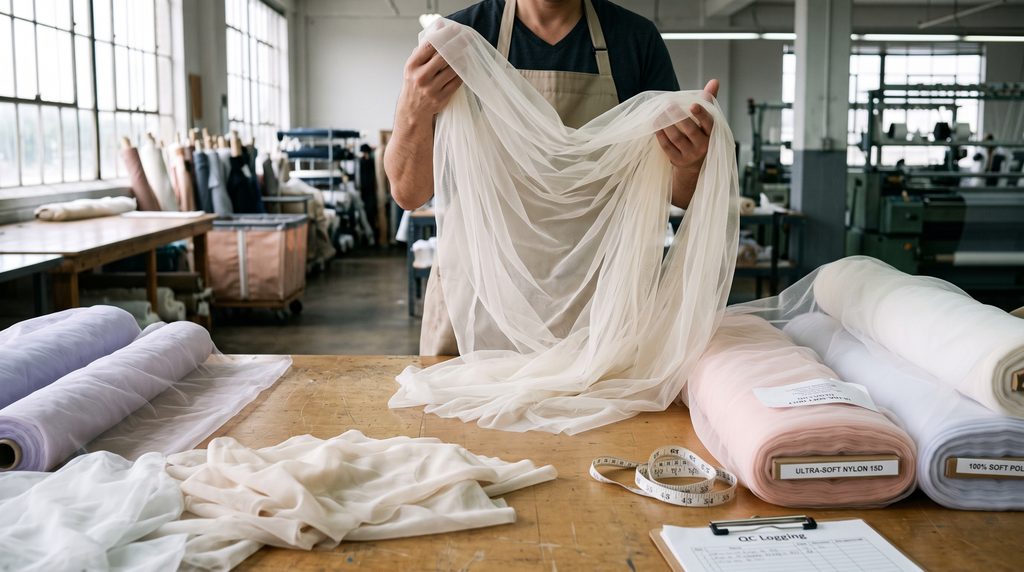
Certified tulle mesh fabric manufacturers offer ultra-soft tulle by knitting ultra-fine denier filaments with gentle tension on specialized machines. These delicate textiles flow like liquid mist while remaining kind to sensitive skin.
Soft finishing processes bypass stiffening resins entirely, relying on soothing washing baths that leave synthetic netting exceptionally supple.
What Makes Fine Filament Mesh Non-Scratchy?
Ultra-soft netting uses micro-denier polyamides that bend under the lightest touch, removing sharp contact points against skin. Here’s the deal: gentle water washing removes residual spinning oils, making fabric completely safe for children’s party frocks.
- Micro-denier yarns measure less than twenty denier per filament
- Non-chemical washing processes leave fibers smooth and supple
- Smooth circular knitting needles eliminate microscopic yarn snags
Premium finishing baths leave delicate synthetic yarns silky smooth for bare-skin wear.
Which Designs Require Fluid Draping Qualities?
Cathedral wedding veils, illusion bodices, and delicate dance costumes require supple netting that follows natural body contours gracefully. Ready for the good part? Soft tulle drapes in gentle cascades that shimmer under chandeliers without bunching rigidly.
- Fluid drape prevents awkward bunching around narrow wrist sleeves
- Supple mesh curves gently across necklines without scratching skin
- Graceful drape enhances flowing movement during bridal aisle walks
Key Takeaway: Sourcing premium soft netting protects your brand from customer complaints about itchy seams or stiff bodices.
| Soft Tulle Classification | Filament Count | Skin Comfort Rating | Typical Design Purpose |
| Illusion Bridal Mesh | 15D / 12 Filaments | Grade 5 (Zero Itch) | Sheer bodices, delicate veils |
| Italian Soft Tulle | 20D / 18 Filaments | Grade 4.8 (Silky Touch) | Flowing overskirts, capes |
| Stretch Soft Mesh | 20D Poly + Spandex | Grade 4.9 (Supple Stretch) | Contemporary dance leotards |
Choosing certified soft grades keeps brides comfortable from morning preparation through evening celebrations.
What Fibers Do Tulle Mesh Fabric Manufacturers Select?
Specialized tulle mesh fabric manufacturers select polyamide, polyester, or natural silk filaments depending on required tensile strength and luster. Each raw material brings distinct performance advantages and cost parameters to apparel production lines.
Understanding fiber properties helps procurement managers choose the right yarn for their specific pricing tier.
Why Compare Polyamide Versus Polyester Yarns?
Nylon delivers superior elasticity and silky softness, making it the preferred fiber choice for luxury bridal veils. What’s the real story? Polyester provides exceptional colorfastness and heat stability at a more accessible commercial wholesale price point.
- Polyamide fibers yield superior elongation and soft hand feel
- Polyester netting resists moisture degradation and ultraviolet fading
- Cost efficiency of polyester supports high-volume event decoration runs
Matching fiber characteristics to your budget protects profit margins without sacrificing garment performance.
When Should Designers Specify Pure Silk Netting?
Haute couture fashion houses demand pure silk tulle for its organic luster, breathability, and heritage luxury appeal. Think about it: while synthetic filaments mimic silk visually, genuine silk mesh offers unmatched prestige for royal bridal attire.
- Natural protein fibers biodegrade cleanly at end of garment life
- Subtle natural sheen reflects evening light without artificial gloss
- Premium fiber costs demand skilled hand sewing by couture tailors
Key Takeaway: Balancing synthetic durability against natural silk luxury ensures your fabric orders match client expectations.
| Fiber Chemistry | Tensile Elasticity | Moisture Regain | Relative Wholesale Cost |
| Polyamide (Nylon 6,6) | High (25% – 30%) | 4.0% – 4.5% | Moderate to Premium |
| Polyester (PET) | Moderate (15% – 20%) | 0.4% (Hydrophobic) | Budget to Moderate |
| Mulberry Silk | Low to Moderate | 11.0% (Breathable) | Luxury / Haute Couture |
Evaluating raw fiber traits helps you balance production costs against luxury fabric drape.
How Do Tulle Mesh Fabric Manufacturers Grade Fabric Weight?
Experienced tulle mesh fabric manufacturers grade fabric weight in grams per square meter to balance structural support against wearer comfort. Accurate weight metrics allow fashion brands to calculate shipping weights and garment drape beforehand.
Digital laboratory scales weigh circular fabric cutouts taken across multiple bolt positions to verify weight uniformity.
How Does Fabric Weight Determine Garment Volume?
Heavier fabrics incorporate denser fiber networks that withstand outward tension without collapsing downward under their own mass. Here is the kicker: using excessively heavy netting makes skirts uncomfortably warm and exhausting to wear for hours.
- Grams per square meter directly correlate with netting thickness
- Ultra-light netting around twelve grams flows like morning fog
- Heavy grades exceeding forty grams build self-supporting skirt domes
Careful weight selection ensures formalwear retains dramatic volume without burdening brides with excess weight.
Which GSM Range Matches Your Specific Project?
Veils demand weights between ten and eighteen grams, while tiered tutu skirts perform best between twenty-five and forty grams. What does this mean for you? Sourcing the correct GSM grade prevents costly pattern adjustments during cutting room setup.
- 10 to 18 GSM delivers sheer transparency for veil tiers
- 19 to 28 GSM provides versatile support for layered fashion skirts
- 30 to 50 GSM gives theatrical costumes resilient shape retention
Key Takeaway: Ordering precise fabric weight swatches prevents unexpected garment heaviness and ensures consistent skirt volume.
| Weight Bracket | GSM Range (g/m²) | Typical Feel | Optimal Garment Sector |
| Featherweight | 10 – 15 GSM | Ethereal, floating | Mantilla veils, sheer sleeves |
| Mid-Weight | 18 – 25 GSM | Balanced, soft body | Bridesmaid dresses, overlays |
| Heavy Structural | 30 – 45+ GSM | Stiff, architectonic | Petticoats, tutus, packaging |
Reviewing GSM specifications ensures your finished garments strike the right balance between volume and comfort.
How Do Tulle Mesh Fabric Manufacturers Address Eco-Impact?
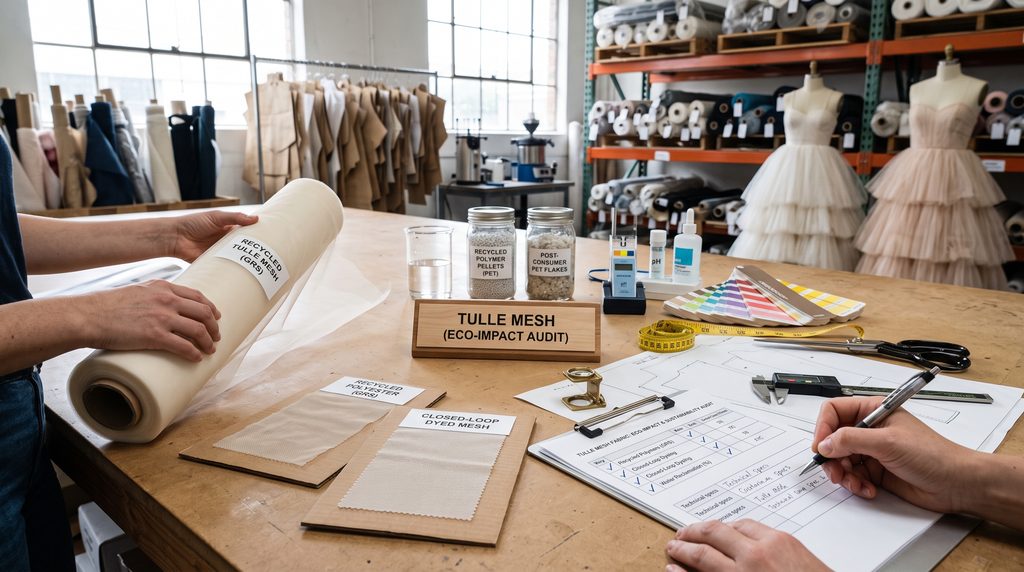
Progressive tulle mesh fabric manufacturers address eco-impact by incorporating recycled polymers and closed-loop dyeing processes. Modern mills actively minimize environmental footprints to meet global sustainability expectations.
Eco-conscious production standards help fashion brands satisfy strict corporate environmental targets without sacrificing textile performance.
Can Mills Produce Recycled Yarn Netting Rolls?
Modern spinning plants turn post-consumer plastic bottles into high-purity polyester yarns that knit into flawless hexagonal netting. Here’s the deal: recycled polyester matches virgin synthetic yarn in tensile strength, clarity, and dye absorption.
- Post-consumer bottle flakes undergo mechanical recycling into spun yarn
- GRS certification confirms traceable recycled content across fabric rolls
- Virgin polymer consumption drops drastically across production cycles
Sourcing recycled netting helps your fashion brand appeal directly to environmentally conscious consumers.
How Do Clean Dyeing Systems Prevent Water Waste?
Closed-loop dye houses filter and reuse process water, preventing toxic wastewater discharges into local river ecosystems. What’s the bottom line? OEKO-TEX certified colorants guarantee that colorful party netting remains free from harmful chemical residues.
- Low-liquor dyeing machines reduce fresh water intake significantly
- Advanced biological filters purify process effluents before release
- Certified non-toxic dyes protect apparel workers and end customers
Key Takeaway: Selecting certified sustainable textile suppliers helps protect the environment while attracting eco-conscious fashion buyers.
| Sustainability Initiative | Production Benefit | Environmental Impact | Certification Standard |
| Recycled PET Yarn | Matches virgin strength | Diverts post-consumer waste | GRS (Global Recycled Standard) |
| Low-Liquor Dyeing | Cuts dye cycle times | Reduces industrial water waste | OEKO-TEX Standard 100 |
| Green Resin Chemistry | Eliminates toxic fumes | Lowers hazardous emissions | REACH Compliant |
Partnering with green certified mills future-proofs your apparel supply chain against tightening environmental regulations.
How to Vet Reliable Tulle Mesh Fabric Manufacturers?
To vet reliable tulle mesh fabric manufacturers, you evaluate physical sample quality, loom capabilities, and strict quality control standards. Thorough supplier vetting prevents costly fabric rejections and keeps seasonal production runs moving smoothly.
Inspecting mill equipment and testing sample bolts gives fashion brands confidence in wholesale fabric consistency.
What Quality Indicators Distinguish Good Swatches?
When physical swatches arrive, stretch the netting diagonally to confirm that hexagonal pores snap back without distorted sagging. What does this mean for you? Superior netting displays crisp cell borders without broken filaments or oily mill odors.
- Examine mesh symmetry under bright magnification lamps for defects
- Pull netting diagonally to verify rapid recovery and elastic bounce
- Check swatch borders for smooth cutting and absent yarn runs
Thorough swatch testing protects your cutting floor from defective rolls that jam machinery.
How Do Modern Looms Guarantee Batch Consistency?
Mills running modern German Karl Mayer warp knitting machinery produce steady yardage with minimal defect rates across massive orders. Ready for the good part? Automated yarn tension regulators prevent optical banding streaks across wide netting bolts.
- Automated electronic tension controllers stop optical barre lines
- Multi-camera defect scanners spot dropped stitches in real time
- High-capacity dye vats preserve color matching between dye lots
Key Takeaway: Rigorous sample testing and loom verification protect your production schedule from unexpected fabric flaws.
| Supplier Evaluation Criterion | Recommended Standard | Verification Method | Business Risk Mitigated |
| Loom Technology | Karl Mayer warp machinery | Mill equipment audit | Optical barre lines, dropped stitches |
| Color Fastness | Grade 4 – 5 wash rating | Lab test report | Garment color bleeding, fading |
| Minimum Order Flexibility | 50m – 100m sample minimums | Supplier sales terms | Excess surplus stock, capital lockup |
Verifying machinery standards upfront guarantees reliable fabric quality across entire production runs.
Strategic Sourcing Summary and Next Steps
Sourcing premium netting requires balancing fiber chemistry, aperture size, hand feel, and fabric weight to meet specific design requirements. This technical guide detailed how hexagonal mesh geometry influences breathability, how finishing treatments control stiffness, and how sustainable polymers reduce environmental impact. By selecting appropriate GSM grades and vetting loom machinery standards, apparel brands avoid scratchy garments and collapsed silhouettes.
Our textile team specializes in high-precision warp-knitted meshes, offering extensive custom color matching, certified skin-safe finishes, and low minimum order quantities for growing fashion labels. Whether you require liquid-drape illusion veil netting or high-memory crinoline for bridal gowns, we deliver verified wholesale quality that elevates your collections. To request physical swatch cards or review custom fabric specifications with our textile specialists, contact us today.
Frequently Asked Questions
Q1: Can I use polyester tulle for wedding veils that touch bare skin?
No, polyester netting often feels too crisp for direct facial or neck contact. Nylon or silk tulle provides far superior softness and fluid drape for heirloom bridal veils.
Q2: What’s the best way to choose between stiff and soft netting?
Examine the functional purpose of the garment tier. Choose stiff crinoline netting for interior support layers and select ultra-soft netting for outer draping or skin-contact panels.
Q3: How do I know if tulle provides sufficient airflow for summer gowns?
Check the laboratory air permeability rating and open-cell aperture diameter. Netting with hexagonal pores wider than one millimeter permits natural airflow, preventing uncomfortable heat accumulation.
Q4: Can I order custom colors with low minimum order quantities?
Yes, modern specialty mills accept custom dye orders starting from fifty to one hundred meters per shade. Send a Pantone reference number or physical fabric swatch to initiate laboratory color matching.
Q5: What’s the best fabric weight for structured ballgown underskirts?
The best fabric weight for structured petticoats falls between thirty and forty-five grams per square meter. This weight bracket delivers resilient shape recovery under heavy formal skirts without adding unnecessary bulk.