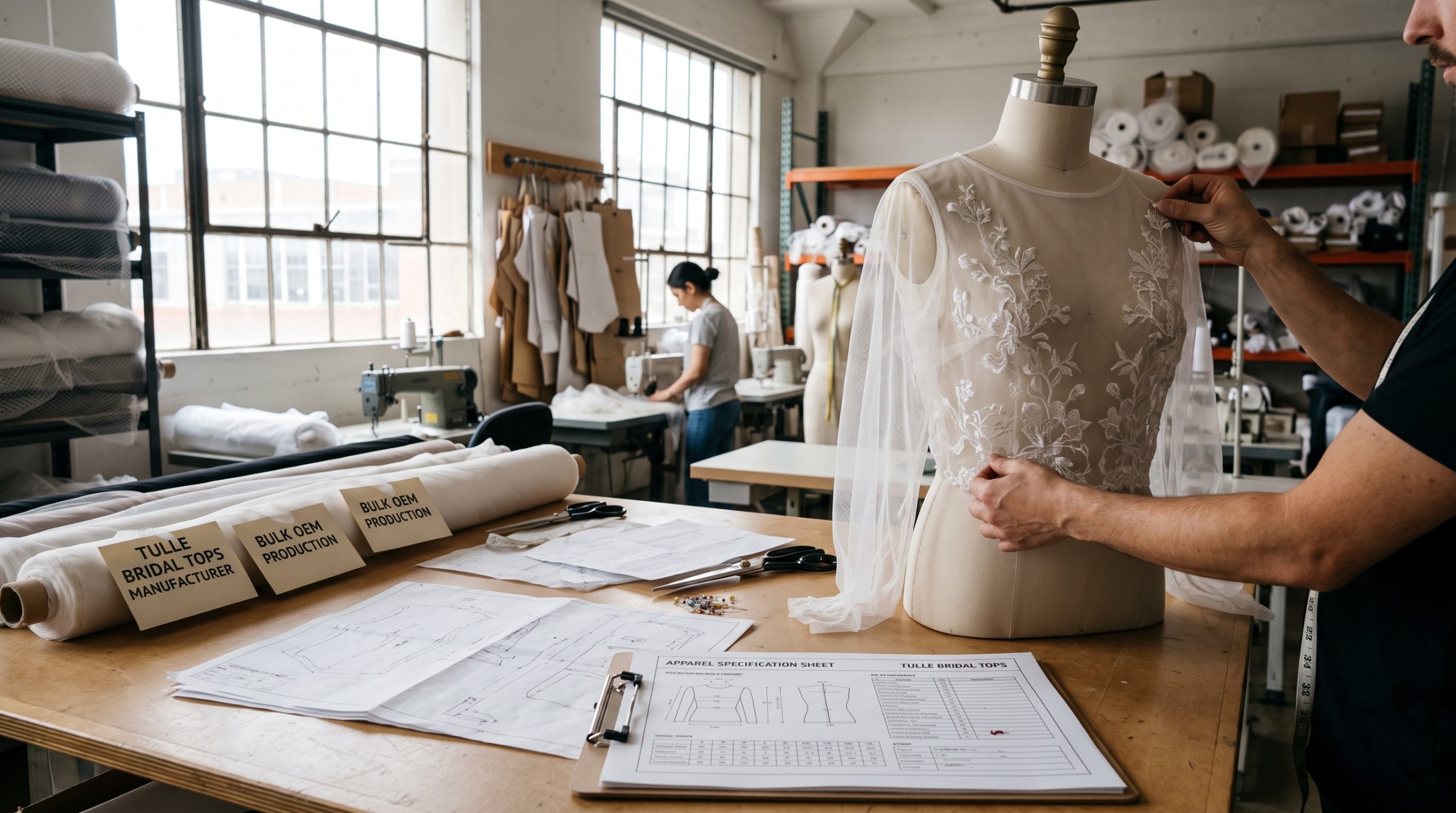
Partnering with an experienced tulle bridal tops manufacturer guarantees reliable illusion seams, structured bodice support, and dependable wholesale delivery for modern bridal separates. Bridal boutiques face mounting client complaints when delicate mesh bodices pull apart during fittings. Cheap netting scratches sensitive shoulders, and weak stitching unravels under heavy pearl appliques, destroying profit margins and delaying wedding timelines. Sourcing through an established tulle bridal tops manufacturer provides reinforced warp-knit mesh, skin-safe hypoallergenic finishes, and exact sizing for discerning fashion labels.
What Defines a Reliable Tulle Bridal Tops Manufacturer?
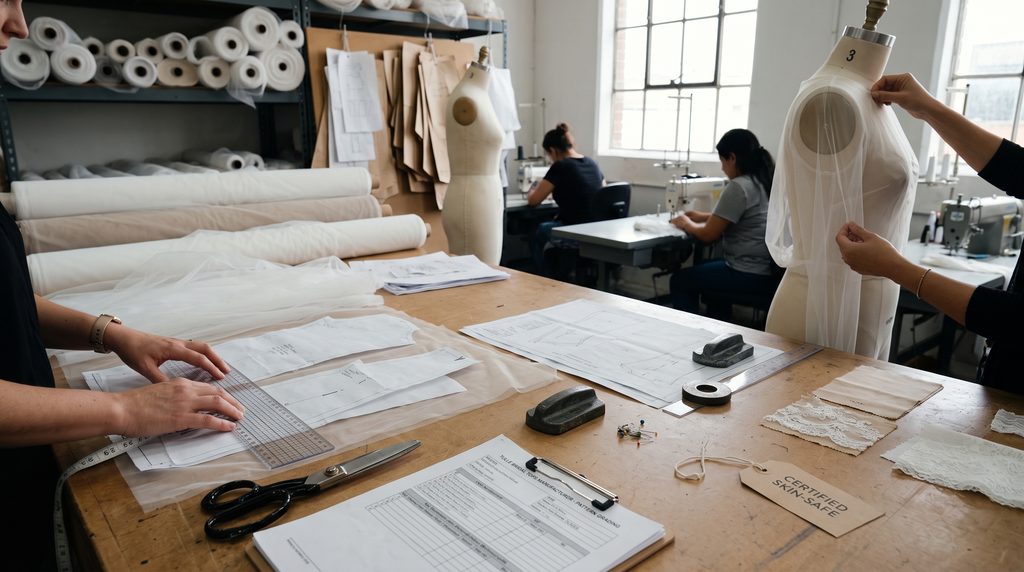
A reliable tulle bridal tops manufacturer delivers consistent pattern grading, clean raw-edge durability, and certified skin-safe fabrics across volume orders. Operating modern cleanrooms with dedicated micro-needle sewing stations separates industrial leaders from generic garment shops. Working with an experienced tulle bridal tops manufacturer prevents puckered neckline gathers and protects delicate illusion sleeves from tearing under movement.
What Stitching Standards Prevent Bodice Puckering?
Precision assembly teams use ballpoint micro-needles and low-friction silicone threads to prevent gathered seam puckering across sheer mesh panels. Standard industrial needles pierce wide holes that fray mesh filaments, creating unsightly puckers along fitted bodice curves.
Here is the deal: specialized feeding mechanisms glide smoothly across fragile netting to keep seamlines flat.
- High-gauge 65/9 jersey needles glide between mesh filaments without puncturing yarn cores.
- Balanced bobbin thread tension stops wavy seam ripples along bias-cut waist panels.
- Teflon-coated presser feet prevent sticky fabric dragging during curved seam joining.
Which Machinery Handles Sheer Illusion Seams?
Four-thread overlock and feed-off-the-arm chainstitch machines create supple stretch joins that withstand dynamic body motion. Production teams integrate narrow flatlock equipment to produce smooth seam joins that sit flush against bare skin.
What is the real story? You eliminate bulky hem ridges because specialized feed dogs preserve uniform fabric feed rates.
- Automated tension sensors adjust thread delivery during high-speed sewing operations.
- Differential feed mechanisms prevent wavy lettuce edges on sheer sleeve borders.
- Ultrasonic cutting heads seal synthetic yarn tips cleanly during seam construction.
| Stitching Profile | Seam Profile Height | Stretch Elasticity | Visual Cleanliness |
| Ultra-Fine Flatlock | 0.8 mm Flat | 140% Elongation | Invisible Against Skin |
| 4-Thread Mock Safety | 1.6 mm Bound | 110% Elongation | Smooth Internal Finish |
| Standard Lockstitch | 2.2 mm Raised | 40% Elongation | Rigid Puckered Border |
This mechanical breakdown shows how narrow flatlock machines preserve fabric elasticity while maintaining an invisible appearance on sheer bridal bodices.
Key Takeaway: Verifying factory machinery standards protects your bridal brand against puckered neckline returns and unsightly seam irritation.
Why Hire an Expert Tulle Bridal Tops Manufacturer?
Hiring an expert tulle bridal tops manufacturer gives your brand access to proprietary anatomical grading, reduced fabric scrap waste, and steady seasonal delivery. Independent design studios frequently lose weeks struggling with slippery sheer yardage that shifts on cutting tables. A dedicated tulle bridal tops manufacturer implements stabilized CAD nesting systems that cut production overhead while maintaining precise silhouette proportions.
How Do Precise Paper Patterns Save Costly Yardage?
Computerized pattern nesting algorithms rotate asymmetric bridal bodice pieces across wide fabric layouts to maximize yield. Tight nesting reduces yardage requirements, lowering wholesale unit costs across volume orders.
Think about this: manual scissor cutting wastes expensive specialty yardage, but computerized nesting lowers cutting room waste.
- Digital pattern matching preserves symmetrical mesh cell orientation across front bodice panels.
- Automated grading programs scale cup curves accurately across twenty standard sizes.
- Tight marker layouts recover up to twenty percent more usable fabric per roll.
Can Sample Revisions Accelerate Runway Deadlines?
Skilled sample technicians translate technical designer flats into finished muslin prototypes within forty-eight hours. Rapid sample turnarounds let fashion houses test bridal separates on models before committing to full production runs.
Ready for the good part? You finalize seasonal bridal collections weeks ahead of wholesale trade markets.
- Dedicated prototype lines produce sample tops without interrupting bulk production.
- Technical fitting sessions generate precise digital pattern adjustments instantly.
- Standardized spec sheets eliminate communication errors between design teams and factory floors.
| Development Milestone | Boutique In-House Studio | Specialized Factory Line |
| First Pattern Draft | 5 to 7 Working Days | 24 to 48 Hours |
| Prototype Fitting Sample | 14 Working Days | 3 to 5 Business Days |
| Production Size Grading | 10 Working Days | Automated 4-Hour Run |
This timeline data illustrates how specialized production facilities compress sampling cycles to help brands meet aggressive seasonal deadlines.
Key Takeaway: Partnering with experienced pattern makers accelerates prototype delivery and protects your production schedule before bridal market presentations.
Can a Tulle Bridal Tops Manufacturer Cut Production Costs?
A professional tulle bridal tops manufacturer cuts production costs by purchasing bulk synthetic yarns directly from warp-knitting mills and utilizing automated CNC cutting equipment. Small workshops pay high retail markups on pre-cut yardage and suffer from manual cutting errors that ruin expensive lace appliques. Sourcing directly through a verified tulle bridal tops manufacturer lowers unit production expenses and protects your wholesale gross margins.
How Does Bulk Sourcing Lower Unit Fabric Pricing?
Primary manufacturers purchase master rolls in multi-kilometer batches straight from high-speed warp knitting facilities. Bypassing regional textile brokers removes layered distribution markups, passing volume savings directly to apparel brands.
Look at the facts: direct yarn sourcing lowers raw material acquisition costs by twenty to thirty percent.
- Direct mill contracts stabilize fabric pricing against seasonal synthetic yarn market swings.
- Standardized greige goods inventory supports rapid custom dye lot production.
- Large warehouse allocations protect clients from sudden international supply chain shortages.
Why Does Automated Cutting Prevent Atelier Fabric Waste?
Multi-ply CNC vacuum cutting tables compress dozens of slippery netting layers firmly during high-speed blade passes. Oscillating carbide knives follow digital cut paths accurately, eliminating jagged borders and ragged seam edges.
What is the real story? You eliminate expensive recutting delays because automated blades maintain razor-sharp tolerances across every layer.
- Vacuum hold-down beds prevent sheer fabric plies from shifting under moving cutter heads.
- Precision blade sensors adjust cutting pressure dynamically through multi-layer stacks.
- Automated layout nesting extracts maximum bodice piece yields from each master roll.
| Processing Parameter | Manual Hand Shears | Automated CNC Vacuum Table |
| Cutting Speed | 0.4 Meters per Minute | 8.5 Meters per Minute |
| Layer Capacity | 3 to 5 Plies Maximum | 40 to 60 Compressed Plies |
| Dimensional Variance | ±3.0 mm Edge Shifting | ±0.2 mm Razor Precision |
This industrial efficiency comparison proves that automated vacuum cutting delivers superior edge accuracy while slashing labor expenses.
Key Takeaway: Sourcing from automated manufacturing facilities lowers unit garment pricing and guarantees consistent panel shapes across volume orders.
How Does a Tulle Bridal Tops Manufacturer Secure Pure Silk Net?
A qualified tulle bridal tops manufacturer secures pure silk net through established partnerships with traditional bobbinet mills, verifying authentic fiber purity and gossamer drape. Natural silk netting requires specialized storage and gentle tension handling to prevent permanent fiber distortion. Specifying premium natural fibers with your tulle bridal tops manufacturer gives high-end couture lines the organic pearlescent drape demanded by luxury bridal salons.
What Separates Silk Net from Synthetic Fibers?
Continuous mulberry silk fibroin proteins refract light with an organic, subdued glow rather than an artificial synthetic shine. The delicate protein matrix drapes against the body with weightless comfort, breathing naturally in warm ceremony venues.
Here is the bottom line: genuine silk net dissipates static electricity naturally, preventing tops from clinging awkwardly to inner slip linings.
- Natural protein filaments eliminate artificial surface sheen under harsh flash photography.
- Organic breathability keeps brides cool during summer outdoor receptions.
- Soft fiber surfaces eliminate skin redness around sensitive underarm areas.
How Do Looms Influence Sheer Optical Clarity?
Antique British and French bobbinet looms twist warp threads around diagonal brass bobbins to create hexagonal cells with vintage texture. High-speed synthetic warp knits lock monofilament yarns securely, providing the mechanical strength required for heavy embroidery.
You might wonder: why do couture houses pay premium prices for heritage bobbinet weaves on luxury separates?
- Twisted bobbinet threads produce a soft hexagonal cellular geometry with rich visual depth.
- Warp-knitted synthetic meshes deliver superior mechanical stability for heavy beadwork.
- Balanced loom tension guarantees consistent sheer clarity across sheer blouson silhouettes.
| Textile Performance | Heritage Silk Bobbinet | Warp-Knitted Synthetic Mesh |
| Raw Fiber Matrix | 100% Mulberry Silk Fibroin | 100% Polyamide Monofilament |
| Static Build-Up | Zero Natural Static Charge | Requires Antistatic Finish |
| Tear Resistance Under Lace | Moderate (Needs Hand Sewing) | High (Machine Embroidery Safe) |
This comparison highlights why silk netting suits delicate minimalist separates while warp-knitted mesh excels as a stable base for dense embellishment.
Key Takeaway: Matching fiber types to garment construction methods protects your collection against unexpected tearing while preserving luxurious visual drape.
What Meshes Does a Tulle Bridal Tops Manufacturer Offer?
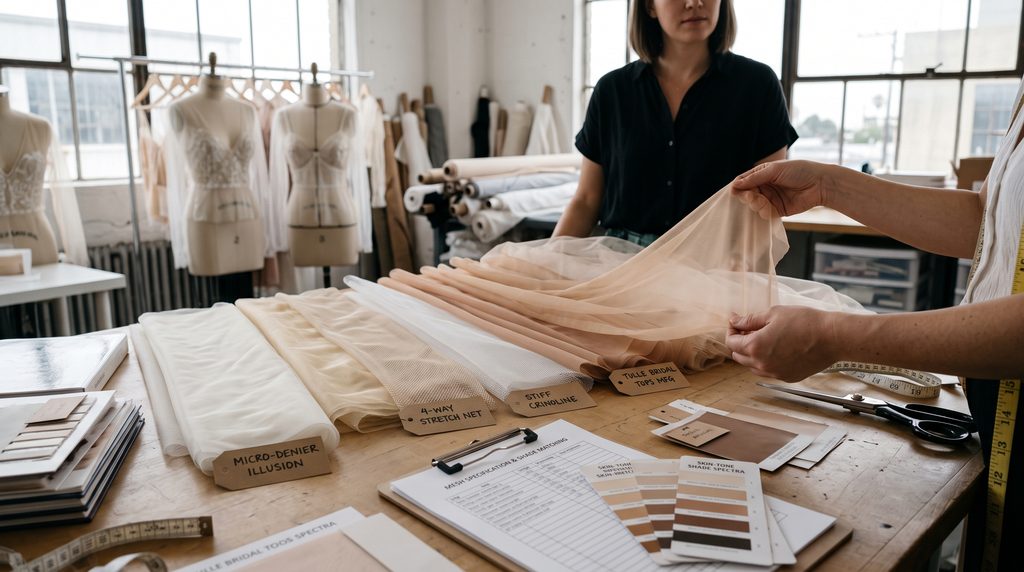
A comprehensive tulle bridal tops manufacturer offers micro-denier illusion meshes, four-way stretch nettings, and structured crinoline foundations across wide shade spectra. Providing diverse mesh types allows bridal designers to build floating illusion necklines alongside firm corsetry foundations. Sourcing through a specialized tulle bridal tops manufacturer guarantees accurate nude skin-tone matching for diverse global consumer demographics.
Which Gauge Density Suits Plunging Illusion Necklines?
Fifty-gauge micro-mesh constructed from fifteen-denier yarns delivers barely-there transparency along plunging necklines and low backs. Slender yarn boundaries become virtually invisible against bare skin, creating the appearance that embroidered lace motifs float unassisted.
Think about this: coarse utility meshes create cloudy borders on camera, but micro-mesh disappears completely in photographs.
- Ultra-fine 15-denier threads drop below digital camera sensor resolution limits.
- High aperture densities diffuse light softly across delicate collarbones.
- Neutral undertone dyes blend smoothly against warm, cool, and deep skin tones.
How Does Four-Way Stretch Net Support Structured Corsetry?
Knitted elastane blends grant four-way stretch net dynamic flexibility that hugs natural body contours without sagging over time. This resilient elasticity supports delicate corsetry stays and boning channels, keeping fitted strapless tops secure through active wedding receptions.
Ready for the good part? You can design fitted long-sleeve tops that allow full arm movement without pulling the waistline upward.
- High elastane percentages provide twenty-five percent mechanical stretch across both grainlines.
- Elastic yarn recovery prevents baggy elbow deformation during dancing.
- Controlled compression stabilizes inner cups without rigid, uncomfortable stays.
| Mesh Classification | Yarn Composition | Stretch Profile | Primary Bodice Function |
| Micro-Gauge Illusion | 100% Polyamide (15D) | Mechanical Flex (15%) | Invisible Plunging Necklines |
| Four-Way Stretch Net | 85% Nylon / 15% Spandex | Dynamic Stretch (60%) | Fitted Illusion Sleeves & Bodices |
| Stable Foundation Net | 100% Polyester (40D) | Rigid Stable (5%) | Inner Corsetry Boning Stays |
This functional mesh guide clarifies how combining distinct knit architectures yields comfortable bridal tops that hold structural shape.
Key Takeaway: Specifying the right mesh construction for each garment section ensures flattering body fit and dynamic comfort throughout wedding festivities.
How Does a Tulle Bridal Tops Manufacturer Build Illusion Seams?
A skilled tulle bridal tops manufacturer builds illusion seams using French flat-fell joins, bound organza perimeters, and clear monofilament threads to achieve visual invisibility. Exposed overlock stitching along necklines cheapens luxury garments and distracts from delicate lace motifs. Choosing an established tulle bridal tops manufacturer guarantees that raw interior seams remain completely unnoticeable through sheer outer fabrics.
Why Do Flat-Felled Seams Protect Tender Bridal Skin?
Flat-felled and enclosed French seams wrap raw fabric edges securely inside folded cloth channels, preventing exposed yarn ends from irritating shoulders. Enclosing cut borders shields delicate bridal skin from abrasive synthetic thread tips during extended celebration hours.
Look at the facts: enclosed seams eliminate uncomfortable skin chaffing along snug armholes and back necklines.
- Enclosed thread channels keep raw mesh borders from scratching sensitive skin.
- Double-needle stitch rows distribute seam strain evenly across adjacent mesh pores.
- Narrow three-millimeter seam widths preserve transparent bodice aesthetics.
How Do Clear Filament Threads Camouflage Stitch Lines?
Extruded nylon monofilament threads refract ambient light, matching the exact color tone of the surrounding mesh fabric naturally. Using translucent threads eliminates the need to maintain hundreds of separate dyed thread spools across varied nude colorways.
What is the real story? You avoid visible needle stitch lines because clear threads adopt the color of the bride skin underneath.
- Translucent filaments blend seamlessly across diverse nude and ivory fabric shades.
- High tensile strength prevents snapped stitches along moving armhole joins.
- Supple filament formulas resist stiffening or yellowing under hot steam pressing.
| Seam Assembly Method | Visible Width | Skin Contact Comfort | Visual Seam Camouflage |
| Enclosed French Seam | 3.0 mm Channel | Smooth Enclosed Fold | Disappears into Sheer Mesh |
| Raw Edge Overlock | 4.5 mm Ridge | Rough Thread Fringe | Highly Visible Thread Border |
| Bound Silk Organza | 2.5 mm Bias | Cashmere Soft Edge | Elegant Couture Finish |
This seam comparison confirms that enclosed French joins provide superior skin comfort while remaining hidden on sheer illusion bodices.
Key Takeaway: Requiring enclosed seam construction protects your bridal clients from abrasive chafing while maintaining flawless sheer transparency.
Can a Tulle Bridal Tops Manufacturer Scale Custom Orders?
A versatile tulle bridal tops manufacturer scales custom orders by balancing flexible small-batch sampling cells with automated multi-line production capabilities. Emerging bridal labels require manageable minimum order quantities, while established distributors need monthly shipments of thousands of pieces. Partnering with a dynamic tulle bridal tops manufacturer gives growing fashion brands room to expand without sudden supply chain disruptions.
How Do Flexible Minimums Protect Independent Boutiques?
Modular production cells accommodate small production runs between fifty and one hundred units per style without imposing excessive factory setup surcharges. Flexible minimums allow boutique owners to test experimental silhouettes in showrooms before ordering large seasonal inventories.
Here is the deal: low trial thresholds protect your cash flow while allowing rapid testing of fresh designer concepts.
- Small order batches lower upfront capital commitments for emerging designers.
- Rapid reorder cycles restock best-selling bridal sizes within two weeks.
- Mixed-size cutting runs accommodate diverse regional boutique size demands.
What Protocols Protect Proprietary Designer Patterns?
Trustworthy contract manufacturing facilities enforce non-disclosure agreements and secure digital pattern storage to protect private label intellectual property. Strict internal procedures stop unique embroidery arrangements and bodice designs from leaking to third-party competitors.
Think about this: protecting your original design assets preserves your competitive advantage in luxury bridal markets.
- Encrypted digital CAD pattern archives prevent unauthorized file transfers.
- Dedicated private cutting rooms protect exclusive runway sample developments.
- Serialized production tags track garments through each assembly station securely.
| Sourcing Tier | Minimum Order Size | Production Lead Time | Design Exclusivity Safeguard |
| Independent Studio Cell | 50 Units per Style | 2 to 3 Weeks | Complete Strict NDA |
| Scaled Commercial Mill | 300 Units per Style | 4 to 6 Weeks | Dedicated Secure Facility |
| Open Jobber Workshop | 500+ Units Required | 8 to 12 Weeks | High Risk of Design Duplication |
This sourcing matrix shows how flexible production cells balance low inventory investment with rigorous design security for growing fashion houses.
Key Takeaway: Choosing manufacturers with low minimum order quantities and strict non-disclosure policies protects your capital and intellectual property.
How Does a Tulle Bridal Tops Manufacturer Test Seam Burst?
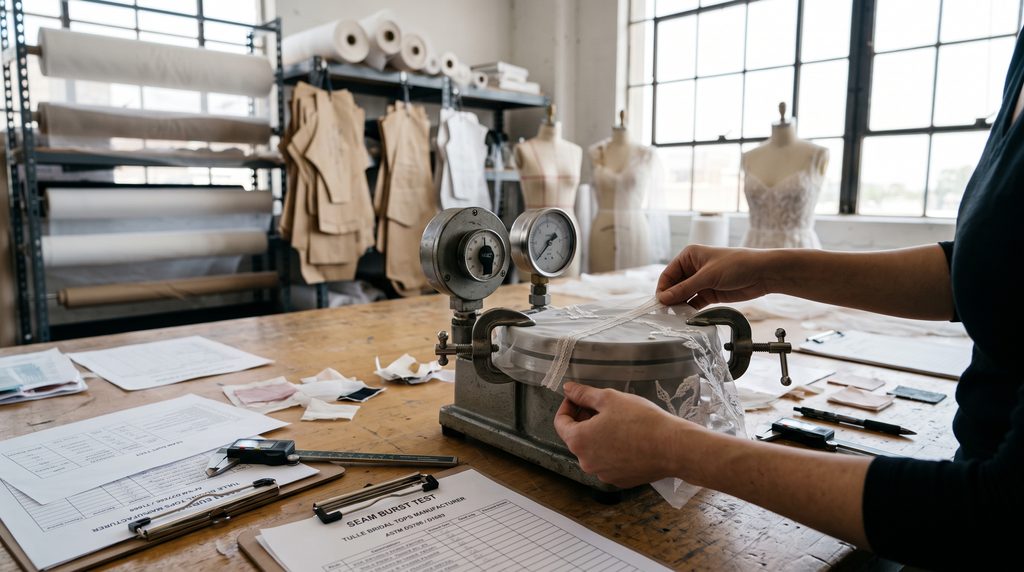
A certified tulle bridal tops manufacturer tests seam burst strength using calibrated pneumatic diaphragm testers and cyclic tensile clamps before shipping bulk orders. Transparent bodices endure substantial lateral pull when brides raise their arms or step into fitted skirts. Relying on verified testing through your tulle bridal tops manufacturer prevents sudden seam ruptures during fittings and wedding ceremonies.
Which Tensile Testing Machines Quantify Pull Strength?
Universal tensile testing equipment clamps finished bodice seams, pulling fabric swatches at constant speeds until thread rupture to record breaking force in Newtons. Testing confirms that delicate open mesh can withstand concentrated stress along zipper joins and hook-and-eye plackets.
Look at the facts: verified seam strength prevents embarrassing bodice tears when brides raise their arms on dance floors.
- ASTM D1683 seam displacement tests verify stitch integrity under high lateral pull.
- Digital load cells measure exact Newton breaking thresholds across bias seams.
- Cyclic stretch audits confirm that gathered seams recover shape after repeated tension.
How Does Dynamic Fatigue Testing Prevent Seam Tears?
Mechanical mannequin simulators flex sheer bodice arms through hundreds of movement cycles to evaluate thread fatigue along stress points. Long-term movement testing identifies fragile zones around armholes, allowing pattern technicians to reinforce seams before bulk production.
This is where it gets interesting… simulated motion audits identify potential tear points before garments ever reach retail fitting rooms.
- Multi-axis testing arms reproduce active dancing and walking motions accurately.
- Stress point mapping identifies areas needing reinforcement along underarm seams.
- Post-fatigue microscopic inspections confirm that yarn pores remain free from micro-tears.
| Testing Protocol | Standard Benchmark | Minimum Passing Value | Production Failure Avoided |
| ASTM D1683 Seam Strength | Constant Rate of Traverse | Above 120 N Force | Ripped Armhole Joins |
| Diaphragm Burst Pressure | ASTM D3786 Hydraulic | Above 190 kPa Force | Torn Zipper Gathering Seams |
| Dynamic Flex Fatigue | 500 Articulated Cycles | 100% Seam Retention | Fabric Laddering at Bust Darts |
This laboratory testing data confirms that rigorous mechanical evaluations protect delicate sheer garments against physical failure under real-world wear.
Key Takeaway: Requiring documented seam strength test certificates protects your brand reputation against catastrophic garment failures during weddings.
Why Trust a Certified Tulle Bridal Tops Manufacturer?
Trusting a certified tulle bridal tops manufacturer ensures that raw synthetic nettings and finishing resins satisfy stringent international chemical safety and ethical labor benchmarks. Unregulated factories frequently use cheap melamine resins and formaldehyde cross-linking agents that emit pungent fishy odors in warm venues. Sourcing with an accredited tulle bridal tops manufacturer guarantees hypoallergenic wear and smooth customs clearance in global markets.
What Clean Chemical Standards Stop Fitting Room Odors?
Clean finishing mills utilize water-based acrylic emulsions and high-temperature hot-air stenter ovens to eliminate volatile organic compounds. Thorough heat exposure destroys chemical residues, leaving finished bridal separates completely scent-free upon delivery.
Ready for the good part? Brides open their delivery boxes to find clean, fresh garments free from offensive chemical odors.
- Water-based acrylic polymers replace cheap amine-based cross-linking agents.
- High-temperature stenter curing evaporates residual chemical processing vapors completely.
- Scent-free fabric finishing prevents bride skin irritation during summer celebrations.
How Does Documented Factory Compliance Reduce Risks?
Independent audit certificates verify that manufacturing facilities maintain fair worker compensation, safe building conditions, and traceable supply chains. Retail buyers require documented compliance certificates before placing luxury bridal wear in major international department stores.
You might wonder: how do international factory credentials protect growing fashion labels from legal import hurdles?
- OEKO-TEX Standard 100 Class 1 confirms zero hazardous heavy metals or formaldehydes.
- ISO 9001 quality management standards guarantee uniform garment sizing across batches.
- Sedex SMETA social audit reports satisfy ethical sourcing standards for luxury retailers.
| Certification Standard | Inspection Focus | Verification Authority | Commercial Buyer Benefit |
| OEKO-TEX Standard 100 | Toxic Chemical Residues | Hohenstein Institute | Hypoallergenic Skin Safety |
| ISO 9001 Accreditation | Quality Management Systems | International Auditing Body | Predictable Sizing Consistency |
| SMETA Social Audit | Ethical Labor Standards | Third-Party Inspectorate | Smooth Retail Partner Clearance |
This compliance matrix illustrates how certified manufacturing partnerships safeguard your brand against consumer safety issues and trade delays.
Key Takeaway: Partnering with accredited manufacturing facilities ensures hypoallergenic comfort for brides and smooth entry into major international department stores.
How Do You Choose the Right Tulle Bridal Tops Manufacturer?
You choose the right tulle bridal tops manufacturer by evaluating sample sewing precision, auditing factory cleanroom standards, and verifying transparent delivery timelines. Touring potential production facilities or reviewing comprehensive third-party audit reports reveals whether a factory can handle sheer fabrics cleanly. Selecting the right tulle bridal tops manufacturer creates a reliable material and assembly pipeline that supports your brand growth year after year.
Which Quality Audit Checklists Screen Factory Floors?
Comprehensive inspection checklists examine cutting room cleanliness, needle disposal tracking, and white-glove finishing procedures for sheer bridal wear. Maintaining pristine production floors prevents dust spots and oil stains from soiling delicate ivory garments during assembly.
What is the real story? You avoid costly dry-cleaning bills because disciplined factories handle sheer white garments with immaculate care.
- Dust-filtered cutting rooms protect sheer fabrics from oil stains and floor grime.
- Strict needle control logs prevent broken metal fragments from remaining in seams.
- White-glove handling stations inspect finished garments before individual polybagging.
How Do Sample Lead Times Reveal Operational Discipline?
Factories that deliver precise first-pass prototypes within ten business days demonstrate strong pattern drafting skills and efficient workflow scheduling. Evaluating sampling communication shows whether a manufacturing partner can meet tight wholesale production deadlines.
Here is the deal: dependable communication during the sampling stage predicts reliable bulk order execution later on.
- Rapid technical feedback identifies pattern flaws before costly production begins.
- Transparent digital tracking portals provide real-time updates on batch progress.
- Dedicated account managers resolve supply questions quickly across international time zones.
| Factory Screening Metric | Red Flag Warning Sign | Gold Standard Performance |
| First Sample Turnaround | Exceeds 25 Business Days | 7 to 10 Business Days |
| Workplace Cleanliness | Visible Fabric Dust on Racks | Sealed Cleanroom Garment Suites |
| Customer Support Response | Delayed 72-Hour Replies | Dedicated 24-Hour Account Contact |
This vendor evaluation checklist provides a clear framework for identifying dependable manufacturing partners who protect your seasonal delivery dates.
Key Takeaway: Auditing factory cleanliness, sampling speed, and communication habits ensures your brand partners with a disciplined manufacturer who delivers on schedule.
Sourcing Partnerships for Modern Bridal Separates
Balancing gossamer sheer transparency with durable structural seam integrity resolves common boutique struggles regarding tearing illusion mesh, puckered necklines, and skin irritation. Choosing precision-engineered warp-knit fabrics paired with enclosed French seam construction protects your bridal brand against fitting room failures and wedding day emergencies. Our advanced garment manufacturing facility produces tailored illusion tops, skin-matched sheer separates, and certified skin-safe bridal wear built to your exact design specifications. We stand committed to equipping global bridal houses with resilient, luxurious separates that inspire complete client confidence down the aisle. To request custom prototype developments or review certified material swatch books for your upcoming collection, contact us today and consult with our technical bridal manufacturing specialists.
Frequently Asked Questions
Q1: Can I order custom dyed nude mesh to match varied skin tones?
Yes, you can order custom dyed nude meshes matched precisely to diverse skin undertone spectrums using spectrophotometer color lab dips. Providing physical skin tone swatches or Pantone references allows our dyeing facility to produce seamless illusion panels that vanish against fair, olive, and deep complexions without optical blue glare.
Q2: What is the best stitch type for sheer illusion tulle bodices?
Enclosed French seams and four-thread narrow flatlock stitches are the best methods for constructing sheer illusion tulle bodices. These specialized techniques wrap abrasive yarn borders securely within smooth fabric channels, preserving a flat appearance while preventing skin chafing along sensitive underarm and collarbone areas.
Q3: How do I know if a factory maintains clean chemical standards?
Verify that your manufacturing partner holds current OEKO-TEX Standard 100 Class 1 certifications confirming zero detectable formaldehyde or toxic chemical finishes. Garments produced under certified standards will be completely odorless when unboxed and will not cause skin redness or allergic itching when worn during long celebrations.
Q4: Can I combine delicate French lace appliques with stretch mesh tops?
Yes, you can combine delicate lace appliques with stretch mesh tops by stabilizing placement zones with temporary water-soluble backings during machine stitching. This technique prevents the underlying stretch netting from tunneling or puckering, allowing embroidery stitches to secure heavy beadwork flat against moving fabric panels.
Q5: What is the best method to calculate sample production lead times?
Allow seven to ten business days for initial prototype development, plus an additional five days for fitting reviews and grading adjustments. Establishing clear digital tech packs with verified dimensional tolerances speeds up initial pattern digitization and ensures your collection stays on schedule for bridal market presentations.