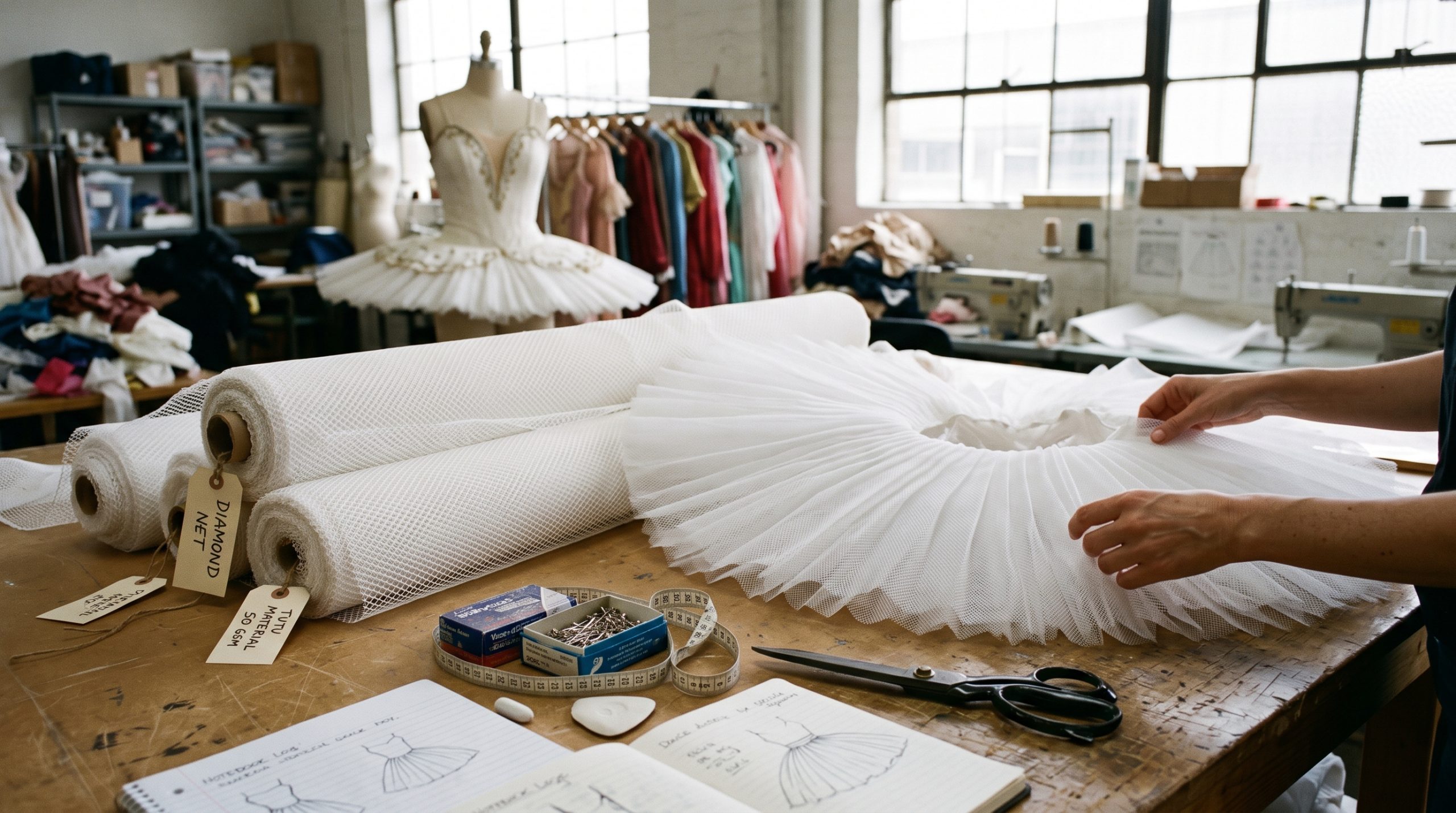
The best tutu material for ballet costumes combines rigid polyamide diamond net with resilient resin finishes to produce architectural horizontal loft. Ballet costume ateliers frequently struggle with limp netting that wilts under intense stage lighting and heavy humidity. Flimsy yardage collapses during pirouettes, ruining dramatic classical choreography while rough scratchy meshes irritate performer skin. Specifying laboratory-certified tutu material from dedicated warp-knitting manufacturers secures upright plate geometry, supple skin contact, and long-lasting shape recovery.
What Defines Authentic Tutu Material in Dance Costumes?
Authentic tutu material defines an engineered open-mesh textile manufactured on high-speed warp looms using rigid synthetic yarns to produce upright structural loft. This specialized construction separates performance stage netting from ordinary craft fabric through calibrated node locking and thermo-fixed resin coatings. Sourcing certified tutu material prevents perimeter edge unravelling during assembly, keeping multi-tiered skirts crisp across demanding theatrical seasons.
What Mesh Cell Geometry Prevents Sagging in Dance Nets?
Precision warp-knitted guide bars loop synthetic yarns into rigid interlocking nodes that form angular geometric cells. Unlike woven gauzes that shift when pulled diagonally, warp-locked apertures maintain structural dimensions under sudden stage movement.
Here is the deal: angular aperture geometry stops gathered ruffles from collapsing downward under gravitational force.
- Knitted nodes lock neighboring yarn loops against lateral shifting.
- Balanced cell tension disperses weight across adjoining courses smoothly.
- Locked loop intersections resist tears when sewing needles pierce dense gathers.
Which Yarn Counts Deliver Exceptional Tensile Resilience?
Continuous monofilament synthetic yarns between forty and seventy denier provide the flexural rigidity required for upright horizontal skirts. These resilient filaments spring back outward immediately after being compressed during packing or costume changes.
What is the real story? You avoid floppy skirt droop because heavy monofilaments push outward against downward pull.
- Monofilament fibers resist sweat absorption during energetic stage routines.
- High tensile strength prevents gathering seams from splitting under dancer leaps.
- Smooth polymer surfaces slide past inner satin lining fabrics without snagging.
| Construction Method | Aperture Stability | Raveling Risk | Structural Stiffness |
| Warp-Knitted Diamond Net | High Stability | Zero Laddering | Outstanding Horizontal Loft |
| Bobbinet Twisted Weave | Moderate Flex | Low Slippage | Gentle Vertical Cascade |
| Square Plain Gauze | Shifting Pores | High Fraying | Complete Drooping Failure |
This structural comparison confirms that warp-knitted diamond netting delivers the mechanical rigidity required to support expansive platter skirts.
Key Takeaway: Choosing warp-knitted netting with locked cell geometry speeds up cutting room production and prevents stage skirts from wilting under performance stress.
Why Is Diamond Net Preferred as Classical Tutu Material?
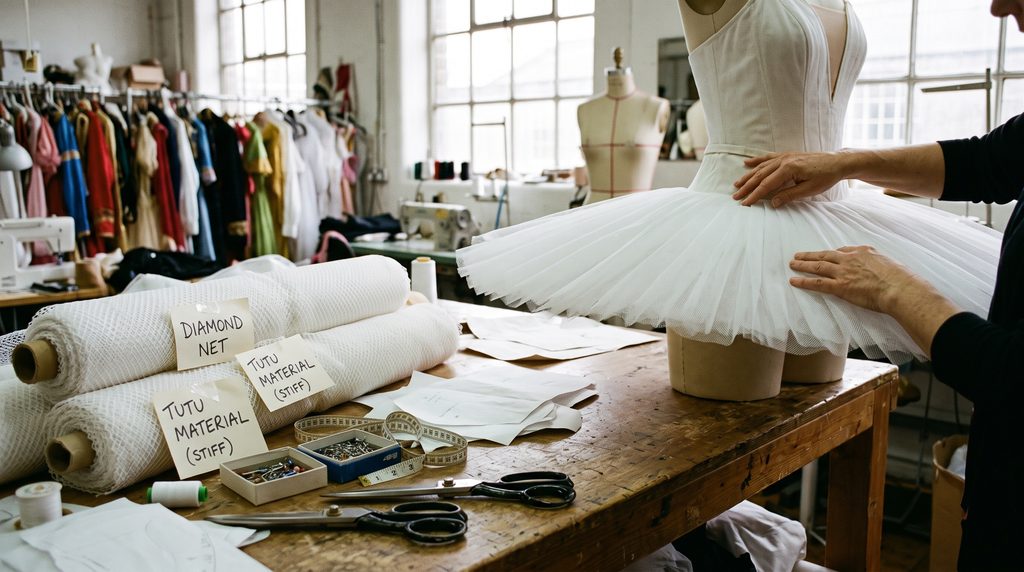
Diamond net is preferred as classical tutu material because its tight angular geometry delivers maximum horizontal stiffness and prevents pancake skirts from drooping downward. Costume departments rely on this firm mesh to build self-supporting platters that remain parallel to the stage floor throughout athletic leaps. Specifying authentic diamond tutu material allows pattern makers to engineer crisp silhouettes that showcase precise leg extension and footwork.
Why Does Diamond Net Hold Stiff Horizontal Pancake Shapes?
The acute angles of diamond mesh lock tightly together under lateral compression, creating a firm structural plane. When costume makers pleat multiple tiers around a basque, the stacked diamond apertures act as mini cantilever trusses.
Think about this: soft nettings flop downward instantly, but diamond mesh pushes outward horizontally to defy gravity.
- Dense diamond nodes resist bending deformation along radial skirt seams.
- Stepped ruffle pleats interlock to establish a solid structural platform.
- Rigid cell walls hold crisp knife pleating without sagging under gravity.
How Do Basques Anchor Tiered Stiff Netting Layers?
Costume basques cut from durable drill or faille provide the stable foundation needed to anchor ten to twelve gathered net tiers. Stitching firm net layers directly to this reinforced hip panel holds the entire pancake skirt securely around the dancer waist.
Look at the facts: anchoring stiff netting across a contoured basque prevents the costume from shifting during rapid turns.
- Reinforced waistband seams distribute skirt weight evenly across dancer hips.
- Staggered row placement keeps inner panty seams flat against performer thighs.
- Firm anchoring prevents upper ruffles from flipping upward during pirouettes.
| Netting Geometry | Bending Modulus (GPa) | Horizontal Projection | Target Ballet Costume |
| Diamond Netting | 5.8 GPa | Rigid Horizontal Plane | Classical Pancake & Platter |
| Hexagonal Soft Tulle | 1.6 GPa | Relaxed Vertical Drape | Romantic Flowing Tutus |
| Square Utility Mesh | 2.1 GPa | Irregular Wrinkled Hang | Inexpensive Rehearsal Wear |
This physical performance comparison demonstrates why diamond netting remains the premier selection for architectural classical stage silhouettes.
Key Takeaway: Utilizing diamond netting across structured basques guarantees classical pancake tutus stay perfectly flat and horizontal through intense stage routines.
How Does Soft Tulle Function as Romantic Tutu Material?
Soft tulle functions as romantic tutu material by providing fluid, lightweight cascades that create calf-length bell skirts with graceful stage motion. While classical tutus demand rigid projection, romantic ballets require airy fabrics that float like clouds around leaping ballerinas. Selecting high-grade romantic tutu material provides the ethereal translucency needed to evoke supernatural woodland spirits and ghostly heroines.
How Does Supple Soft Tulle Create Flowing Romantic Skirts?
Ultra-fine synthetic yarns processed with silicone softeners allow romantic netting to drape into gentle vertical ripples. As dancers glide across the stage, these lightweight layers catch ambient air currents to create breathtaking floating visual trails.
You might wonder: why does romantic netting move with such magical grace compared to stiff petticoat mesh?
- Fine yarn deniers yield low flexural resistance for fluid drapery.
- Multi-layered hemlines create misty optical depth without adding heavy weight.
- Supple mesh edges ripple softly around dancer calves without sticking.
Why Do Layered Draperies Prevent Fitting Room Static?
Specialized antistatic chemical baths applied during textile finishing dissipate electrical charges that accumulate between synthetic fabric plies. This treatment prevents fine skirt tiers from clinging awkwardly to tights during dry theatre winter performances.
Ready for the good part? You avoid messy cling issues because treated netting hangs free in separate undulating layers.
- Topical antistatic coatings neutralize frictional static charges between fabric plies.
- Breathable cell voids allow body heat to disperse through multi-layered skirts.
- Smooth yarn filaments slide quietly without producing distracting rustling noises.
| Material Property | Romantic Soft Tulle | Classical Stiff Net |
| Handfeel Rating | Cashmere Soft & Pliant | Crisp, Stiff & Textured |
| Silhouette Profile | Ethereal Calf-Length Bell | Horizontal Extended Platter |
| Stage Motion Character | Floating Liquid Suspension | Stable Architectural Plate |
This textile comparison shows how drapery characteristics dictate the dramatic visual tone between classical and romantic ballet presentations.
Key Takeaway: Choosing supple soft netting for romantic bell tutus creates breathtaking floating movement while preventing annoying static cling during performances.
Which Synthetic Fibers Form High-Tenacity Tutu Material?
Polyamide nylon 6.6 filaments form the strongest high-tenacity tutu material by offering outstanding tensile strength and superior fatigue recovery compared to generic polyester. Costume shops subject stage garments to intense washing cycles, energetic partner lifts, and cramped storage trunks between tour stops. Specifying premium polyamide tutu material prevents sudden seam blowouts, fabric tears, and permanent creasing during international tour circuits.
Why Do Polyamide Filaments Outperform Standard Polyester?
Polyamide molecular chains feature strong hydrogen bonds that absorb repeated physical impacts without suffering fiber breakage. When dancers execute deep lunges or floor work, nylon filaments stretch slightly under peak load and recover instantly.
Here is the bottom line: nylon fibers spring back from crushing folds, whereas standard polyester can retain unsightly permanent creases.
- High elastic recovery prevents crushed skirts from staying flat after transport.
- Superior abrasion resistance protects mesh from scuffs against stage floors.
- Resilient polymer chains maintain springiness through dozens of costume dry cleanings.
How Does High-Tenacity Fiber Prevent Needle Hole Runs?
Continuous nylon monofilaments withstand the sharp mechanical punching of high-speed industrial sewing needles without splintering into runs. This durability allows costume technicians to gather yards of stiff mesh tightly onto waistband seams without structural failures.
What is the real story? You eliminate costly mid-production repairs because strong fibers keep gathered needle holes stable.
- Locked fiber nodes isolate needle holes to prevent vertical laddering.
- Tough monofilament strands resist slicing from heavy duty sewing thread.
- Stable yarn structure prevents gathers from pulling loose under stress.
| Fiber Polymer Matrix | Tensile Elastic Recovery | Abrasion Resistance Cycles | Crease Resistance Index |
| Polyamide Nylon 6.6 | 98% Recovery Rate | 25,000 Rub Cycles | High Memory Springback |
| Polyethylene Polyester | 90% Recovery Rate | 12,000 Rub Cycles | Moderate Crease Hold |
| Natural Silk Protein | 82% Recovery Rate | 4,000 Rub Cycles | Wrinkles Under Pressure |
This material matrix shows why nylon 6.6 remains the premier polymer choice for high-stress professional theatrical costuming.
Key Takeaway: Investing in nylon 6.6 netting protects your costume inventory from tearing along gather lines and keeps skirts bouncing back after travel.
How Does Resin Finish Alter Rigidity in Tutu Material?
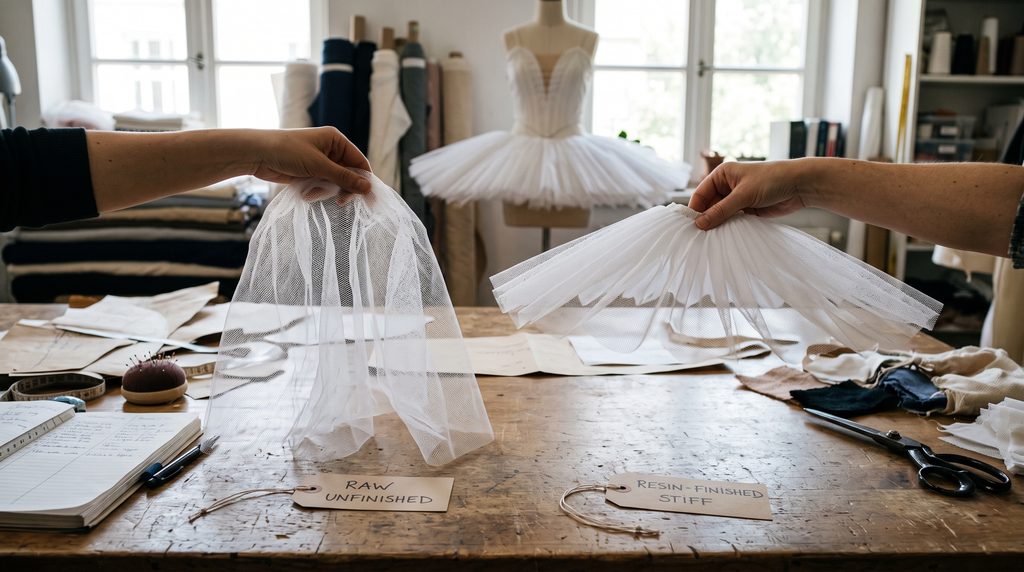
A specialized resin finish alters rigidity in tutu material by coating intersecting yarn nodes with thermo-setting polymers that freeze open apertures into spring-like structural tiers. Raw unfinished netting emerges from knitting machines limp and pliable, making it incapable of supporting dramatic stage volume. Applying balanced resin chemistry within tutu material transforms limp synthetic mesh into durable structural architecture.
What Chemical Resins Freeze Hexagonal Aperture Nodes?
Water-based acrylic and polyurethane emulsions penetrate knitted yarn junctions before passing through high-temperature curing stenter ovens. Heat sets these resin compounds permanently, locking the threads into crisp geometric forms that resist moisture and body sweat.
Here is the deal: baked-in resins give netting the spring memory needed to pop back into shape after quick costume changes.
- Thermal curing creates rigid polymer bridges across intersecting yarn nodes.
- Moisture-resistant cross-linking prevents ambient theatre humidity from wilting ruffles.
- Calibrated chemical baths establish repeatable stiffness ratings across production runs.
Can Odor-Free Water-Based Resins Prevent Skin Rash?
Modern aqueous resin systems eliminate harsh formaldehyde and volatile amines, preventing pungent fishy odors and painful contact dermatitis. Clean finishing chemistry protects performers who spend hours wearing tight costumes against bare skin during rehearsals.
Think about this: dancers perform with total focus when soft, odor-free nettings prevent distracting skin itching and redness.
- Formaldehyde-free resins eliminate abrasive chemical vapor odors in dressing rooms.
- Hypoallergenic coatings protect sensitive skin around performer groins and hips.
- Pure water-based formulations comply with international textile consumer safety laws.
| Resin Chemistry Type | Flexural Rigidity Index | Odor Profile | Performer Skin Tolerance |
| Aqueous Acrylic Polymer | High Spring Memory | Completely Odorless | Hypoallergenic Comfort |
| Urea-Formaldehyde Resin | Stiff but Brittle | Sharp Fishy Smell | Potential Skin Irritation |
| Unfinished Raw Greige | Limp Zero Support | Clean Fiber Scent | Soft but Lacks Loft |
This finishing overview illustrates how modern aqueous acrylic resins achieve extreme structural stiffness without compromising performer skin comfort.
Key Takeaway: Demanding certified water-based resin finishing keeps stage skirts standing firm while eliminating embarrassing chemical odors and dancer skin irritation.
What Fabric Weights Determine Silhouette in Tutu Material?
Fabric weights between thirty-five and fifty-five grams per square meter determine silhouette volume in tutu material by balancing self-supporting stiffness against dancer comfort. Lightweight meshes measuring twenty grams per square meter provide airy upper overlays, while dense sixty-gram nettings anchor base tiers. Selecting correct weight gradations in tutu material prevents costumes from feeling like cumbersome lead weights while maintaining theatrical impact.
What Gram Weights Separate Pancake Nets from Soft Veils?
Pancake tutus require dense dress netting measuring forty to fifty-five grams per square meter to hold their broad horizontal spread. In contrast, flowing bridal veils and soft romantic skirts perform best with gossamer meshes under twenty-five grams per square meter.
Look at the facts: pairing the wrong fabric weight with a classical silhouette causes the skirt to sag like a wilted umbrella.
- 45 to 55 GSM netting creates self-supporting horizontal platter layers.
- 30 to 38 GSM net provides springy intermediate ruffles that cushion outer plates.
- 18 to 24 GSM tulle produces gossamer top plate overlays and soft sleeve ruffles.
How Does High Denier Prevent Premature Skirt Drooping?
Filaments extruded at fifty to seventy denier possess the cross-sectional mass needed to resist gravitational bending under multiple skirt layers. Heavier denier yarns prevent inner ruffles from collapsing under the weight of decorated silk top plates.
What is the real story? You protect the investment in lavish bodice beadwork by building a foundation that never droops.
- Thick yarn filaments hold sharp knife pleats across months of rehearsals.
- High denier cores prevent moisture from penetrating fiber structures.
- Heavy yarn mass distributes bodice weight evenly across hip basques.
| Tutu Layer Position | Target Fabric Weight | Recommended Denier | Primary Structural Role |
| Base Foundation (Rows 1-3) | 50 – 55 GSM | 60D – 70D Monofilament | Heavy Structural Cantilever |
| Middle Tiers (Rows 4-8) | 40 – 45 GSM | 40D – 50D Monofilament | Volume Building & Cushioning |
| Top Plate & Frills (Rows 9-10) | 28 – 35 GSM | 20D – 30D Monofilament | Smooth Surface Presentation |
This structural weight breakdown illustrates how graduated fabric densities work together to create a lightweight, self-supporting stage costume.
Key Takeaway: Layering graduated fabric weights from heavy base netting to fine top tulle produces a sturdy skirt that dancers can wear comfortably.
How Does Layer Architecture Prevent Sagging Tutu Material?
Graduated tier architecture prevents sagging tutu material by stacking ten to twelve incrementally shorter gathered ruffles beneath the top plate to build a cantilevered support foundation. Placing full-length netting across all layers would create a bulky, drooping mess that overwhelms the performer. Engineering your tutu material into precise stepped lengths allows lower ruffles to act as structural buttresses that hold upper tiers flat.
How Many Tiered Layers Create Professional Ballet Loft?
Professional classical tutus require between ten and twelve gathered tiers stitched onto the basque panty at half-inch intervals. This multi-tiered construction creates hundreds of thousands of interlocking mesh nodes that resist downward crushing forces.
You might wonder: why do professional ballet companies insist on ten or more layers instead of four or five thick tiers?
- Multiple fine layers trap air cushions that provide resilient, buoyant bounce.
- Dense stepped rows prevent unsightly gaps when dancers leap or bend.
- Layered netting distributes weight across the hips without pulling downward.
Why Does Graduated Tier Stepping Support Top Frills?
Cutting bottom layers as short as two inches while graduating upper tiers to fifteen inches creates a solid wedge of structural support. The short, stiff lower ruffles prop up longer middle layers, keeping the wide top plate horizontal.
Ready for the good part? You achieve a flat pancake silhouette without inserting rigid, uncomfortable wire hoops inside the skirt.
- Short base tiers provide unyielding upward thrust against longer middle ruffles.
- Graduated stepping prevents outer edges from curling downward toward the floor.
- Internal fabric support eliminates dangerous wire punctures during partner lifts.
| Skirt Layer Number | Tier Cut Width (Inches) | Gather Ratio to Basque | Structural Support Function |
| Rows 1 – 2 (Base) | 2.0 – 3.5 Inches | 3.5 : 1 Tight Gather | Rigid Horizontal Buttress |
| Rows 3 – 6 (Mid) | 5.0 – 9.5 Inches | 3.0 : 1 Medium Gather | Intermediate Loft & Fill |
| Rows 7 – 10 (Top) | 11.0 – 15.0 Inches | 2.5 : 1 Standard Gather | Flawless Top Plate Coverage |
This graduated cutting matrix confirms that systematic tier stepping provides the physical support needed to maintain an upright horizontal pancake silhouette.
Key Takeaway: Implementing stepped layer ratios gives your classical costumes architectural support without resorting to heavy steel wires that restrict dancer mobility.
Can Non-Fraying Edges Accelerate Cutting Tutu Material?
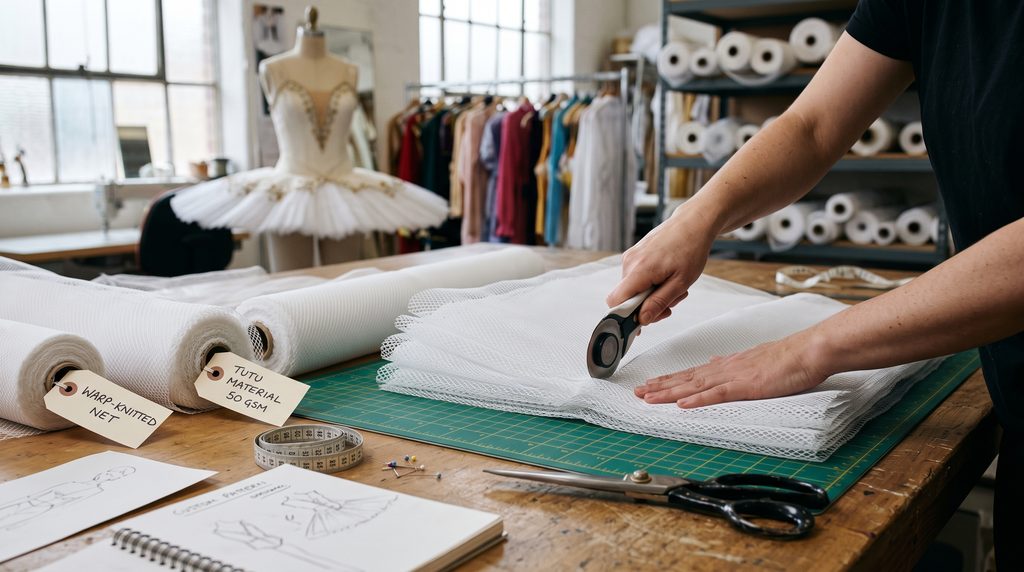
Locked warp-knitted nodes ensure non-fraying edges that accelerate cutting tutu material by allowing costume makers to slice dozens of layered tiers without folding or binding hem borders. Traditional woven fabrics require serging, rolled hemming, or bias binding to stop thread unraveling, which adds hours of labor. Specifying authentic non-fraying tutu material frees technicians to focus on precise gathering and decorative plate embellishment.
Why Do Interlocking Knit Loops Eliminate Edge Binding?
Raschel knitting needles loop warp threads continuously through adjacent vertical chains, creating mechanical knots at every pore intersection. Slicing through mesh leaves cut filaments trapped in surrounding knots, preventing edges from unraveling into loose strings.
Here is the deal: raw scissor borders stay neat and clean through dozens of high-intensity stage performances.
- Locked knit nodes prevent horizontal runs when skirts catch on shoe buckles.
- Raw cut edges keep skirt borders lightweight, airy, and transparent.
- Eliminating edge binding trims garment weight by up to twenty percent.
How Does Rotary Blade Cutting Speed Atelier Workflows?
Electric rotary cutters glide through stacks of fifty net plies simultaneously without chewing or distorting the open mesh geometry. Costume shops cut hundreds of graduated ruffle strips in a single afternoon, dramatically lowering production costs.
What is the real story? You accelerate garment turnaround times while maintaining precision millimeter cutting tolerances across entire costume lines.
- Multi-ply blade cutting ensures identical ruffle lengths across all tiers.
- Smooth cutting edges prevent netting plies from fusing or snagging together.
- Fast cutting workflows reduce costly workshop labor hours across large productions.
| Hem Finishing Technique | Labor Time per Costume | Skirt Border Weight | Long-Term Fraying Risk |
| Raw Rotary Scissor Cut | 10 Minutes Total | Zero Added Weight | Zero Raveling or Laddering |
| Rolled Machine Hem | 180 Minutes Total | Noticeable Stiff Ridge | Low but Adds Visible Bulk |
| Satin Ribbon Binding | 240 Minutes Total | Heavy Outer Perimeter | High Risk of Seam Peeling |
This workflow productivity comparison shows how raw-edge warp knits save hours of assembly labor while delivering the crisp, lightweight hemlines dancers prefer.
Key Takeaway: Utilizing clean-cutting warp-knitted mesh slashes workshop labor costs and keeps voluminous stage skirts lightweight and flutter-free.
How Do Quality Labs Verify Performance of Tutu Material?
Quality laboratories verify tutu material performance through standardized diaphragm burst audits, cantilever bending stiffness tests, and accelerated humidity chamber evaluations. Relying solely on subjective manual touch risks approving bolts that wilt in warm theatres or split along waistlines during lifts. Performing certified laboratory audits on your tutu material protects your atelier against embarrassing wardrobe malfunctions on opening night.
Which Burst Strength Audits Quantify Seam Resistance?
Hydraulic diaphragm burst testers clamp standardized netting swatches, applying fluid pressure until the fabric ruptures to record maximum strength in kilopascals. This test proves whether delicate open mesh can withstand the concentrated stress of tight waistline gathering stitches.
Think about this: verified burst strength prevents costumes from ripping open during athletic partner lifts on stage.
- ASTM D3786 diaphragm tests measure omnidirectional burst resistance accurately.
- Certified burst ratings above two hundred kilopascals prevent seam gathering tears.
- Cyclic stretch testing verifies that knit nodes retain strength under repeated pulling.
How Do Accelerated Humidity Chambers Test Shape Memory?
Technicians suspend pleated net samples inside environmental test chambers set at ninety percent relative humidity and body temperature for twenty-four hours. Measuring how much ruffles sag reveals whether finishing resins resist sweat and stage fog.
This is where it gets interesting… scientific humidity testing guarantees your stage skirts will never droop during humid summer opera house tours.
- Controlled humidity chambers simulate grueling three-hour stage performance environments.
- Laser height gauges measure vertical ruffle sag under humid conditions.
- Superior resin formulas retain over ninety percent of their dry stiffness after testing.
| Laboratory Performance Audit | Industry Test Protocol | Acceptance Benchmark | Catastrophic Failure Avoided |
| Diaphragm Burst Strength | ASTM D3786 Hydraulic | Minimum 220 kPa Force | Ripped Seams During Lifts |
| Cantilever Bending Rigidity | ASTM D1388 Overhang | Minimum 5.5 cm Length | Limp Drooping Skirt Ruffles |
| High Humidity Sag Retention | 24 Hours at 90% RH | Minimum 90% Loft Hold | Wilting Under Stage Fog & Sweat |
This comprehensive laboratory benchmark confirms that systematic testing protects production runs from costly performance failures.
Key Takeaway: Demanding documented laboratory test certificates guarantees every roll of performance netting delivers dependable structural strength and humidity resistance.
How Do Costume Ateliers Source Wholesale Tutu Material?
Costume ateliers source wholesale tutu material efficiently by partnering directly with specialized warp-knitting mills that supply seamless three-meter roll widths and certified skin-safe batches. Sourcing directly from primary manufacturers eliminates middleman markups and guarantees consistent dye lots across large company rosters. Securing dependable tutu material straight from modern knitting plants gives your production house a steady, cost-effective material supply.
Why Do Seamless Wide Widths Reduce Cutting Waste?
Extra-wide three-meter rolls allow costume cutters to lay out expansive circular top plates and long ruffle strips without piecing seams together. Wide bolts reduce fabric scrap waste by up to thirty percent compared to narrow retail yardage.
Ready for the good part? You save thousands of dollars in annual fabric costs while building cleaner, stronger skirts without ugly joining seams.
- 300 cm wide rolls accommodate full circular platter plates without center seams.
- Efficient pattern nesting cuts scrap waste across high-volume company orders.
- Flat selvages feed smoothly through automated fabric spreading machines.
What Mill Certifications Guarantee Skin Safety Standards?
International textile certifications verify that raw materials contain zero harmful heavy metals, pesticides, or toxic formaldehyde finishing residues. Working with accredited mills gives costume directors confidence that stage garments protect dancer skin health.
Look at the facts: independent safety audit certificates protect your brand against legal liabilities and performer complaints.
- OEKO-TEX Standard 100 Class 1 confirms raw materials are skin-safe and non-toxic.
- ISO 9001 factory accreditation ensures tight roll-to-roll quality consistency.
- Traceable lot documentation protects your business against supply chain delays.
| Sourcing Supply Channel | Minimum Purchase Volume | Order Lead Time | Available Width Range |
| Direct Warp-Knitting Mill | 100m – 300m Flexible | 10 to 14 Business Days | Full Custom up to 300cm |
| Wholesale Regional Jobber | Single Bolt (50m) | Immediate Stock Pull | Limited Narrow Widths |
| Retail Fabric Shop | Cut Yardage by Meter | Immediate In-Store | Expensive 140cm Narrow Bolts |
This sourcing channel analysis shows why partnering directly with primary textile producers yields superior roll widths, reliable inventory, and healthy gross margins.
Key Takeaway: Sourcing extra-wide rolls directly from certified knitting mills slashes cutting room scrap waste while securing skin-safe materials for your company.
Strategic Sourcing for Tutu Manufacturing Collections
Balancing rigid horizontal projection with dancer comfort solves the common atelier dilemmas of drooping skirts, tearing seams, and skin irritation. Choosing precision-engineered warp-knit netting treated with clean water-based resins protects your costume inventory against humidity collapse and seam failure during intense stage performances. Our advanced textile manufacturing facility produces specialized high-tenacity diamond net, versatile three-meter wide bolts, and certified skin-safe fabrics tailored to your exact performance specifications. We stand committed to equipping global ballet companies and costume ateliers with resilient, stage-proven textiles that inspire total choreographic confidence. To request certified sample swatch cards or discuss custom roll specifications for your upcoming season, contact us today and speak with our theatrical textile specialists.
Frequently Asked Questions
Q1: Can I steam stiff tutu netting directly?
No, you should never touch stiff synthetic tutu netting directly with a hot metal iron plate because synthetic filaments melt instantly under direct heat. You should instead use diffused indirect steam held four to six inches away from the ruffles to safely relax storage creases without degrading the thermo-set resin finish.
Q2: What is the best netting type to prevent droop in humid theatres?
High-tenacity nylon diamond net finished with aqueous acrylic cross-linking resin is the best choice for resisting humidity. This specialized formulation repels ambient moisture and body perspiration, maintaining over ninety percent of its horizontal stiffness even under intense stage fog and high theatre temperatures.
Q3: How do I know if tutu netting is skin-safe for dancers?
Verify that your textile supplier provides documented OEKO-TEX Standard 100 Class 1 certification confirming the material is free from formaldehyde, toxic amines, and heavy metals. Certified skin-safe netting will be completely odorless when unpacked and will not cause itching or redness when worn against bare skin.
Q4: Can I stitch heavy jeweled appliques onto fine top plate net?
Yes, you can stitch heavy beaded lace and jewels onto fine top net by reinforcing the underside with a layer of forty-denier diamond netting. This hidden backing distributes concentrated embroidery weight across multiple knit nodes, preventing the delicate top layer from tearing or pulling out of shape.
Q5: What is the best way to store classical pancake tutus between performances?
The best method is to store pancake tutus flat inside breathable, circular costume bags or suspended upside down by their internal hanging loops. Hanging skirts upside down allows gravity to pull ruffles outward, helping the netting maintain its crisp horizontal projection for the next performance.