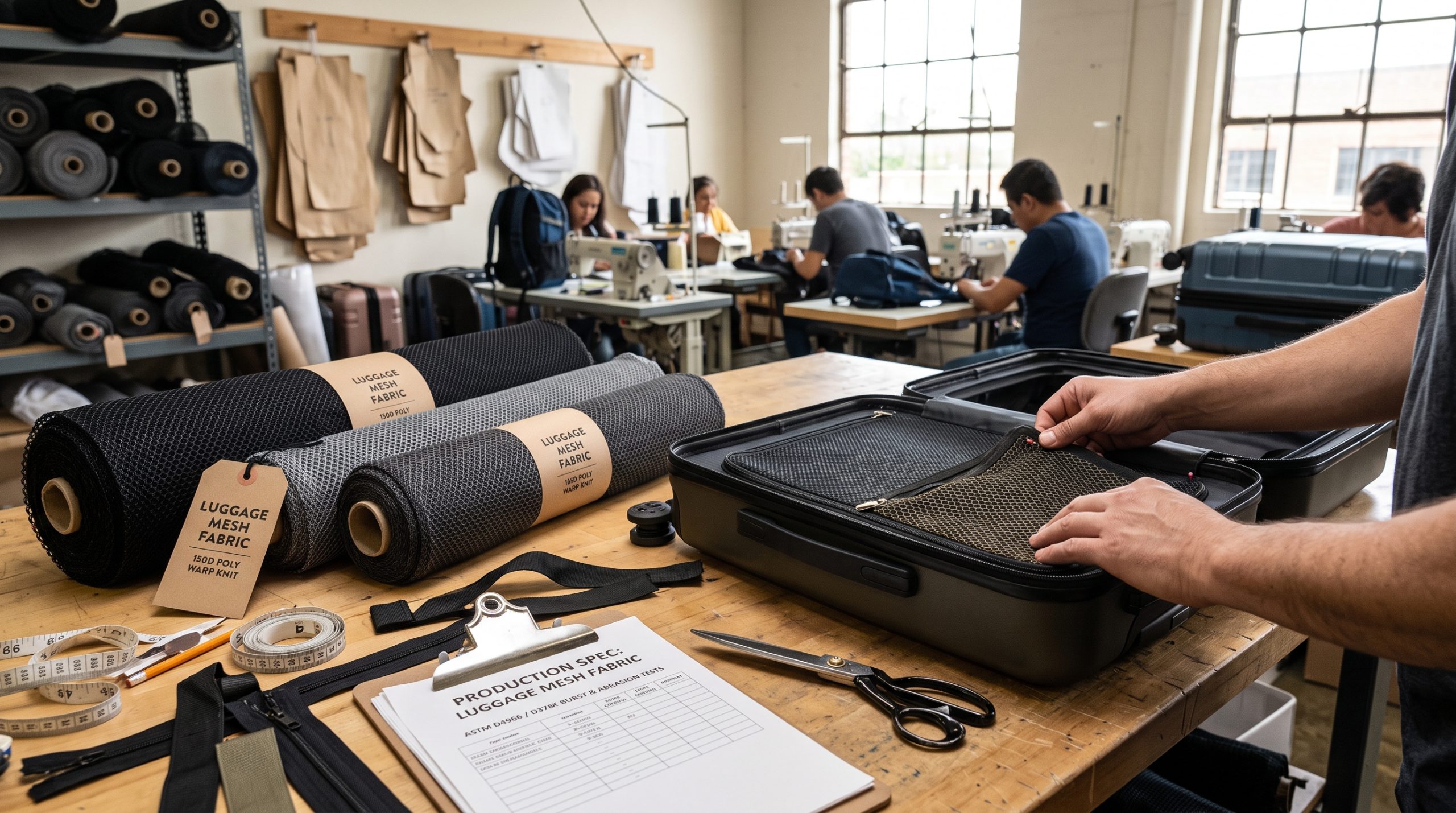
The best luggage mesh fabric for bags combines high-tenacity polyester warp knitting with balanced hexagonal apertures to deliver superior puncture resistance and interior visibility. Travel goods manufacturers constantly battle warranty claims caused by shredded pocket netting, busted zipper seams, and frayed organizer panels. Rough metal zipper sliders catch weak yarns, turning premium suitcases into frustrating liabilities that drive away repeat buyers. Specifying laboratory-tested luggage mesh fabric from certified warp-knitting producers equips travel collections with long-lasting structural strength, snag resistance, and dependable load capacity.
What Defines Industrial Luggage Mesh Fabric in Bags?
Industrial luggage mesh fabric defines an open-aperture textile constructed on multi-bar warp knitting machinery using high-denier synthetic yarns to secure heavy interior loads. This engineered fabric separates durable luggage liners from flimsy apparel tulle through locked loop nodes and thermo-stabilized resin coats. Integrating certified luggage mesh fabric prevents edge unravelling along zipper attachments, preserving neat organizational compartments across years of airport transit.
What Mechanical Properties Resist Puncture in Travel Gear?
High-tenacity synthetic yarns distribute sharp local pressure across surrounding mesh links instead of snapping individual filaments. When travelers force pointed toiletry bottles or bulky charging adapters against pocket dividers, flexible mesh nodes expand without puncturing.
Here is the deal: locked yarn intersections absorb concentrated impacts and prevent holes from spreading into long runs.
- Interlocking raschel loops distribute outward force across multiple adjoining courses.
- Controlled yarn elasticity cushions sudden baggage shifts during airline handling.
- Resilient polymer chains snap back into uniform pore symmetry after sustained compression.
Which Knit Structures Stop Laddering Along Zipper Lines?
Warp-knitted constructions interlace vertical pillar stitches that isolate yarn damage to single pores rather than laddering down entire panels. In contrast, cheap circular knits run rapidly once a zipper tooth snags a loose filament.
What is the real story? You avoid customer complaints because locked mesh stays intact even if an individual loop breaks.
- Vertical tricot chains prevent horizontal tears during vigorous luggage packing.
- Reinforced selvedge borders anchor sewing stitches without pulling loose from tape.
- Heat-set finishing eliminates yarn slippage around heavy coil zippers.
| Textile Construction | Puncture Tolerance | Run Propagation | Edge Stability |
| Warp-Knitted Raschel | 280 N Resistance | Non-Laddering Cells | Stable Raw Border |
| Circular Weft Knit | 95 N Resistance | Severe Vertical Ladder | Curls Under Tension |
| Woven Window Screen | 140 N Resistance | Shifting Thread Pores | Frays Fast at Cut Line |
This structural comparison confirms that warp-knitted meshes offer superior mechanical stability for heavy luggage compartments.
Key Takeaway: Choosing warp-knit meshes with non-laddering nodes safeguards your bag designs against costly zipper seam blowouts and customer returns.
Why Is Polyester Warp Knit the Best Luggage Mesh Fabric?
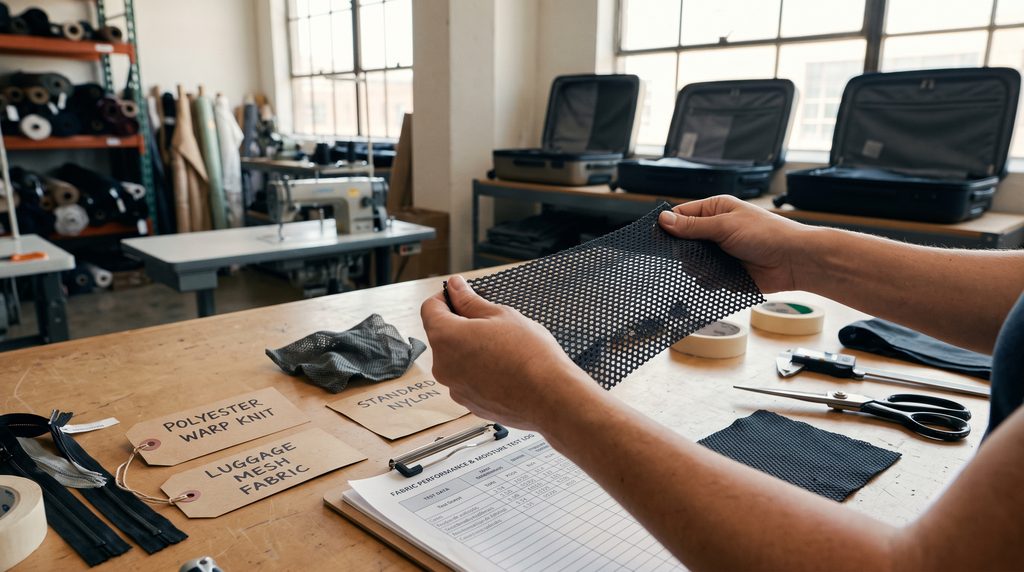
Polyester warp knit represents the premier luggage mesh fabric choice because its rigid molecular backbone provides dimensional stability, low water retention, and high tensile endurance. Unlike nylon which slackens in damp environments, polyester retains its taut rectangular shape whether stored in dry hotel rooms or humid cargo bays. Sourcing verified polyester luggage mesh fabric guarantees that interior dividers maintain firm tension across changing travel climates.
Why Does High-Tenacity Polyester Outperform Nylon in Bags?
Polyester fibers resist moisture absorption, preventing mesh dividers from sagging when travelers pack damp swimwear or wet umbrellas. The hydrophobic polymer preserves structural tension, keeping contents pressed firmly against suitcase shells.
Think about this: nylon pockets droop when exposed to humidity, but polyester panels hold clothes neatly in place.
- Low moisture regain below 0.4 percent stops pocket sagging in tropical travel climates.
- High initial modulus resists stretching out of shape under heavy laptop accessories.
- Superior cost stability protects bulk manufacturing margins against volatile polymer pricing.
How Does UV Stability Protect Luggage Mesh from Embrittling?
Polyester filaments resist ultraviolet radiation, maintaining tensile endurance during long outdoor warehouse storage and sunlit luggage carousels. This UV barrier prevents outdoor duffels and travel backpacks from cracking prematurely along exterior mesh drink holders.
Look at the facts: you avoid brittle mesh failures because polyester resists sunlight degradation over long travel seasons.
- Inherent UV resistance protects exterior water bottle pockets against sunlight yellowing.
- Polymer stability preserves elasticity after years of exposure to trunk heat.
- Stable filament matrices withstand frequent wipe-downs with commercial disinfectant sprays.
| Material Attribute | High-Tenacity Polyester | Standard Polyamide (Nylon) |
| Moisture Regain Rate | 0.4% (Maintains Stiffness) | 4.5% (Relaxes and Sags) |
| Tensile Wet Recovery | 100% Strength Retention | 85% Strength Retention |
| UV Resistance Index | High Radiation Stability | Rapid Surface Degradation |
This material matrix shows why high-tenacity polyester remains the premier polymer selection for high-stress travel goods.
Key Takeaway: Specifying polyester netting protects your luggage collections from moisture-induced sagging and extends exterior pocket service life.
How Does Aperture Geometry Shape Luggage Mesh Fabric?
Aperture geometry dictates luggage mesh fabric performance by balancing clear compartment visibility against directional load-bearing support. Modern travelers demand see-through pockets to breeze through security checkpoints while requiring firm netting that prevents small accessories from tumbling loose. Selecting calibrated luggage mesh fabric allows bag designers to match hole shapes to specific gear storage zones.
How Do Hexagonal Pores Improve Pocket Visibility on Travel?
Hexagonal cell geometries provide wide open apertures that allow travelers to identify stored passports, cables, and toiletries without unzipping compartments. Balanced angles disperse ambient light, eliminating hazy reflections under bright airport terminal illumination.
You might wonder: why do premium luggage brands prefer hexagonal netting over dense micro-mesh for interior pockets?
- Open hexagonal pores reveal small items rapidly during airport security screenings.
- Balanced multi-directional flexibility hugs bulky items without distorting adjoining seams.
- Smooth yarn junctions prevent snagging against delicate nylon garment fabrics.
Why Does Diamond Mesh Provide Rigid Perimeter Compression?
Acute diamond pores lock together along diagonal grainlines, establishing firm tensile resistance that holds folded shirts flat against suitcase frames. This compression force prevents clothing stacks from shifting into wrinkled heaps during turbulent flights.
Ready for the good part? You build compression dividers that hold garments securely without adding heavy metal support stays.
- Narrow diamond angles create high resistance along vertical pull lines.
- Dense mesh intersections resist sagging under heavy stacks of denim pants.
- Diagonal tension distributes pulling force evenly toward perimeter zipper tapes.
| Aperture Geometry | Visual Clarity Score | Diagonal Stretch Flex | Primary Luggage Application |
| Hexagonal Open Pore | 92% See-Through Index | Balanced 360-Degree Flex | Zippered Valuables Pockets |
| Diamond Compressed | 74% See-Through Index | Low Stretch (Directional) | Garment Compression Dividers |
| Square Micro-Mesh | 55% See-Through Index | Rigid Stable Boundary | Concealed Passport Pouches |
This aperture analysis illustrates how selecting specific cell configurations tailors pocket visibility and structural support across luggage interiors.
Key Takeaway: Matching pore geometry to pocket functionality enhances traveler packing convenience while maintaining secure garment compression.
Which Denier Weights Strengthen Luggage Mesh Fabric?
Denier weights between one hundred and three hundred define luggage mesh fabric strength by supplying the filament thickness required to resist abrasive wear from metal keys and luggage zippers. Thin forty-denier fashion tulle rips apart under minimal friction, making it useless for durable luggage compartments. Engineering your products with rugged denier ratings within luggage mesh fabric guarantees reliable durability across thousands of travel miles.
What Yarn Counts Prevent Bag Mesh from Snagging on Keys?
Yarns extruded at one hundred and fifty denier feature thick filament diameters that slide smoothly past sharp keychain edges without snagging or pulling loose. This rugged thickness stops everyday EDC accessories from creating ugly pulled loops across pocket faces.
Here is the bottom line: thick filaments resist abrasive friction and keep pocket faces looking clean across years of daily commuting.
- 150D filaments resist cutting actions from jagged house key tips.
- Smooth polymer surfaces allow metal zippers to slide past without abrading yarn loops.
- Tight yarn twisting minimizes loose surface fibers that attract lint and debris.
How Does High Denier Withstand Heavy Luggage Packing Loads?
Three-hundred-denier monofilament or high-filament yarns build heavy-duty netting capable of supporting dense electronic chargers and heavy power banks without bursting. These thick yarns anchor deep into seam allowances, resisting pullout under excessive packing loads.
What is the real story? You eliminate warranty repairs because heavy yarns keep pocket perimeters firmly anchored under maximum tension.
- 300D warp threads withstand intense pulling when travelers cram shoes into exterior pouches.
- Thick yarn cores prevent seam needle punctures from elongating into gaping tears.
- High load tolerances support heavy tech gear without stretching out pocket elastic bands.
| Filament Denier | Tear Strength Rating | Snag Resistance | Recommended Gear Usage |
| 75D Lightweight | 45 N Break Force | Moderate (Avoid Keys) | Lightweight Toiletry Bags |
| 150D Medium Heavy | 110 N Break Force | High Snag Defense | Standard Suitcase Dividers |
| 300D Heavy Duty | 260 N Break Force | Maximum Rough Defense | Exterior Duffel Pockets |
This denier matrix proves that choosing heavier filament weights provides the rugged mechanical defense demanded by frequent international travelers.
Key Takeaway: Selecting 150D to 300D filament specifications protects your bag pockets against key snags and prevents seams from pulling out under heavy loads.
How Does PVC Coating Reinforce Luggage Mesh Fabric?
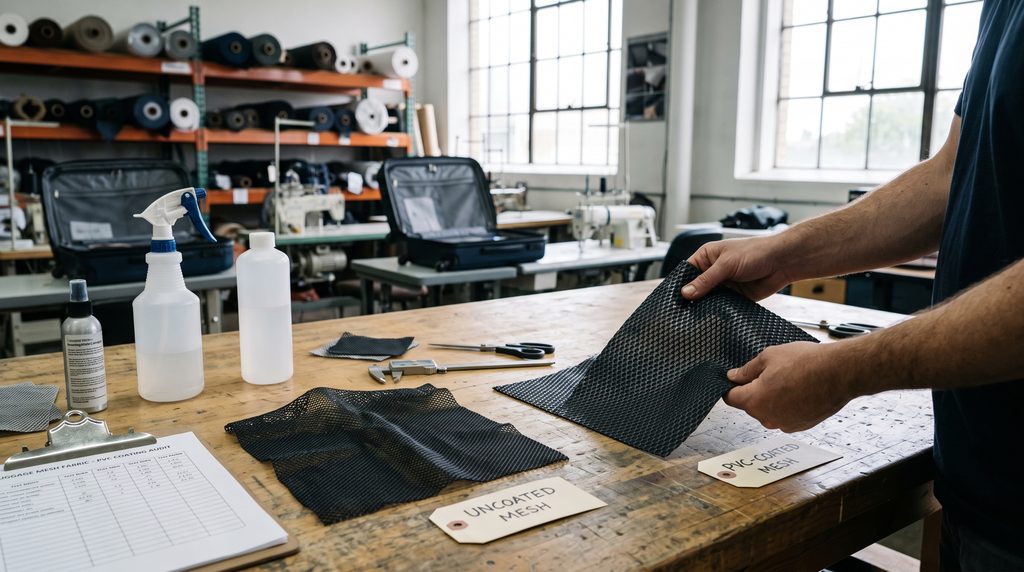
A protective PVC coating reinforces luggage mesh fabric by encapsulating polyester yarns in a flexible polymer sheath that enhances abrasion resistance and wet-grip traction. Uncoated meshes can feel slick, allowing damp toiletries or smooth bottles to slide around wildly inside unzipped bags. Applying specialized polymer coatings within luggage mesh fabric creates durable non-slip compartments that withstand grease, spilled shampoos, and damp outdoor gear.
What Polymer Dip Coatings Add Grip to Wet Gear Compartments?
Thermoplastic PVC and polyurethane dip baths bond directly to knitted yarn junctions, creating rubberized textures that grip smooth plastic travel bottles securely. This textured friction prevents travel accessories from rattling around or slipping out when travelers open luggage vertically.
Here is the deal: rubberized mesh coatings keep toiletries upright and stop messy shampoo spills from spreading across clothes.
- Textured polymer sheaths prevent smooth plastic bottles from sliding during transport.
- Waterproof yarn encapsulation stops spilled liquids from soaking into fiber cores.
- Smooth rubberized nodes wipe clean with damp cloths after messy toiletry leaks.
Can Phthalate-Free Coatings Safeguard Global Travel Standards?
Modern eco-certified plasticizers eliminate harmful orthophthalates, passing stringent international consumer safety regulations like REACH and Prop 65 effortlessly. Environmentally sound coatings protect human health while delivering rugged abrasion performance across high-end consumer luggage lines.
Think about this: compliant chemical coatings protect your business from costly product recalls and customs border seizures.
- Phthalate-free formulas comply with strict North American and European chemical safety laws.
- Non-toxic polymer sheaths prevent foul plastic odors from penetrating packed clothing.
- Advanced plasticizers prevent surface cracking during freezing cargo hold flights.
| Coating Formulation | Abrasion Resistance | Wet Grip Traction | Chemical Safety Standard |
| Eco-Friendly Phthalate-Free PVC | 35,000 Rub Cycles | High Anti-Slip Hold | REACH & RoHS Compliant |
| Standard Industrial PVC | 28,000 Rub Cycles | High Anti-Slip Hold | Contains Banned Plasticizers |
| Uncoated High-Tenacity Mesh | 12,000 Rub Cycles | Low Slick Surface | Clean Fiber Composition |
This coating overview confirms that eco-compliant PVC dips multiply abrasion endurance while providing safe non-slip performance for travel organizers.
Key Takeaway: Requiring phthalate-free polymer coatings upgrades pocket grip and abrasion life while clearing international chemical compliance hurdles.
What Fabric Weights Define Durable Luggage Mesh Fabric?
Fabric weights between eighty and two hundred and fifty grams per square meter define durable luggage mesh fabric by balancing pocket flexibility against structural tear resistance. Ultra-lightweight meshes under seventy grams suit airy apparel linings but buckle under the weight of footwear or heavy electronics. Utilizing calibrated weight specifications within luggage mesh fabric guarantees that interior panels remain light while holding bulky travel gear.
What Gram Weights Separate Inner Dividers from Outer Pockets?
Internal zippered lids utilize medium ninety to one hundred and thirty gram netting to remain lightweight while exterior backpack pouches demand heavy two hundred gram mesh to endure rough tarmac friction. Matching fabric density to pocket location keeps bags light while reinforcing critical high-wear areas.
Look at the facts: pairing the wrong gram weight with high-wear exterior pockets leads to torn netting before the first travel season ends.
- 90 to 120 GSM netting produces flexible interior zippered lid dividers.
- 130 to 160 GSM mesh provides sturdy dividers for heavy shoe compartments.
- 180 to 240 GSM heavy netting builds rugged exterior drink holders and tactical pouches.
How Does Fabric Density Stop Small Accessories Slipping Away?
Dense pore counts trap small memory cards, coins, and loose collar stays, preventing valuable items from slipping through open mesh apertures into deep luggage crevices. High yarn density keeps travel essentials contained while preserving open visual transparency.
What is the real story? You protect traveler valuables by specifying hole apertures smaller than standard SD cards and key rings.
- Compact two-millimeter pore openings prevent small charging adapters from sliding out.
- High needle counts per inch establish a solid fabric face that resists snagging.
- Smooth filament finishes allow quick fingers to retrieve small items without catching nails.
How Do Birdseye and Pique Structures Compare for Pocket Linings?
Birdseye mesh provides smooth, compact micro-pores that offer exceptional snag resistance for delicate inner linings, while pique knit delivers a textured honeycomb surface with superior three-dimensional airflow. For luggage interior organizer sleeves, birdseye knits prevent charging cables and zipper pulls from catching, whereas pique structures excel in padded tablet sleeves where moisture dissipation and cushioning matter. Evaluating these tactile and structural differences helps product managers select the exact hand feel and ventilation balance needed for modern tech-travel compartments.
- Birdseye micro-apertures prevent jewelry, pins, and cable heads from snagging on pocket walls.
- Pique honeycomb relief creates air channels that prevent moisture buildup inside padded sleeves.
- Calibrated loop densities ensure both knit structures maintain shape stability under tension.
| Luggage Pocket Location | Target Fabric Weight | Aperture Pore Size | Primary Performance Function |
| Interior Lid Organizer | 95 – 110 GSM | 2.5 mm Open Pore | Lightweight Visual Storage |
| Base Packing Compression | 130 – 150 GSM | 1.8 mm Dense Pore | Garment Containment & Hold |
| Exterior Cargo Pouch | 200 – 240 GSM | 3.5 mm Coated Pore | Heavy Impact & Scuff Defense |
This density and weight breakdown clarifies how distributing fabric mass correctly creates a lightweight suitcase that withstands rough airport handling.
Key Takeaway: Specifying targeted gram weights from lightweight lid organizers to heavy exterior pouches keeps overall luggage tare weight low without sacrificing durability.
How Do Divider Panels Integrate Luggage Mesh Fabric?
Zippered divider panels integrate luggage mesh fabric by sewing elasticized edge bindings and structural perimeter zippers directly onto flexible netting panels to secure packed contents. Without mesh dividers, clothing items tumble violently inside hardshell luggage, shifting weight and making suitcases difficult to roll smoothly. Engineering high-tenacity luggage mesh fabric into compression dividers keeps bulky garments secured flat against the suitcase base throughout long flights.
How Do Framed Dividers Support Heavy Clothes Under Compression?
Reinforced webbing perimeters hold mesh panels taut, acting like architectural trampolines that compress clothing stacks down into suitcase wells. This tension prevents packed garments from billowing upward and jamming exterior closure zippers.
You might wonder: how do fabric panels hold heavy denim loads without ripping away from perimeter zipper teeth?
- Heavy-duty elastic bindings absorb dynamic tension when travelers overpack suitcases.
- Box-stitched corner reinforcements transfer compression load to luggage corner molds.
- Flexible mesh bodies adapt to irregular packing shapes without splitting center seams.
Why Does Flexible Netting Absorb Impact During Baggage Handling?
Flexible knit pores expand under sudden external drops, absorbing mechanical shock waves when baggage handlers toss heavy luggage onto conveyor ramps. This cushioning flex prevents hard plastic toiletries inside from cracking against suitcase outer shells.
Ready for the good part? You reduce shattered toiletry claims because springy mesh pockets dampen baggage handling impacts.
- Elastic pore expansion dissipates sudden luggage drop impacts smoothly.
- Soft netting contacts prevent hard suitcase shells from scuffing fragile cosmetic bottles.
- Dynamic fabric flex protects delicate hardshell zipper tracks from blowouts under pressure.
| Divider Assembly Component | Construction Standard | Structural Duty | Long-Term Durability Benefit |
| Perimeter Elastic Binding | 25 mm Heavy Poly-Spandex | Edge Tension Absorption | Prevents Mesh Seam Tearing |
| Main Center Divider Panel | 140 GSM Hexagonal Mesh | Garment Load Compression | Holds Clothes Flat and Tidy |
| Heavy-Duty Zipper Join | #5 Spiral Nylon Coil | Full Perimeter Closure | Smooth Pulling Under Load |
This assembly matrix shows how combining flexible mesh with rugged perimeter bindings establishes a resilient compression system for modern travelers.
Key Takeaway: Integrating elasticized perimeter frames with durable mesh dividers prevents clothes from shifting and cushions packed valuables against baggage impacts.
Can Non-Fraying Edges Speed Cutting Luggage Mesh Fabric?
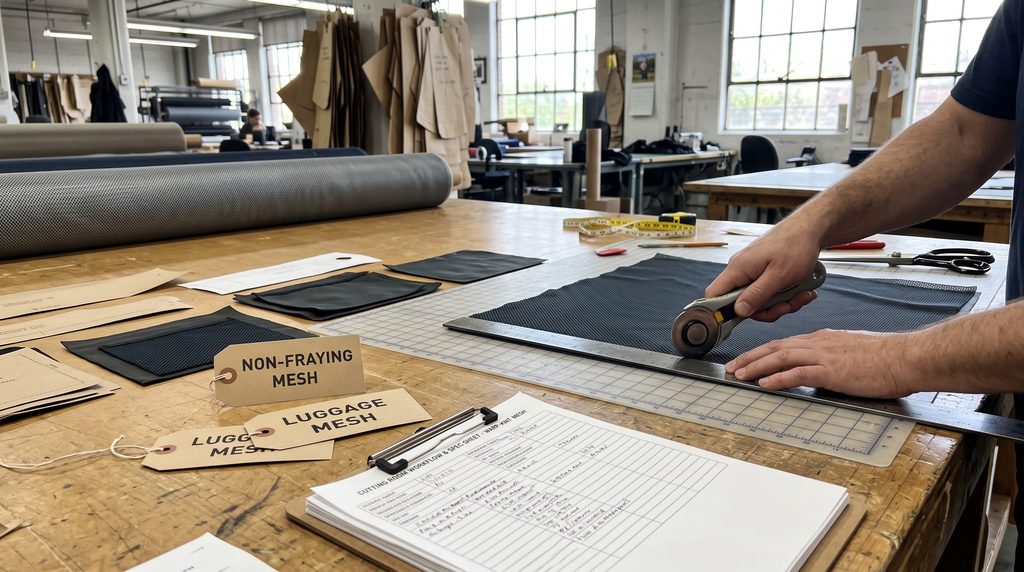
Locked warp-knitted loops provide non-fraying edges that speed cutting luggage mesh fabric by permitting factory technicians to slice hundreds of pocket panels without serging cut borders. Woven fabrics require folded hems or bias binding tapes to prevent loose threads from jamming sewing machines, adding minutes of labor to each bag. Specifying genuine non-fraying luggage mesh fabric streamlines cutting room workflows and lowers unit manufacturing costs across large production runs.
Why Do Warp Knitted Nodes Eliminate Edge Hem Binding?
Raschel needles loop threads continuously through interconnected pillar chains, locking cut yarn ends firmly inside adjacent knit knots. Slicing through panels leaves raw borders completely stable, eliminating the need to fold or overcast cut edges before sewing.
Here is the deal: raw cut edges stay clean and intact without unravelling into loose threads during automated sewing assembly.
- Interlocking loop nodes trap cut yarn tips securely inside surrounding knit chains.
- Raw cut borders eliminate thick, bulky fabric ridges along internal pocket seams.
- Eliminating edge overlocking trims up to fifteen percent from pocket assembly labor.
How Does Automated CNC Knife Cutting Accelerate Bag Assembly?
Automated CNC cutting beds slice through stacks of sixty mesh plies simultaneously without pulling or distorting delicate pore geometries. Precise digital knives follow CAD patterns accurately, ensuring that thousands of pocket panels match zipper tape dimensions down to the millimeter.
What is the real story? You boost factory output because clean, automated cutting speeds up sewing workstation feeding.
- Vacuum compression beds hold slippery synthetic netting flat during high-speed cutting.
- Carbide oscillating blades slice clean edges without fusing synthetic yarns together.
- Identical panel dimensions eliminate tedious manual trimming at sewing stations.
| Edge Processing Method | Labor Time per 100 Pockets | Edge Thickness Profile | Yarn Fraying Risk |
| Raw Rotary CNC Cut | 4 Minutes Total | Ultra-Thin 0.6 mm Flat | Zero Thread Unravelling |
| Overlocked Serged Edge | 45 Minutes Total | Bulky 2.4 mm Seam | Low (Adds Thread Clutter) |
| Folded Bias Tape Binding | 90 Minutes Total | Stiff 3.2 mm Ridge | Zero (High Material Cost) |
This manufacturing speed comparison demonstrates that raw-cut warp knits save significant sewing time while maintaining clean, durable interior seams.
Key Takeaway: Adopting clean-cutting warp knits cuts pocket assembly labor hours and eliminates bulky interior seam allowances that crowd luggage space.
How Do Quality Labs Verify Tough Luggage Mesh Fabric?
Accredited quality laboratories verify tough luggage mesh fabric through standardized Martindale abrasion audits, Mullen burst tests, and cyclic zipper fatigue evaluations. Relying merely on manual touch risks approving mesh rolls that shred against abrasive zipper sliders or pop open during airline transit. Demanding documented laboratory test certificates for your luggage mesh fabric protects your brand against catastrophic luggage failures and costly retail warranty claims.
Which Martindale Rub Tests Verify Abrasion Life in Luggage?
Martindale testing machines rub wool abradant discs against clamped mesh samples in complex Lissajous patterns, recording the exact cycle count before two yarn loops snap. Passing high cycle benchmarks proves that pocket netting can endure constant friction from packed metal zippers and toiletries.
Think about this: verified abrasion testing guarantees that your interior pockets will never wear through during years of frequent travel.
- ASTM D4966 testing benchmarks quantify pocket rub endurance accurately.
- Passing 25,000 rub cycles guarantees multi-year resistance against key scratches.
- Microscopic thread checks confirm that coating layers remain bonded after abrasion.
How Do Seam Burst Tests Protect Zippers Against Overpacking?
Hydraulic diaphragm burst testers apply fluid pressure beneath clamped seamed mesh samples, measuring the exact force in kilopascals needed to rupture the fabric. This audit confirms that delicate netting will not tear away from zipper tape stitches when travelers overstuff pockets.
This is where it gets interesting… scientific burst testing prevents seams from ripping open when travelers cram heavy souvenirs into full suitcases.
- ASTM D3786 hydraulic pressure audits quantify omnidirectional burst limits.
- Minimum 250 kPa ratings ensure mesh seams withstand aggressive suitcase overpacking.
- Cyclic stretch audits verify that pocket seams spring back after heavy loads.
| Quality Laboratory Audit | Test Standard Protocol | Acceptance Benchmark | Practical Failure Avoided |
| Martindale Abrasion Test | ASTM D4966 Lissajous | Minimum 25,000 Cycles | Worn Holes from Zipper Friction |
| Hydraulic Diaphragm Burst | ASTM D3786 Bursting | Minimum 250 kPa Pressure | Ripped Seams from Overpacking |
| Seam Yarn Slippage Test | ASTM D434 Seam Pull | Minimum 120 N Force | Pocket Netting Pulling Off Tape |
This laboratory benchmark overview confirms that rigorous physical testing protects bulk production runs from embarrassing in-transit failures.
Key Takeaway: Demanding certified laboratory test reports guarantees that every roll of pocket netting delivers proven abrasion defense and burst resistance.
How Do Bag Manufacturers Source Bulk Luggage Mesh Fabric?
Bag manufacturers source bulk luggage mesh fabric by partnering directly with primary warp-knitting textile mills that offer seamless wide widths, custom colorways, and certified quality standards. Buying through secondary jobbers inflates fabric costs and introduces unpredictable batch variations that disrupt automated factory cutting rooms. Securing high-volume luggage mesh fabric directly from modern knitting plants guarantees consistent roll tension, stable dye lots, and healthy gross margins.
Why Do Wide Master Rolls Cut Down Processing Scrap in Factories?
Extra-wide two-meter and three-meter master rolls permit computerized cutting rooms to nest large divider patterns efficiently alongside small accessory pouches. Wide rolls reduce off-cut fabric scrap by up to twenty-five percent compared to narrow retail bolts.
Ready for the good part? You save thousands of dollars annually on raw materials by optimizing pattern layouts across wide master rolls.
- 220 cm to 300 cm roll widths support efficient pattern nesting for large suitcase lids.
- Continuous roll lengths feed smoothly through automated multi-ply fabric spreaders.
- Stable roll selvages eliminate uneven edge waste during automated cutting cycles.
What Environmental Audits Qualify Suppliers for Global Brands?
International textile certifications verify that synthetic raw materials contain zero toxic heavy metals, azo dyes, or harmful plasticizers. Sourcing from certified mills gives luggage brands confidence that their travel products comply with strict international import and retail regulations.
Look at the facts: independent supplier certifications protect your brand from border delays and retail compliance fines.
- OEKO-TEX Standard 100 confirms fabrics are free from harmful volatile chemicals.
- GRS recycled polyester certifications satisfy growing consumer demand for sustainable travel gear.
- ISO 9001 factory management audits guarantee consistent roll-to-roll tensile strength.
| Supply Channel Tier | Minimum Order Volume | Lead Time Window | Available Roll Widths |
| Direct Warp-Knitting Mill | 500 – 1,000 Meters | 12 to 16 Business Days | Custom Widths to 300 cm |
| Regional Wholesale Agent | 100 – 200 Meters | Immediate Stock Pull | Limited Standard 150 cm |
| Retail Fabric Jobber | Cut Yardage by Meter | Immediate In-Store | Expensive Narrow 120 cm |
This sourcing analysis shows why direct mill partnerships deliver superior roll widths, reliable inventory schedules, and substantial volume savings.
Key Takeaway: Sourcing extra-wide rolls directly from certified warp-knitting mills reduces cutting scrap while securing sustainable, eco-compliant textiles for your luggage line.
Strategic Sourcing for High-Performance Luggage Collections
Balancing see-through visibility with rugged puncture resistance solves the common luggage manufacturing struggles of torn pockets, jammed zippers, and customer warranty claims. Selecting precision-engineered warp-knit polyester netting treated with clean polymer finishes protects your travel gear against heavy abrasion and burst failures during international transit. Our modern textile knitting facilities produce high-tenacity diamond netting, flexible hexagonal meshes, and eco-certified wide rolls tailored to your exact luggage engineering requirements. We stand committed to equipping global luggage brands and travel gear manufacturers with resilient, road-tested textiles that inspire total traveler confidence around the world. To request certified laboratory swatch books or discuss custom roll specifications for your upcoming collection, contact us today and consult with our technical luggage fabric specialists.
Frequently Asked Questions
Q1: Can I use nylon mesh instead of polyester for luggage pockets?
No, you should avoid nylon mesh for luggage interior pockets because nylon absorbs ambient humidity and sags loosely over time. High-tenacity polyester warp knits maintain crisp, flat tension across diverse travel climates and offer superior resistance against UV light and chemical exposure.
Q2: What is the best mesh weight for interior zippered luggage dividers?
A fabric weight between one hundred and one hundred and thirty grams per square meter is the best choice for zippered luggage dividers. This density balances lightweight packing convenience with the tensile strength needed to hold heavy clothing stacks flat without tearing along zipper lines.
Q3: How do I know if luggage mesh will snag on sharp metal keys?
Inspect the yarn denier rating and filament structure to verify that the fabric utilizes continuous filaments rated at one hundred and fifty denier or higher. Higher denier yarns possess thick filament diameters that slide smoothly past jagged key edges without pulling surface loops loose.
Q4: Can I cut warp-knitted luggage mesh without stitching hem bindings?
Yes, you can cut warp-knitted mesh with raw borders because interconnected raschel loop nodes lock cut yarn ends securely inside surrounding knit chains. This non-fraying property allows factory cutters to slice clean panels using automated knives without requiring costly edge overlocking or folded bindings.
Q5: What is the best method to clean PVC-coated travel gear mesh?
The best method is to wipe the coated mesh surface with a damp microfiber cloth and mild soapy water before air drying completely. Avoid using aggressive acetone solvents or high-heat drying tumblers because harsh chemicals and extreme heat degrade protective polymer coatings.