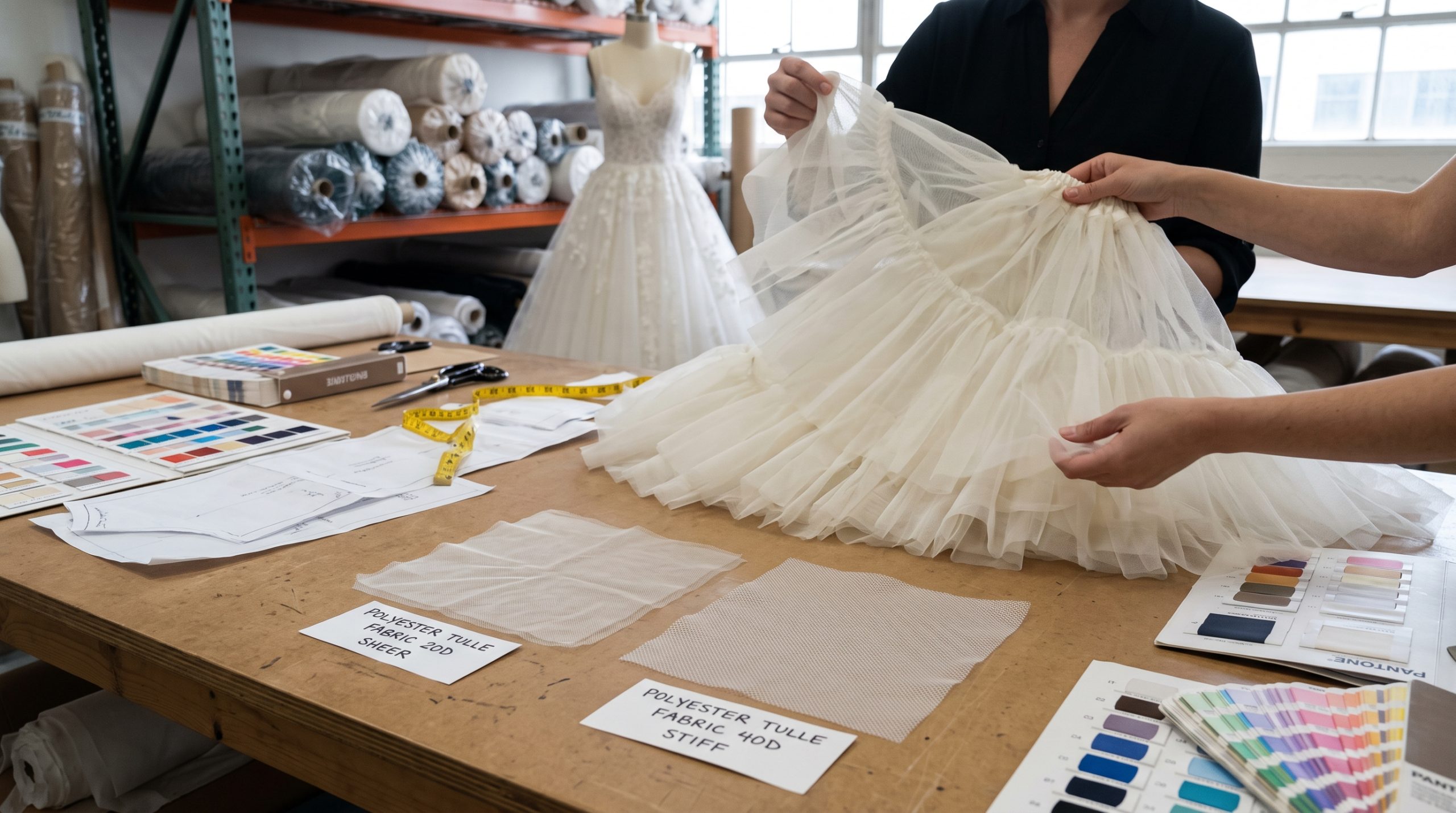
Polyester tulle fabric represents a lightweight synthetic netting woven from continuous polyester filaments that provides structural volume and crisp body for eveningwear and wedding dress design. Sourcing delicate bridal yardage often presents serious production pitfalls when fragile skirt layers collapse under heavy train hemlines. Sagging gown tiers ruin dramatic silhouettes and force bridal ateliers into expensive pattern reconstructions. Selecting dependable polyester tulle fabric resolves these structural failures by providing resilient architectural volume and dependable wrinkle recovery.
What Is Polyester Tulle Fabric and Its Construction?
Polyester tulle fabric is an open-cell netting manufactured by interlacing synthetic polyester yarns on high-speed warp knitting looms to form uniform hexagonal mesh openings. Textile engineers configure specialized guide bars that loop threads continuously across adjacent courses to prevent yarn shifting. This interlocking structure prevents edge unravelling during high-volume apparel cutting. Modern garment manufacturers specify polyester tulle fabric whenever they need lightweight fabric that preserves its geometry under mechanical tension.
How Do Warp Knitting Looms Form Hexagonal Pores?
Precision guide bars knit parallel yarns across adjacent needles to form stable honeycomb boundaries. Single circular knits unravel when snagged but warp-knit meshes anchor every interlocking loop permanently.
Here is the deal:
Needle bar timing dictates the exact pore diameter of every finished hexagonal cell.
- Parallel synthetic yarns move diagonally across reciprocal courses.
- Constant yarn tension controllers prevent optical distortions across wide netting bolts.
- Dense needle bars produce microscopic boundary lines that stay clean along raw borders.
Why Does Filament Tenacity Prevent Edge Fraying?
Continuous extrusion polyester filaments yield extraordinary tensile strength along raw cut panels. Locked knit nodes keep adjacent yarns steady when garment makers slice through multiple plies simultaneously.
Look:
You avoid time-consuming edge surging on expansive gown underskirts.
The Key Takeaway for apparel factory planners centers on cutting efficiency: utilizing warp-knit hexagonal polyester mesh prevents edge disintegration and accelerates table assembly.
| Construction Method | Aperture Stability | Raveling Tendency | Edge Cleanliness |
| Warp Knit (Raschel) | Outstanding | Non-laddering | Clean scissor cut |
| Plain Woven Net | Moderate | Shifts under pressure | High fraying risk |
| Circular Weft Knit | Flexible | Ladders when snagged | Curled borders |
Warp-knit raschel loops offer unmatched perimeter security compared to traditional cross-woven netting methods.
Why Does Polyester Tulle Fabric Hold Crisp Structural Form?
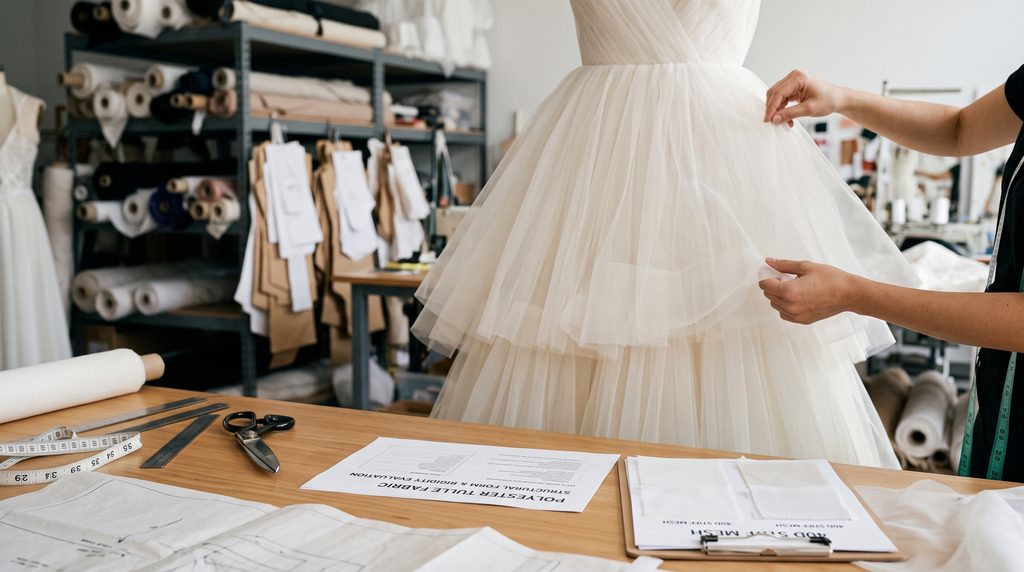
Polyester tulle fabric holds crisp structural form because polyethylene terephthalate molecules possess high flexural rigidity that resists mechanical bending. This molecular rigidity allows individual mesh walls to push outward against adjacent fabric layers. Gowns gain lasting three-dimensional puffiness without needing heavy internal hoop skirts. Atelier pattern cutters choose this textile when designing show-stopping ballgowns that demand commanding stage presence.
What Delivers Reliable Volume Without Heavy Boning?
Textured synthetic filaments spring back immediately after experiencing compression inside shipping cartons. This springiness keeps wedding dresses camera-ready straight out of packaging.
Think about it:
Brides dislike wearing heavy metal frames beneath delicate bridal silks.
- High flexural modulus keeps skirt tiers projecting outward horizontally.
- Elastic recovery pushes creased netting back into original rounded shapes.
- Lightweight yarn bulk avoids burdening the bride with unnecessary gown weight.
How Does Polymer Modulus Maintain Resilient Silhouette?
Polyester filaments resist moisture softening so ambient humidity cannot deflate your garment architecture. Rain or ballroom sweat will not weaken the crystalline polymer skeleton holding your design intact.
This is what happens:
Your dramatic collection keeps its sculpted lines through long reception dinners.
The Key Takeaway for couture designers: structural polyester netting provides self-supporting body that reduces reliance on restrictive undergarment hardware.
| Polymer Classification | Flexural Rigidity | Moisture Drop Ratio | Silhouette Retention |
| Polyethylene Terephthalate | High (8.5 – 11.0 GPa) | Negligible change | Unyielding loft |
| Polyamide Polymer | Low (3.5 – 4.5 GPa) | Softens in humidity | Fluid drapery |
| Natural Silk Protein | Moderate (5.0 – 7.0 GPa) | Pronounced softening | Supple fall |
Rigid polymer structures guarantee that skirt volume resists collapse regardless of atmospheric moisture.
How Does Polyester Tulle Fabric Compare to Soft Nylon Tulle?
Polyester tulle fabric differs from nylon tulle by providing stiffer hand feel, lower moisture absorption, and significantly greater resistance to chemical wrinkling. Nylon provides liquid drapery that flows gracefully along human skin curves. Polyester delivers self-supporting architecture that sculpts dramatic volume away from the body. Apparel designers source specialized polyester tulle fabric whenever silhouette stiffness outweighs requirements for silky skin contact.
Does Polyester Offer Higher Bending Stiffness Than Nylon?
Higher tensile modulus makes polyester filaments stiffer than polyamide threads of equal denier. This mechanical difference means fewer fabric layers produce equivalent skirt loft.
What is the real story?
You spend less money on overall yardage while achieving superior skirt volume.
- Stiff netting walls stand away from the wearer to build dramatic fullness.
- Dense crystalline zones inside the fiber resist crushing forces during transit.
- Controlled hand feel prevents flimsy skirt collapse under beaded bridal lace overlays.
How Do Moisture and Static Levels Differ Between Fibers?
Polyester absorbs almost zero ambient moisture making it hydrophobic during damp weather. This dry behavior eliminates fabric droop but requires antistatic fabric rinses in dry winter regions.
Here is why:
Water molecules cannot penetrate closed polyester crystalline structures.
The Key Takeaway for procurement specialists: select nylon for soft face veils that touch bare skin but specify polyester for foundational petticoats that demand unwavering lift.
| Material Property | Polyester Tulle Net | Nylon Tulle Mesh | Design Selection Impact |
| Hand Softness Level | Crisp and crisp-firm | Silky and skin-gentle | Nylon suits necklines |
| Skirt Lift Capacity | Superior loft per tier | Moderate loft per tier | Polyester saves yardage |
| Ambient Moisture Uptake | Under 0.8% | 4.0% – 4.5% | Polyester resists rain droop |
Comparative fiber testing highlights why polyester serves as the ideal choice for load-bearing petticoat foundations.
Which Polyester Tulle Fabric Weight Fits Your Gown Volume?
Selecting the correct polyester tulle fabric weight depends on whether your design requires whisper-light surface veiling or dense structural crinoline support. Fabric mills categorize netting through denier yarn thickness and gram weight metrics. Fine twenty-denier meshes create romantic cloud-like overlays that float around evening hemlines. Heavy fifty-denier meshes build rigid petticoat bases that lift massive ballgown trains effortlessly.
Which Denier and GSM Suit Delicate Illusion Sleeves?
Ultra-light netting utilizing fifteen to twenty denier filaments provides translucent visual modesty across sleeves. The fine mesh creates an understated aesthetic without scratching sensitive arm skin.
Look:
You achieve sheer elegance while maintaining fabric strength against elbow movement.
- Fifteen-denier yarn yields weight around twelve grams per square meter.
- Fine pore grids scatter incoming light to soften bodily contours visually.
- Supple weave prevents stiff gathering folds around narrow wrist openings.
How Do Heavy Crinoline Nets Support Layered Ballgowns?
High denier structural netting uses forty to seventy denier mono-yarns to construct unyielding geometric walls. These stiff underlayers carry heavy brocades and thick satin overskirts without buckling inward.
Ready for the good part?
Three layers of crinoline replace dozens of lightweight tiers saving hours of sewing labor.
The Key Takeaway for costume ateliers: matching precise yarn denier to gown silhouette targets prevents premature structural collapse in multi-layered dresses.
| Fabric Grade | Yarn Denier | Weight Range | Best Garment Placement |
| Bridal Illusion | 15D – 20D | 12 – 18 GSM | Sheer sleeves, illusion necklines |
| Standard Dress Net | 25D – 35D | 22 – 30 GSM | Tiered overskirts, veil borders |
| Heavy Crinoline | 50D – 70D | 40 – 55 GSM | Foundation petticoats, bridal tutus |
Denier selection directly dictates whether the resulting textile serves as an airy veil or an architectural support base.
Can Polyester Tulle Fabric Provide Adequate Breathability?
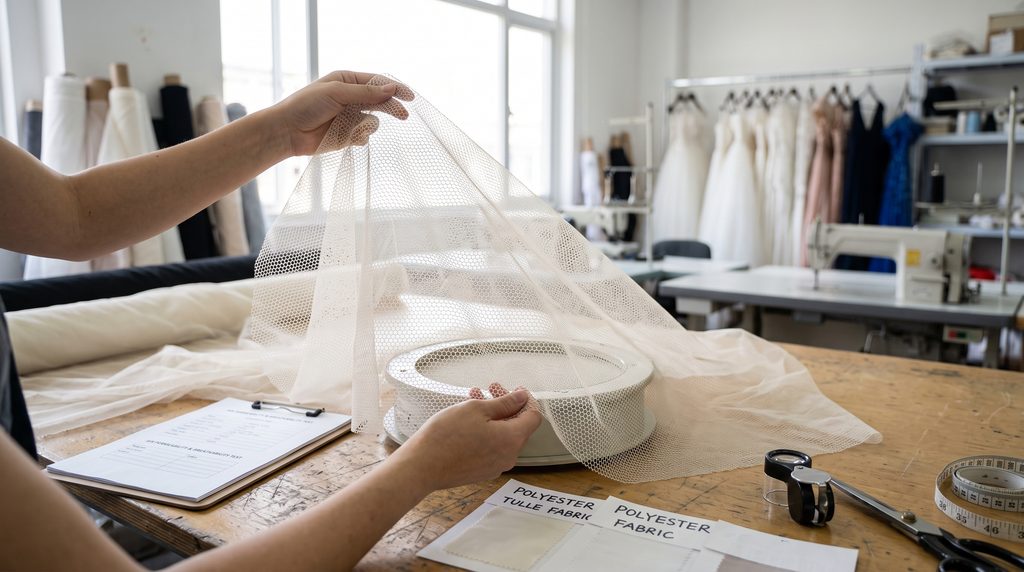
Polyester tulle fabric provides exceptional breathability because its open hexagonal architecture features a porosity rating exceeding eighty-five percent. Ambient breezes circulate freely through these microscopic air gates around warm body zones. Heat generated by wedding guests dissipates directly outward through open mesh pores. Sourcing breathable polyester tulle fabric guarantees that voluminous dresses remain surprisingly comfortable during outdoor summer ceremonies.
How Do Open Voids Permit Continuous Heat Convection?
Wide hexagonal openings present minimal resistance to natural upward thermal airflow. Hot air rises away from skin surfaces while fresh ambient breezes penetrate inward continuously.
Here is the deal:
Athletic principles apply directly to multi-layered formal gown engineering.
- Porous mesh apertures bypass the stifling trap of solid woven linings.
- Convective thermal transfer prevents sweat accumulation around the waistline.
- Continuous ventilation prevents damp moisture condensation on inner satin linings.
Can Layered Petticoats Maintain Skin Comfort in Heat?
Stiff mesh fibers keep adjacent skirt tiers physically separated by tiny gaps of open air. These air gaps create a natural cooling buffer between the sunlit outer fabric and the wearer.
Think about it:
Separated skirt tiers insulate against solar heat far better than dense clinging garments.
The Key Takeaway for summer wedding collections: open-cell polyester netting provides expansive gown drama without causing heat exhaustion for brides in warm venues.
| Layering Configuration | Airflow Rating (CFM) | Heat Dissipation Speed | Wearer Comfort Index |
| Single Outer Tier | 380 – 450 CFM | Instantaneous venting | Maximum coolness |
| Four Gathered Tiers | 190 – 240 CFM | Continuous thermal draft | Comfortable active wear |
| Eight Dense Tiers | 95 – 130 CFM | Moderate convection rate | Stable indoor wear |
Porosity evaluations confirm that open hexagonal netting maintains steady air ventilation across multi-tiered apparel assemblies.
How Does Heat Setting Stabilize Polyester Tulle Fabric?
Heat setting stabilizes polyester tulle fabric by heating tensioned greige yardage above its glass transition temperature inside industrial stenter frames. Thermal energy reorganizes tangled polymer chains into permanent crystalline grids that lock pore dimensions securely. This thermal treatment guarantees that finished netting will not shrink or skew during subsequent garment steaming. Professional dressmakers rely on thermally stabilized yardage to preserve clean skirt proportions through repeated fittings.
How Does Thermal Stenter Setting Lock Mesh Dimensions?
Pin stenters grip fabric selvages securely while circulating heated air around two hundred degrees Celsius. This heat treatment relieves mechanical stresses introduced during rapid knitting cycles.
Look:
You eliminate uneven diagonal torquing across expansive pattern markers.
- Heat relaxation prevents finished skirt hemlines from pulling upward unevenly.
- Pore diameters freeze into symmetrical geometric alignments across wide widths.
- Permanent stabilization keeps cut panels completely flat on computerized spreading tables.
Why Does Thermal Stability Protect Pleated Hemlines?
Polyester retains permanent memory when creased under intense heat and mechanical pressure. Accordion pleats and sharp sunburst folds survive retail handling without flattening out.
Here is why:
Crystalline polymer regions resist unfolding once thermal cooling sets their shape.
The Key Takeaway for sample developers: heat-set polyester tulle prevents puckered seams and guarantees lasting pleat sharpness across commercial product lines.
| Processing Stage | Temperature Range | Physical Fiber Transformation | Production Benefit |
| Knitting Loom Output | Ambient (22°C) | Stressed, unstable loops | Raw roll stock |
| Stenter Thermal Setting | 190°C – 205°C | Crystalline realignment | Zero shrinkage risk |
| Final Steam Finishing | 100°C – 120°C | Surface relaxation | Flawless roll presentation |
Thermal processing permanently fixes stitch geometry, eliminating downstream distortion during retail steaming operations.
Why Choose Polyester Tulle Fabric for Embellished Gowns?
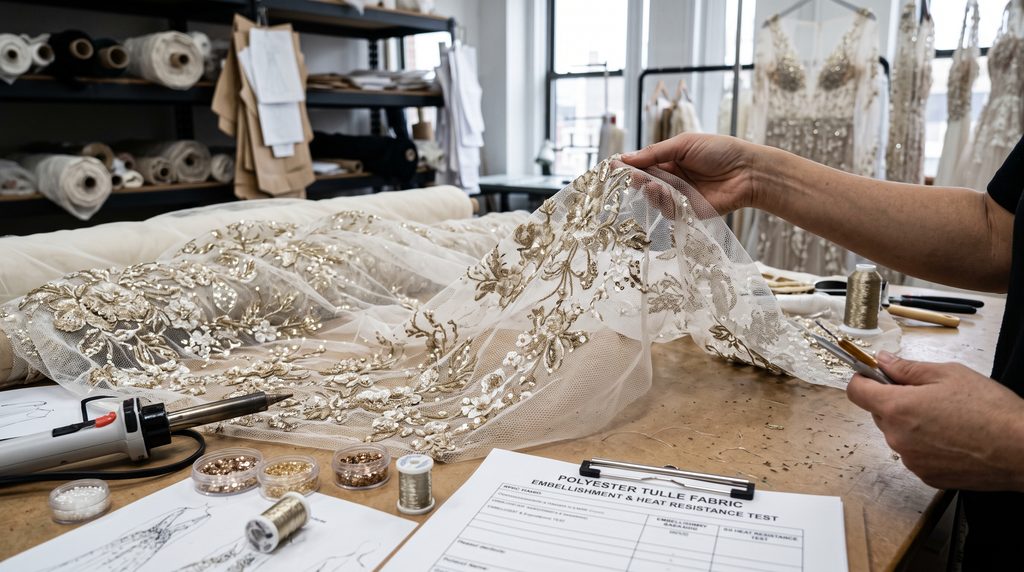
Apparel creators choose polyester tulle fabric for embellished gowns because its elevated melting point withstands the intense heat of foil stampers and glitter binders. Lower-grade synthetic meshes melt or shrivel when exposed to hot-melt adhesive rollers. Polyester withstands heat up to two hundred and thirty degrees Celsius without structural deterioration. Sourcing dependable base netting allows embroiderers to anchor heavy metallic threads, sequins, and pearls without tearing delicate mesh nodes.
Why Does Polyester Netting Support Heavy Sequins and Foil?
High tensile modulus enables thin netting threads to carry substantial downward decorative loads without tearing. Locked knit loops hold needle punctures firmly without splitting apart under needle impact.
Ready for the good part?
Heavy multi-head embroidery machines run at top speeds without ripping the base fabric.
- High needle puncture tolerance prevents runner runs along dense sequin bands.
- Thermal adhesives bond securely to polyester filament surfaces.
- Resilient mesh grids bear the weight of heavy seed beads across evening bodices.
Can High Heat Transfer Printing Damage Delicate Mesh?
Disperse dye sublimation transfers require dry heat around two hundred degrees Celsius to vaporize inks. Polyester absorbs these gaseous dyes readily without melting or losing its springy body.
What is the real story?
You produce vivid floral patterns directly across open mesh panels without ink bleeding.
The Key Takeaway for eveningwear designers: selecting heat-resistant polyester netting unlocks complex embellishment techniques like glitter bonding and sublimation without substrate failure.
| Decorative Technique | Working Temperature | Mesh Performance | Visual Outcome |
| Glitter Adhesive Cure | 160°C – 180°C | Resists heat shrinkage | Sparkle stays anchored |
| Dye Sublimation Print | 195°C – 205°C | Full vapor dye uptake | Razor-sharp custom art |
| Multi-Needle Embroidery | Mechanical friction | Zero needle run damage | Dense, opulent beading |
High thermal thresholds allow polyester netting to undergo aggressive decorative finishing without suffering structural degradation.
When Is Polyester Tulle Fabric Ideal for Event Decors?
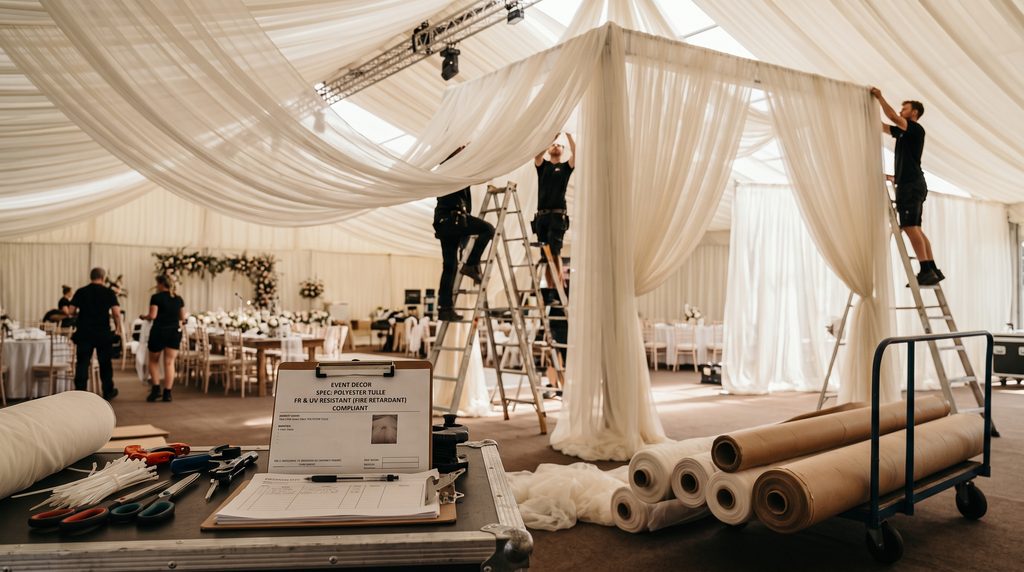
Polyester tulle fabric is ideal for event decors when commercial installations require flame-retardant compliance, ultraviolet light resistance, and vast yardage within defined budgets. Event production companies drape hundreds of meters across wedding canopies, banquet ceilings, and grand archways. Polyester fibers accept flame-retardant chemistry that satisfies strict municipal building codes. Its synthetic resistance to ultraviolet radiation prevents outdoor wedding draperies from turning brittle under afternoon sun exposure.
Why Do Event Planners Rely on Flame Retardant Nets?
Commercial hospitality spaces enforce stringent fire codes requiring textiles to extinguish immediately upon ignition. Polyester netting treated with flame-retardant chemistry prevents fire from climbing across room draperies.
Think about it:
A single stray banquet candle must never endanger an entire wedding venue.
- Self-extinguishing properties meet rigorous NFPA 701 commercial fire safety rules.
- Durable chemical bonding retains fire protection through multiple storage cycles.
- Non-toxic formulation ensures zero hazardous fumes when exposed to ambient heat lamps.
How Does UV Resistance Protect Outdoor Pavilion Drapes?
Sunlight degrades unprotected organic and nylon fibers, turning white bridal drapes into yellowed, brittle rags. Polyester polymer backbones withstand ultraviolet light energy without molecular chain breakage.
Here is why:
Aromatic rings inside the polymer absorb ultraviolet energy safely without yellowing.
The Key Takeaway for event production directors: durable polyester netting delivers code-compliant fire safety alongside weather resistance for large architectural installations.
| Environmental Stress | Treated Polyester Net | Untreated Natural Fiber | Venue Suitability |
| Open Flame Exposure | Self-extinguishing | Ignites and spreads fire | Meets NFPA 701 rules |
| Outdoor Solar UV Rays | High color stability | Yellows and weakens | Ideal for sunlit tents |
| High Ambient Humidity | Zero moisture sagging | Droops and stretches | Crisp ceiling swags |
Specialized finishes make polyester netting the industry benchmark for large-scale hospitality and ceremonial decor installations.
How Can You Inspect Bulk Polyester Tulle Fabric Rolls?
You can inspect bulk polyester tulle fabric rolls by combining illuminated backlit table inspections with standardized burst strength and dimensional wash shrinkage testing. Sheer textiles reveal structural defects immediately when unrolled across bright diffused glass surfaces. Quality assurance inspectors flag broken loops, oil spots, and aperture distortions before fabric bolts reach pattern tables. Sourcing certified polyester tulle fabric protects your production timeline from expensive delays caused by unspotted material flaws.
Which Lab Standards Verify Mesh Diaphragm Bursting?
Standard ASTM D3786 hydraulic diaphragm tests evaluate multi-directional bursting pressure across open-cell textiles. Hydraulic bladders expand against clamped fabric swatches until mechanical rupture occurs.
Look:
You verify that thin mesh withstands vigorous dance movement without seam failure.
- Electronic sensors measure exact failure pressure thresholds in kilopascals.
- Testing across roll centers and edges confirms knitting tension uniformity.
- Data logging isolates weak dye lots before fabric spreads across cutting tables.
How Do Backlit Tables Detect Broken Loops and Slubs?
Transmitted light illuminates every yarn boundary clearly, highlighting thick slubs or missed tuck stitches. High-contrast illumination allows human inspectors to tag imperfections with colored adhesive markers.
Here is the deal:
Marking roll flaws allows automated spreading machines to bypass defective yardage cleanly.
The Key Takeaway for apparel quality directors: enforcing rigorous backlit inspections and burst testing eliminates fabric-related bridal alterations.
| Quality Inspection Check | Test Standard | Commercial Acceptance Criteria | Apparel Protection Goal |
| Hydraulic Diaphragm Burst | ASTM D3786 | Minimum 140 kPa threshold | Prevents gown blowout |
| Wash Shrinkage Stability | AATCC 135 | Less than 1.5% change | Retains pattern sizing |
| Optical Pore Uniformity | Visual Scale | Zero visible ladder runs | Guarantees sheerness |
Standardized testing protocols shield couture ateliers from material discrepancies and preserve garment quality standards.
How Can You Source Quality Polyester Tulle Fabric Safely?
You can source quality polyester tulle fabric safely by partnering with vertically integrated textile mills that provide flexible order minimums, rapid lab dips, and transparent quality control documentation. Many traditional mills impose huge order requirements that tie up valuable capital for independent bridal designers. Modern fabric partners support emerging collections by offering low minimum order quantities per colorway. Reviewing physical color cards under calibrated lighting confirms tactile hand feel and shade accuracy before mass production begins.
How Do Flexible Dye Lot Tiers Safeguard Working Capital?
Agile knitting mills accommodate low initial orders starting around one hundred meters per shade. Sourcing short runs protects your operating capital while testing new bridal market trends.
Ready for the good part?
You adapt your bridal collection to customer demand without holding expensive surplus stock.
- Low order thresholds allow safe expansion into custom pastel colorways.
- Shorter production lead times accelerate your speed to fashion markets.
- Lean fabric inventory minimizes dead-stock write-downs at season end.
Why Is Physical Swatch Approval Vital Before Mass Dyeing?
Evaluating physical swatch cards under calibrated daylight lamps eliminates costly shade discrepancies. Touching the material in person confirms hand stiffness and porosity before roll shipments dispatch.
Look:
Digital phone photos distort subtle ivory and champagne tones, but physical fabric swatches never lie.
The Key Takeaway for fashion procurement executives: establishing structured lab dip approval stages guarantees consistent bridal hues across multiple production runs.
| Sourcing Phase | Typical Timeframe | Key Verification Deliverable |
| Swatch Book Review | 2 – 4 business days | Evaluate tactile hand and mesh stiffness |
| Lab Dip Color Match | 3 – 6 business days | Approve Pantone shades under D65 light |
| Bulk Production Run | 12 – 18 business days | Receive inspected rolls with QC test certificates |
Structured procurement milestones reduce supply risks and deliver predictable textile quality for your upcoming gown season.
Balancing crisp structural loft, reliable heat stability, breathable open-cell pores, and cost-effective yardage dictates the production success of your next eveningwear collection. This guide detailed the warp-knitting mechanics, polymer bending stiffness, embellishment heat tolerances, and inspection standards required to select ideal bridal netting. Our advanced production facility features high-speed German Karl Mayer warp knitting machines, flexible hundred-meter order minimums, and rapid color swatch dispatches to empower your label. To turn these textile advantages into stunning gowns that captivate your clients, contact us today to discuss your technical specifications and request free fabric swatches. We believe exceptional bridal elegance begins with flawless knit precision, and our team stands ready to deliver dependable fabric excellence for your brand.
FAQ Section
- Q1: Can I use polyester tulle fabric for bridal veils?
Yes, lightweight fifteen-denier polyester tulle creates budget-friendly veils with crisp, structured shapes. However, brides seeking liquid-soft fluidity against skin often prefer softer polyamide netting. - Q2: What’s the best polyester tulle fabric weight for dramatic ballgowns?
Fifty-denier crinoline netting weighing between forty and fifty-five grams per square meter represents the best choice. This dense grade provides maximum structural lift without requiring heavy metal underskirt hoops. - Q3: How do I know if my polyester tulle fabric sample has heat stability?
Perform a quick laboratory heat press test at one hundred and eighty degrees Celsius. Heat-stabilized netting retains its flat geometry and pore symmetry without puckering, melting, or curling along raw edges. - Q4: Can I print customized graphics onto polyester tulle fabric?
Yes, polyester accepts disperse dye sublimation printing exceptionally well. The high thermal resistance allows gaseous dye inks to bond permanently with polymer chains, producing crisp, fade-resistant visual designs. - Q5: What’s the best way to prevent needle damage when stitching tulle?
Equip your sewing machines with fresh, sharp 60/8 or 70/10 microtex needles. Slender needle shafts pierce open mesh nodes smoothly without tearing individual filaments or creating snagged runner runs.