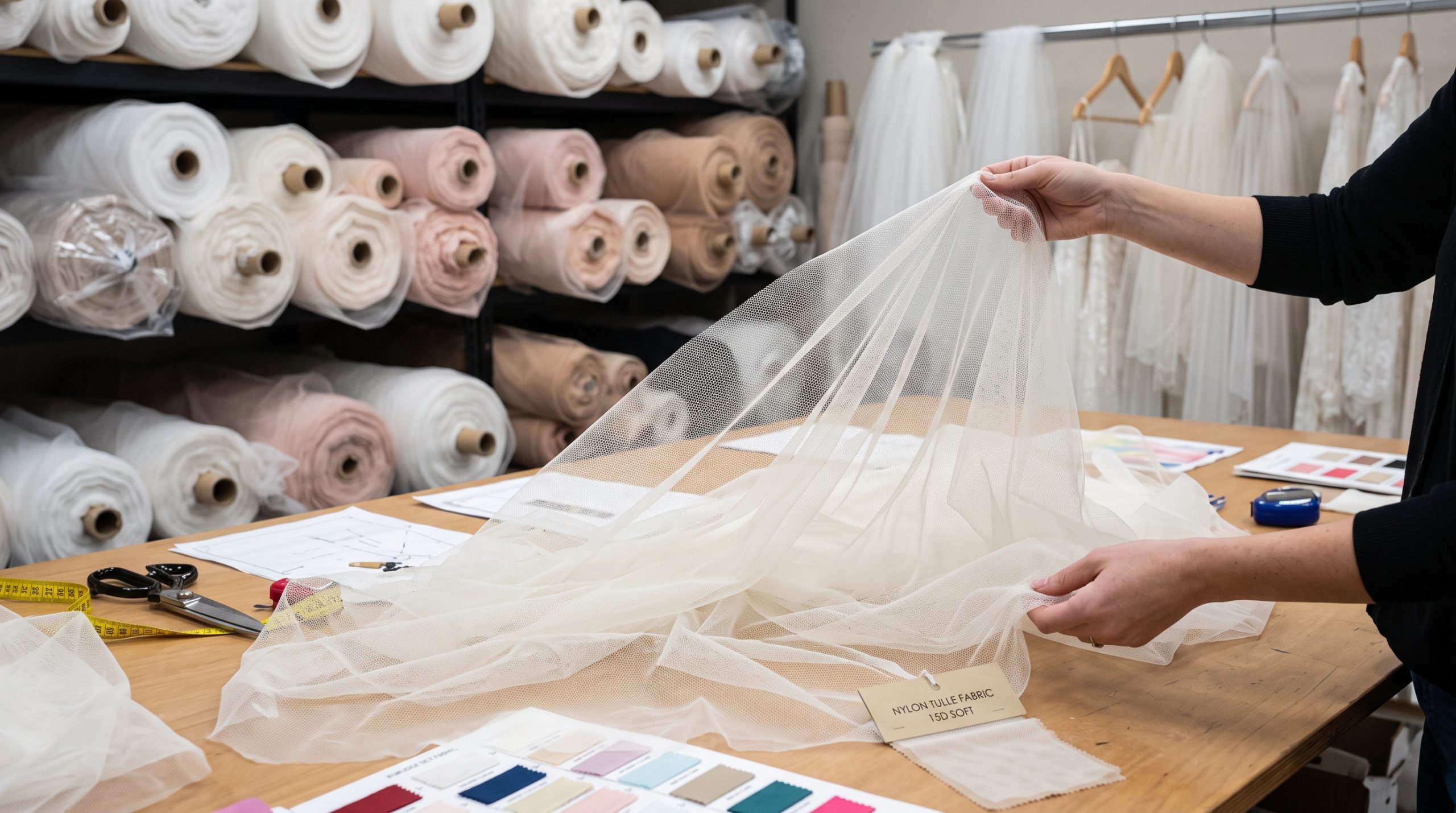
Nylon tulle fabric is a lightweight warp-knit textile characterized by a distinct hexagonal mesh structure that delivers sheer transparency and structural flexibility. Imagine sourcing yardage for a premier bridal gown collection, only to discover stiff netting that scratches skin and tears during final alterations. Fabric rigidity defects trigger customer dissatisfaction and tarnish your apparel label’s reputation. Choosing premium nylon tulle fabric resolves these tactile issues immediately by providing ultra-soft drape alongside durable tensile strength.
What Is Nylon Tulle Fabric and How Is It Made?
Nylon tulle fabric is an open-weave netting manufactured from polyamide continuous filaments on high-speed warp knitting machinery. Industrial guide bars knit parallel yarns into stable hexagonal honeycomb cells that maintain their shape under stress. This precision mechanical interlocking ensures that individual apertures remain uniform across thousands of production meters. High quality nylon tulle fabric delivers exceptional sheer elegance without compromising seam integrity.
How Do German Warp Knitting Machines Form Mesh?
Precision guide bars direct fine nylon filaments through needle beds to form interlocking pillar chains. Unlike circular knits that unravel when pulled, warp knitting locks every stitch securely.
Here is the deal:
Machine gauge settings dictate the exact diameter of every finished hexagonal cell.
- Parallel warp yarns knit across multiple needle channels simultaneously.
- Continuous tension controls prevent diagonal distortion across wide fabric panels.
- High needle counts produce microscopic mesh boundaries that feel smooth against skin.
Why Does Hexagonal Geometry Guarantee Stability?
Six-sided cell structures distribute applied stress evenly across six adjoining yarn nodes. When you pull the fabric bias, the hexagonal openings flex rather than split.
Look:
Even if a single filament snaps under sudden tension, the surrounding locked loops prevent laddering.
The Key Takeaway for garment manufacturing teams: specifying warp-knit hexagonal tulle eliminates edge unraveling risks during automated high-speed pattern cutting.
| Knitting Parameter | Hexagonal Warp Knit | Diamond Woven Net | Technical Benefit |
| Stitch Architecture | Interlocked Pillar Loops | Simple Crossed Yarns | High resistance against laddering |
| Edge Stability | Non-fraying raw borders | Fraying raw borders | Clean edges on cutting tables |
| Cell Uniformity | ± 0.05 mm tolerance | ± 0.25 mm tolerance | Consistent visual transparency |
Warp-knit engineering delivers predictable mechanical stability across high-volume apparel cutting operations.
Why Does Nylon Tulle Fabric Beat Polyester in Softness?
Nylon tulle fabric offers superior softness because polyamide polymers possess lower flexural rigidity and higher natural moisture regain than polyester fibers. Polyamide molecular chains slide smoothly against each other, eliminating the abrasive crispness common in cheaper synthetic nettings. When brides wear multi-tiered gowns next to bare skin, nylon prevents the red abrasion marks caused by stiff polyester edges. Apparel designers select nylon whenever luxury tactile comfort dictates collection value.
Does Nylon Deliver Superior Tactile Fluidity?
Lower fiber bending modulus allows thin nylon filaments to drape gracefully around bodily contours. Polyester filaments resist bending, creating angular folds rather than gentle cascades.
Think about it:
Luxury buyers judge garment quality through hand feel within seconds of touching a rack.
- Moisture regain around 4.5% prevents harsh static cling during low-humidity seasons.
- Individual 15D filaments yield a silky, featherlight contact surface.
- Supple mesh contours drape without creating awkward, boxy silhouette lines.
How Can You Eliminate Skin Irritation in Gowns?
Smooth yarn extrusion methods eliminate sharp microscopic edges along the mesh surface. Applying gentle wash softening during finishing treatments enhances skin compatibility even further.
Here is why:
Rounded filament profiles slide effortlessly over sensitive shoulder and neckline tissue.
The Key Takeaway for bridal brands: switching to polyamide tulle eliminates customer complaints regarding itchy skirts and scratchy neckline trims.
| Material Property | Polyamide (Nylon 6) | Polyethylene (Polyester) | Impact on Wearer |
| Moisture Regain | 4.0% – 4.5% | 0.4% – 0.8% | Nylon reduces static cling |
| Fiber Flexural Modulus | 3.5 – 4.5 GPa | 8.5 – 11.5 GPa | Nylon yields softer draping folds |
| Hand Feel Rating | Silky, skin-friendly | Crisp, slightly abrasive | Nylon suits direct skin contact |
Laboratory physical evaluations prove polyamide delivers vastly superior tactile smoothness over conventional polyester.
How Does Nylon Tulle Fabric Balance Airflow with Form?
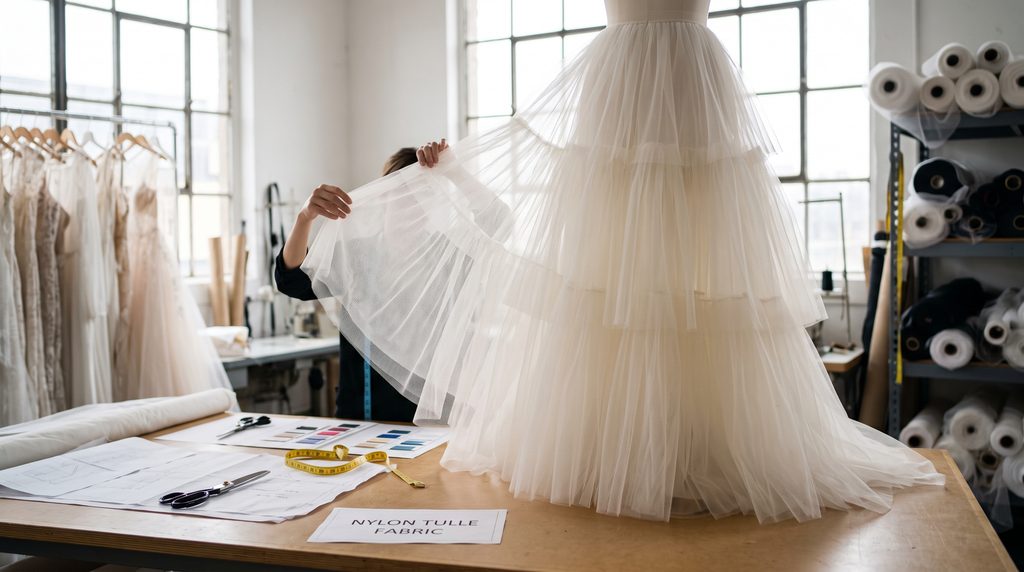
Nylon tulle fabric balances airflow with form by combining high pore volume ratios with micro-filament structural resilience. The open hexagonal voids permit ambient breezes to circulate freely around body heat zones. Meanwhile, the interlocked yarn network supports layered ballgown volume without trapping heavy pockets of warm air. Sourcing specialized nylon tulle fabric guarantees your multi-tiered designs stay voluminous while remaining remarkably cool.
How Do Mesh Pores Facilitate Natural Airflow?
Over eighty percent of the fabric surface area consists of empty space. Body heat dissipates straight through these hexagonal chimneys via natural convection currents.
Ready for the good part?
Dancers wear twenty layers of netting without experiencing thermal exhaustion during stage performances.
- Micro-pores allow perspiration vapor to vent instantly to the atmosphere.
- Lightweight structure avoids heat insulation even in crowded indoor event spaces.
- Open architecture prevents damp sweat patches from adhering to underlying silk linings.
Can Structured Volume Maintain Breathability?
Crimped yarn structures lift adjacent fabric layers apart to establish natural ventilation channels. These micro-air corridors prevent tiered skirts from compacting into suffocating solid masses.
This is what happens:
Your dramatic silhouettes retain sweeping grandeur while keeping the wearer physically comfortable.
The Key Takeaway for runway and eveningwear designers: multi-layered tulle creates dramatic sculptural volume while preserving breathability.
| Layer Count | Total Thickness | Air Permeability | Thermal Retention |
| 1 Layer (Veil) | 0.15 mm | Over 350 CFM | Negligible heat trapping |
| 6 Layers (Overskirt) | 1.80 mm | 180 – 220 CFM | Free convective ventilation |
| 12 Layers (Tutu) | 4.20 mm | 90 – 130 CFM | Maintains moderate airflow |
Structural testing confirms open pore architecture maintains airflow even across high-density skirt constructions.
Which Nylon Tulle Fabric Finish Fits Your Silhouette?
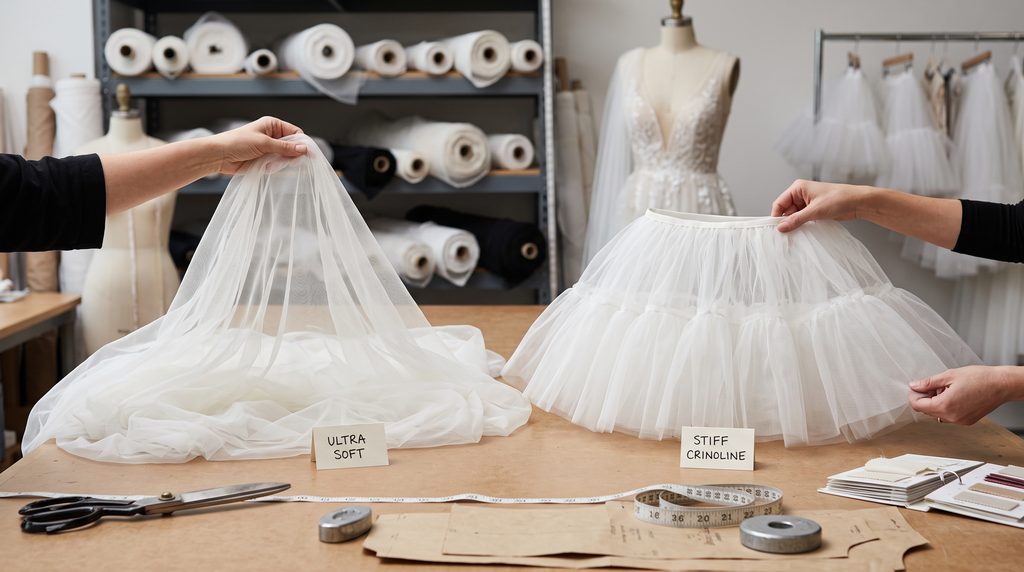
Selecting the right finish depends on whether your design requires liquid drape or structural architectural support. Textile mills apply heat-setting and specialized resin coatings to adjust yarn stiffness from ultra-soft to firm crinoline netting. Bridal veils demand featherlight fluidity that trails smoothly down aisle runners. Conversely, classical ballet costumes require rigid finishes that stand horizontally under dynamic spinning forces.
When Should You Specify Ultra Soft Tulle?
Ultra-soft finishes undergo minimal chemical stiffening and focus on thermal relaxation. The resulting goods provide an ethereal appearance suited for illusion sleeves and bridal drapery.
Look:
You avoid stiff triangular creases when brides sweep their trains across the floor.
- Flowing drape falls naturally along vertical body contours.
- Gentle hand feel protects sensitive skin across shoulder straps and back panels.
- Low mechanical friction prevents audible rustling sounds during formal walking.
Why Is Stiff Finish Essential for Tutu Volume?
Thermosetting resins coat cross-over knit nodes to lock yarn angles firmly into place. This structural rigidity prevents heavy dress hemlines from sagging downward over time.
Here is why:
A few foundation tiers of stiff netting lift heavy silk overlays with minimal overall garment weight.
The Key Takeaway for atelier production managers: align fabric resin finishes directly with garment silhouette goals to eliminate unnecessary structural boning.
| Finish Classification | Chemical Treatment | Hand Feel Characteristic | Ideal Garment Application |
| Ultra Soft Finish | Heat relaxed, minimal resin | Fluid, silk-like drape | Cathedral veils, illusion yokes |
| Medium Semi-Stiff | Light acrylic stabilization | Gentle body, soft volume | A-line skirts, sleeve caps |
| Stiff Crinoline Finish | Melamine resin cured | Rigid, crisp architecture | Petticoats, classical tutus |
Finishing resin concentrations determine whether the textile behaves as a fluid drape or a load-bearing foundation.
How Does Nylon Tulle Fabric Perform Under Tension?
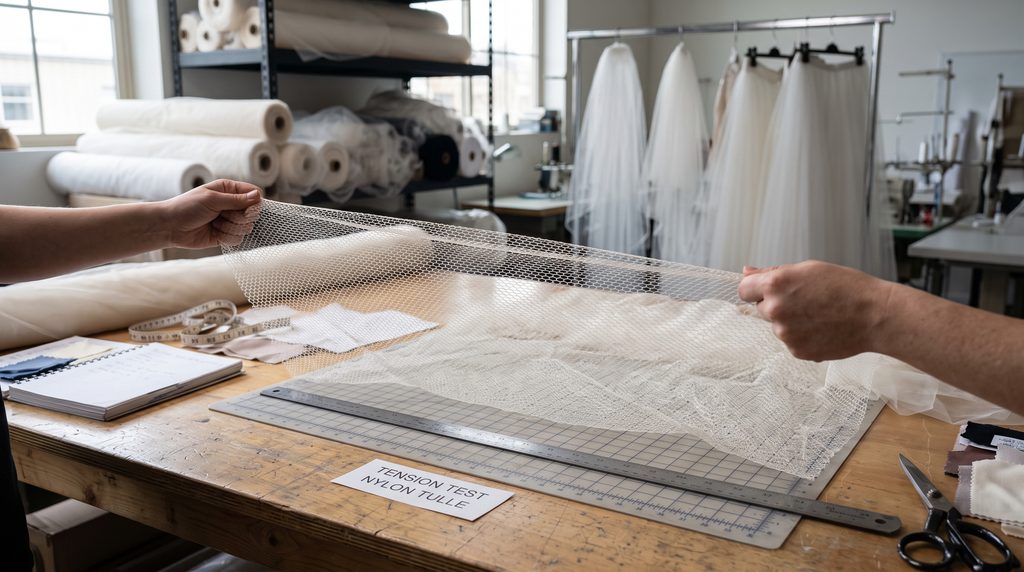
Nylon tulle fabric performs exceptionally well under multi-directional tension due to polyamide’s high tensile strength and superior elongation recovery. Synthetic polyamide filaments elongate up to thirty percent under stress before reaching their yield point. When mechanical pulling forces release, the interlocking loops spring back to their original geometric positions without sagging. Durable nylon tulle fabric withstands rough fitting room handling and vigorous dance choreography without bursting.
How Does Elastic Recovery Prevent Bagging?
Polyamide molecular chains feature strong hydrogen bonds that act like microscopic springs. Applying sudden strain aligns these molecules temporarily without breaking polymer backbones.
Here is the deal:
Garment elbow zones and knee panels rebound smoothly without leaving stretched baggy spots.
- High elastic recovery exceeds ninety percent under moderate everyday strains.
- Interlocking loop architecture absorbs pulling stresses across neighboring courses.
- Resilient knit nodes prevent permanent mechanical distortion around fitted seams.
What Prevents Tears Along Interlocking Courses?
Warp-knit pillar chains hold adjacent horizontal inlay yarns tightly within double-loop nodes. If a sharp fingernail snags an aperture, the force distributes across surrounding threads.
Think about it:
Woven veils split down the center seam, but warp-knit tulle stops tears right at the snag point.
The Key Takeaway for apparel quality managers: choosing high-tenacity nylon prevents costly seam ruptures during demanding garment fitting sessions.
| Performance Metric | Polyamide Netting | Conventional Woven Net | Garment Reliability Impact |
| Tensile Recovery (5% strain) | 92% – 95% | 60% – 68% | Eliminates bagging at stress points |
| Elongation at Break | 25% – 35% | 12% – 18% | Accommodates vigorous body movement |
| Seam Burst Resistance | 180 kPa | 95 kPa | Prevents blowout during alterations |
Tensile metrics prove that polyamide knit loops recover from mechanical strain far better than simple crossed yarns.
Why Is Nylon Tulle Fabric Ideal for Illusion Necklines?
Nylon tulle fabric is ideal for illusion necklines because ultra-fine filaments reflect light minimally, creating the visual effect of bare skin. When dyed to match diverse skin complexions, the sheer netting disappears visually under auditorium stage lights and camera flashes. Its high tensile strength provides a reliable foundation for heavy decorative glass beads and intricate lace appliques. Designers rely on this textile to create gravity-defying necklines that appear completely unsupported.
What Makes Skin Tone Illusion Netting Invisible?
Micro-denier monofilaments scatter incident light evenly rather than reflecting glaring white beams. Matching the exact shade tone to the wearer creates seamless blending with natural skin undertones.
What is the real story?
Spectators see floating pearls and cascading lace while the supporting mesh fades into transparency.
- Sheer aperture density allows natural skin pigmentation to show through.
- Matte filament luster prevents unnatural reflective glare under studio flash photography.
- Ultra-thin profile sits flush against the skin without creating raised collar ridges.
How Does Sheer Mesh Support Heavy Beadwork?
High filament tenacity allows thin netting panels to carry substantial downward decorative weight. Sewing operators anchor heavy embroidery motifs directly through the locked knit nodes.
Look:
You avoid drooping necklines when hand-sewing glass seed beads and metallic thread accents.
The Key Takeaway for bridal couturiers: skin-tone nylon mesh provides invisible architectural support capable of carrying dense crystal embellishments.
| Illusion Mesh Grade | Thickness | Visual Sheerness | Weight Capacity (Beads) |
| 12D Invisible Nude | 0.08 mm | 95% Bare Skin Look | Light lace motifs, scattered pearls |
| 15D Standard Illusion | 0.12 mm | 90% Translucent Look | Medium density beading, corded lace |
| 20D Reinforced Sheer | 0.16 mm | 82% Semi-Sheer Look | Heavy crystal chains, dense applique |
Optical transparency ratings confirm that finer denier counts provide invisible foundations for heavy couture embellishments.
How Does Dye Affinity Differ in Nylon Tulle Fabric?
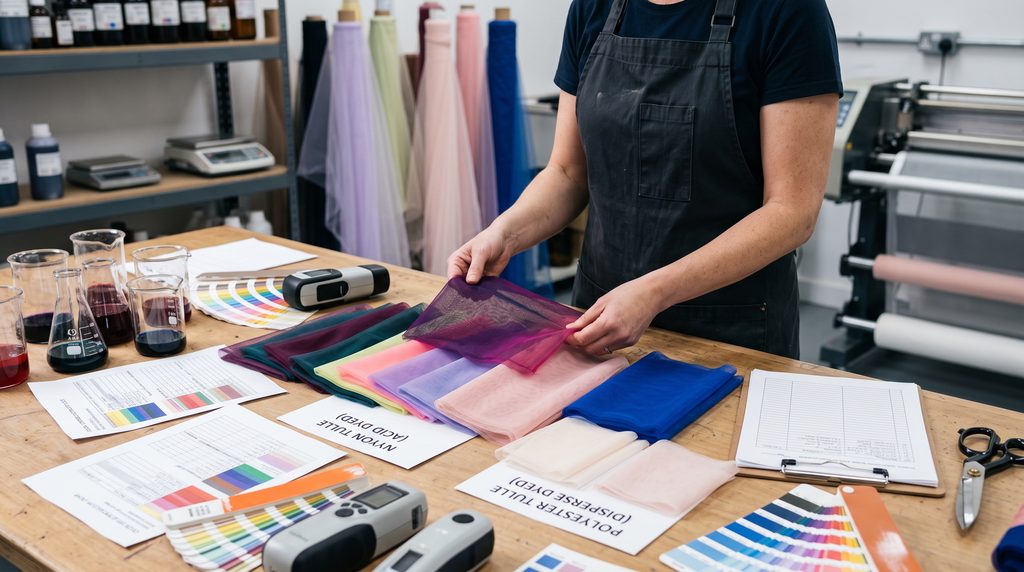
Dye affinity differs in nylon tulle fabric because polyamide contains abundant terminal amine groups that bond rapidly with acid and metal-complex dyes. These chemical dye sites allow colorants to penetrate the interior polymer matrix rather than remaining on the surface. Polyester requires high-temperature pressure dyeing with disperse dyes, often resulting in paler shades. Nylon absorbs rich, luminous colors across vibrant pastel ranges, yielding exceptional batch-to-batch uniformity.
Why Do Acid Dyes Produce Vibrant Nylon Shades?
Acid dyestuffs form ionic bonds with protonated amino groups inside the polyamide filament. This molecular bonding produces deep shades with exceptional luminous clarity.
Here is the deal:
Your delicate blush tones and deep navy shades exhibit radiant vibrancy under retail display lights.
- Ionic dye absorption occurs at atmospheric boil temperatures without high pressure.
- Polyamide accepts a wide spectrum of specialized fashion color formulations.
- Deep color saturation prevents pale, washed-out tones on thin monofilament netting.
How Do You Validate Commercial Wash Fastness?
Standardized laboratory wash testing evaluates how well dyed filaments retain color against detergents and dry cleaning solvents. Multi-fiber test swatches confirm that dye molecules remain locked within the nylon fiber.
Ready for the good part?
Properly fixed acid dyes will not migrate onto contrasting white satin linings during spot cleaning.
The Key Takeaway for textile procurement directors: specifying acid-dyed nylon guarantees color consistency across multi-component bridal ensembles.
| Dye Class | Substrate Pairing | Dyeing Temperature | Color Vibrancy Level |
| Acid Dyes | Polyamide (Nylon) | 98°C – 100°C Atmospheric | Exceptional luminous depth |
| Disperse Dyes | Polyester (PET) | 130°C High Pressure | Moderate, slightly muted |
| Cationic Dyes | Acrylic / Modacrylic | 100°C Atmospheric | High, limited lightfastness |
Dye bonding chemistry confirms polyamide achieves superior shade luminosity under standard atmospheric processing.
When Should You Choose Fine Gauge Nylon Tulle Fabric?
You should choose fine gauge nylon tulle fabric when producing couture veil edges, delicate lingerie, and high-end evening wear that touches bare skin. Fine gauge machinery utilizes thirty-two to forty needles per inch to knit micro-denier yarns down to fifteen denier. Coarser gauges running forty denier threads suit crinoline underskirts where mechanical support supersedes tactile softness. Choosing the right filament denier ensures that your garment balances visual delicacy with production handling strength.
When Is 15D Micro Mesh Best for Couture Veils?
Fifteen-denier yarns produce micro-hexagonal grids that float weightlessly in ambient drafts. Brides wearing cathedral veils glide down the aisle without feeling neck strain from fabric drag.
Think about it:
Heavy netting pulls bridal headpieces out of position right before wedding ceremony photos.
- Ultra-fine 15D filaments eliminate fabric weight across sweeping four-meter veils.
- Tiny apertures create a subtle softening blur across facial features.
- Supple hand feel prevents wrinkles when veils fold inside boutique storage boxes.
How Does 40D Netting Reinforce Ballgowns?
Forty-denier yarns provide the cross-sectional mass needed to resist downward garment gravity. Placing several layers beneath outer skirts lifts heavyweight mikado silk effortlessly.
Here is why:
Thicker yarn dimensions create durable cantilever support that withstands hours of formal banquet wear.
The Key Takeaway for pattern makers: deploy 15D tulle for visible surface layers and reserve 40D netting for concealed structural foundations.
| Filament Denier | Fabric Weight (GSM) | Drape Rigidity (Bending) | Target Garment Component |
| 15D Monofilament | 12 – 16 GSM | Extremely Low (Fluid) | Luxury veils, illusion yokes |
| 20D Multifilament | 18 – 24 GSM | Low (Gentle Body) | Soft layered bridesmaid skirts |
| 40D Structural Yarn | 35 – 45 GSM | High (Rigid Support) | Crinoline petticoats, underskirts |
Denier selection dictates whether the resulting textile serves as a floating aesthetic veil or a structural crinoline base.
How Can You Inspect Bulk Nylon Tulle Fabric Rolls?
You can inspect bulk nylon tulle fabric rolls by combining continuous roll backlit inspection with standardized diaphragm burst strength and shrinkage laboratory tests. Open mesh goods reveal weaving imperfections readily when unrolled over illuminated glass tables. Automated tension rollers prevent excessive stretching while human inspectors mark dropped stitches and hole diameter variations. Performing structured quality checks before dispatching yardage to cutting lines prevents costly factory floor interruptions.
Which Standard Lab Tests Check Burst Strength?
ASTM D3786 hydraulic diaphragm burst testing measures the multi-directional pressure required to rupture knit mesh apertures. Testing swatches across roll headers, centers, and footers guarantees lot-to-lot consistency.
Look:
You identify weak dye lots before fabric layers reach automated multi-ply cutting tables.
- Diaphragm pressure testing establishes true mechanical burst thresholds in kilopascals.
- Dimensional stability checks measure shrinkage after steam pressing and dry cleaning.
- Optical microscopes verify aperture geometry consistency across roll widths.
How Do You Spot Dropped Stitches Across Rolls?
Backlit inspection frames illuminate broken loops and irregular pore sizes clearly. The contrast between bright transmitted light and fine filaments reveals yarn slubs immediately.
Here is the deal:
Marking fabric roll flaws with removable color tags allows cutting technicians to bypass defects easily.
The Key Takeaway for quality assurance directors: implementing standard backlit roll inspections prevents flawed yardage from reaching final garment assembly.
| Inspection Check | Test Standard | Commercial Tolerance | Quality Assurance Purpose |
| Diaphragm Burst | ASTM D3786 | Minimum 150 kPa | Prevents blowout during gown alterations |
| Pore Uniformity | Optical 50x Scale | ± 5% Aperture Area | Maintains uniform visual sheerness |
| Thermal Shrinkage | AATCC 135 (Steam) | Less than 2.0% | Prevents skirt distortion during pressing |
Standardized testing protocols guarantee fabric rolls meet the rigorous aesthetic requirements of premier fashion labels.
How Can You Source Quality Nylon Tulle Fabric Safely?
You can source quality nylon tulle fabric safely by partnering with established warp-knit manufacturers that provide low minimum order quantities, swift lab dip services, and transparent quality control data. Sourcing directly from modern mills equipped with German Karl Mayer machinery ensures tight stitch consistency across seasonal reorders. Flexible order minimums allow your atelier to test niche color palettes without committing substantial working capital. Securing verified physical swatches protects your margins before starting production.
How Do Low MOQ Tiers Protect Working Capital?
Agile manufacturing mills offer small trial runs starting around one hundred meters per shade. Sourcing smaller initial volumes prevents warehouse shelves from filling with slow-moving inventory.
Ready for the good part?
You test emerging seasonal color trends across actual bridal clients before committing to container loads.
- Flexible dye lots allow swift expansion into custom bridal palette variations.
- Low capital commitments free up financial resources for marketing and runway shows.
- Rapid reorder cycles keep warehouse inventory lean and responsive to market shifts.
Why Is Swatch Approval Vital Before Dye Lots?
Reviewing physical swatch color cards under calibrated D65 retail daylight lamps eliminates costly shade discrepancies. Evaluating tactile hand feel in person confirms softness before mill dyeing begins.
Look:
Digital screen mockups distort delicate blush and champagne hues, but physical swatch approvals never lie.
The Key Takeaway for global sourcing directors: establishing rigorous lab dip approval protocols guarantees exact Pantone color matching across production batches.
| Sourcing Stage | Working Lead Time | Critical Verification Milestone |
| Color Card & Swatches | 2 – 4 business days | Evaluate tactile hand feel and transparency |
| Custom Lab Dip Matching | 3 – 5 business days | Confirm exact shade match under D65 lighting |
| Bulk Production Run | 12 – 20 business days | Dispatch verified rolls with full QC test logs |
Structured sourcing phases eliminate quality surprises and deliver consistent yardage for ongoing fashion collections.
Navigating the engineering choices between ultra-soft draping veils and rigid structural crinoline netting determines the ultimate market success of your eveningwear line. This guide clarified the warp-knitting mechanics, polymer softness advantages, tension durability, and inspection standards needed to source the perfect sheer textile. Our specialized manufacturing facility stands equipped with precision Karl Mayer warp knitting machines, flexible hundred-meter dye lot minimums, and rapid swatch dispatches to elevate your designs. To secure certified quality yardage tailored to your exact hand feel and opacity specifications, contact us today to discuss your technical requirements and receive complimentary swatch cards. We believe exceptional couture begins with flawless knit consistency, and our team remains dedicated to supplying reliable fabric excellence for your brand.
FAQ Section
- Q1: Can I use soft nylon tulle fabric for structured petticoats? No, soft nylon tulle lacks the mechanical rigidity required to support heavy bridal hemlines. You should select resin-finished 40D stiff netting to provide adequate load-bearing volume.
- Q2: What’s the best nylon tulle fabric specification for wedding veils? Fine 15D or 20D illusion nylon tulle fabric is the ideal choice. These ultra-fine filaments deliver a weightless, floating drape that rests gently without obscuring delicate dress details.
- Q3: How do I know if my nylon tulle fabric sample is genuine nylon or polyester? Perform a quick fabric burn test and check hand softness. Nylon melts into a hard, amber bead with a celery-like aroma, while polyester generates black smoke with sweet chemical odors.
- Q4: Can I order custom dyed shades in small production batches? Yes, modern flexible dye houses accommodate custom lab dips for small production orders. Starting volumes around one hundred meters per color allow fashion brands to test new palettes safely.
- Q5: What’s the best way to prevent needle damage when sewing delicate tulle? Use a brand-new 60/8 or 70/10 microtex needle paired with fine synthetic thread. Sharp, slender needle points glide between open mesh voids without snagging or severing filaments.