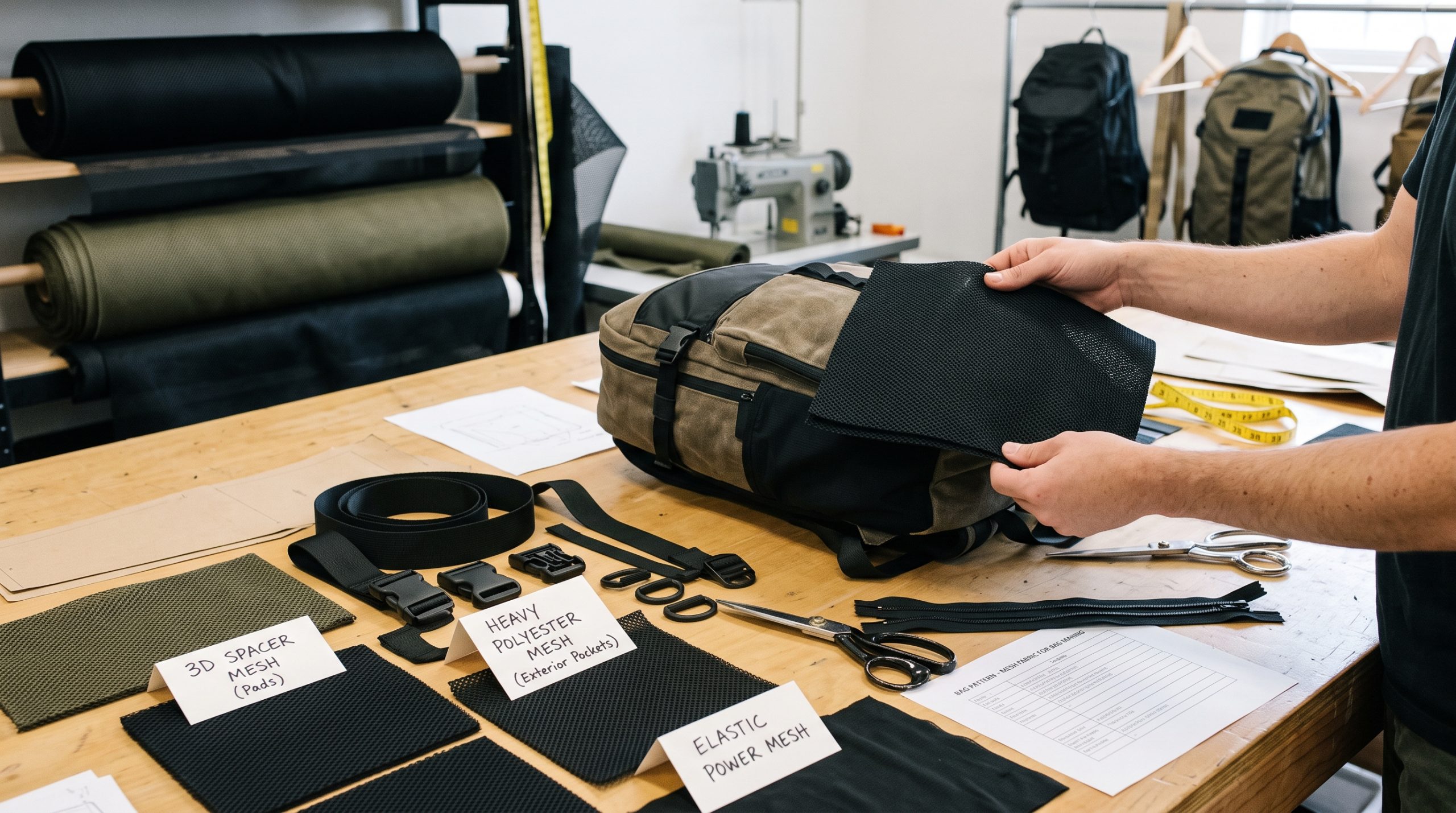
Mesh fabric for bag making is a porous textile engineered from synthetic filaments to supply ventilation, structural lightness, and visible organization for commercial carry gear. Imagine delivering thousands of outdoor duffel bags, only to find damp sports equipment molding inside dense lining panels within forty-eight hours. Poor airflow ruins customer equipment, triggering warranty disputes and return claims. Procuring durable mesh fabric for bag making fixes these packaging failures directly by circulating ambient air through tough, snag-resistant yarn apertures.
What Is Mesh Fabric for Bag Making and How Is It Knitted?
Mesh fabric for bag making is an open-grid textile produced on high-speed warp looms that interlock synthetic threads into puncture-resistant geometric openings. Specialized guide bars knit continuous yarn loops across adjoining wales, producing open voids without weakening crosswise seam stability. This mechanical architecture prevents laddering whenever a sharp tool punctures an individual filament node. Choosing high-tenacity mesh fabric for bag making provides structural integrity while giving users quick visual confirmation of packed gear.
How Do Warp Knits Prevent Seam Laddering?
Modern warp knitting equipment moves parallel yarn beams simultaneously through compound needles. Each synthetic filament binds tightly into multiple stitch columns, stopping runs from traveling down cut fabric panels.
Here is the deal:
Locked loop geometry keeps raw edges neat during automated die cutting passes.
- Dual bar guide systems bind each mesh node against vibration stress.
- Controlled machine tension preserves equal hole diameter along wide fabric rolls.
- Interlocking loop anchors eliminate fraying when sewing heavy zipper tapes.
Why Does High Filament Tenacity Guard Edge Seams?
Polymer extrusion produces smooth synthetic filaments boasting exceptional tensile ratings. These tough yarns absorb needle friction during high-speed sewing, preventing perimeter thread fractures along structural seams.
Look:
You can join open netting directly against thick cordura shells without fabric puckering.
The Key Takeaway for gear designers: selecting warp-knit netting prevents edge raveling, cutting assembly time during automated pack sewing.
| Knitting Attribute | Warp-Knit Bag Netting | Plain Woven Screen | Manufacturing Value |
| Stitch Architecture | Interlocked Pillar Loops | Simple Warp-Weft Cross | Zero run propagation when snagged |
| Seam Holding Power | High Needle Retention | Low Thread Friction | Prevents seam slippage under loads |
| Edge Stability | Clean Laser or Blade Cut | High Fraying Tendency | Accelerates high-speed factory sewing |
Interlocking stitch loops deliver seam stability that protects rugged packs against high packing strain.
Why Does Mesh Fabric for Bag Making Improve Air Circulation?
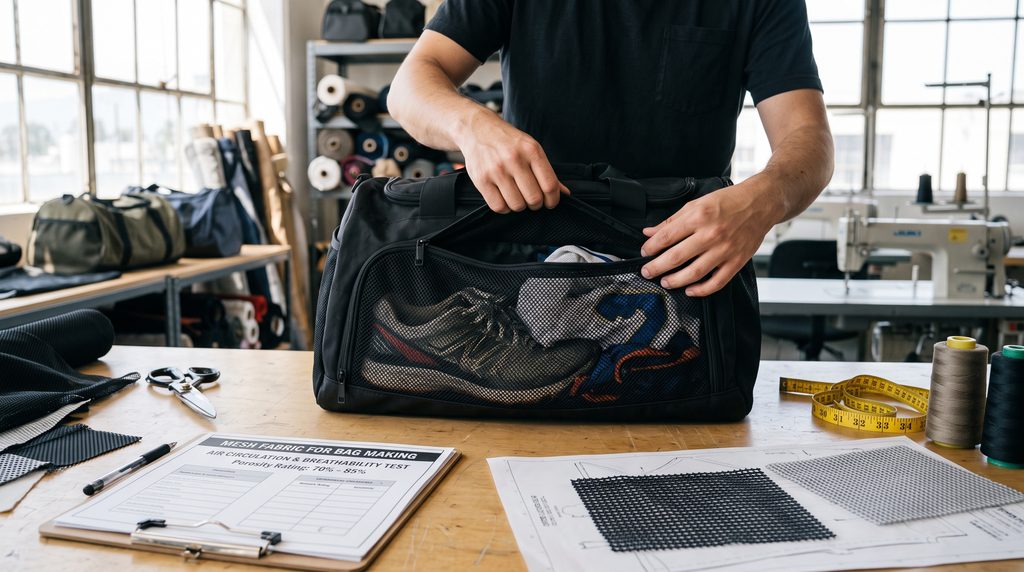
Mesh fabric for bag making improves air circulation because its open-pore architecture delivers porosity levels between seventy and eighty-five percent. Ambient air currents pass freely across warm clothing compartments, expelling sweat vapor before mold spores develop. Odors disperse quickly instead of becoming trapped inside sealed nylon linings. Heavy-duty mesh fabric for bag making guarantees sports gear dries rapidly after intense training sessions.
Does Open Porosity Expel Heat Around Wet Gear?
Trapped humidity inside dense bags creates foul microbial growth on leather and rubber surfaces. Wide mesh apertures allow natural thermal convection to channel humid air outward into room spaces.
Think about it:
Wet football jerseys dry twice as fast when packed inside ventilated pockets.
- Microscopic air passages eliminate damp stagnation spots around soiled footwear.
- Porous side walls let trapped liquid drain from rinsed dive gear.
- Constant airflow stops odor molecules from settling inside adjacent dry compartments.
How Do Micro Vents Accelerate Moisture Evaporation?
Open mesh walls expose wet items to surrounding breezes from every angle. Water evaporation accelerates across broad gear surfaces, saving athletes from unpacking damp clothes at home.
This is what happens:
Your commercial bags stay fresh even after containing soaked gear throughout weekend tournaments.
The Key Takeaway for sports pack brands: integrating high-porosity netting prevents bacterial odors and protects expensive athletic equipment from mildew damage.
| Ventilation Metric | Open Warp Mesh Wall | Solid Nylon Wall | Performance Impact |
| Air Permeability | Over 450 cm³/cm²/s | Under 12 cm³/cm²/s | Continuous passive air exchange |
| Moisture Evaporation | 90 Minutes to Dry | Over 12 Hours to Dry | Prevents mold on damp gear |
| Odor Retention Index | Low Static Odor | High Trapped Vapor | Maintains fresh interior pack scent |
Wide mesh apertures establish cross-directional ventilation that eliminates trapped moisture inside athletic gear compartments.
How Does Mesh Fabric for Bag Making Compare to Solid Canvas?
Mesh fabric for bag making compares favorably to solid canvas by shedding up to sixty percent of shell weight while maintaining surprising puncture resistance. Heavy cotton canvas absorbs water weight during rain showers, whereas synthetic netting repels liquid absorption entirely. Users spot packed items through see-through pockets without unzipping compartments. Sourcing lightweight mesh fabric for bag making trims total pack tare weight for hikers navigating remote trails.
Which Textile Cuts Total Pack Tare Weight?
Thick canvas shells add unnecessary dead weight to multi-day trekking backpacks. High-tenacity synthetic netting delivers strong enclosure boundaries at a fraction of standard canvas thickness.
Here is the deal:
You cut total backpack weight without sacrificing compartment load capacity.
- Lightweight mesh reduces long-distance carrying strain on outdoor hikers.
- Hydrophobic synthetic yarns prevent water weight gain during sudden storms.
- Compact netting folds flat inside storage cartons, saving shipping space.
Can Open Netting Match Heavy Shell Abrasion?
Industrial synthetic filaments resist surface scuffing from abrasive rock faces and gravel pathways. Dense yarn groupings disperse sharp friction points across multiple interlocking nodes, preventing localized wear holes.
Look:
Synthetic netting withstands rough airline luggage conveyors without developing unsightly abrasion tears.
The Key Takeaway for travel gear developers: substituting netting for canvas pockets cuts pack tare weight while maintaining dependable resistance against exterior surface friction.
| Material Property | Synthetic Warp Mesh | Heavy Cotton Canvas | Design Consequence |
| Area Density | 120 – 220 GSM | 400 – 550 GSM | 60% tare weight reduction |
| Wet Weight Increase | Under 1.5% | Over 45% (Saturated) | Zero moisture absorption on trail |
| Content Visibility | High Visual Clues | Zero Visibility | Fast equipment identification |
Tough synthetic netting provides significant weight reductions without compromising boundary strength during intense outdoor hauling.
Which Mesh Fabric for Bag Making Grade Fits Your Pack Design?
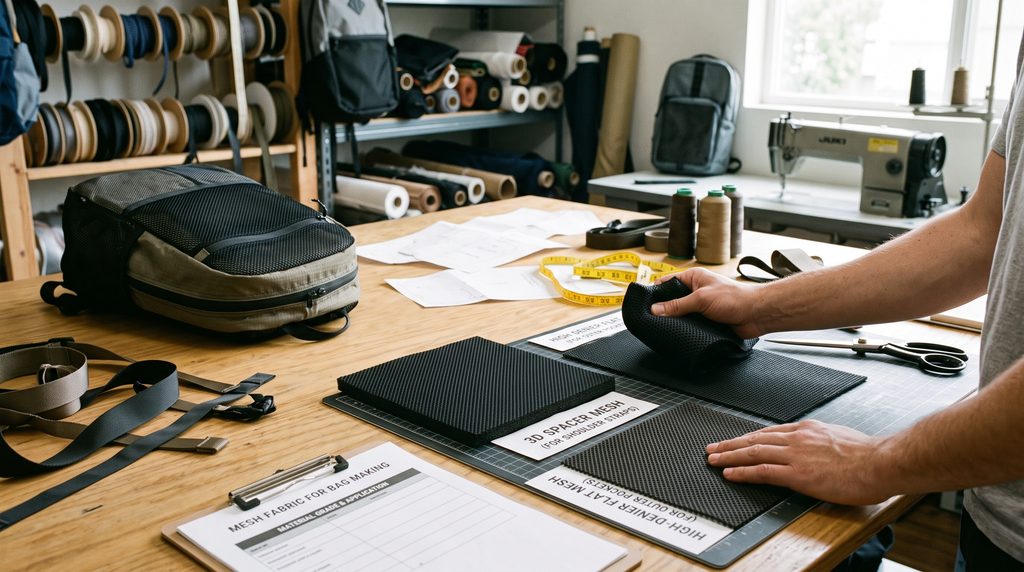
Selecting the right grade depends on whether you are padding shoulder straps or building rugged exterior water bottle sleeves. Three-dimensional spacer knits provide thick cushioning that distributes heavy loads across human shoulders. Flat high-denier polyester knits supply rugged abrasion resistance for external trail pockets. Specifying custom mesh fabric for bag making allows factory developers to align textile strength with distinct pack stress zones.
When Should You Select Heavy 3D Spacer Knit?
Three-dimensional spacer knits incorporate monofilament pile yarns between two separate mesh faces. This micro-spring cushion prevents heavy pack straps from biting into collarbones during extended mountain ascents.
Think about it:
Thick foam padding retains sweat, but breathable spacer cushions keep shoulders dry.
- Micro-filament pile layers collapse under shock and bounce back immediately.
- Open face channels vent body heat away from sweaty shoulder zones.
- Resilient spacer architecture replaces dense closed-cell EVA foam layers.
Why Pick High Denier Polyester for Outer Pockets?
External backpack sleeves encounter direct contact with thorny branches and rough granite ledges. Coarse four-hundred denier polyester yarns deliver the puncture toughness needed to protect delicate base shells.
Ready for the good part?
You gain tough equipment pouches that flex around bulky water bottles.
The Key Takeaway for pack architects: mapping spacer knits to body contact points and high-denier flat mesh to exterior pouches optimizes ergonomics and durability.
| Mesh Variant | Yarn Denier | Common Thickness | Recommended Pack Zone |
| 3D Air Spacer | 30D Face / 100D Monofil | 3.0 mm – 8.0 mm | Back panels, contoured shoulder straps |
| Coarse Polyester Flat | 300D – 600D | 0.8 mm – 1.2 mm | Cargo pouches, external bottle sleeves |
| Fine Pocket Tricot | 50D – 75D | 0.3 mm – 0.5 mm | Internal passport slots, zippered dividers |
Matching specific mesh constructions to structural pack zones ensures balanced ergonomics and long service life.
How Does Mesh Fabric for Bag Making Endure Severe Punctures?
Mesh fabric for bag making endures severe punctures through locked warp stitches that distribute localized point stress across adjacent yarn loops. When a sharp tent stake strikes an open void, the surrounding loops slide slightly before binding tight. This mechanical movement prevents the initial puncture from ripping open into an irreparable seam blowout. Tough mesh fabric for bag making protects tactical gear bags from catastrophic failure during rough field operations.
Why Do Interlocked Nodes Halt Tear Expansion?
Standard fabrics rip continuously once a puncture breaks cross yarns under tension. Warp knitting incorporates pillar loops that act like miniature mechanical knots along every fabric inch.
What is the real story?
An accidental puncture hole remains isolated within its original cell boundary.
- Double-tricot knit stitches trap applied shear loads within a single opening.
- Flexible yarn loops redistribute impact force away from the sharp point.
- High filament tenacity prevents fibers from snapping during sudden puncture strikes.
Can Coated Synthetic Filaments Resist Rough Branches?
Thick resin coatings bond individual synthetic filaments into solid monofilament bundles. Sharp brush branches glance harmlessly off the slick yarn surfaces without catching loose micro-filaments.
Here is why:
Coated synthetic yarns do not fray when dragged through abrasive wilderness terrain.
The Key Takeaway for tactical bag makers: locked warp-knit nodes isolate mechanical tears, keeping field packs functional after sharp punctures.
| Puncture Metric | Industrial Warp Mesh | Standard Woven Screen | Field Reliability |
| Tear Propagation Force | Over 1400 cN | 520 cN | Punctures do not travel into rips |
| Burst Threshold | Over 220 kPa | 110 kPa | Resists blowout from shifting tools |
| Yarn Separation | Zero Loop Slippage | High Thread Shifting | Maintains aperture uniformity |
Standardized burst and tear evaluations confirm warp-knit mesh resists damage propagation far better than plain woven screens.
When Is Coated Mesh Fabric for Bag Making Selected for Totes?
Coated mesh fabric for bag making is selected for totes when carrying sandy beach towels, muddy dive regulators, and greasy boat tools. Applying liquid vinyl coatings over knitted polyester creates a waterproof, non-absorbent shell that repels salt spray and sunscreen oils. Sand grains shake straight through open mesh apertures instead of collecting inside bottom corner seams. Industrial-strength mesh fabric for bag making allows users to wash dirty boat gear inside the bag using a high-pressure garden hose.
How Does Vinyl Coating Stop Sand Entrapment?
Uncoated textiles trap tiny silica grains between individual yarn fibers, causing internal fabric grinding. Vinyl coatings seal filament bundles completely, creating slick surfaces that shed sticky seaside sand instantly.
Look:
You shake the empty tote twice and every single sand grain drops right out.
- Sealed yarn bundles prevent seawater salts from degrading internal fibers.
- Smooth polymer surfaces stop wet sand particles from clinging to mesh walls.
- Non-porous coatings eliminate musty odors after damp beach trips.
Why Clean Slurry Residue with Simple Water Rinsing?
Muddy dive gear leaves heavy silt deposits inside equipment carriers after underwater recovery work. Coated netting allows workers to blast away thick grime using cold water without soaking the fabric core.
Here is the deal:
Dirty rinse water drains freely through the bottom mesh openings within seconds.
The Key Takeaway for utility tote manufacturers: vinyl-coated netting repels mud and salt while providing effortless rinse-and-drain functionality.
| Coating Treatment | Sand Shedding Rate | Rinse Clean Speed | Target Bag Category |
| Heavy Vinyl Dip | Instant Surface Fall | Under 30 Seconds | Scuba totes, offshore fishing bags |
| Light PU Spray | Moderate Resistance | 2 – 3 Minutes | Gym sacks, pool equipment holders |
| Uncoated Standard | Traps Fine Silt | Requires Machine Wash | Interior storage pouches |
Vinyl dip coatings provide non-stick barrier properties that transform open netting into easy-to-clean utility gear.
How Does Mesh Fabric for Bag Making Resist Ultraviolet Decay?
Mesh fabric for bag making resists ultraviolet decay because polyester polymer chains incorporate aromatic rings that absorb solar radiation without breaking molecular bonds. Bag pockets exposed to blinding sun on boat decks resist premature fiber brittleness and surface chalking. Ultraviolet stabilizers blended during initial extrusion neutralize free radicals formed by sun exposure. Sourcing stabilized mesh fabric for bag making ensures exterior backpack pouches survive years of high-altitude mountain sun.
Why Does Polyester Resist Outdoor Sunlight Yellowing?
Polyamide yarns yellow and weaken when exposed to outdoor ultraviolet radiation for extended periods. Synthetic polyester maintains its baseline tensile strength and white clarity despite relentless sun exposure on deck.
Ready for the good part?
Your brand colors stay crisp through multiple seasons of blazing outdoor use.
- Benzene ring structures in polyester absorb ultraviolet rays safely.
- Extrusion stabilizers stop polymer chain scission under high solar exposure.
- Hydrophobic chemistry stops solar heat from triggering hydrolytic yarn decay.
Can Solution Dyeing Preserve Deep Hue Saturation?
Standard piece dyeing coats colorants only on exterior yarn surfaces, leaving cores vulnerable to fading. Solution dyeing injects pigments directly into liquid polymers before spinning filaments, locking deep colors permanently inside.
Think about it:
Boat totes sitting on marina docks all summer retain rich black hues without fading.
The Key Takeaway for marine bag makers: utilizing UV-stabilized, solution-dyed polyester netting stops sun bleaching and prevents premature fabric embrittlement.
| Solar Resistance Factor | Solution-Dyed Polyester | Piece-Dyed Polyamide | Outdoor Reliability |
| Xenon Arc Lightfastness | Grade 4.5 – 5.0 (1200 hrs) | Grade 2.5 – 3.0 (400 hrs) | Zero color fading on boat decks |
| Tensile Loss (1 Year Sun) | Under 6% Baseline | Over 35% Loss | Resists tearing under sun stress |
| Photo-Oxidation Rating | High Stability | Moderate to Low | Prevents chalking and cracking |
Accelerated weathering data shows solution-dyed polyester netting survives prolonged solar exposure without losing mechanical strength.
Can Elastic Mesh Fabric for Bag Making Secure Water Bottles?
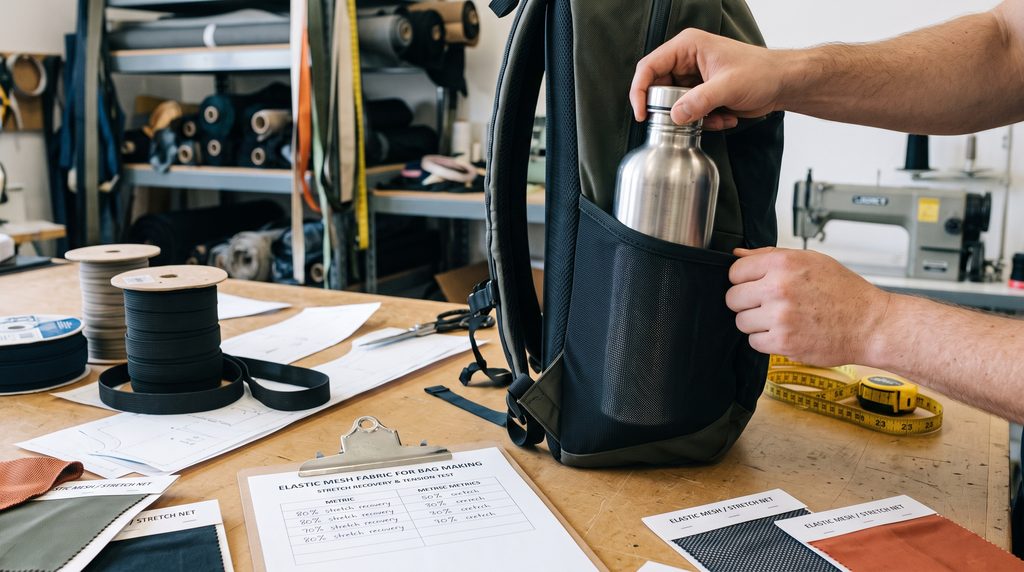
Elastic mesh fabric for bag making secures water bottles by blending flexible elastane fibers with rigid synthetic yarns to deliver eighty percent stretch recovery. When hikers force wide metal flasks into side pockets, the elastic mesh expands smoothly without tearing at side seams. As soon as the flask is pulled free, the resilient mesh contracts snugly against the pack body. Integrating stretch mesh fabric for bag making prevents water containers from bouncing out during downhill trail runs.
How Do Spandex Blends Recover from High Extension?
Knitting polyurethane elastane filaments alongside polyester produces strong four-way stretch netting. These high-recovery yarns expand around irregular objects and immediately snap back to their original profile.
Look:
Pockets stay taut against pack walls rather than sagging open after months of use.
- Four-way stretch adapts effortlessly to oversized thermal hydration flasks.
- High elastic modulus creates inward clamping pressure that grips slick metal bottles.
- Shape memory polymers resist permanent bagging caused by prolonged stretching.
Why Anchor Pocket Openings with Elastic Binding?
Raw netting edges lose tension if top borders are hemmed with standard non-stretch thread stitches. Binding pocket mouths with heavy elastane tape reinforces grip pressure while protecting cut mesh loops.
Here is why:
A reinforced binding tape keeps heavy bottles locked tight during steep downhill scrambles.
The Key Takeaway for trail pack designers: combining four-way stretch mesh with elastane binding creates self-clamping pockets that hold flasks secure on rugged trails.
| Elastic Property | Power Mesh Blend | Non-Stretch Netting | Pocket Grip Value |
| Multi-Directional Stretch | 70% – 90% Extension | Under 8% Slack | Expands around bulky flasks |
| Recovery After 100 Cycles | 94% Instant Snap | Low Deformation Recovery | Prevents loose, sagging pocket tops |
| Clamping Tension | High Inward Pressure | Zero Holding Grip | Keeps bottles safe during runs |
Dynamic extension testing proves stretch-blended netting provides the necessary clamping force to secure loose hydration gear.
How Can You Test Bulk Mesh Fabric for Bag Making Shipments?
You can test bulk mesh fabric for bag making shipments by conducting hydraulic Mullen burst tests, seam slippage evaluations, and backlit visual inspections. Factory laboratory staff clamp sample swatches over pressurized diaphragms to verify bursting strength meets minimum commercial benchmarks. Unrolling full fabric bolts over illuminated glass tables exposes dropped stitches, oil contamination, and irregular aperture holes. Checking certified mesh fabric for bag making rolls before cutting panels prevents sewing line shutdowns and expensive rework costs.
Which Mullen Burst Protocol Validates Pouch Seams?
ASTM D3786 hydraulic diaphragm tests measure multidirectional burst thresholds across porous netting structures. Pressurized fluid pushes rubber diaphragms upward against clamped mesh until the interlocking warp loops finally separate.
Think about it:
Catching weak dye lots in factory labs stops pockets bursting under customer loads.
- Hydraulic burst testing establishes exact puncture tolerances in kilopascals.
- Seam slippage evaluations confirm needle stitches will not slide out under stress.
- Dimensional stability checks confirm zero shrinkage during commercial steam setting.
How Does Backlit Table Inspection Catch Loop Flaws?
Backlit inspection frames shine diffuse light upward through open mesh pores as rolls feed across rollers. Inspectors identify dropped loops, uneven yarn tension, and oil streaks using standardized four-point inspection scoring.
Here is the deal:
Marked roll flaws let automated cutting machines lay pattern markers around defective fabric areas.
The Key Takeaway for sourcing executives: establishing rigorous burst testing and illuminated table inspections prevents substandard netting rolls from reaching sewing lines.
| Inspection Protocol | Test Standard | Minimum Factory Benchmark | Defect Protection |
| Hydraulic Burst Strength | ASTM D3786 | 180 kPa (Light) / 320 kPa (Heavy) | Prevents bottom blowout under load |
| Seam Slippage Resistance | ASTM D434 | Under 3.0 mm at 100 N | Stops seams pulling apart at zippers |
| Visual Defect Threshold | ASTM D5430 | Under 25 Points / 100 yd² | Keeps finished pack panels flawless |
Standardized laboratory testing ensures incoming textile rolls satisfy heavy commercial hauling demands before pattern cutters touch the fabric.
How Can You Source Bulk Mesh Fabric for Bag Making Safely?
You can source bulk mesh fabric for bag making safely by partnering with verified warp-knitting factories that offer low minimum order quantities, fast lab dips, and open quality logs. Mega textile conglomerates demand high order volumes that drain operating cash into slow-moving inventory rolls. Agile suppliers offering low purchase minimums allow growing luggage labels to develop seasonal prototypes without taking excessive financial risks. Examining physical swatch books ensures that your specified mesh fabric for bag making matches your required hand feel, color depth, and hole geometry.
What Minimum Order Terms Protect Factory Cash Flow?
Progressive warp-knitting mills offer sensible trial thresholds starting around one hundred meters per custom colorway. Sourcing small initial lots protects your working capital while you test fresh backpack concepts across retail accounts.
Look:
You can validate market demand across boutique gear shops before committing to full container orders.
- Low order minimums reduce raw material capital locked inside warehouse storage.
- Shorter production lead times help your company respond quickly to trending colors.
- Flexible dye lots allow simultaneous prototyping of diverse gear lines.
Why Verify Physical Swatches Prior to Cutting?
Digital catalog images fail to convey the tactile hand feel, surface stiffness, and true color tone of technical netting. Handling physical fabric swatches under standard D65 daylight bulbs verifies pore size and flexibility before placing bulk orders.
Ready for the good part?
Physical swatches allow sewing managers to run real needle puncture tests on factory machines.
The Key Takeaway for luggage procurement directors: pairing sensible order minimums with physical swatch approvals eliminates supply chain uncertainty and preserves healthy production margins.
| Sourcing Stage | Average Timeframe | Primary Milestone | Supply Chain Safety |
| Swatch Book Dispatch | 24 – 48 Hours | Physical hand feel & color swatches | Confirms aperture size and rigidity |
| Custom Lab Dip Match | 3 – 5 Business Days | 3-shade Pantone recipe approvals | Guarantees exact brand color match |
| Bulk Production Run | 12 – 16 Business Days | Full rolls with certified QC reports | Delivers dependable seam strength |
Structured procurement milestones reduce delivery risks and ensure seamless raw material flow into your luggage factory.
Final Strategic Sourcing for Mesh Fabric for Bag Making
Balancing structural puncture strength, tare weight reduction, and rapid air circulation determines the long-term success of your technical luggage collection. This manufacturing guide resolved your core questions surrounding warp-knit geometry, ventilation rates, UV resistance, and laboratory inspection protocols. Our specialized textile facility supplies precision warp-knitted mesh, three-dimensional spacer knits, and elastic netting engineered specifically for high-stress bag components. To secure certified quality yardage tailored to your precise denier, elasticity, and colorway specifications, contact us today to speak with technical specialists and order physical sample swatches. We believe durable carry gear begins with uncompromising textile engineering, and our manufacturing team stands ready to deliver dependable materials for your brand.
FAQ Section
- Q1: Can I use lightweight mesh fabric for bag making on tactical gear? No, lightweight netting lacks the puncture toughness required for intense military operations. You should specify high-denier coated polyester or nylon mesh to ensure pocket walls resist sharp field tools.
- Q2: What’s the best mesh fabric for bag making for backpack shoulder straps? Three-dimensional spacer mesh is the best choice for shoulder straps and lumbar panels. Its internal monofilament cushion distributes heavy loads while allowing cooling air to circulate around sweat zones.
- Q3: How do I know if my mesh fabric for bag making can handle wet gear? Verify that the base yarn is hydrophobic synthetic polyester or coated vinyl. These polymers absorb virtually zero water, allowing soaked equipment to drain rapidly without weakening the textile structure.
- Q4: Can I sew heavy mesh fabric for bag making on home sewing equipment? Yes, but you must install heavy-duty jeans needles and walking foot attachments. Using strong bonded polyester thread prevents tension jams when joining thick netting layers to dense bag shells.
- Q5: What’s the best way to prevent fraying along mesh bag cut edges? Specify warp-knitted mesh rather than plain woven netting, and enclose raw seams with folded webbing tape. Warp-knit loop stitches resist unraveling, while bias binding provides permanent perimeter seam strength.