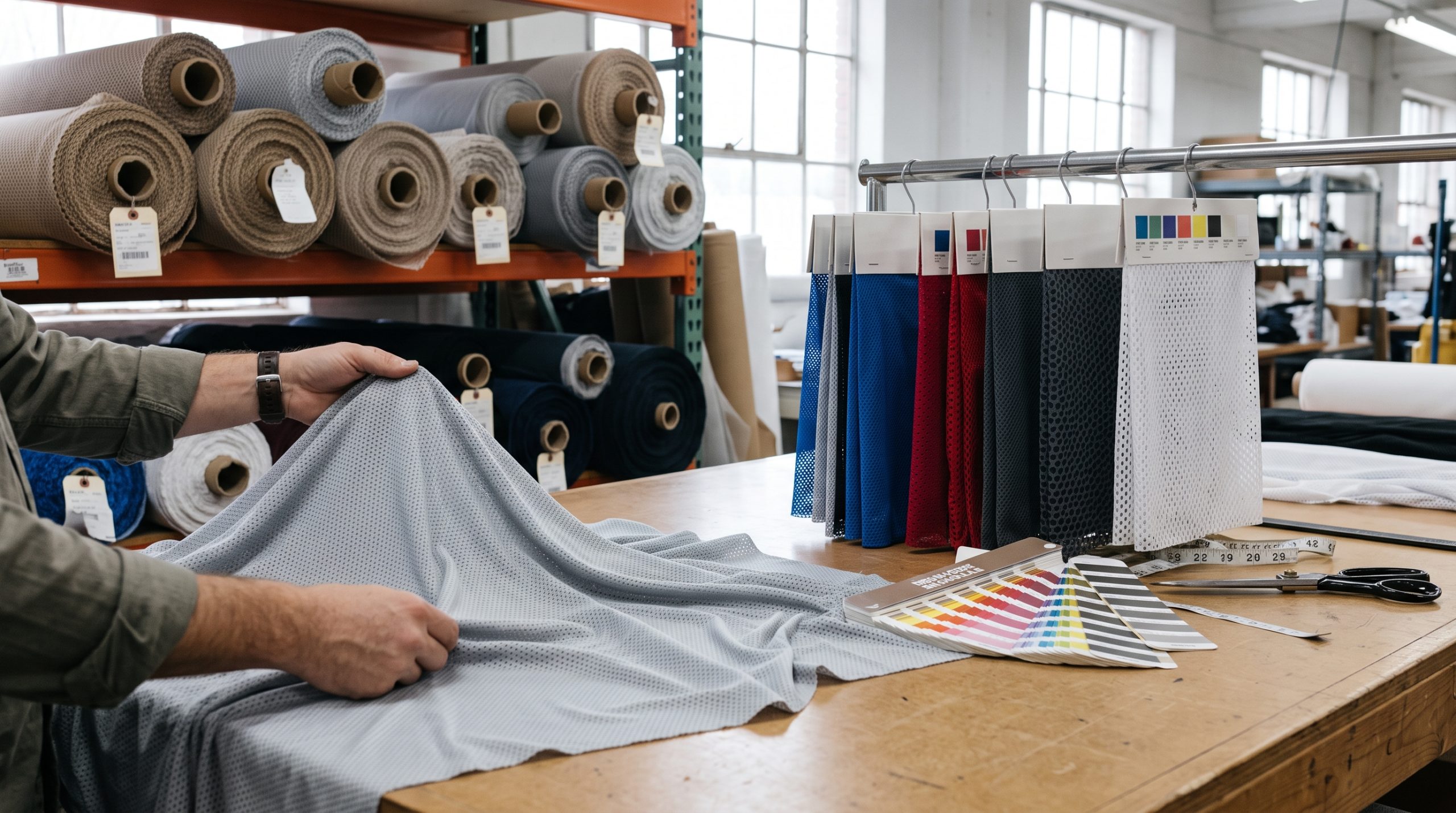
Mesh fabric represents a porous textile engineered with deliberate open spaces between knit yarns to facilitate continuous airflow. Picture preparing a summer teamwear run, only to receive stiff garments that trap sweat and generate blistering customer returns. Poor material choices ruin athletic performance and drain your production budget. Selecting the right knit structure between bird’s-eye eyelets and pique waffles solves these ventilation defects permanently. You can source specialized mesh fabric engineered specifically to keep active bodies cool and comfortable.
What Is Mesh Fabric and How Is It Constructed?
Mesh fabric is an open-structured textile created by knitting or weaving yarns to form stable geometric voids throughout the material face. Industrial knitters produce these porous openings using specialized needle arrangements that hold loops open across consecutive courses. Modern warp knitting machinery builds interlocking pillar chains that prevent open holes from fraying under mechanical tension. These porous networks deliver natural airflow while maintaining tensile strength across both fabric directions.
Does Open Knit Structure Define Mesh Construction?
Porous architecture gives this textile its distinct ventilation capabilities. Standard solid fabrics pack weft yarns tightly to eliminate light passage. Open knits leave regular gaps between interlocking threads.
Here is the deal:
You control ventilation volume simply by adjusting hole diameter during the knitting run.
- Open spaces allow heated air to escape immediately from skin surfaces.
- Interlocking loop nodes maintain tensile integrity during continuous apparel stretch.
- Flexible synthetic filaments prevent structural collapse after repeated commercial laundering.
Which Knitting Methods Create Durable Porous Holes?
Warp knitting secures loose threads far better than circular weft knitting. Tricot and Raschel machines route parallel yarns through dedicated guide bars to lock every aperture firmly.
Look:
If one loop breaks during rugged athletic activity, warp knit mesh stops runs from traveling down your garment panel.
The Key Takeaway for your design team centers on seam strength: selecting warp knit configurations eliminates unraveling risks along raw cut garment edges.
| Knitting Method | Aperture Stability | Run Resistance | Production Speed | Common Apparel Application |
| Warp Knit (Raschel) | Exceptionally High | Non-fraying | Fast continuous output | Athletic jerseys, outer mesh |
| Warp Knit (Tricot) | High | Run-resistant | Moderate continuous output | Lightweight linings, stretch panels |
| Weft Circular Knit | Moderate | Prone to ladders | High flexibility | Casual t-shirts, basic trims |
Warp knit construction offers superior hole perimeter stability compared to basic single-knit methods.
Why Does Birdseye Mesh Fabric Excel in Breathability?
Birdseye mesh fabric excels in breathability because deliberate tuck stitches create thousands of tiny oval eyelets across every square inch. These micro-perforations function like mechanical exhaust valves across your finished garment. Heat generated by athlete exertion flows directly through these thin textile pores rather than remaining trapped inside thick synthetic layers. The resulting airflow keeps body temperature balanced during heavy training sessions.
What Creates the Birdseye Mesh Eyelet Formation?
Precision needle selection produces these distinctive bird eye marks. Knitting needles miss specific loops on alternating courses to generate intentional micro-hollows.
Think about it:
That unique dot pattern is not a surface print.
- Alternating knit and tuck cycles shape concave geometric pockets.
- Thin synthetic yarn keeps weight around 130 to 160 grams per square meter.
- Raised boundary walls prevent wet fabric from suctioning flat against human skin.
How Does Continuous Air Permeability Vent Heat?
High air permeability ratings translate directly into physical cooling. Laboratory testing measures cubic feet of air passing through fabric swatches per minute.
Here is why:
Open eyelets present almost zero resistance to natural convection currents.
The Key Takeaway for garment developers is simple: bird’s-eye knits maximize moisture evacuation during warm seasons, preventing sweat accumulation inside team apparel.
| Fabric Metric | Birdseye Mesh Value | Standard Solid Knit | Benefit for Athletes |
| Airflow Rating (CFM) | 180 – 240 CFM | 35 – 60 CFM | Rapid body heat dispersion |
| Average Fabric Weight | 135 – 150 GSM | 180 – 220 GSM | Featherlight athletic wearability |
| Moisture Dry Rate | Under 25 minutes | 45 – 65 minutes | Fast sweat clearing from skin |
Testing proves that eyelet geometry triples airflow rates over conventional jersey weaves.
How Does Pique Knit Differ from Birdseye Mesh Fabric?
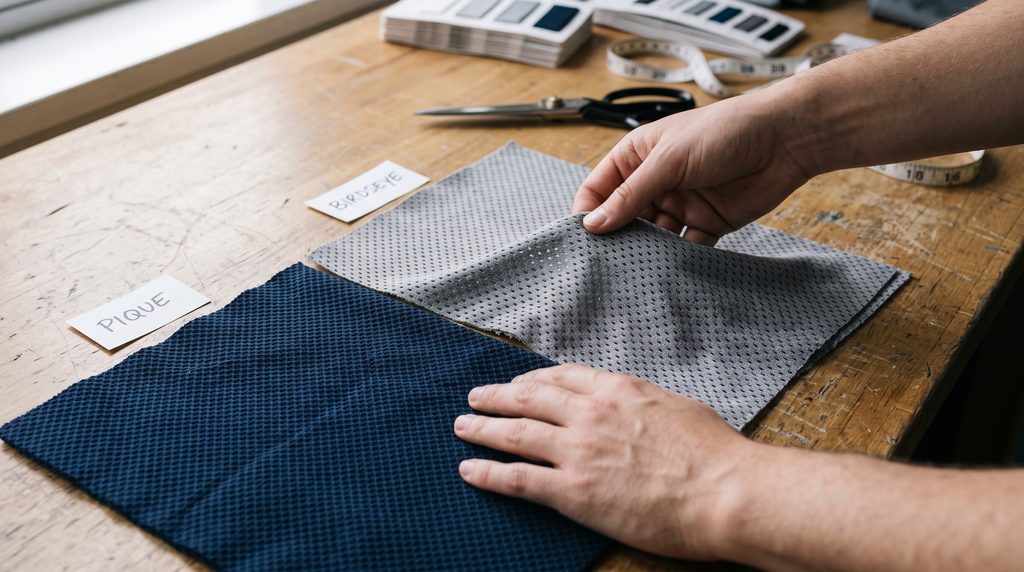
Pique knit differs from bird’s-eye mesh fabric by building a three-dimensional textured waffle or honeycomb surface rather than opening distinct see-through holes. The pique machine arrangement knits raised geometric cords that introduce physical thickness without adding dead weight. Birdseye fabrics prioritize open porosity with smooth flat faces. Pique focuses on structured body, subtle shadowing, and tailored apparel presentation.
What Makes Pique Fabric Structurally Distinct?
Geometric surface relief defines authentic pique knits. Needles form parallel ridges or geometric diamond cells that trap air between the fabric and skin.
This is what happens:
Textured peaks lift the base yarn away from direct skin contact.
- Honeycomb cells create micro-cushions that maintain fabric shape across wide garment panels.
- Two-ply yarns generate firmer body than featherweight jersey meshes.
- Subtle surface indentations absorb light to minimize synthetic sheen.
How Do Yarn Tuck Loops Alter Fabric Bulk?
Tuck stitches in pique add density rather than punching empty voids. Stacking extra loops behind surface cords creates natural dimensional stiffness.
Here is the deal:
You gain structural stability without resorting to heavy chemical finishes.
The Key Takeaway for apparel buyers is that pique delivers a refined look, making it suitable whenever your client demands crisp collars and tailored silhouettes.
| Structural Feature | Birdseye Eyelet Knit | Honeycomb Pique Knit |
| Surface Topography | Flat face with micro-holes | 3D raised waffle texture |
| Optical Transparency | Semi-translucent in sunlight | Opaque solid look |
| Flexural Rigidity | Soft and fluid drape | Firm, shape-holding drape |
| Common Weight Range | 120 – 160 GSM | 180 – 240 GSM |
Pique structures favor dimensional rigidity, whereas eyelet mesh structures favor lightweight permeability.
Which Mesh Fabric Provides the Ideal Tactile Hand Feel?
Birdseye mesh fabric provides a noticeably softer and sleeker skin feel compared to textured pique textiles. Its micro-filament yarns glide smoothly across moving joints without chafing sensitive skin. Pique delivers a dry, substantial hand feel characterized by pleasant tactile friction. Your preference depends entirely on whether your customer wants fluid athletic movement or crisp structured comfort.
Does Birdseye Provide a Smoother Skin Contact?
Continuous filament polyester produces a silky contact face across bird’s-eye goods. Flat loop transitions eliminate coarse knots that irritate runners during multi-hour marathons.
Think about it:
Athletes notice abrasive seams and rough textures within minutes of hard training.
- Micro-denier yarns eliminate abrasive friction against skin during repetitive motions.
- Flat back surfaces slide effortlessly over base layers.
- Low mechanical friction prevents athletic skin irritation under humid conditions.
Why Does Pique Create a Firmer Textile Drape?
Raised honeycomb ribs give pique substantial structural backbone. The fabric rests with dignified weight rather than clinging to torso contours.
Look:
If you produce executive activewear, customers prefer garments that drape cleanly without highlighting every body line.
The Key Takeaway here relates to customer perception: choose bird’s-eye for sensory softness in motion, and specify pique for substantial corporate garment feel.
| Sensory Parameter | Birdseye Fabric Score (1-10) | Pique Fabric Score (1-10) | User Experience |
| Surface Smoothness | 9 / 10 | 5 / 10 | Birdseye feels slicker on touch |
| Body & Substance | 4 / 10 | 8 / 10 | Pique holds cleaner drape lines |
| Anti-Cling Property | 8 / 10 | 9 / 10 | Both textiles prevent sweat cling |
Sensory testing confirms bird’s-eye provides superior skin comfort for high-speed dynamic activities.
How Do Moisture Properties Differ Across Mesh Fabric?
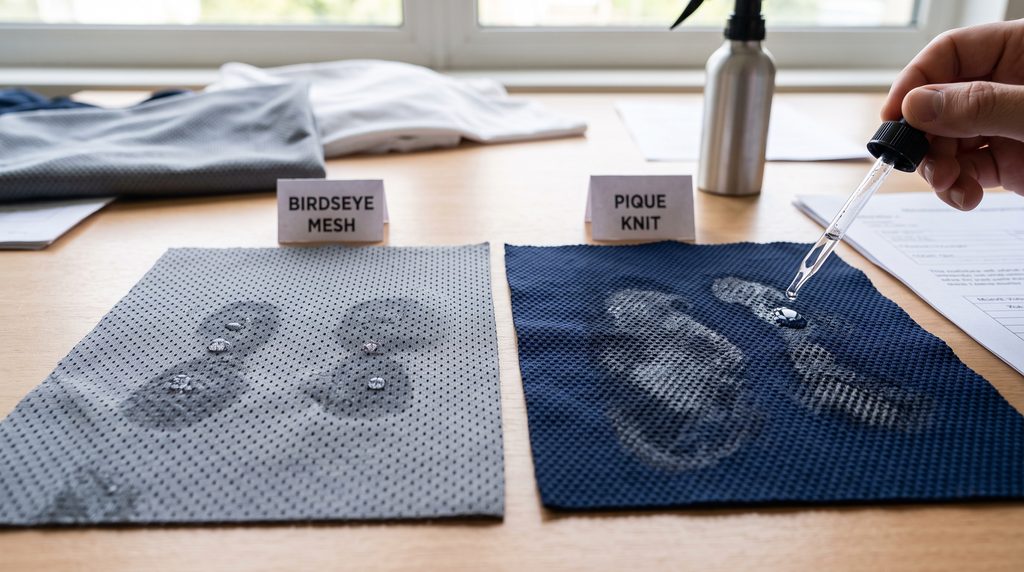
Moisture properties vary because open eyelet mesh fabric relies on rapid air passage to evaporate perspiration, while pique spreads sweat along raised surface yarns. Birdseye eyelets draw perspiration outward through capillary action, releasing vapor directly into passing ambient breezes. Pique absorbs sweat along cotton or textured polyester ridges, using surface area to dissipate liquid. Both mechanisms prevent clamminess, but they function through distinct physical processes.
How Do Eyelets Accelerate Sweat Evaporation?
Small circular holes act like chimney flues across hot muscle groups. Body heat drives moisture vapor straight through open eyelets without requiring fabric saturation.
Here is why:
Vapor escapes before it can condense into heavy liquid droplets.
- Hydrophobic synthetic fibers refuse to hold onto liquid water.
- Open apertures expose underlying moisture directly to moving air currents.
- Dry times drop significantly during outdoor wind exposure.
Does Honeycomb Pique Trap Excessive Sweat?
Structured pique balances absorption with geometric spacing. Deep channels between honeycomb ridges prevent saturated yarn from resting entirely on the wearer.
Ready for the good part?
Air channels behind the textured ridges circulate breeze continuously under your clothes.
The Key Takeaway for procurement managers: specify eyelet mesh for intense sweat production, but choose pique blends for moderate activity where consistent appearance matters.
| Moisture Metric | Birdseye Polyester Mesh | Cotton-Poly Pique Knit |
| Wicking Height (10 min) | 120 mm | 75 mm |
| Water Retention Rate | Under 3.5% | 12.0% – 18.0% |
| Evaporation Time (1 ml) | 12 minutes | 28 minutes |
Eyelet designs accelerate physical sweat evaporation by more than double compared to cellular pique.
When Should You Choose Birdseye Mesh Fabric for Shirts?
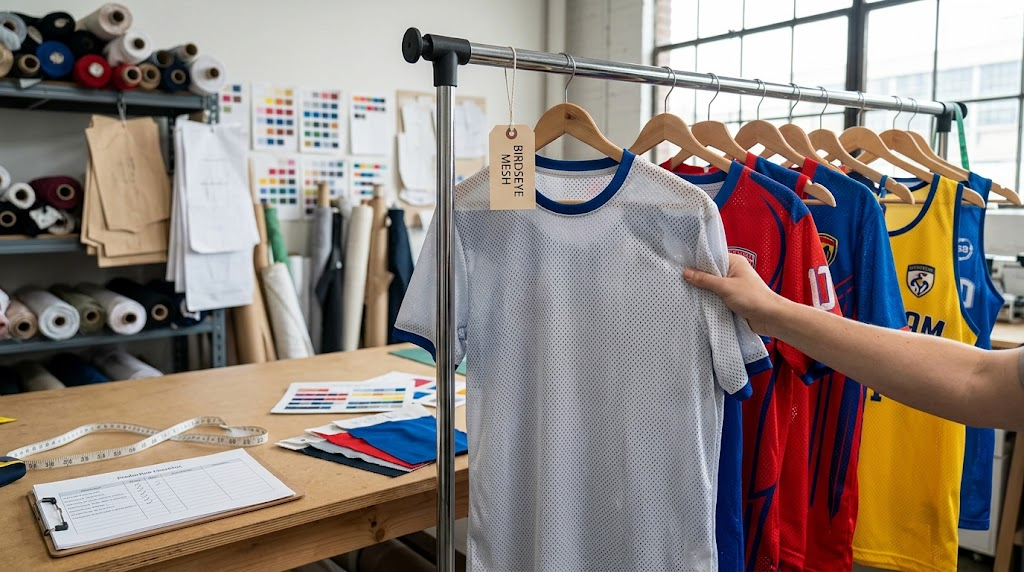
You should choose bird’s-eye mesh fabric whenever producing competitive activewear, running singlets, soccer jerseys, or gym apparel. The combination of minimal fabric weight and rapid sweat dispersion directly benefits athletes who demand unhindered movement. Its smooth surface also accommodates vibrant graphics without broken print edges. When maximum ventilation and featherweight agility top your design priorities, this eyelet knit remains unmatched.
Why Is Birdseye Favored for Athletic Teamwear?
High exertion demands materials that manage intense sweat without sagging. Birdseye construction stays featherlight even when players sweat through multiple halves of play.
Look:
Nobody likes running in a drenched shirt that weighs twice as much as when they started.
- Fast capillary action keeps garments feeling light throughout tough matches.
- Low weight reduces overall athlete fatigue during endurance competitions.
- Smooth yarn loops resist snagging against competitor gear or sports turf.
Can You Achieve Sharp Sublimation Printing on It?
Sublimation heat presses require flat contact areas to transfer detailed vector patterns. Birdseye mesh provides a surprisingly uniform surface despite its tiny ventilation holes.
Here is the deal:
Your team logos and sponsor badges retain crisp borders without blurry bleed lines.
The Key Takeaway for apparel manufacturers: choose bird’s-eye mesh when clients need photographic dye sublimation on lightweight athletic jerseys.
| Target Garment Type | Recommended Fabric | Key Production Driver |
| Marathon Running Tops | Birdseye Mesh (130 GSM) | Minimal weight, zero skin abrasion |
| Soccer Match Kits | Birdseye Mesh (150 GSM) | Sweat wicking, vivid sublimation |
| Training Tank Tops | Birdseye Mesh (125 GSM) | Complete air passage in gym heat |
Competitive athletic lines gain significant performance advantages from open eyelet knit specifications.
When Is Pique Knit Better Than Open Mesh Fabric?
Pique knit is far superior to open mesh fabric when designing classic polo shirts, school uniforms, hospitality apparel, and corporate workwear. Open eyelets look distinctly athletic, which conflicts with formal office or customer service dress codes. Pique delivers structural opacity, meaning garments never appear transparent under harsh retail or office lights. It also provides the thickness required to support fused collars and crisp button plackets.
Why Does Classic Pique Dominate Uniform Polos?
Uniform buyers demand professional silhouettes that survive repeated commercial laundering. Pique knits resist wrinkles and hold straight side seams without twisting out of alignment.
Think about it:
A floppy collar makes staff members look unkempt within hours of starting their shift.
- Thick knitted ribs stabilize collars and sleeve cuffs without puckering.
- Opaque construction protects employee modesty across varied workplace lighting.
- Crisp texture elevates perceived garment value in corporate catalogs.
Does Pique Resist Fabric Snags and Abrasions?
Interlocked loop cords withstand rough handling much better than delicate sheer nettings. Daily friction against desks, seatbelts, and outerwear causes minimal yarn pulling.
Here is why:
Tightly anchored tuck stitches shield inner filaments from catching on sharp object corners.
The Key Takeaway for uniform brand owners: pick pique whenever garments must balance all-day comfort with authoritative, tailored workplace styling.
| Evaluation Metric | Corporate Pique Polo | Birdseye Athletic Mesh |
| Collar Rigidity Retention | High (Holds crisp fold) | Poor (Tends to collapse) |
| Opacity Rating | 100% Solid Coverage | 75% – 85% Semi-Sheer |
| Pilling Resistance (Martindale) | Class 4 – 5 | Class 3 – 4 |
Pique fabric remains the gold standard for tailored workwear requiring long-term silhouette stability.
How Does Machine Gauge Impact Knit Mesh Fabric Quality?
Machine gauge impacts knit mesh fabric quality by dictating needle density per inch, which directly determines hole uniformity, bursting strength, and hand softness. Higher gauge settings, such as 28-gauge or 32-gauge configurations on modern Karl Mayer machines, pack finer filaments into tighter, more precise loop geometries. Lower gauge setups produce coarser holes suited for heavy utility bags rather than next-to-skin apparel. Investing in fine-gauge knitting ensures smooth surface texture without irregular pore distortions.
How Does Fine Machine Gauge Improve Loop Density?
Precision needle bars produce microscopic knit nodes that resist dimensional distortion. When your factory runs high gauge settings, every eyelet mirrors its neighbor with mathematical precision.
Look:
Consistent loop formation prevents uneven stretching when your cutting team pulls fabric from rolls.
- High needle counts distribute pulling forces evenly across adjacent courses.
- Ultra-fine filaments create softer skin feel without reducing burst strength.
- Consistent pore size prevents dye lot streaks during piece dyeing operations.
What Prevents Raw Edge Curling on Cutting Tables?
Balanced loop tension built on high-precision machinery keeps cut fabric panels completely flat. Single-knit jersey often rolls tightly at the borders, slowing down sewing operators significantly.
Here is the deal:
Warp knit meshes maintain neutral tension along both warp and weft directions.
The Key Takeaway for factory managers: running balanced, high-gauge knit goods speeds up sewing lines and reduces labor costs on cutting tables.
| Machine Gauge (GG) | Typical Yarn Denier | Pore Diameter | Primary Product Output |
| 18 Gauge | 150D – 300D | 2.5 mm – 4.0 mm | Heavy luggage netting, safety vests |
| 24 Gauge | 75D – 100D | 1.0 mm – 1.8 mm | Standard teamwear, active shorts |
| 28 – 32 Gauge | 30D – 50D | 0.5 mm – 0.8 mm | Premium micro-birdseye, luxury polos |
Finer machine gauges produce tighter eyelet tolerances and superior dimensional stability during sewing.
How Can You Test and Inspect Bulk Mesh Fabric Rolls?
You can test and inspect bulk mesh fabric rolls by executing standardized burst strength, air permeability, wash shrinkage, and colorfastness protocols before garment cutting begins. Open-hole textiles experience unique mechanical strains, making standard grab tensile tests insufficient. Conducting hydraulic diaphragm burst tests reveals how well knit apertures hold under pressure. Verifying batch-to-batch consistency protects your production line from catastrophic field failures.
Which Standard Lab Tests Validate Porous Fabrics?
Standardized testing procedures isolate structural flaws before bulk yardage hits your cutting floor. Hydraulic diaphragm equipment measures bursting thresholds across multi-directional stretch planes.
Think about it:
Discovering weak seams after sewing thousands of athletic jerseys destroys seasonal profit margins.
- ASTM D3786 hydraulic burst testing measures load-bearing capacity in kilopascals.
- ASTM D737 checks airflow velocity through eyelet grids to confirm cooling specs.
- Four-point visual inspection checks rolls for dropped stitches or blocked apertures.
How Do You Verify Colorfastness and Shrinkage?
High heat during sublimation printing or home laundering can shrink open knit apertures unevenly. Thorough wash testing establishes exact dimensional change rates for marker making.
Here is why:
Synthetic yarns relax when exposed to high water temperatures.
The Key Takeaway for quality assurance teams: run independent lab checks on first dye lots to guarantee color retention against sweat and repeated washing.
| Inspection Check | Test Standard | Acceptable B2B Tolerance | Impact on Garment |
| Diaphragm Burst | ASTM D3786 | Minimum 250 kPa | Prevents blowout during athletics |
| Airflow Rate | ASTM D737 | Target ± 10% CFM | Guarantees cooling consistency |
| Wash Shrinkage | AATCC 135 | Less than 3.0% (L / W) | Preserves correct garment sizing |
Rigorous laboratory testing protects apparel brands from dimensional distortion and seam failures.
How Can You Source Quality Mesh Fabric for Production?
You can source quality mesh fabric by partnering with vertically integrated manufacturers that offer flexible order volumes, clear lab dip procedures, and rapid sampling support. Many global mills enforce massive order thresholds that prevent emerging brands from testing new sportswear collections. Locating suppliers with low minimum order requirements lets you validate new market segments safely. Verifying machinery setups and factory testing guarantees reliable delivery across seasonal reorders.
What Minimum Order Volumes Support Custom Production?
Modern textile mills now support agile production through flexible dye lot programs. Sourcing yards without crushing minimums helps your business manage inventory capital efficiently.
Look:
You avoid tying up working capital in warehouse rolls that might sit unused for months.
- Flexible dye houses accept orders as low as 100 meters per color.
- Short initial runs let you test customer reactions to specific knit hand feels.
- Low thresholds allow swift color expansions across seasonal sportswear releases.
How Do Sample Protocols Secure Production Accuracy?
Reviewing physical fabric swatches remains the safest way to evaluate drape, eyelet density, and elasticity. Swatch analysis eliminates misunderstandings before mass roll dyeing begins.
Ready for the good part?
Requesting custom lab dips ensures your corporate teamwear matches exact Pantone brand standards.
The Key Takeaway for apparel sourcing executives: insist on testing physical swatch cards before signing off on full container shipments to prevent costly fabric discrepancies.
| Procurement Stage | Typical Lead Time | Key Verification Goal |
| Swatch & Lab Dip Phase | 3 – 5 business days | Match Pantone shade, evaluate hand |
| Sample Roll Production | 7 – 10 business days | Test sewing performance, wash shrinkage |
| Bulk Production Run | 15 – 25 business days | Fulfill complete garment manufacturing |
Structured sampling stages minimize production errors and secure consistent yardage delivery.
Finding the perfect balance between breathable bird’s-eye eyelets and structured pique waffles determines the ultimate market success of your apparel collection. This guide clarified the engineering differences, tactile feedback, sweat management, and manufacturing checks required to pick the ideal textile for your next design. Our manufacturing facility equips you with precision warp knits, low minimum order thresholds, and fast lab dips to build exceptional sportswear lines. To turn these textile advantages into tangible customer satisfaction, contact us today to discuss your technical specifications and request tailored fabric swatches. We believe premium garments begin with flawless knit engineering, and our team stands ready to deliver consistent excellence for your brand.
FAQ Section
- Q1: Can I use bird’s-eye mesh fabric for corporate uniform polos?
No, bird’s-eye knit lacks the structural stiffness required for formal collars. The textile drapes loosely and looks casual, whereas pique knit maintains the structured silhouette expected in office workwear. - Q2: What’s the best mesh fabric choice for sublimation printed sports jerseys?
Bird’s-eye mesh fabric is the superior option for heat transfer printing. Its micro-textured face offers a smoother contact area than rough pique, allowing dispersed dye inks to produce sharp graphics. - Q3: How do I know if my mesh fabric sample has adequate snag resistance?
You should run a mace snag test or simulate hook abrasion on the fabric face. Tighter knit geometries with fewer loose floats resist snagging much better during daily laundering. - Q4: Can I specify custom Pantone colors with a low minimum order quantity?
Yes, flexible modern dye houses accommodate custom lab dips for small production runs. Starting orders around one hundred meters per shade allow brands to test market demand safely. - Q5: What’s the best way to prevent edge curling during garment cutting?
Select heat-set warp knit textiles rather than unbalanced single jersey knits. Stabilized loop tension ensures flat roll edges that stay aligned on automated cutting tables.