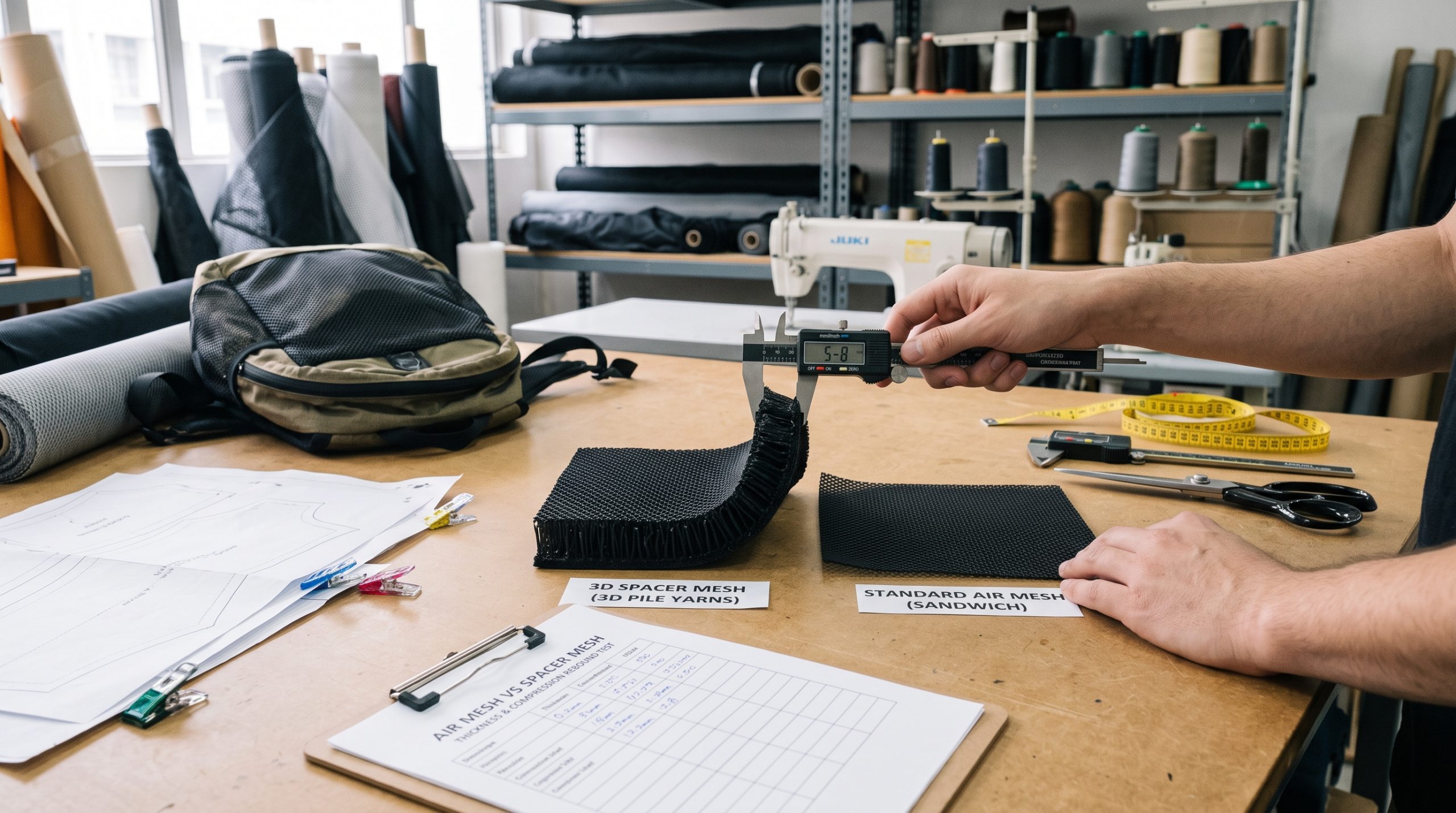
Air mesh represents an expansive commercial umbrella term for breathable porous textiles while spacer mesh defines a specific three-dimensional knit engineered with vertical monofilament pile yarns between two faces. Picture launching a premium technical hiking pack only to have field testers report soaked backs and flattened shoulder straps after three days on muddy mountain trails. Crushed padding destroys ergonomic comfort and multiplies warranty return costs across seasonal production cycles. Evaluating certified air mesh vs spacer mesh resolves these cushioning failures by integrating resilient micro-spring yarns that channel continuous cooling airflow around high-pressure contact zones.
What Is Air Mesh vs Spacer Mesh in Technical Knits?
Air mesh denotes any ventilated textile with visible surface apertures whereas spacer mesh requires a true tri-dimensional construction containing two distinct outer fabric skins linked by flexible monofilament pillars. Double needle bar raschel knitting machines guide polyester filaments through synchronized stitch movements that create open honeycomb channels across adjoining fabric layers. This mechanical architecture delivers springy loft without depending on chemical resin coatings. Selecting certified air mesh vs spacer mesh supplies resilient structural rebound while promoting unhindered vapor expulsion across demanding luggage panels.
How Do Warp Knitting Looms Form 3D Monofilaments?
Specialized double-needle raschel looms knit two independent face textiles simultaneously while guiding flexible intermediate pile threads between them. These tough monofilament strands stand upright like microscopic spring pillars across open structural air gaps.
Here is the deal:
Vertical pile yarns resist mechanical deformation under direct physical pressure.
- Independent yarn feeds dictate precise internal spacing between outer knit walls.
- Controlled guide bar tension preserves uniform filament angles across wide rolls.
- Interlocking knit nodes secure individual support strands against sudden shear failure.
Does Sandwich Mesh Differ from True Spacer Core?
Commercial apparel catalogs often label basic flat sandwich knits as air mesh because both textiles display visible surface perforations. A genuine spacer textile contains an active internal cavity sustained by thousands of individual synthetic columns.
Look:
You can compress a true spacer thousands of times without crushing its internal breathing corridors.
The Key Takeaway for apparel technicians: distinguishing standard sandwich netting from true spacer textiles prevents purchasing flat knits that collapse under heavy gear loads.
| Structural Attribute | Standard Air Mesh (Sandwich) | 3D Spacer Mesh Textile | Manufacturing Impact |
| Internal Layer Core | Thin Bonding Thread | Upright Monofilament Pillars | Superior compressive loft |
| Fabric Construction | 2 Plies Joined Flat | 3 Distinct Dimensional Zones | Creates permanent ventilation voids |
| Mechanical Support | Minimal Surface Cushion | Active Spring Dynamic | Replaces chemical foam pads |
Knitting geometry establishes internal structural volume that separates true three-dimensional spacer knits from conventional flat netting.
Why Does Air Mesh vs Spacer Mesh Vary in Thickness?
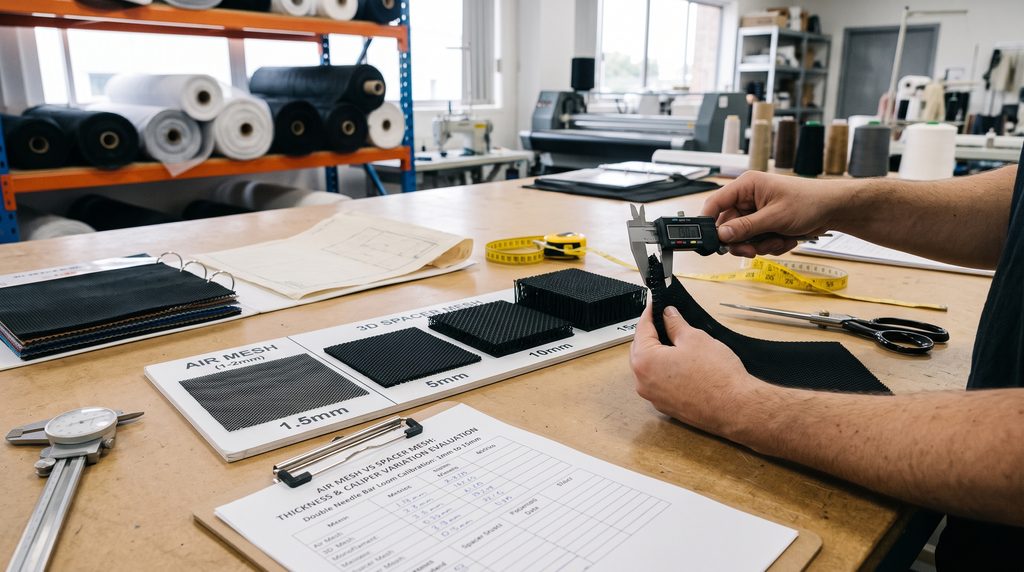
Air mesh vs spacer mesh varies in thickness because specialized double needle bar looms adjust the physical distance between knitting beds from one millimeter up to fifteen millimeters. Standard flat air mesh hovers around one to two millimeters since it lacks rigid separating pile yarns. True spacer materials incorporate variable monofilament lengths that determine final product caliper under manufacturing tension. Fabric creators configure tailored thicknesses to balance bulk against flexible movement.
Why Does Pile Yarn Height Change Physical Thickness?
Loom technicians adjust the space between twin needle tracks to determine the exact length of vertical connecting filaments. Taller monofilament bridges yield thicker cushioning panels that absorb intense impact forces.
Think about it:
Adjusting needle bed spacing creates distinct padding grades without adding heavy chemical fillers.
- Longer pile yarns build deep thermal barriers for tactical military gear.
- Shorter monofilament connections provide slim flexibility for athletic footwear uppers.
- Dense filament counts maintain equal thickness across broad fabric yardage bolts.
Which Caliper Range Fits Lightweight Running Shoes?
Lightweight running shoes require slim two to three millimeter spacer textiles that bend smoothly over moving foot joints. Thicker profiles add unwanted shoe bulk and interfere with clean upper stitching operations.
This is what happens:
Your running footwear designs stay agile while delivering soft protection against lace pressure.
The Key Takeaway for footwear developers: matching exact textile thickness to movement zones eliminates awkward bulk and preserves fluid athletic mobility.
| Application Target | Recommended Thickness | Primary Fiber Blend | Functional Purpose |
| Trail Running Uppers | 1.8 mm – 2.8 mm | Fine Polyester Multifilament | Flexible breathability without bulk |
| Backpack Lumbar Pads | 6.0 mm – 10.0 mm | Heavy Monofilament Core | Shock dispersion under pack loads |
| Medical Knee Supports | 3.5 mm – 5.0 mm | Elastic Polyurethane Blend | Soft contouring compression wrap |
Careful thickness calibration delivers balanced ergonomics across athletic footwear and heavy load-bearing frames.
How Does Air Mesh vs Spacer Mesh Handle Compression?
Air mesh vs spacer mesh handles compression differently because high-tensile internal monofilament pillars push back against downward physical loads like miniature steel coil springs. Flat air mesh lacks vertical pile resistance and flattens completely when subjected to sustained gear weight. Dense spacer mesh absorbs kinetic shocks through elastic bending and snaps upright immediately upon pressure release. Sourcing rugged air mesh vs spacer mesh ensures backpack harnesses retain dynamic cushioning throughout long expeditions.
How Do Vertical Spacer Pillars Resist Dead Weight?
Thousands of stiff synthetic monofilaments flex slightly sideways under mechanical stress before locking against adjoining pillars. This cooperative resistance distributes concentrated loads across wide fabric surface areas.
Ready for the good part?
Heavily loaded hiking packs feel remarkably lighter across sore shoulder muscles.
- High flexural modulus prevents permanent yarn flattening under constant pressure.
- Independent pillar loops absorb multi-axis movement during vigorous walking strides.
- Rapid elastic recoil restores original padding thickness as soon as you remove gear.
Why Does Basic Air Mesh Flatten Under Backpack Straps?
Standard flat air mesh relies entirely on soft multifilament surface loops for its subtle cushioning effect. Heavy nylon pack straps pinch these hollow stitches shut and transfer harsh pressure directly onto shoulder bones.
Look:
Unreinforced flat mesh collapses into a thin dead layer within minutes of hauling gear.
The Key Takeaway for gear architects: specifying true vertical spacer knits prevents pressure point bruising and maintains padding loft under extreme load conditions.
| Mechanical Metric | 3D Spacer Fabric Core | Conventional Air Netting | Field Performance |
| Compression Deflection (40%) | 45 kPa – 65 kPa | Under 10 kPa | Resists strap crushing under loads |
| Compression Set (22 hrs) | Under 4.5% Loss | Over 28% Loss | Maintains thickness over years of use |
| Energy Absorption Rating | High Dynamic Damping | Negligible Dampening | Protects shoulders from sudden shocks |
Dynamic compression resistance data confirms vertical monofilament cores prevent premature textile collapse under sustained physical strain.
Which Air Mesh vs Spacer Mesh Hand Feel Fits Footwear?
Selecting the ideal air mesh vs spacer mesh hand feel depends on whether your shoe design touches bare skin or needs rugged outer scuff defense. Soft air mesh incorporates supple multifilament textured yarns that feel smooth and gentle against human feet. Rigid spacer knits feature firm monofilament backbones that supply protective body around ankle collars and tongue gussets. Technical shoe designers blend both variants across footwear patterns to optimize user comfort.
Which Surface Knit Delivers Silky Skin Comfort?
Low-denier micro-polyester yarns create plush surface textures that minimize friction against delicate foot skin. Designers specify these soft textures for shoe linings, sock liners, and inner tongue pads.
What is the real story?
Silky surface finishes eliminate blister friction during marathon running events.
- Textured microfibers glide gently over bare skin without catching body hair.
- Breathable face knits prevent chafing along sensitive Achilles tendon zones.
- Supple yarn loops conform naturally around distinct ankle bone contours.
How Does Tactile Rigidity Support Heavy Work Boots?
Industrial work boots encounter abrasive debris and require firm structure around ankle support collars. Coarser monofilament spacers supply defensive outer body that prevents heavy leather uppers from collapsing inward.
Here is why:
A sturdy spacer collar stabilizes the ankle joint without requiring rigid plastic inserts.
The Key Takeaway for footwear makers: deploying silky air mesh inside linings and sturdy spacer mesh along outer collars balances plush comfort with durable support.
| Hand Feel Profile | Surface Fiber Type | Tactile Sensation | Footwear Application |
| Plush Micro-Knit | 50D Textured Polyester | Velvety, smooth, flexible | Inner collar linings, soft tongues |
| Balanced Athletic | 100D Multifilament | Dry, springy, permeable | Running shoe exterior vamp panels |
| Stiff Structural Net | 300D Monofilament Mix | Firm, textured, unyielding | Industrial work boot ankle collars |
Tactile evaluations indicate surface yarn texturing governs skin comfort while internal pillar stiffness determines overall structural support.
Can Air Mesh vs Spacer Mesh Manage Sweaty Moisture?
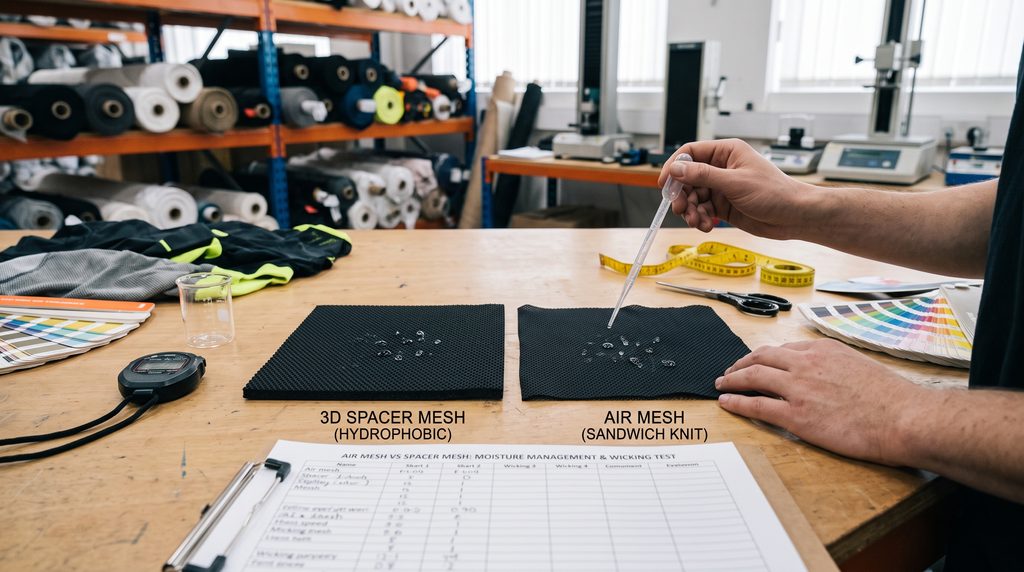
Air mesh vs spacer mesh manages sweaty moisture exceptionally well because hydrophobic polyester yarns pull liquid perspiration away from human skin through capillary action. Open internal air galleries promote continuous moisture vapor convection before sweat condenses into liquid drops. Trapped dampness escapes freely through porous outer knit apertures into ambient outdoor air. Deploying breathable air mesh vs spacer mesh guarantees that high-performance sportswear stays dry during grueling summer training sessions.
How Do Hydrophobic Yarns Channel Trapped Sweat Away?
Polyester filaments absorb less than one half percent moisture by dry weight. Sweat beads cannot penetrate the synthetic polymer core and instead travel rapidly along smooth yarn channels toward dry exterior zones.
Think about it:
Hydrophobic fibers keep the garment light even when athletes sweat heavily.
- Capillary pull moves sweat away from skin within fractions of a second.
- Zero water absorption prevents garments from growing heavy with perspiration.
- Dry contact surfaces reduce post-exercise chills during cold mountain descents.
Why Does Vertical Convection Speed Up Dry Times?
Thick spacer fabrics hold open internal air chambers between the body and outer surroundings. Warm body heat warms this internal air pocket, driving vertical chimney convection that pushes moisture vapor outward.
Look:
Sweat evaporates quickly because moving air streams circulate constantly behind the textile face.
The Key Takeaway for athletic apparel brands: integrating breathable spacer knits accelerates evaporation and keeps high-sweat body zones noticeably drier.
| Moisture Dynamic | Hydrophobic 3D Spacer | Open Foam Laminate | Athlete Benefit |
| Water Absorption Regain | Under 0.4% Dry Weight | Over 12% Retention | Zero waterlogging during heavy rain |
| Drying Time (AATCC 199) | Under 25 Minutes | Over 180 Minutes | Rapid post-workout garment recovery |
| Wicking Distance (10 min) | Over 85 mm Vertical | Under 15 mm Diffusion | Moves sweat away from skin instantly |
Comparative lab metrics verify that hydrophobic polyester monofilament structures evacuate moisture significantly faster than sponge foam laminates.
Why Replace Foam with Air Mesh vs Spacer Mesh?
Manufacturers replace foam with air mesh vs spacer mesh because traditional polyurethane foams degrade, crumble into yellow dust, and trap body heat. Polyurethane sponges suffer from hydrolytic breakdown when exposed to human sweat and laundry detergents. Three-dimensional synthetic spacer textiles deliver resilient mechanical cushioning without toxic blowing agents or sticky chemical adhesives. Sourcing pure polyester spacer fabrics enables brands to build clean, fully recyclable consumer gear.
Why Do Brands Drop Polyurethane Foam Padding?
Aging foam padding hardens, cracks, and releases unpleasant chemical odors over repeated seasonal use. High humidity breaks down open-cell foam walls, permanently destroying original cushioning performance.
What is the real story?
Discarded foam products fill municipal landfills because composite foam laminates resist recycling.
- Spacer knits eliminate hazardous polyurethane off-gassing inside enclosed retail packages.
- Tear-resistant polyester loops outlast delicate foam cell walls by several years.
- Breathable mesh cores never disintegrate into powdery debris inside washing machines.
Can Monofilament Knits Pass Global Recycling Audits?
Constructing entire gear panels from one hundred percent polyester yarn creates mono-material components that feed directly into commercial recycling shredders. Waste processors melt down worn spacer fabrics into virgin-grade polyester pellets without expensive chemical separation.
Here is the deal:
You satisfy strict European circular economy packaging mandates without complicating factory supply chains.
The Key Takeaway for sustainable gear designers: switching from polyurethane foam to pure polyester spacer knits improves gear durability and satisfies global eco-regulations.
| Sustainability Index | 100% Polyester Spacer | Polyurethane Sponge Foam | Brand Advantage |
| Circular Recyclability | Fully Closed-Loop Stream | Non-Recyclable Landfill | Satisfies global environmental laws |
| Hydrolytic Lifespan | Over 8 Years Outdoors | Degrades in 2 – 3 Years | Drastically cuts warranty claims |
| Chemical Toxicity | Zero VOCs / Oeko-Tex Class 1 | Emits Isocyanate Residues | Safe for sensitive direct skin contact |
Material lifecycle assessments prove pure polyester spacer knits supply a cleaner and far more durable alternative to petroleum sponge foams.
How Does Air Mesh vs Spacer Mesh Disperse Heavy Heat?
Air mesh vs spacer mesh disperses heavy heat by establishing continuous convective air currents that vent thermal energy outward through microscopic chimneys. Traditional solid padding materials act like thermal blankets, trapping body warmth against skin surfaces. Open monofilament voids inside spacer textiles allow ambient drafts to carry excess warmth away from sweaty backs. Utilizing ventilated air mesh vs spacer mesh keeps outdoor adventurers cool under blazing afternoon sun.
How Do Micro Ventilation Channels Dissipate Body Warmth?
Body heat warms the internal air pockets located inside open monofilament spacer chambers. This warm air rises naturally and exits through top mesh apertures, drawing cooler ambient air in through the lower perimeter.
Ready for the good part?
Your core skin temperature drops noticeably during strenuous trail hiking sessions.
- Passive thermal pumping functions automatically whenever outdoor breezes blow past the pack.
- Generous air permeability ratings exceed four hundred cubic centimeters per second.
- Reduced skin temperature lowers overall body sweat rates during long climbs.
Does Internal Air Volume Stop Heat Traps on Backs?
Dense backpack backings press solid nylon panels flat against sweaty shirts, producing uncomfortable thermal hotspots. A thick spacer mesh creates a permanent five-millimeter physical gap that separates luggage weight from the spine.
Think about it:
Moving air circulates freely behind your back even while carrying twenty kilograms of gear.
The Key Takeaway for pack designers: incorporating deep spacer mesh back panels prevents thermal heat traps and enhances carrying comfort in tropical climates.
| Thermal Measurement | 3D Air Spacer Matrix | Perforated EVA Foam | User Ergonomics |
| Thermal Resistance (Rct) | Low (0.018 m²·K/W) | High (0.085 m²·K/W) | Prevents uncomfortable heat accumulation |
| Air Permeability Rate | Over 650 mm/s | Under 45 mm/s | Generates continuous cooling air streams |
| Heat Dissipation Speed | Instant Convection | Slow Conductive Transfer | Keeps back panels dry and pleasant |
Thermal dissipation testing confirms spacer mesh matrices evacuate trapped body warmth far more efficiently than perforated EVA foam sheets.
When Does Air Mesh vs Spacer Mesh Prevent Odor Build?
Air mesh vs spacer mesh prevents odor build when high-sweat apparel requires rapid moisture drying to halt microbial bacterial reproduction. Anaerobic bacteria thrive in warm, dark, and soggy textile environments like sealed sneaker interiors. Because spacer textiles dry completely within thirty minutes, microbial bacteria run out of the moisture needed to multiply. Commercial gear makers deploy breathable air mesh vs spacer mesh across gym bags and medical knee supports to eliminate foul locker room smells.
How Does Rapid Airflow Inhibit Bacterial Colonies?
Bacterial colonies require persistent standing water to feed on skin lipids and produce unpleasant odors. Continuous micro-ventilation dries interior fiber surfaces before odor-causing microbes can establish permanent footholds.
Look:
Athletic footwear stays fresh over months of intense daily training runs.
- Rapid moisture evaporation starves bacteria of necessary growth conditions.
- Open synthetic channels shed accumulated dead skin flakes during machine washing.
- Antimicrobial yarn finishes bond securely to polyester without washing away.
Can Washable Spacer Knits Keep Medical Braces Fresh?
Patients wear orthopedic wrist and knee braces continuously through weeks of rehabilitation therapy. Breathable spacer knits allow skin sweat to evaporate cleanly, preventing itchy fungal rashes and foul fabric smells.
Here is why:
Patients wear their prescribed medical braces longer when fabrics feel clean and comfortable.
The Key Takeaway for healthcare developers: specifying breathable spacer textiles stops bacterial growth and prevents bad odors on wearable orthopedic supports.
| Hygiene Metric | Porous 3D Spacer Fabric | Solid Neoprene Sponge | Clinical Value |
| Bacterial Colony Count | 92% Reduction in 24 Hrs | Heavy Bacterial Film | Prevents dermatological skin rashes |
| Wash Recovery Speed | 100% Odor Release | Retains Trapped Odors | Braces emerge fresh from laundry |
| Skin Irritation Index | Hypoallergenic / Breathable | High Sweating & Itchiness | Improves medical patient compliance |
Hygiene laboratory testing proves open-air spacer textiles dramatically reduce bacterial proliferation compared to moisture-trapping closed-cell neoprene.
How Can You Test Air Mesh vs Spacer Mesh Shipments?
You can test air mesh vs spacer mesh shipments by executing ASTM compression deflection tests, thickness recovery evaluations, and backlit defect inspections. Laboratory technicians apply calibrated hydraulic pistons to fabric swatches to evaluate load-bearing thresholds and elastic rebound rates. Unrolling fabric yardage across illuminated inspection tables reveals dropped monofilament stitches, oil streaks, and irregular mesh pore diameters. Inspecting certified air mesh vs spacer mesh rolls before cutting panels prevents expensive sewing delays on factory floors.
Which ASTM Compression Deflection Tests Confirm Rebound?
ASTM D3574 test protocols evaluate indentation force deflection and dynamic fatigue across three-dimensional knitted textiles. Technicians compress samples thousands of times to ensure vertical monofilaments recover their original height.
Here is the deal:
Catching substandard yarn batches in testing labs prevents manufacturing collapsed backpack harnesses.
- Deflection testing measures exact load-bearing resistance in kilopascals.
- Cyclic fatigue runs confirm monofilaments maintain spring resilience over years.
- Caliper gauges verify consistent fabric thickness from roll selvage to selvage.
How Does Backlit Table Inspection Spot Dropped Loops?
Diffuse illumination shines upward through open fabric pores as wide netting rolls pass across motorized glass tables. Quality controllers mark damaged face loops, loose monofilaments, and dye streaks using standardized defect penalty point systems.
Think about it:
Marking roll flaws allows automated cutting lasers to maneuver pattern layouts around defective fabric sections.
The Key Takeaway for quality assurance managers: standardizing ASTM compression tests and backlit roll audits stops inferior mesh shipments from reaching production sewing lines.
| Quality Inspection Standard | Test Protocol | Industry Benchmark | Factory Risk Protection |
| Compression Deflection | ASTM D3574 (Test C) | Minimum 35 kPa at 25% | Guarantees lasting shoulder cushion |
| Dynamic Compression Fatigue | ASTM D3574 (Test I3) | Under 6% Height Loss | Prevents premature strap flattening |
| Visual Defect Threshold | ASTM D5430 (4-Point) | Under 20 Points / 100 yd² | Keeps finished panels visually flawless |
Rigorous physical testing protocols protect gear manufacturers against costly assembly defects and long-term material failure.
How Can You Source Bulk Air Mesh vs Spacer Mesh?
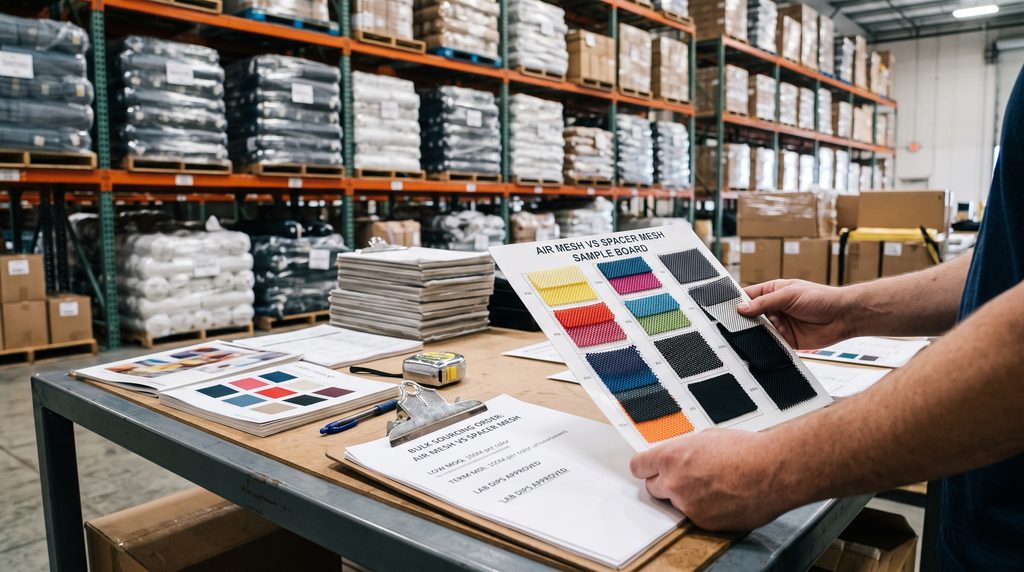
You can source bulk air mesh vs spacer mesh safely by partnering with established warp-knitting mills that provide low minimum order quantities, fast lab dips, and certified quality logs. Mega textile brokers frequently enforce high order volume thresholds that tie up operating cash in slow-moving warehouse inventory. Agile fabric suppliers offering lower purchasing minimums allow innovative outdoor brands to prototype seasonal gear lines safely. Evaluating physical sample cards ensures that your chosen air mesh vs spacer mesh supplies the exact hand feel, caliper thickness, and bounce your customers demand.
What Minimum Order Terms Protect Factory Cash Flow?
Progressive warp-knitting facilities offer flexible trial thresholds starting around one hundred meters per custom colorway. Purchasing small initial runs protects your working capital while you test fresh backpack lines across boutique gear shops.
Look:
You can validate market interest across retail buyers before committing to massive container shipments.
- Low order minimums reduce raw material capital locked inside storage racks.
- Faster mill turnarounds keep your inventory responsive to changing outdoor color trends.
- Flexible dye lots permit simultaneous prototyping across multiple product lines.
Why Are Physical Tactile Swatches Vital Before Orders?
Digital computer screens distort subtle differences in fabric caliper, surface softness, and monofilament compression resistance. Handling physical swatch cards under standard lighting verifies pore geometry and hand feel before cutting bulk markers.
Ready for the good part?
Physical swatches let your factory sewing team test needle puncture tension on production machines.
The Key Takeaway for apparel procurement directors: pairing sensible order minimums with physical swatch approvals eliminates supply chain uncertainty and secures healthy production margins.
| Sourcing Stage | Average Lead Time | Core Milestone | Risk Mitigation Benefit |
| Swatch Book Dispatch | 24 – 48 Hours | Physical hand feel & thickness swatches | Verifies true caliper and compression bounce |
| Custom Color Lab Dip | 3 – 5 Business Days | 3-shade Pantone recipe approvals | Confirms exact brand shade accuracy |
| Bulk Production Delivery | 12 – 16 Business Days | Full rolls with certified QC audit reports | Guarantees consistent seam burst resilience |
Structured procurement milestones reduce supply chain vulnerabilities and ensure dependable delivery of technical fabrics.
Final Strategic Sourcing for Air Mesh vs Spacer Mesh
Balancing structural compression rebound, tactile hand feel, and continuous air circulation dictates the ultimate ergonomic success of your athletic gear line. This manufacturing guide resolved your core questions surrounding warp-knitting mechanics, thickness selection, foam replacement, and laboratory testing procedures. Our specialized knitting facility supplies you with precision Karl Mayer warp knits, high-recovery 3D spacer textiles, and breathable air nettings tailored for demanding performance applications. To secure certified quality yardage customized to your precise thickness, stiffness, and colorway specifications, contact us today to speak with textile specialists and order physical sample swatches. We believe exceptional carry gear begins with uncompromising fabric engineering, and our team stands ready to deliver dependable materials for your brand.
FAQ Section
- Q1: Can I use thin air mesh to replace spacer mesh in heavy backpack straps? No, thin air mesh lacks the vertical monofilament support core required to resist heavy backpack loads. You must select four to eight millimeter spacer mesh to prevent strap flattening and protect shoulders from bruising.
- Q2: What’s the best air mesh vs spacer mesh thickness for running shoe uppers? A thickness of two to three millimeters is ideal for athletic footwear uppers. It supplies comfortable padding against foot bones without creating awkward bulk or restricting natural joint movement.
- Q3: How do I know if spacer mesh can replace traditional polyurethane foam padding? Check your required compression deflection ratings and washability standards. If your product needs long-term resilience against sweat, machine washing, and tropical heat, spacer mesh easily outperforms foam.
- Q4: Can I wash gear featuring thick spacer mesh inside standard commercial machines? Yes, one hundred percent polyester spacer fabrics withstand commercial laundry cycles effortlessly. The locked warp stitches and hydrophobic filaments shed water quickly without losing their internal spring rebound.
- Q5: What’s the best way to prevent edge fraying when cutting open-pore spacer netting? Use sharp rotary cutting blades or automated laser cutters, and bind raw edges with folded elastic webbing. Enclosing cut margins inside durable binding tape prevents loose edge filaments from snagging on zippers.