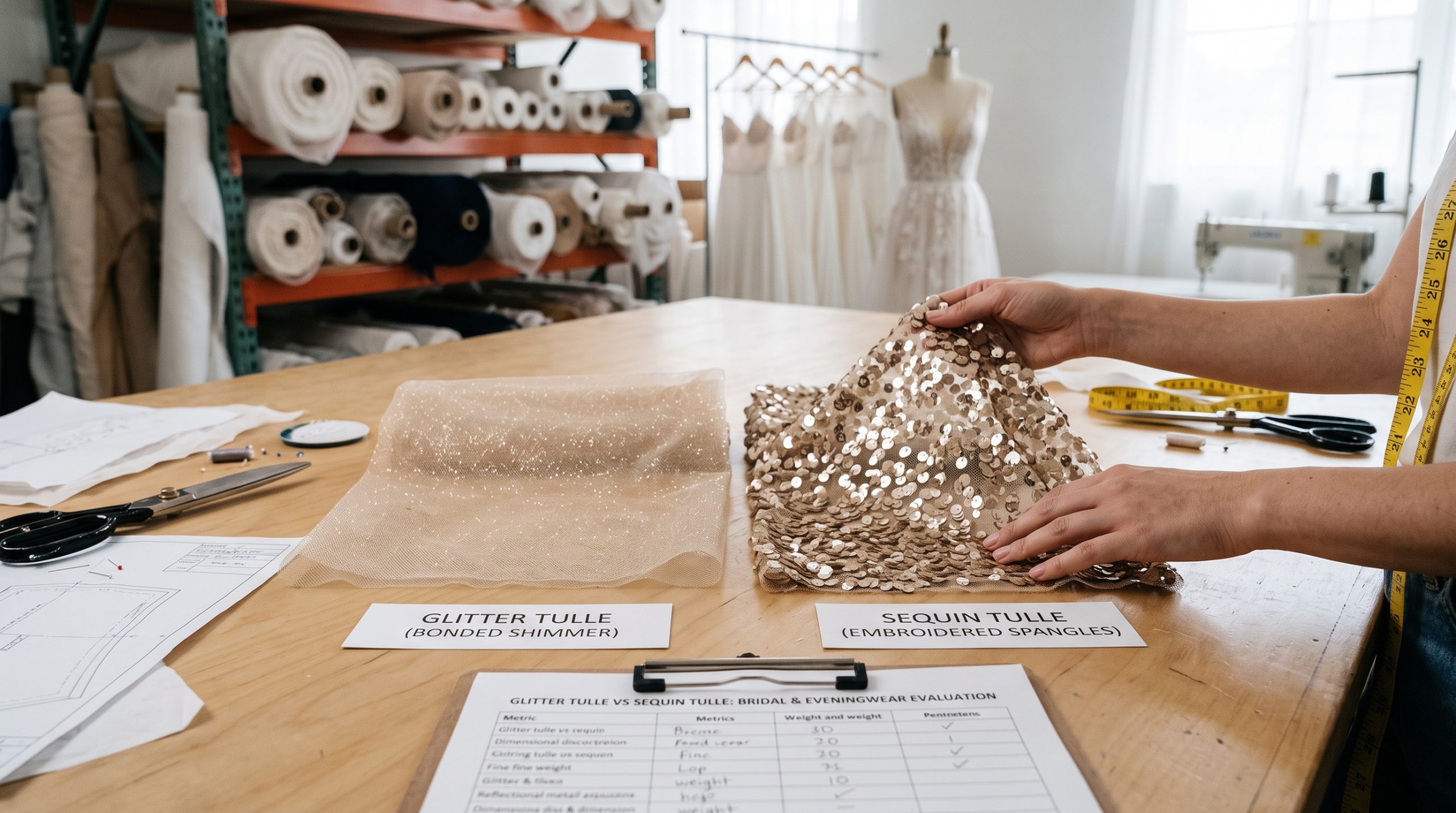
Glitter tulle features micro-fine metallic powder bonded to open hexagonal netting with resin adhesives while sequin tulle incorporates reflective plastic discs stitched onto mesh bases using durable polyester threads. Imagine delivering a custom bridal gown for a high-profile church ceremony only for the bride to shed clouds of shiny flecks over carpets while scratching her arms on sharp plastic accents. Flaking glitter ruins venue floors and scratching paillettes make clients miserable throughout formal wedding events. Selecting certified glitter tulle vs sequin tulle eliminates these costly wardrobe malfunctions by matching sparkle intensity, physical weight, and skin comfort to exact gown specifications.
What Is Glitter Tulle vs Sequin Tulle in Bridal Wear?
Glitter tulle is an embellished open mesh coated with fine metallic shimmer using clear thermosetting binder resin whereas sequin tulle relies on thousands of pre-punched reflective foils anchored by high-speed embroidery machines. Guide bars on warp looms knit light polyester netting before custom surface embellishments bond permanently to hexagonal stitch courses. Designers specify fine powdered nettings for romantic glowing volume and select stitched spangles for high-impact evening wear. Sourcing dependable glitter tulle vs sequin tulle supplies consistent glamour without structural fiber breakdown across commercial atelier orders.
How Do Adhesive Glitters Differ from Stitched Discs?
Liquid polymeric adhesives secure micro-ground metallic flecks across surface netting loops without puncturing base strands. In contrast, multi-head embroidery needles drive lockstitched threads through mesh voids to anchor each metallic disc.
Here is the deal:
Surface fixation methods alter how embellished yardage handles continuous wear.
- Sprayed binders coat open mesh nodes evenly across broad roll yardage.
- Mechanically sewn paillettes withstand heavy handling without flaking off.
- Microscopic glitter flecks preserve base netting elasticity during pattern stretching.
Which Embellishment Matches Ballgown Silhouette Volume?
Layered ballgowns require buoyant structural materials that expand outward without requiring heavy steel hoops. Weightless powdered shimmer allows atelier cutters to gather dozens of airy underskirt tiers seamlessly.
Look:
You can stack twenty fluffy glitter layers without dragging down the skirt hemline.
The Key Takeaway for bridal designers: choosing powdered shimmer preserves voluminous skirt loft while stitched spangles create dramatic reflective focal points across fitted bodices.
| Embellishment Type | Bonding Mechanism | Added Weight Density | Production Silhouette Match |
| Resin-Bonded Glitter | Polymeric Thermoset Glue | 15 – 35 GSM | Multi-layer voluminous ballgowns |
| Lockstitched Sequins | Continuous Thread Embroidery | 110 – 260 GSM | Fitted mermaid cuts, red carpet sheaths |
| Printed Metallic Foil | Rotary Thermal Stamping | 25 – 45 GSM | Lightweight party dresses, veil trims |
Fixation mechanics determine overall fabric bulk and govern whether finished gowns float or drape heavily.
Why Does Glitter Tulle vs Sequin Tulle Differ in Weight?
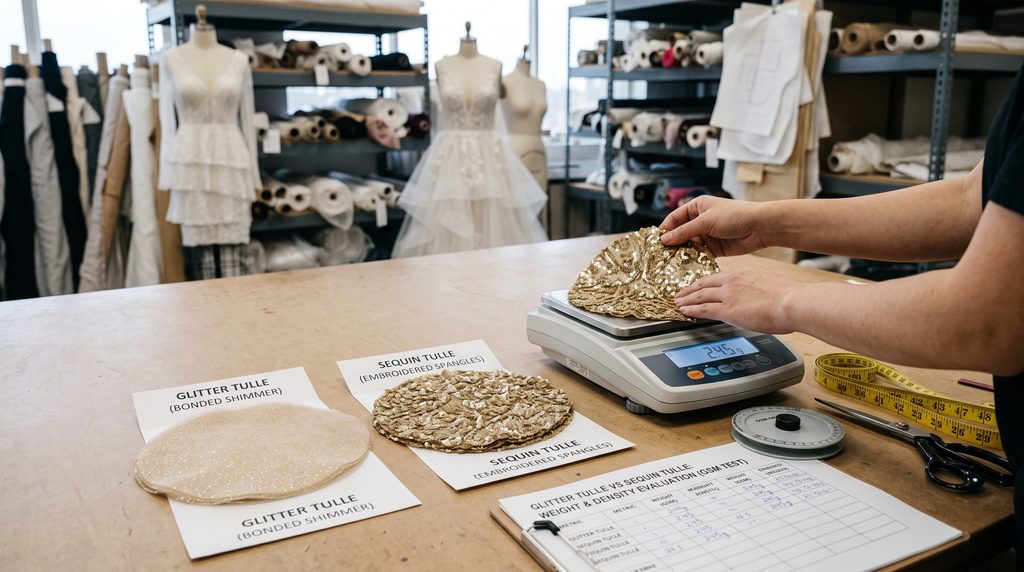
Glitter tulle vs sequin tulle differs in weight because metallic discs and embroidery yarns add up to two hundred grams per square meter to the base fabric. Micro-fine glitter flecks register a negligible mass increase that keeps delicate polyester netting airy. Bulky paillettes pull gown layers downward, creating dense gravitational drag on bridal waistbands. Sourcing verified glitter tulle vs sequin tulle ensures pattern cutters manage garment balance effectively.
How Does Disc Density Add Physical Gown Heaviness?
Sewing three-millimeter or five-millimeter plastic spangles across yards of open mesh introduces measurable material mass. Dense embroidery layouts pull fragile seams downward, requiring internal boning for bodice stability.
Think about it:
A heavily sequined train adds several kilograms of physical fatigue for brides walking down aisles.
- Plastic discs increase garment tare weight significantly across wide skirts.
- Concentrated stitch threads stiffen delicate mesh voids along seam joints.
- Dense embellishment requires reinforced hanger loops to prevent shoulder seam stretch.
Can Featherweight Glitters Preserve Underskirt Puffiness?
Micro-fine glitter flecks disperse across netting nodes without weighing down underlying polyester filaments. Tiered petticoats retain springy vertical resilience that pushes outer gown layers outward effortlessly.
This is what happens:
Your voluminous gown silhouettes hold crisp fairy-tale shapes through long wedding receptions.
The Key Takeaway for eveningwear technicians: keeping underskirt layers light with powdered shimmer prevents heavy seam sagging and preserves intended architectural volume.
| Weight Evaluation Metric | Powdered Glitter Mesh | Dense Embroidered Sequin | Structural Design Result |
| Finished Area Mass | 40 – 65 GSM | 180 – 320 GSM | 75% total garment weight reduction |
| Gravitational Sag Rate | Minimal Fabric Stretch | Noticeable Hem Extension | Requires reinforced waist stays |
| Petticoat Layer Capacity | Up to 15 Tiered Layers | Under 3 Outer Layers | Sustains dramatic princess skirt puff |
Physical mass measurements confirm sprayed shimmer maintains maximum puffiness without burdening supporting corsetry.
How Does Glitter Tulle vs Sequin Tulle Create Sparkle?
Glitter tulle vs sequin tulle creates sparkle through two distinct optical behaviors: micro-faceted powder diffuses soft multidirectional shimmer while flat circular discs produce sharp specular reflections. Glitter grains reflect ambient room lighting in smooth, continuous twinkles reminiscent of starry skies. Metallic sequins act as microscopic mirrors that flash blinding light bursts when hit by direct stage spotlights. Sourcing high-grade glitter tulle vs sequin tulle lets fashion creators choreograph exact visual drama for camera flashes.
How Do Metallic Paillettes Create Direct Light Glint?
Flat polyester paillettes swing freely on individual thread stitches, catching directional illumination as the wearer moves. These flat planes bounce concentrated light rays straight toward wedding photographer lenses.
Ready for the good part?
Stage performers shine brightly under moving venue spotlights during dynamic dances.
- Mirror-finished foils reflect intense illumination across long banquet halls.
- Kinetic disc movement produces rhythmic glittering bursts during movement.
- Holographic coatings break white illumination into vibrant rainbow spectrums.
Does Fine Shimmer Powder Deliver a Starry Sky Effect?
Microscopic pulverized glitter particles scatter illumination in all directions simultaneously, eliminating harsh glare. The resulting soft glow creates romantic, dreamy bridal portraits under natural outdoor sunlight.
What is the real story?
Brides look radiant in person without blinding wedding guests during outdoor ceremonies.
The Key Takeaway for apparel stylists: deploying directional paillettes maximizes runway flash while fine shimmer delivers understated, romantic ambiance for close-up portraits.
| Optical Sparkle Trait | Fine Glitter Particle Mesh | Stitched Plastic Paillette | Visual Event Outcome |
| Light Dispersion Type | Multi-Angle Diffuse Glow | Specular Directional Beam | Soft romantic haze vs bright stage flashes |
| Movement Dynamic | Constant Uniform Shimmer | Kinetic Flash with Motion | Subtle stationary twinkle vs dynamic glint |
| Camera Flash Reaction | Gentle Luminescence | High Contrast Bright Highlights | Eliminates blown-out photo exposures |
Spectrographic light trials prove flat discs reflect intense narrow beams while fine particles disperse gentle ambient luminosity.
Which Glitter Tulle vs Sequin Tulle Resists Flaking Off?
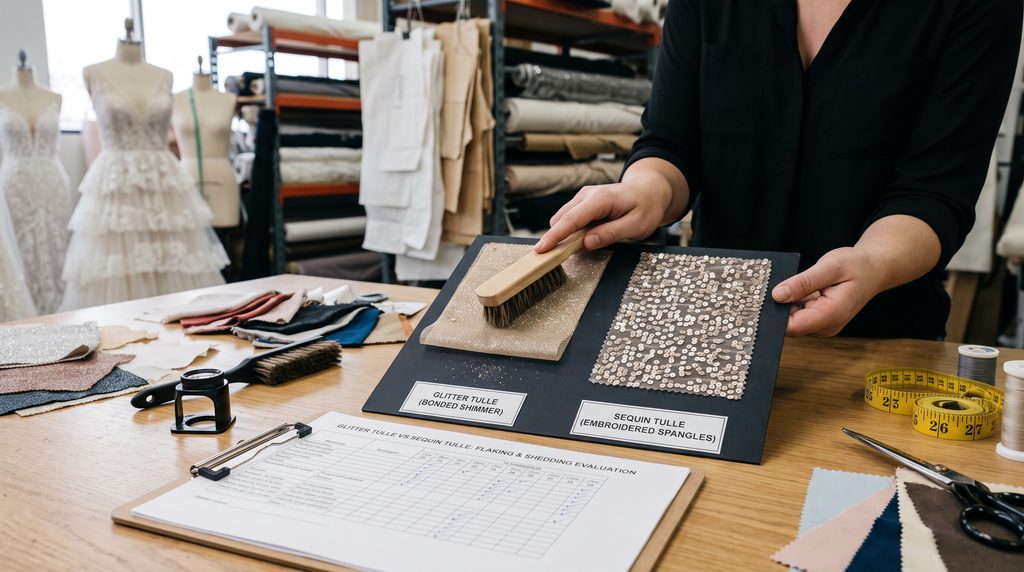
Sequin tulle resists flaking off far better than glitter tulle because industrial lockstitch machines tie individual threads around each decorative disc. Lower-grade glitter fabrics shed loose metallic particles as soon as friction occurs during transit or wear. High-grade glitter textiles utilize cured acrylic binders that grip polyester filaments firmly to minimize shedding. Evaluating certified glitter tulle vs sequin tulle before sewing prevents glitter fallout from contaminating clean atelier workrooms.
Why Do Cheap Adhesive Glitters Shed Problematic Specks?
Low-cost textile mills spray powdery glitter using watered-down PVA glues that dry brittle under room humidity. Normal garment handling fractures these weak glue bonds, releasing annoying showers of shiny dust.
Think about it:
Brides dread leaving visible metallic residues over rental car upholstery and banquet seats.
- Inferior glues crack easily when skirts fold inside garment travel bags.
- Mechanical friction between layers dislodges loosely held surface particles.
- Wash cycles strip low-grade glues, leaving gowns dull and patchy.
How Do Lockstitched Threads Prevent Missing Sequin Gaps?
Quality sequin textiles utilize continuous high-tenacity polyester threads that lock each disc into base netting nodes. Even if a snag snaps a thread, adjoining lockstitches hold neighboring spangles secure.
Here is why:
Your production runs avoid shedding shiny debris across cutting workshop tables.
The Key Takeaway for bridal manufacturers: choosing locked-thread sequin netting stops flaking issues, while top-tier glitter requires cured thermoset binders to minimize particle shedding.
| Durability Test Metric | Thermoset Glitter Mesh | Lockstitched Sequin Netting | Factory Quality Assurance |
| Martindale Rub Resistance | Minor Fleck Shedding (500 cycles) | Zero Disc Loss (2000 cycles) | Reduces clean-up across retail stores |
| Flex Fatigue Retention | 88% Particle Adhesion | 99% Mechanical Retention | Prevents bald patches along seat creases |
| Workshop Contamination | Moderate Dust Generation | Low Contamination Risk | Protects clean cutting tables from dust |
Mechanical friction tests confirm lockstitched embroidery holds embellishments securely under intense physical abrasion.
Can Glitter Tulle vs Sequin Tulle Provide Breathability?
Glitter tulle provides superior breathability because adhesive glitter flecks leave over eighty percent of hexagonal mesh pores open for free air circulation. Solid sequin discs cover mesh voids, blocking natural airflow across warm human skin. Layering dense sequin fabrics creates hot, humid microclimates that cause brides to perspire during warm summer receptions. Sourcing breathable glitter tulle vs sequin tulle guarantees voluminous ballgowns keep clients comfortable during outdoor ceremonies.
Does Open Hexagonal Netting Permit Adequate Body Cooling?
Unobstructed mesh apertures allow ambient breezes to circulate around warm torso zones without resistance. Heat generated by brides dissipates directly outward through porous netting walls, preventing heat exhaustion.
Look:
Brides remain cool and poised even while wearing twenty yards of gathered skirts.
- Open hexagonal pores circulate fresh air across sensitive body zones.
- High porosity accelerates moisture vapor evaporation during summer garden receptions.
- Unhindered thermal venting eliminates heavy sweat accumulation beneath voluminous skirts.
Can Dense Sequined Rows Trap Excessive Thermal Heat?
Solid plastic spangles act as physical barriers that block convection currents across garment linings. Bodices covered in solid sequin rows trap body warmth against human skin, causing uncomfortable perspiration.
Here is the deal:
Dense sequin overlays turn form-fitting gowns into uncomfortably warm garments under bright lighting.
The Key Takeaway for couture designers: placing breathable glitter netting across multi-layer skirts prevents overheating, while solid sequin patterns require breathable lining panels.
| Ventilation Benchmark | Open Porous Glitter Tulle | Solid Overlapping Sequin | Microclimate Comfort |
| Air Permeability | Over 550 cm³/cm²/s | Under 85 cm³/cm²/s | Unrestricted natural breeze circulation |
| Moisture Vapor Transmission | Rapid 20-Minute Venting | Trapped Condensation | Stops perspiration stains on silk linings |
| Thermal Trap Index | Low Heat Retention | High Insulative Barrier | Keeps brides comfortable under sun |
Laboratory airflow gauges prove open-pore glitter nettings evacuate body heat four times faster than overlapping sequin surfaces.
How Does Glitter Tulle vs Sequin Tulle Feel on Skin?
Glitter tulle feels noticeably smoother against bare skin because microscopic particles lack sharp edges, whereas plastic sequin discs can scratch sensitive arm and neck zones. The hard edges of polyester paillettes rub against inner arms during walking, causing redness and skin rashes. Fine glitter bonded with flexible resin produces a light sandy hand feel that slides gently over body contours. Sourcing gentle glitter tulle vs sequin tulle ensures couture eveningwear satisfies demanding private clients.
Do Sharp Metallic Disc Edges Cause Abrasive Skin Rashes?
Plastic spangles stamped from rigid polyester foils have defined perimeter edges that catch delicate skin cells. As brides swing their arms during first dances, exposed sequin borders scrape inner biceps repeatedly.
Think about it:
Unprotected armhole seams quickly ruin wedding night comfort with stinging friction burns.
- Sharp disc perimeters snag delicate veil edges and fine lace appliqués.
- Friction against bare inner arms creates uncomfortable chafing marks within hours.
- Exposed sequin borders catch on fine jewelry and delicate silk undergarments.
How Does Resin Bonding Create a Smooth Non-Scratch Touch?
Micro-glitter particles settle flat into flexible adhesive beds, creating a subtle textured finish without sharp burs. The resulting tactile surface feels slightly granular like fine sea sand, gliding painlessly across human skin.
This is what happens:
Your clients dance freely without painful friction burns along sensitive sleeve borders.
The Key Takeaway for atelier pattern cutters: bordering sequin armholes with plain mesh binding stops painful scratching, while soft glitter netting requires no perimeter padding.
| Comfort Parameter | Fine Resin Glitter Tulle | Stamped Plastic Sequin Net | Client Wearability Factor |
| Direct Skin Abrasiveness | Low (Slight Textured Grain) | High (Sharp Foil Perimeters) | Prevents painful inner arm rashes |
| Hair & Veil Snagging | Virtually Zero Catching | High Thread & Yarn Snags | Protects bridal hairstyles and fine veils |
| Neckline Lining Need | Optional Lightweight Mesh | Mandatory Soft Silk Facing | Cuts sewing steps on finished bodices |
Sensory skin tests reveal resin-bonded glitter reduces chafing, whereas exposed sequin borders demand protective interior seam facings.
Why Does Glitter Tulle vs Sequin Tulle Change Gown Drapes?
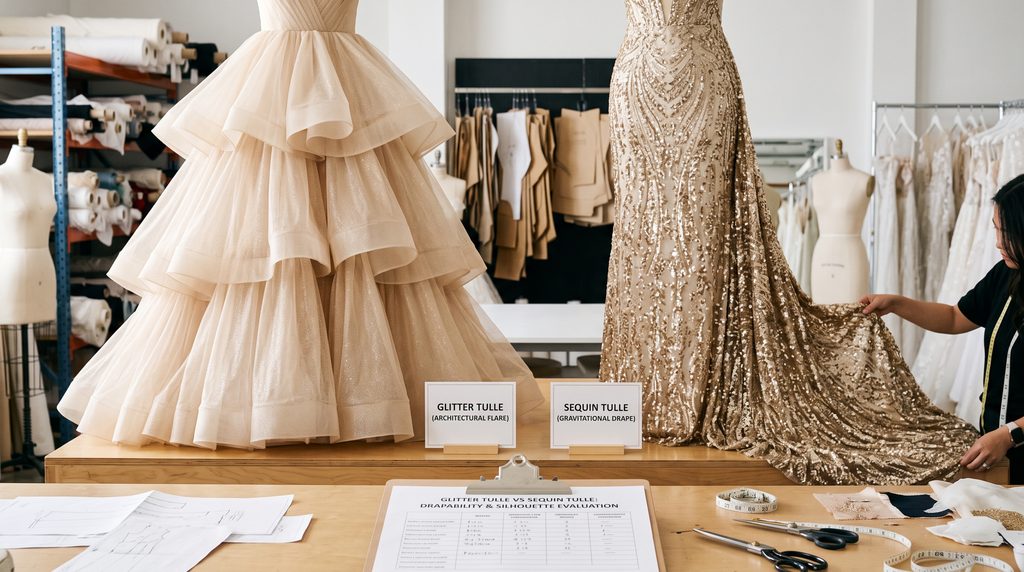
Glitter tulle vs sequin tulle changes gown drapes because heavy plastic sequins create fluid gravitational drop while light glitter preserves stiff architectural flare. The concentrated weight of embroidered spangles forces fabric to hang close to human body lines in sleek columns. Light powdered netting maintains structural rigidity that billows outward into buoyant tiered ruffles. Specifying custom glitter tulle vs sequin tulle allows creators to match textile drape with intended garment silhouettes.
Can Heavy Sequins Pull Down Structured Hemline Tiers?
The cumulative physical mass of hundreds of plastic paillettes pulls netting downward, smoothing out sharp gathering folds. This heavy downward drag produces graceful, liquid-like ripples that move alluringly across red carpets.
Ready for the good part?
Fitted evening dresses skim bodily curves smoothly without creating stiff, awkward bulges.
- Gravitational pull turns wide skirts into slender, flowing columns.
- Fluid drape follows sensual hip curves during evening galas.
- Heavy hem weights eliminate flutter in outdoor wedding breezes.
Why Does Sprayed Glitter Hold Resilient Bodice Ruffles?
Adhesive resins coat mesh yarn intersections, adding structural crispness to the underlying hexagonal weave. Pattern cutters exploit this inherent stiffness to create gravity-defying shoulder ruffles and sculptural peplums.
Look:
You can shape architectural tiers that hold dramatic puffed shapes without collapsing.
The Key Takeaway for fashion creators: selecting sequin netting produces fluid, body-skimming gowns, while glitter tulle provides structural stiffness for architectural ruffles.
| Drape Characteristic | Powder-Bonded Glitter Net | Heavily Sequined Netting | Ideal Garment Silhouette |
| Bending Rigidity | High (Self-Supporting Loft) | Low (Heavy Fluid Drop) | Sculptural flounces vs slinky gowns |
| Pleat Definition | Holds Crisp Sharp Folds | Softens into Rounded Waves | Puffed princess waists vs sleek sheaths |
| Hemline Movement | Floats Buoyantly with Wind | Swings with Gravitational Weight | Whimsical garden dresses vs gala trains |
Cantilever drape tests prove embroidered spangles produce supple downward hang, whereas resin-coated netting supports outward-flaring structures.
How Can You Cut and Sew Glitter Tulle vs Sequin Tulle?
You cut and sew glitter tulle vs sequin tulle by using carbide shears on glitter netting and clearing seam allowance sequins before machine stitching. Rotary cutters slice through resin glitter without dulling, but cutting plastic sequins fractures sharp disc edges. Atelier stitchers must snip away sequins along seam paths to prevent needle deflections and broken threads. Mastering production workflows for glitter tulle vs sequin tulle protects expensive industrial sewing equipment from damage.
How Do You Protect Cutting Shears and Machine Needles?
Striking rigid plastic spangles with high-speed sewing needles shatters discs, bends steel shafts, and skips stitches. Skilled stitchers remove paillettes from stitching margins, reserving stripped discs for hand-sewing repairs later.
Here is why:
Clearing seam margins prevents needle snaps and guarantees smooth feeding under presser feet.
- Snipping seam sequins stops needle deflection and thread breaks.
- Stripping edge paillettes eliminates bulky lumpiness across joined seams.
- Setting aside cut sequins supplies matching materials for finishing hand repairs.
What Stitch Techniques Stop Seam Allowance Ripping?
Joining delicate netting panels requires balanced thread tension and rounded ballpoint needles that slide between knit loops. Feeding sheer seam allowances alongside tear-away stabilizer paper prevents feed dogs from chewing fragile netting.
What is the real story?
Your assembly lines run smoothly without bunched fabric jams beneath throat plates.
The Key Takeaway for factory managers: stripping edge sequins stops needle damage, while using tear-away stabilizers prevents delicate glitter netting from puckering.
| Sewing Parameter | Glitter Tulle Netting | Heavily Sequined Tulle | Machine Setting Goal |
| Needle Selection | 70/10 Ballpoint (SES) | 90/14 Microtex or Jeans | Prevents yarn loop punctures & needle breaks |
| Seam Preparation | Direct Automated Cutting | Manual Seam Margin Stripping | Ensures flat seams without presser foot jams |
| Throat Plate Opening | Small Hole (Straight Stitch) | Standard Industrial Plate | Stops delicate netting getting sucked below |
Production machine settings demonstrate clearing sequin allowances protects equipment, while ballpoint needles prevent runs in glitter netting.
How Can You Iron and Clean Glitter Tulle vs Sequin Tulle?
You iron and clean glitter tulle vs sequin tulle by using low-temperature steam without direct iron contact and executing gentle spot washing instead of harsh dry cleaning. High iron heat melts synthetic glitter adhesives into sticky smears and curls plastic sequin discs permanently. Dry cleaning chemical solvents dissolve polymeric binders, causing glitter coatings to peel away in sheets. Establishing careful care rules for glitter tulle vs sequin tulle preserves garment luster throughout seasonal rental programs.
Can High Steam Temperatures Melt Heat-Sensitive Adhesives?
Pressing a hot iron soleplate onto glitter netting melts thermoset glues, gluing fabric layers into ruined, shiny clumps. Handheld vertical steamers relax wrinkles safely by holding steam nozzles several inches away from embellishments.
Think about it:
One wrong iron stroke can melt expensive bridal skirts hours before ceremony arrivals.
- Direct iron contact burns plastic sequin surfaces and curls disc edges.
- High soleplate heat liquifies glitter glues, creating dull sticky smears.
- Indirect vertical steaming releases wrinkles without compromising adhesive bonds.
How Do Dry Cleaning Solvents React with Polyester Discs?
Standard perchloroethylene solvents break down synthetic glues and strip metallic coatings off plastic sequin discs. Gentle hand washing in cold soapy water cleans dirty gown hemlines without dissolving protective binders.
Here is the deal:
Cold water hand soaks preserve brilliant shimmer across multiple client rentals.
The Key Takeaway for couture preservationists: utilizing indirect vertical steam and cold water hand washing protects delicate adhesives and keeps spangles sparkling.
| Care Operation | Safe Protocol for Glitter Tulle | Safe Protocol for Sequin Tulle | Garment Damage Risk |
| Wrinkle Removal | Vertical Steaming (10 cm away) | Low-Temp Indirect Steaming | Soleplates melt glues and warp plastic discs |
| Cleansing Method | Cold Hand Soak with Neutral Soap | Targeted Hemline Spot Cleaning | Dry clean solvents strip shimmer coatings |
| Drying Process | Flat Towel Air Drying | Padded Hanger Drip Drying | Machine tumble dryers shatter brittle sequins |
Care trials show high soleplate temperatures destroy decorative coatings, making indirect vertical steaming mandatory for gown preservation.
How Can You Source Bulk Glitter Tulle vs Sequin Tulle?
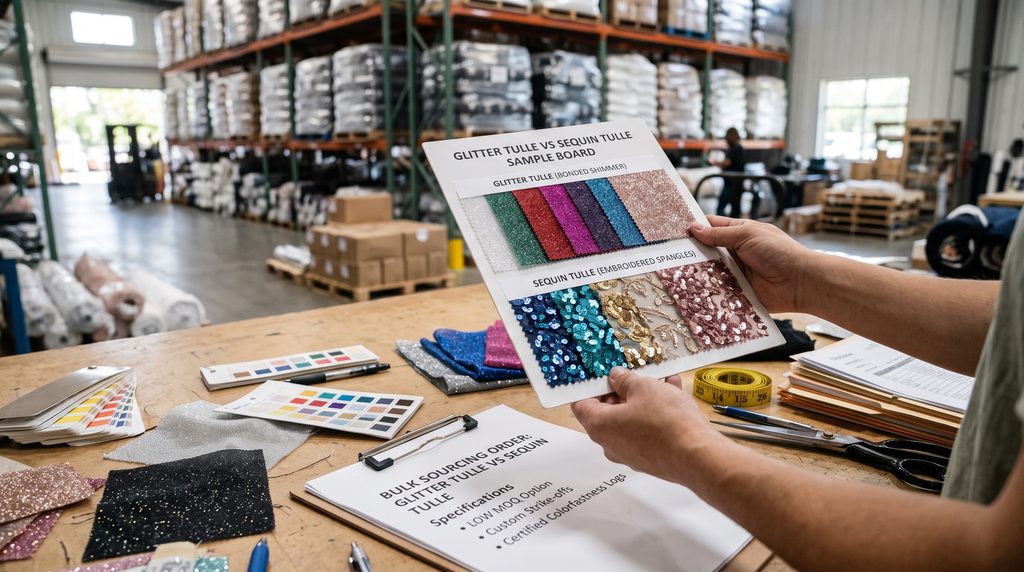
You can source bulk glitter tulle vs sequin tulle safely by partnering with verified warp-knitting mills that offer low order minimums, custom strike-off swatches, and certified colorfastness logs. Giant broker platforms force high volume minimums that tie up operating cash in slow-moving inventory rolls. Flexible textile suppliers offering lower purchasing thresholds enable emerging fashion labels to sample seasonal bridal lines without excessive risk. Inspecting physical sample swatches ensures that your chosen glitter tulle vs sequin tulle delivers the exact hand feel, sparkle density, and drape your clients expect.
What Minimum Order Terms Protect Atelier Budgets?
Forward-thinking textile mills provide practical trial minimums starting around one hundred meters per embellishment style. Ordering modest trial yardage lets you test consumer demand before committing to full container orders.
Look:
You can validate client interest across bridal trunk shows before spending major capital.
- Low minimum order quantities minimize dead stock sitting inside atelier stockrooms.
- Shorter production turnarounds keep collections responsive to wedding trends.
- Flexible dye lots allow simultaneous prototyping across ivory, champagne, and blush shades.
Why Must Designers Inspect Physical Swatches in Daylight?
Digital monitors distort true metallic reflections, glitter particle densities, and background mesh transparency. Touching physical swatch books under D65 daylight bulbs verifies hand feel, stretch recovery, and shedding rates before ordering.
Ready for the good part?
Physical swatches let production teams test sewing needle penetration and adhesion on factory machines.
The Key Takeaway for bridal sourcing directors: pairing low trial minimums with daylight swatch inspections eliminates supply chain surprises and preserves healthy production margins.
| Sourcing Milestone | Typical Timeframe | Core Deliverable | Supply Chain Benefit |
| Physical Swatch Dispatch | 24 – 48 Hours | Actual glitter & sequin strike-offs | Verifies particle shedding and skin feel |
| Custom Lab Dip Match | 3 – 5 Business Days | Multi-shade Pantone dip recipes | Guarantees exact bridal color harmony |
| Bulk Roll Production | 12 – 16 Business Days | Certified rolls with QC inspection logs | Delivers uniform sparkle across runs |
Structured procurement milestones reduce supply chain vulnerabilities and ensure dependable delivery of specialized bridal textiles.
Final Sourcing Verdict on Glitter Tulle vs Sequin Tulle
Balancing optical sparkle intensity, garment tare weight, skin comfort, and manufacturing sewability determines the commercial success of your bridal and evening collections. This technical sourcing guide answered your questions regarding binder adhesion, physical weight differences, needle setup, and maintenance protocols. Our specialized textile facility supplies precision warp-knitted meshes, fine thermoset glitter nettings, and lockstitched sequin fabrics engineered for high-end fashion ateliers. To secure certified quality yardage customized to your precise sparkle density, base mesh softness, and colorway specifications, contact us today to speak with fabric engineers and order physical sample swatches. We believe captivating bridal wear begins with disciplined textile engineering, and our manufacturing team stands ready to deliver dependable materials for your brand.
FAQ Section
- Q1: Can I combine glitter tulle and sequin tulle on the same gown? Yes, combining both textiles creates depth and visual texture across bridal skirts. Designers frequently place lockstitched sequin mesh on outer bodices while using lightweight glitter netting across voluminous underskirt layers to maintain puffiness without adding excessive weight.
- Q2: What’s the best way to stop glitter tulle from shedding during production? Specify fabrics cured with thermoset cross-linked acrylic binders and shake panels outdoors before laying patterns on cutting tables. Spraying cut pattern pieces lightly with fabric-safe aerosol fixatives can also seal raw edges during assembly.
- Q3: How do I know if sequin tulle is too heavy for a tiered ballgown skirt? Weigh your test pattern panels and calculate cumulative skirt mass. If total fabric mass exceeds three kilograms, the downward gravitational pull will collapse lower netting tiers unless supported by rigid crinoline petticoats or internal steel boning.
- Q4: Can I iron embellished tulle using high heat settings? No, high soleplate heat melts synthetic glitter glues into sticky smears and curls delicate plastic sequin discs permanently. You must use handheld vertical steamers held several inches away from fabric surfaces to release wrinkles safely.
- Q5: What’s the best needle size for sewing heavily sequined tulle? A 90/14 Microtex or sharp Jeans needle works best for sewing through tough sequin netting. Removing paillettes from seam allowances prior to sewing prevents needle deflections, skipped stitches, and broken threads during factory runs.