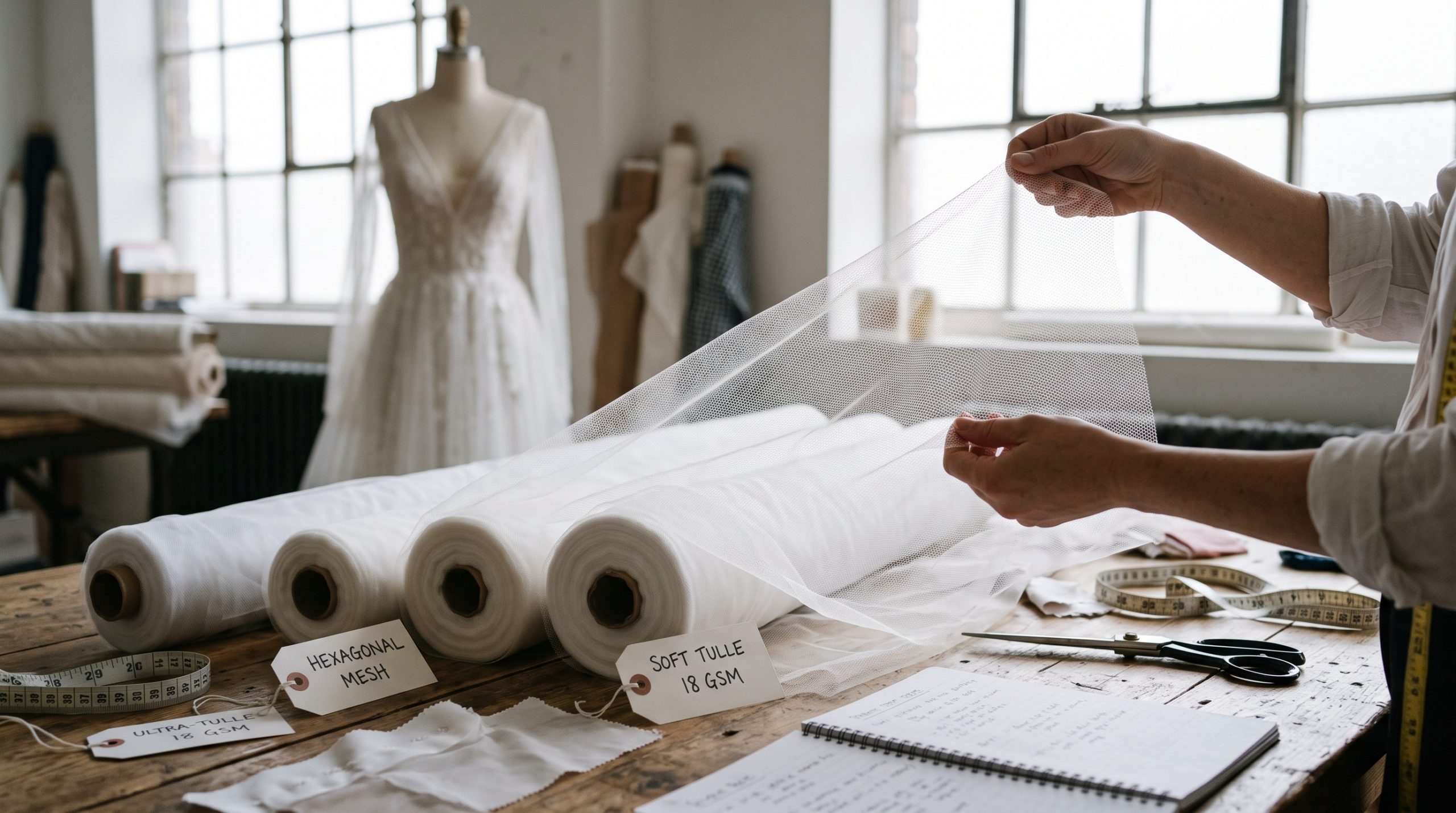
Core tulle fabric characteristics center on open hexagonal mesh geometry, sheer transparency, calibrated stiffness, and non-fraying edge stability across garment layers. Fashion houses and couture ateliers frequently battle stiff netting that scratches bare skin and tears under embroidery needles. Flimsy yardage collapses under heavy decorative lace, spoiling silhouette volume and triggering costly client returns. Specifying laboratory-tested tulle fabric characteristics from dedicated warp-knitting manufacturers secures soft skin contact, dependable loft, and flawless cutting table efficiency.
What Defines Core Tulle Fabric Characteristics?
Core tulle fabric characteristics center on interlocking warp-knitted hexagonal cells that provide lightweight volume without adding heavy garment mass. This open-cell architecture produces an ethereal veil that holds three-dimensional silhouettes while permitting steady air passage. Sourcing verified tulle fabric characteristics prevents edge unravelling during rapid workshop cutting and guarantees uniform fabric behavior across bridal tiers.
What Cell Geometry Forms Hexagonal Tulle Apertures?
High-speed Raschel and tricot knitting looms loop parallel synthetic yarns into repeating hexagonal apertures. Unlike cross-woven nets that distort when pulled on the bias, warp-knitted loops lock each aperture boundary permanently.
Here is the deal: locked cell geometry preserves uniform mesh openings during automated spreading and multi-ply cutting operations.
- Parallel yarn guides loop threads diagonally across adjacent needle courses.
- Balanced cell tension eliminates optical distortion under photography studio strobe lights.
- Interlocking loop nodes stop ladders from forming when sewing needles puncture the netting.
Which Yarn Types Determine Mechanical Durability?
Textile engineers select continuous-filament synthetic yarns to produce clean mesh walls without loose fiber fuzz. Continuous extrusion filaments yield remarkable tensile strength while keeping surface roughness minimal against bare skin.
What is the real story? You avoid seam snapping under tension because continuous filaments distribute mechanical strain evenly across the fabric web.
- Micro-denier filaments bend smoothly around gathered waistbands without producing stiff needle-like ends.
- High filament tenacity holds heavy metallic embroidery threads without perimeter tearing.
- Smooth polymer walls slide easily against satin linings without generating abrasive friction.
| Construction Parameter | Warp-Knit Hexagonal Tulle | Bobbinet Woven Net | Square Utility Netting |
| Cell Architecture | Interlocking Hexagon | Twisted Thread Hexagon | Cross-Woven Grid |
| Structural Bias Stability | High Dimensional Hold | Moderate Flexibility | Poor Diagonal Shifting |
| Edge Raveling Risk | Zero Edge Laddering | Low Fiber Slippage | High Perimeter Fraying |
This structural comparison confirms that warp-knitted hexagonal mesh delivers superior dimensional stability compared to traditional square utility netting.
Key Takeaway: Choosing authentic warp-knitted hexagonal netting speeds up factory cutting and prevents perimeter seam failure during garment wear.
How Does Mesh Shape Dictate Tulle Fabric Characteristics?
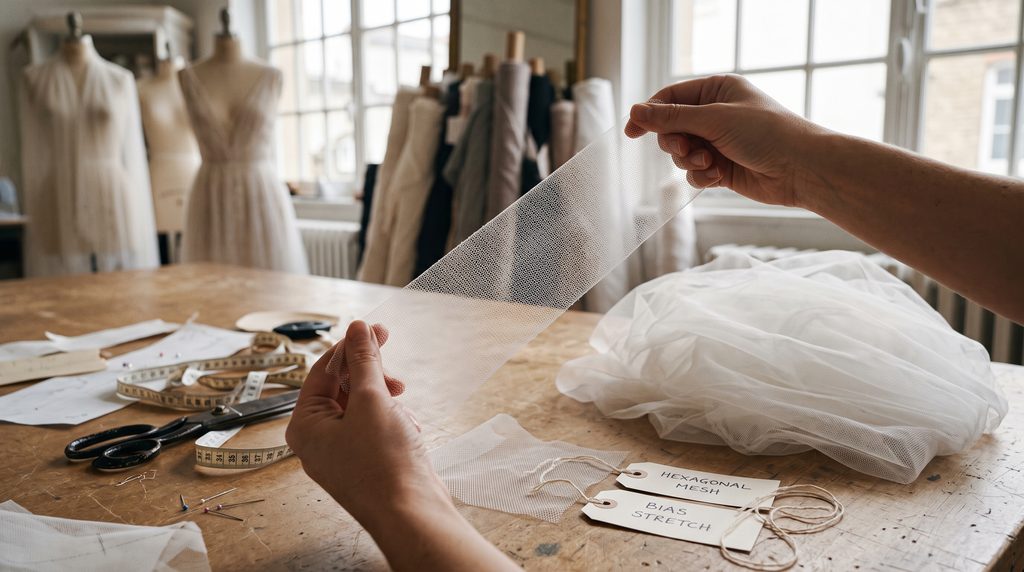
Mesh shape dictates tulle fabric characteristics by controlling diagonal tensile stretch, pore transparency, and structural recovery under outward tension. Uniform hexagonal geometry disperses pulling forces across adjacent cell walls, maintaining stable dimensions during active movement. Engineered tulle fabric characteristics allow pattern drafters to create billowing skirts that bounce back immediately after packing.
Why Does Hexagonal Mesh Outperform Square Netting?
Hexagonal cell walls share mechanical stress across six perimeter nodes rather than concentrating force at right angles. This balanced load distribution prevents localized tearing when voluminous skirts catch on furniture or shoe heels.
Think about this: square utility netting sags unevenly along the bias, but hexagonal geometry maintains balanced springiness in every direction.
- Multi-axis node connections disperse localized physical impacts across adjacent cells.
- Diagonal flexibility wraps smoothly around complex curved bodice patterns without puckering.
- Resilient cell geometry pushes crushed netting back into its original rounded shape.
How Does Aperture Gauge Govern Facial Transparency?
Knitting machine gauge defines the number of needles per inch, which directly establishes aperture pitch and wall thickness. High-gauge machines place slender yarns far apart, creating an invisible mist that reveals intricate dress lace underneath.
Look at the facts: fifty-gauge netting lets facial expressions show clearly through blusher veils without camera moiré interference.
- Slender yarn boundaries drop below digital camera sensor detection thresholds.
- Open cellular voids allow over ninety percent of ambient light to pass cleanly.
- Uniform aperture spacing eliminates dark photographic grid shadows across cheekbones.
| Machine Needle Gauge | Aperture Pitch (mm) | Light Transmittance | Visual Sheer Level |
| 50-Gauge Fine Warp | 0.7 – 0.9 mm | 94% Light Passage | Barely-There Sheer |
| 36-Gauge Standard Warp | 1.2 – 1.5 mm | 82% Light Passage | Soft Misty Veil |
| 28-Gauge Utility Loom | 2.0 – 2.5 mm | 68% Light Passage | Visible Coarse Grid |
This machine gauge breakdown illustrates how needle density directly governs optical sheer and eliminates digital camera pattern distortions.
Key Takeaway: Specifying fifty-gauge warp-knitted netting ensures bridal veils remain weightless and photograph cleanly without pattern blur.
Which Fibers Influence Tulle Fabric Characteristics?
Synthetic polyamide and polyester polymers influence tulle fabric characteristics by determining tensile fiber tenacity, moisture absorption, and tactile softness. Polyamide provides unmatched elasticity and a buttery skin feel, whereas polyester delivers exceptional color retention and thermal stability. Evaluating polymer formulations within tulle fabric characteristics ensures your production line matches tactile luxury with garment durability.
Why Do Polyamide Filaments Yield Superior Softness?
Polyamide fibers possess low flexural rigidity that allows micro-filaments to bend effortlessly upon skin contact. This supple bending response eliminates prickliness along delicate necklines, illusion sleeves, and off-the-shoulder straps.
You might wonder: why does nylon mesh feel significantly smoother than standard polyester against sensitive skin?
- Fine filament cross-sections reduce surface friction against shoulders and collarbones.
- Natural polymer elasticity accommodates dynamic elbow and arm movement without binding.
- Soft fiber tips eliminate red friction marks during long wedding ceremonies.
How Does Polyester Provide Resilient Wrinkle Recovery?
Polyethylene terephthalate chains exhibit high elastic recovery and negligible moisture absorption, making polyester netting impervious to humid weather. Gowns constructed with polyester netting hold crisp three-dimensional silhouettes even after overseas ocean container shipping.
Ready for the good part? You avoid time-consuming steamer touch-ups because polyester netting sheds transit creases within minutes.
- High molecular modulus maintains flared volume through humid outdoor events.
- Low moisture regain prevents skirt drooping during rainy garden receptions.
- Thermal dimensional stability permits high-temperature heat transfer printing.
| Fiber Polymer Blend | Tensile Elastic Recovery | Moisture Regain (%) | Tactile Skin Comfort |
| 100% Polyamide (Nylon) | 98% Recovery Rate | 4.0% – 4.5% | Cashmere-Soft Hand |
| 100% Polyester (PET) | 92% Recovery Rate | 0.4% – 0.6% | Crisp Structural Touch |
| Silk Protein Bobbinet | 85% Recovery Rate | 11.0% – 12.0% | Ultra-Delicate Vintage |
This polymer performance index demonstrates why nylon excels for skin-contact necklines while polyester provides resilient volume for expansive underskirts.
Key Takeaway: Allocating nylon netting to upper bodices and polyester netting to layered underskirts balances wearer skin comfort with architectural skirt loft.
Why Does Weight Shape Tulle Fabric Characteristics?
Fabric weight shapes tulle fabric characteristics by establishing whether netting floats as an airy blusher or anchors voluminous bridal petticoats. Material mass ranges from fourteen grams per square meter for gossamer drop veils up to seventy grams for theatrical crinoline. Selecting the correct density in tulle fabric characteristics prevents headpieces from sliding out of bridal hair while delivering dependable skirt flare.
Which Gram Weights Suit Floating Veil Blushers?
Featherlight densities measuring sixteen to twenty grams per square meter allow multi-tiered veils to hover gracefully in moving air. These slender weaves glide smoothly over floral headpieces without tugging bridal hairpins loose.
Here is the bottom line: selecting low-density yardage keeps long cathedral trains featherlight for walking brides.
- 14 to 18 GSM netting glides effortlessly across carpeted ceremony aisles.
- Slender yarn mass prevents hair combs from tilting backward during processions.
- Breathable cell voids let brides breathe comfortably beneath lowered blusher layers.
How Do Heavy Densities Anchor Voluminous Ballgowns?
Petticoats and dance tutus demand dense netting ranging between thirty-five and fifty-five grams per square meter to resist downward skirt weight. These substantial textiles push heavy satin and brocade outer fabrics outward into wide bell contours.
What is the real story? You achieve commanding ballgown puffiness without sewing cumbersome steel hoop cages into skirt linings.
- Stiff monofilament yarns hold wide pleating angles under heavy outer drapery.
- Concentrated waist gathers create horizontal ledges that elevate heavy skirt hems.
- High tear resistance withstands shoe kicks and vigorous dance floor movement.
| Weight Classification | Density Range (GSM) | Typical Filament Denier | Best Garment Application |
| Ultra-Light Sheer | 14 – 18 GSM | 12D – 15D Monofilament | Drop Blushers & Cathedral Veils |
| Medium Volume | 22 – 32 GSM | 20D – 30D Monofilament | Tiered Ruffles & Prom Overlays |
| High-Stiffness Net | 40 – 65 GSM | 40D – 60D Monofilament | Ballgown Petticoats & Tutus |
This density classification chart shows how matching fabric mass to specific structural needs guarantees proper garment elevation.
Key Takeaway: Matching fabric mass to target garment zones keeps delicate headpieces comfortable while ensuring dramatic ballgown skirts maintain commanding loft.
How Does Rigidity Alter Tulle Fabric Characteristics?
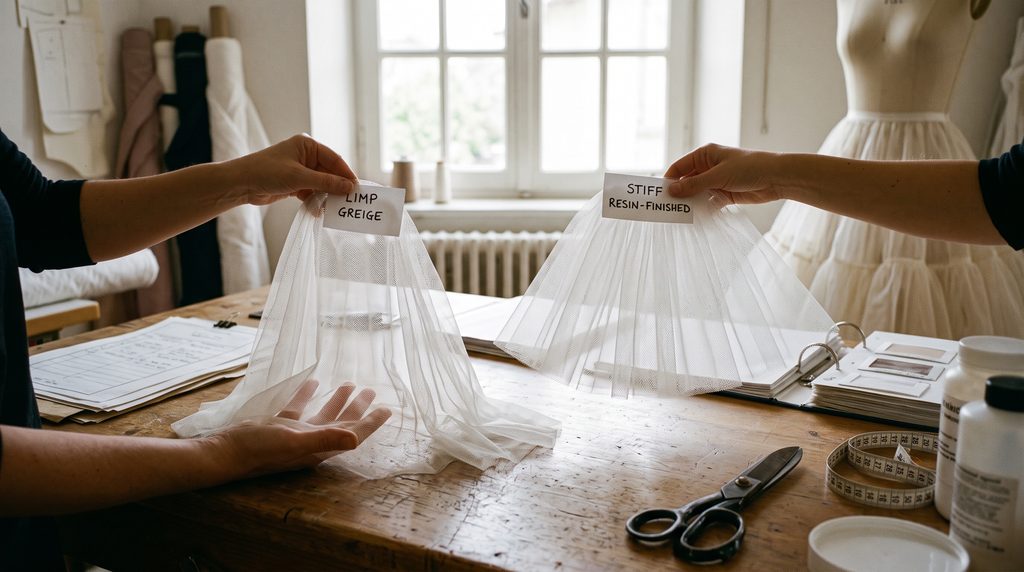
Finishing resins alter tulle fabric characteristics by transforming limp greige mesh into self-supporting structural tiers that resist gravitational collapse. Mills pass knitted netting through specialized stenter frames to apply water-based acrylic or polyurethane resins that freeze yarn intersections. Calibrating resin formulas within tulle fabric characteristics gives garment creators total control over skirt silhouette stiffness.
What Chemical Resins Create Architectural Petticoat Loft?
Cross-linking acrylic resins coat intersecting yarn nodes, locking filaments into rigid geometrical frameworks. This chemical treatment increases flexural resistance, preventing horizontal ruffles from drooping under garment layers.
Here is the deal: resin-hardened netting springs back outward immediately after being squashed inside shipping boxes.
- Thermal curing bonds resin polymers permanently into yarn junction nodes.
- High flexural modulus keeps skirt tiers standing outward horizontally.
- Elastic springback restores full silhouette puffiness straight out of packaging.
Can Supple Finishes Prevent Fitting Room Skin Rash?
Silicone-based softening emulsions coat raw synthetic filaments to create a slick surface that glides harmlessly across bare skin. Supple finishes lower friction coefficients, allowing multi-layered skirts to slide smoothly against legs.
Think about this: sensitive brides will reject a gorgeous gown immediately if rough seams cause skin irritation in the fitting room.
- Silicone smoothing agents eliminate prickly fiber burrs along raw borders.
- Low surface friction prevents netting from clinging to inner silk linings.
- Supple yarn flexibility conforms gently around moving arms and necklines.
| Softness Category | Bending Resistance (mg·cm) | Tactile Hand Quality | Placement Recommendation |
| Cashmere Soft | 15 – 25 mg·cm | Silky, Fluid, Pliant | Necklines, Sleeves, Blushers |
| Medium Balanced | 45 – 65 mg·cm | Supple with Soft Spring | Flowing Skirt Tiers & Ruffles |
| High Crinoline | 120 – 180 mg·cm | Crisp, Rigid, Unyielding | Hidden Underskirt Architecture |
This stiffness evaluation guide clarifies how resin finishing levels dictate whether a textile bends softly over shoulders or pushes heavy skirts outward.
Key Takeaway: Checking certified stiffness ratings keeps brides comfortable by isolating firm structural netting away from sensitive skin.
What Makes Tulle Fabric Characteristics Non-Fraying?
Interlocking warp knit nodes make tulle fabric characteristics non-fraying by preventing cut yarns from slipping or laddering across raw borders. Modern pattern makers cut intricate scalloped edges, circular veil borders, and tiered ruffles without needing folded hem stitches. Selecting authentic tulle fabric characteristics eliminates tedious seam sewing and accelerates factory assembly lines.
Why Do Interlocking Knit Nodes Eliminate Hem Binding?
Raschel guide bars twist continuous yarn loops through adjoining chain courses, creating mechanical knots at every intersection. Slicing through a mesh aperture leaves surrounding loops anchored, so raw borders never unravel into messy thread fringes.
Look at the facts: eliminating hem binding trims garment production labor by up to twenty-five percent across voluminous skirt designs.
- Locked knit intersections hold neighboring filaments steady along raw borders.
- Scissor cuts create crisp edges that will not shed loose yarn dust on cutting tables.
- Clean raw borders keep delicate veil perimeters visually weightless and transparent.
How Do Clean Scissor Cuts Accelerate Garment Nesting?
Automated CNC cutting blades slice through dozens of stacked fabric plies simultaneously without pulling or distorting raw borders. Clean-cutting yardage streamlines pattern nesting, reducing raw textile waste across expansive cathedral veil cuts.
What is the real story? You avoid time-consuming edge overlocking because clean raw borders maintain their structural stability through washing and wear.
- Non-curling selvages lay completely flat on automated fabric spreading tables.
- Laser cutting melts synthetic fiber ends slightly, producing smooth sealed borders.
- High cutting precision preserves delicate pattern curves across intricate lace appliques.
| Cutting & Finishing Method | Processing Time per Meter | Border Cleanliness | Visual Hem Bulk |
| Raw Rotary Scissor Cut | 5 Seconds / Meter | Clean, Zero Fraying | Weightless Invisible Border |
| Automated Laser Cut | 3 Seconds / Meter | Sealed, Smooth Border | Perfectly Flat Contour |
| Folded Rolled Hem Stitch | 45 Seconds / Meter | Thread Bound Border | Visible Opaque Border Ridge |
This cutting efficiency matrix shows how raw-edge warp knits drastically reduce labor time compared to traditional folded hem sewing.
Key Takeaway: Utilizing clean-cutting warp-knitted netting cuts workshop labor hours while delivering the airy, floating hemlines modern brides prefer.
How Does Dye Uptake Impact Tulle Fabric Characteristics?
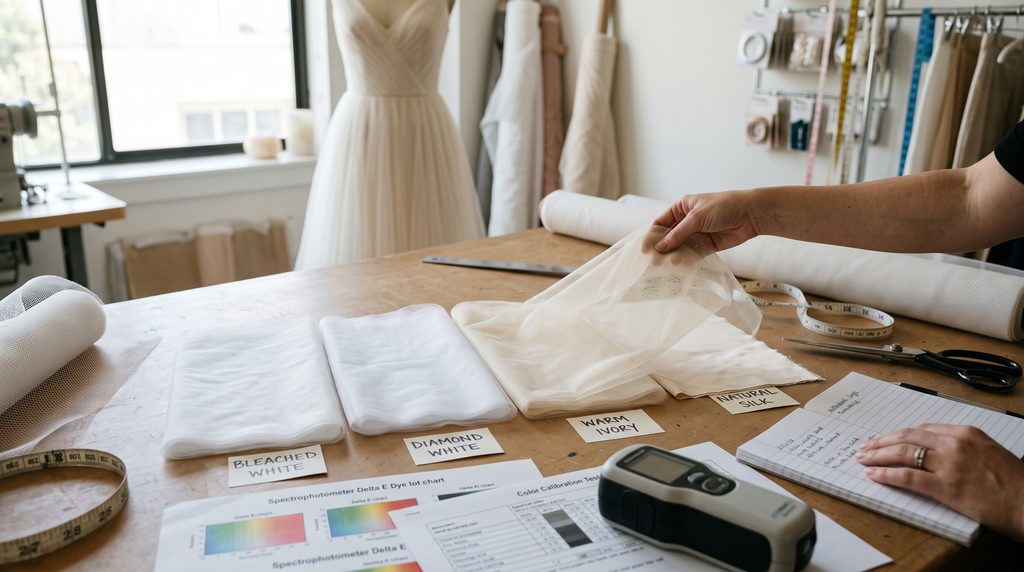
Controlled heat and dye chemistry impact tulle fabric characteristics by maintaining uniform colorfastness and preventing optical brightener glare under cameras. Synthetic fibers must undergo calibrated dye bath immersion to match warm natural silk and ivory wedding dress fabrics seamlessly. Sourcing certified tulle fabric characteristics eliminates fluorescent blue tinting that ruins formal wedding portraits.
Why Do Spectrophotometers Eliminate Camera Glare?
Computerized spectrophotometers track light reflectance curves, identifying excessive optical brightening agents that glow unnatural purple in sunlight. Formulating dye recipes without fluorescent chemicals ensures bridal accessories harmonize naturally with untreated gown silks.
Ready for the good part? Your veil collections will photograph with natural warmth under both indoor chandelier bulbs and bright outdoor sun.
- Low optical brightener formulas eliminate garish blue glare in flash photography.
- Automated color audits maintain tight Delta E color variances below 0.5 points.
- Stable disperse dyes resist fading under intense summer venue lighting.
How Do Mills Match Ivory Tones Across Bulk Bolts?
Computer-controlled dye dispensers measure liquid colorants precisely, maintaining identical color saturation across hundreds of fabric bolts. Standardized D65 daylight boxes confirm that sample cards match bulk warehouse deliveries before yardage ships to ateliers.
You might wonder: how do mills prevent color shading differences between separate production lots?
- Tension-controlled dye jiggers cycle fabric evenly through heated dye liquor.
- Calibrated temperature curves ensure deep, uniform color molecule penetration.
- Standardized light booths verify visual harmony across different commercial lighting types.
| Bridal Colorway | Target Undertone Profile | Spectrophotometer Delta E | Best Gown Match |
| Bleached Stark White | Clean High L-Value | Delta E Below 0.4 | Bright White Synthetic Crepe |
| Soft Diamond White | Neutral Balanced Pale | Delta E Below 0.4 | Natural Raw Silk & Mikado |
| Warm Bridal Ivory | Subtle Warm Yellow Hue | Delta E Below 0.4 | Antique Satin & Champagne Lace |
This color calibration chart proves that tight spectrophotometer controls guarantee seamless visual harmony between bridal netting and luxury gown silks.
Key Takeaway: Enforcing strict spectrophotometer tolerances prevents embarrassing color mismatches between veil accessories and bridal gowns.
Why Do Tulle Fabric Characteristics Prevent Odors?
Modern hot-air stenter curing and odor-free aqueous resins define tulle fabric characteristics that eliminate unpleasant chemical smells completely. Traditional stiff netting often emitted a sharp fishy odor caused by low-cost formaldehyde and amine finishing agents breakdown in storage. Verifying clean chemical processes within tulle fabric characteristics ensures bridal gowns arrive in fitting rooms fresh and ready to wear.
What Drying Cycles Eliminate Fishy Finishing Smells?
Dual-stage drying ovens heat greige netting to precise temperatures, evaporating volatile chemical compounds before rolls are wrapped in plastic. Thorough heat exposure destroys chemical residues, leaving finished bolts completely scent-free.
Here is the deal: brides will never encounter foul chemical odors when unboxing their dream wedding dresses.
- High-temperature stenter chambers bake off lingering finishing chemistry residues.
- Pure water-based acrylic polymers replace cheap amine-based cross-linking agents.
- Forced hot-air circulation extracts volatile vapors from the fabric web.
Why Do Eco-Friendly Formulations Protect Bare Skin?
Aqueous resin formulations eliminate toxic formaldehyde, preventing skin redness, itching, and allergic contact dermatitis during extended celebrations. Clean chemistry certifications confirm that synthetic textiles satisfy strict international consumer safety standards.
Think about this: sensitive wearers remain comfortable through twelve hours of wedding festivities without experiencing allergic skin irritation.
- Formaldehyde-free finishing resins eliminate chemical skin irritation risks.
- Skin-safe chemistry complies with international apparel consumer safety standards.
- Non-toxic finishing agents keep workshop air clean for garment sewing teams.
| Finishing Resin Chemistry | Residual Odor Profile | Formaldehyde Content | Skin Safety Standard |
| Aqueous Acrylic Emulsion | Completely Odorless | Zero Detectable PPM | OEKO-TEX Class 1 Safe |
| Traditional Melamine Resin | Noticeable Fishy Smell | Exceeds 75 PPM | Restricted in EU Markets |
| Natural Starch Finish | Slight Earthy Scent | Zero Formaldehyde | Washes Out in Moisture |
This chemical analysis illustrates why modern aqueous acrylic finishing provides the safest, odor-free foundation for luxury bridal apparel.
Key Takeaway: Demanding certified odor-free finishing protects your brand reputation and keeps clients happy from unboxing to the final dance.
How Do Labs Verify Tulle Fabric Characteristics?
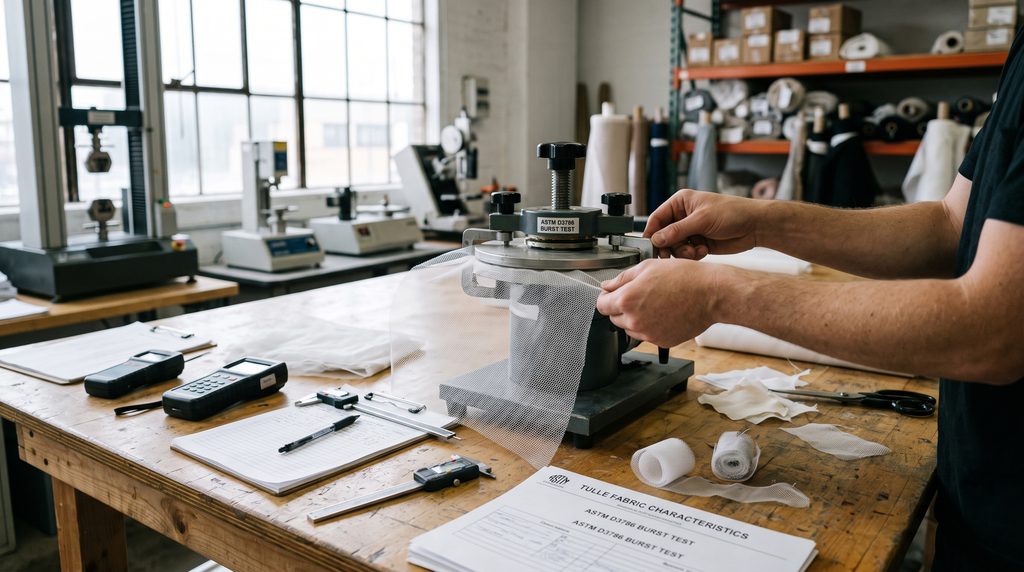
Calibrated laboratory audits verify tulle fabric characteristics through standardized seam burst testing, flexural bending measurements, and spectrophotometer color analysis. Relying solely on subjective hand feel risks shipping garments that tear at gathered seams or wilt in humid reception halls. Testing tulle fabric characteristics before bulk production safeguards your atelier against costly garment reworks.
Which Tensile Audits Measure Seam Burst Resistance?
Digital universal testing machines clamp standardized netting swatches, pulling fibers until failure to measure maximum tensile breaking strength. Ball burst tests measure how well interlocking knit nodes resist localized puncturing from sharp bridal jewelry or hairpins.
Look at the facts: verified burst strength protects multi-layered skirts from ripping during exuberant wedding dance receptions.
- ASTM D5034 grab testing evaluates breaking force along warp and weft directions.
- Ball burst penetration audits quantify resistance against sharp hairpin punctures.
- Cyclic stretch testing ensures elastic recoverability holds after repeated tension.
How Do Bending Tests Quantify Fabric Stiffness?
Cantilever bending machines measure the overhang length at which a fabric strip bends under its own weight, calculating flexural rigidity. Standardized bending data allows ateliers to order exact stiffness grades without relying on vague supplier descriptions.
What is the real story? You can replicate your best-selling dress silhouettes season after season using precise numerical stiffness benchmarks.
- Heart loop testing quantifies flexural softness for delicate facial blushers.
- Cantilever overhang scales establish reproducible numerical stiffness ratings.
- Certified lab data sheets ensure consistent fabric feel across repeat production orders.
| Laboratory Test Method | Industry Test Standard | Target Passing Value | Garment Failure Avoided |
| Seam Burst Resistance | ASTM D3786 Diaphragm | Above 180 kPa Force | Torn Waistline Gathers |
| Cantilever Bending Rigidity | ASTM D1388 Overhang | 2.5 – 4.0 cm Overhang | Limp Collapsing Skirt Tiers |
| Wash Colorfastness | ISO 105-C06 Protocol | Class 4.5 Minimum | Color Bleeding on Linings |
This testing benchmark confirms that systematic laboratory audits protect garment collections from unexpected structural failures.
Key Takeaway: Requiring documented laboratory test certificates guarantees every bulk fabric shipment matches your exact performance specifications.
How Do Mills Scale Tulle Fabric Characteristics?
Automated warp-knitting looms scale tulle fabric characteristics by maintaining constant yarn beam tension across seamless three-meter widths. Collaborating directly with primary textile mills gives fashion houses access to custom dye lots, soft resin hand-finishes, and factory wholesale pricing. Partnering directly with experienced producers secures dependable tulle fabric characteristics for large seasonal collections.
Why Do Seamless Wide Widths Minimize Cutting Waste?
Three-meter-wide fabric bolts allow pattern drafters to nest circular cathedral veils and wide ballgown skirts without piecing seams together. Extra-wide rolls eliminate visible joining seams, creating clean silhouettes while lowering fabric scrap waste.
Ready for the good part? You reduce fabric consumption by up to thirty percent across circular skirt cutting layouts.
- 300 cm wide rolls accommodate royal cathedral veils without center seams.
- Wide pattern nesting maximizes fabric yield across high-volume production cuts.
- Flat roll selvages feed smoothly through automated fabric spreading machines.
What Audit Records Safeguard Wholesale Supply Chains?
Factory audit records verify machine maintenance logs, in-house quality inspection procedures, and international environmental compliance certificates. Direct mill partnerships reduce supply chain lead times and eliminate third-party broker markups.
You might wonder: how can growing fashion brands secure flexible order quantities from large textile manufacturers?
- Flexible trial minimums between 100 and 300 meters lower development risks.
- Rapid lab dip services provide custom color swatches within forty-eight hours.
- Transparent lot tracking ensures seamless quality consistency across bulk runs.
| Sourcing Channel | Minimum Order Size | Production Lead Time | Width Customization |
| Direct Knitting Mill | 100m – 300m Flexible | 10 to 14 Business Days | Full Custom up to 300cm |
| Fabric Jobber / Importer | Single Bolt (50m) | Immediate Stock Pull | Limited Narrow Widths |
| Retail Fabric Store | Cut Yardage by Meter | Immediate In-Store | Pre-Cut 140cm Narrow Bolts |
This sourcing channel comparison illustrates why working directly with primary textile producers yields superior custom widths and healthy gross margins.
Key Takeaway: Partnering directly with certified warp-knitting mills delivers seamless wide bolts that eliminate center seams and maximize workshop profits.
Strategic Sourcing for Tulle Garment Collections
Balancing ethereal transparency against structural loft resolves common atelier challenges regarding scratchy netting, photographic glare, and edge unravelling. Choosing precision-engineered warp-knit constructions protects your bridal line against unsightly runs, seam sagging, and color clashes beside natural wedding silks. Our advanced textile manufacturing facility produces specialized warp-knit netting, versatile three-meter widths, and certified skin-safe fabrics tailored to your exact custom specifications. We stand committed to equipping global apparel brands with resilient, luxurious textiles that inspire absolute design confidence. To request premium swatch cards or discuss custom development for your upcoming collection, contact us today and speak with our technical textile specialists.
Frequently Asked Questions
Q1: Can I steam tulle fabric directly with a hot iron?
No, you should never touch synthetic tulle directly with a hot metal iron plate because synthetic filaments melt instantly under direct heat. You should instead use indirect diffused steam held four to six inches away from the netting to safely relax packing creases.
Q2: What is the best veil fabric to prevent static cling?
Pure silk tulle and nylon netting treated with topical antistatic finishes are the best options for eliminating static cling. These textiles discharge static electrical charges rapidly, preventing sheer veil tiers from sticking awkwardly to bridal gown skirts during dry winter ceremonies.
Q3: How do I know if netting will clash with ivory silk?
Examine fabric swatches alongside your gown silk inside a standardized D65 daylight box to detect undertone variances. Netting containing heavy optical brighteners fluoresces with a cold bluish glare, while warm ivory meshes blend smoothly with natural silk fibers.
Q4: Can I stitch heavy beaded lace borders onto fine mesh?
Yes, you can stitch heavy lace trims onto fine mesh by choosing two-bar warp-knitted netting rather than delicate woven bobbinet. The locked knitted nodes distribute concentrated bead weight evenly across surrounding hexagonal cells, preventing localized tearing along the perimeter hemline.
Q5: What is the best netting weight for cathedral veils?
Lightweight netting measuring between sixteen and twenty grams per square meter is the best choice for royal cathedral veils. This featherlight density lets expansive three-meter trains float effortlessly behind the bride without pulling hair combs or causing uncomfortable neck fatigue.