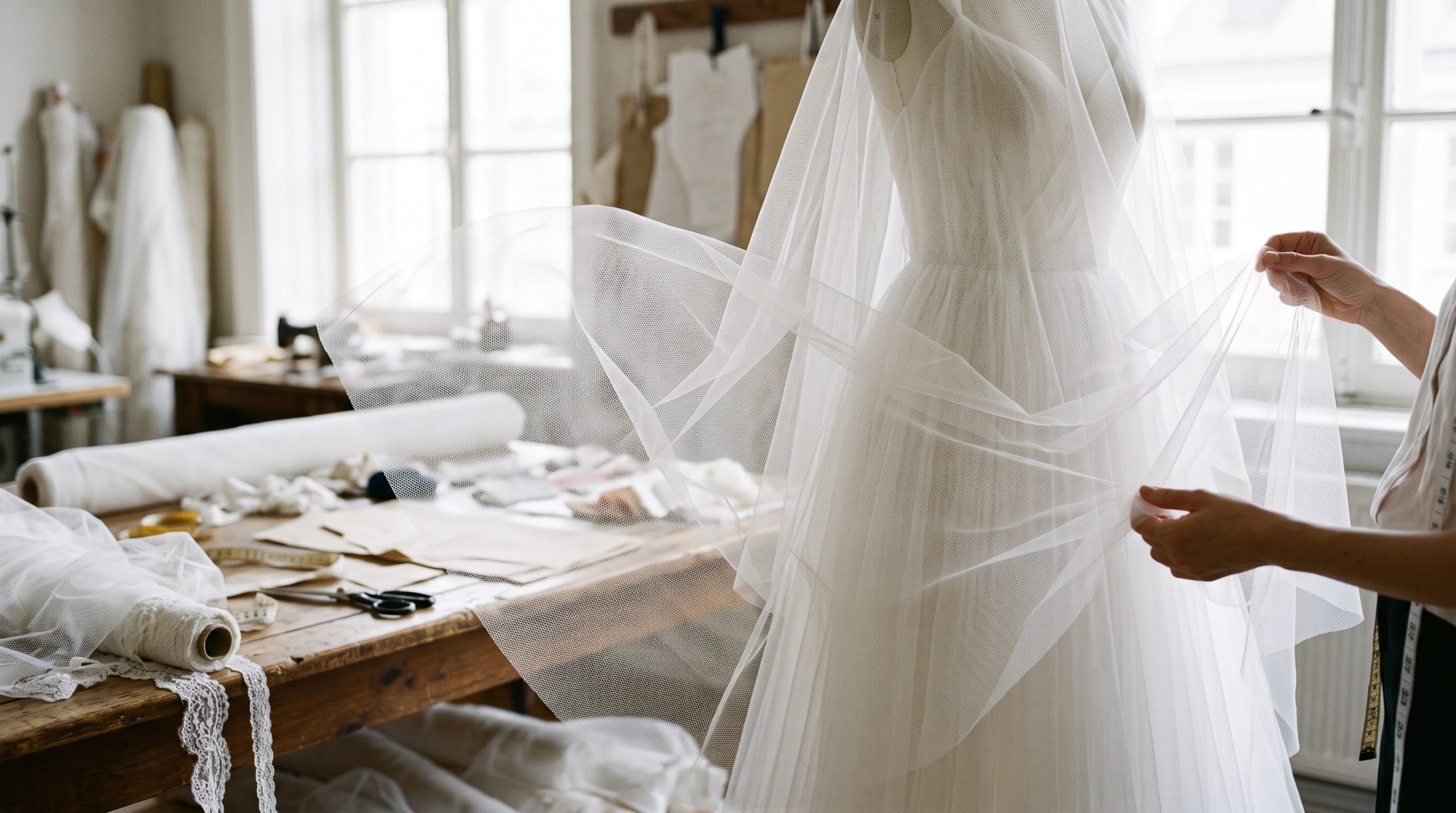
Illusion tulle fabric delivers unmatched sheer transparency, buoyant architectural loft, and clean raw-edge stability for modern bridal gowns. Bridal ateliers frequently struggle with limp, scratchy netting that clashes against luxurious wedding silks. Substandard veil yardage collapses beneath heavy lace appliques, spoiling silhouette proportions and frustrating discerning couture brides. Specifying laboratory-tested illusion tulle fabric from specialized warp-knitting manufacturers secures fluid movement, soft skin contact, and pristine photographic clarity.
What Defines Authentic Illusion Tulle Fabric?
Authentic illusion tulle fabric represents an ultra-fine, lightweight open netting knitted on high-speed warp looms to produce stable hexagonal cells. This micro-aperture geometry gives the textile its signature barely-there transparency while maintaining dimensional stability against mechanical pulling. Selecting precision-knitted illusion tulle fabric prevents edge fraying during rapid cutting and keeps raw perimeter borders flat.
What Cell Geometry Forms Hexagonal Illusion Netting?
Precision guide bars interloop parallel synthetic yarns across adjacent needles to create continuous honeycomb boundaries. Traditional woven nettings shift when pulled diagonally, but locked warp knits anchor every interlocking loop permanently.
Here is the deal: stable cell geometry stops raw borders from unraveling during rapid scissor cutting.
- Parallel synthetic filaments loop diagonally across reciprocal knit courses.
- Uniform cell tension eliminates optical distortion under photography studio lighting.
- Locked knit nodes prevent laddering runs when sewing needles pierce the netting.
Which Synthetic Filaments Deliver Raw Edge Stability?
Continuous extrusion polyamide filaments deliver extraordinary tensile strength along delicate mesh borders. Locked warp-knit intersections keep neighboring threads steady when pattern makers slice through multiple plies simultaneously.
What is the real story? You avoid time-consuming edge binding because clean-cut borders stay neat without unravelling.
- Micro-filament yarns bend smoothly under manual manipulation without kinking.
- High tensile strength resists ripping along gathered waistlines and comb attachments.
- Controlled extrusion yields pristine surface smoothness that eliminates skin scratching.
| Construction Method | Aperture Stability | Raveling Risk | Edge Finish Quality |
| Warp-Knit Raschel | High Stability | Zero Laddering | Clean Scissor Border |
| Bobbinet Weave | Moderate Flex | Low Fraying | Delicate Raw Edge |
| Plain Square Mesh | Shifting Voids | High Unraveling | Requires Hem Binding |
This manufacturing comparison confirms that warp-knitted hexagonal netting withstands intense garment assembly without perimeter fraying.
Key Takeaway: Choosing authentic warp-knitted hexagonal netting speeds up cutting room throughput and protects garments from embarrassing edge unraveling during weddings.
Why Pick Illusion Tulle Fabric Over Soft Tulle?
You should pick illusion tulle fabric over soft tulle when your design requires crisp structural loft, lightweight blusher volume, and transparent facial visibility. While soft tulle drapes in relaxed vertical folds, illusion netting possesses enough tensile spring to stand away from hairstyles and shoulder lace. Specifying authentic illusion tulle fabric allows bridal accessory makers to sculpt floating tiers that maintain their rounded contours.
How Does Drape Rigidity Vary Against Soft Netting?
Soft tulle incorporates heavier denier threads with lower resin finishing, producing a sleepy, downward drop. Illusion netting balances slender synthetic fibers with thermal heat-setting to hold three-dimensional shapes without steel wires.
Think about this: heavy fabrics drag down bridal hair, but buoyant netting floats effortlessly throughout long reception hours.
- Slender filaments bounce back immediately after compression inside garment bags.
- Calibrated bending rigidity creates wide circular puffiness around veil crowns.
- Resilient pore structures prevent blusher tiers from clinging to wet makeup.
Which Gown Silhouettes Demand Crisp Loft?
Structured ballgowns, dropped-waist silhouettes, and tiered skirts require the architectural support that crisp netting provides. Pairing limp veil materials with wide skirts creates an unbalanced aesthetic that diminishes gown presence.
Look at the facts: voluminous bridal trains demand complementary accessories that project outward with commanding authority.
- Multi-tier fingertip veils frame bridal shoulders with crisp symmetry.
- Bouffant blushers stay lifted above elaborate wedding hairstyles.
- Structured bell silhouettes balance expansive crinoline skirt dimensions.
| Textile Type | Average Bending Modulus | Transparency Level | Target Silhouette Role |
| Illusion Tulle | Moderate (4.2 GPa) | 92% Light Passage | Structured Blushers & Tiers |
| Soft Netting | Low (1.8 GPa) | 78% Light Passage | Flowing Bohemian Capes |
| Heavy Crinoline | High (9.5 GPa) | 60% Light Passage | Concealed Underskirt Support |
This performance index highlights how balanced bending stiffness delivers upright structural volume without sacrificing delicate visual sheer.
Key Takeaway: Specifying crisp illusion netting gives your bridal collection architectural volume that photographs beautifully and keeps facial features unobstructed.
How Does Italian Tulle Differ from Illusion Tulle Fabric?
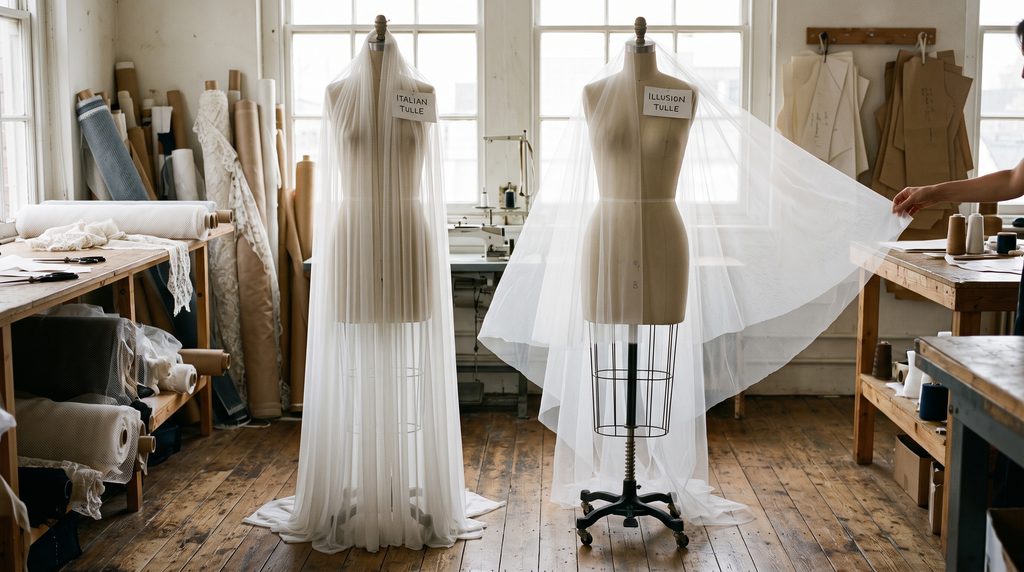
Italian tulle differs from illusion tulle fabric by offering a heavier, silkier handfeel that produces column-like vertical cascades rather than buoyant cloud volume. Artisans craft Italian netting with specialized micro-modal or polyamide blends that replicate antique silk bobbinet drapery. Selecting engineered illusion tulle fabric remains preferable when your target silhouette demands independent horizontal flare and lightweight headpiece comfort.
Does Italian Netting Provide Softer Surface Contact?
Italian netting features ultra-fine yarn counts processed with softening emulsions to eliminate abrasive fiber tips. The resulting material slides across bare skin with cashmere-soft touch, minimizing redness along sensitive necklines.
You might wonder: why does Italian mesh hang closer to the body during movement?
- Weighted yarn bundles pull the textile downward into vertical drape columns.
- Low bending resistance lets fabric puddle softly across carpeted floors.
- Silky finishing agents reduce tactile skin friction during summer ceremonies.
Which Styling Needs Weighted Liquid Cascades?
Minimalist slip gowns, sheath dresses, and bohemian lace designs harmonize best with the fluid fall of Italian net. Structured netting clashes with slinky silhouettes, making liquid drapery the natural choice for modern column cuts.
Ready for the good part? You can layer Italian mesh over silk gowns without disrupting clean dress profiles.
- Hugs natural body contours without expanding outer silhouette dimensions.
- Pools into romantic ripples behind walking brides during chapel processionals.
- Coordinates seamlessly with bias-cut satin and low-back wedding gowns.
| Drapery Metric | Italian Soft Tulle | Hexagonal Illusion Tulle |
| Fabric Mass (GSM) | 28 – 34 GSM | 16 – 22 GSM |
| Silhouette Projection | Slender Vertical Fall | Outward Buoyant Flare |
| Wind Billow Reaction | Stays Close to Frame | Catches Breeze Gently |
This drapery breakdown demonstrates how yarn mass directly governs whether a bridal accessory hugs body curves or projects outward.
Key Takeaway: Reserve Italian net for relaxed column gowns that require liquid cascades, and rely on illusion netting for buoyant bridal loft.
Is Silk Net More Luxurious Than Illusion Tulle Fabric?
Pure silk net provides unmatched historical prestige and organic drape, but illusion tulle fabric delivers superior wrinkle resistance, tensile strength, and accessible pricing for commercial bridal production. Authentic silk tulle originates from mulberry protein fibers woven on delicate antique bobbinet machinery. Modern ateliers balance silk net for bespoke royal commissions against durable illusion tulle fabric for large-scale designer collections.
What Distinguishes Silk Net from Synthetic Fibers?
Natural silk filaments feature a triangular cross-section that refracts light with an organic pearlescent glow rather than a synthetic shine. The delicate protein matrix drapes against the body with gossamer weight that synthetic fibers rarely achieve.
Here is the bottom line: genuine silk net breathes naturally and resists static charges completely.
- Continuous silk fibroin fibers eliminate artificial synthetic glare.
- Natural protein bonds disperse static electrical charges instantly.
- Breathable cell voids keep brides comfortable across warm garden venues.
How Do Looms Influence Transparency and Tactile Feel?
Antique bobbinet looms twist threads together under low tension, producing soft hexagonal apertures that yield fragile elegance. High-speed warp knits lock monofilament yarns securely, giving synthetic mesh the resilience needed for heavy embellishments.
What is the real story? Silk netting tears easily under needle tension, requiring painstaking manual hand-sewing.
- Bobbinet weaving creates airy hexagonal pores with vintage texture.
- Warp knitting locks knit loops to prevent tearing under machine sewing.
- Synthetic monofilaments withstand high-heat pressing without fiber degradation.
| Performance Attribute | Authentic Silk Bobbinet | High-Tenacity Illusion Tulle |
| Raw Fiber Composition | 100% Mulberry Silk | 100% Extruded Polyamide |
| Wrinkle Sensitivity | High (Creases Easily) | Low (Bounces Back Quickly) |
| Sewing Durability | Fragile Hand-Sew Only | Robust Machine Stitchable |
This comparative chart illustrates why silk net commands ultra-luxury bespoke pricing while illusion mesh provides durable efficiency for bridal ateliers.
Key Takeaway: Specifying illusion netting protects your production line from catastrophic sewing tears while offering brides resilient luxury at accessible price points.
Why Does Illusion Tulle Fabric Excel in Transparency?
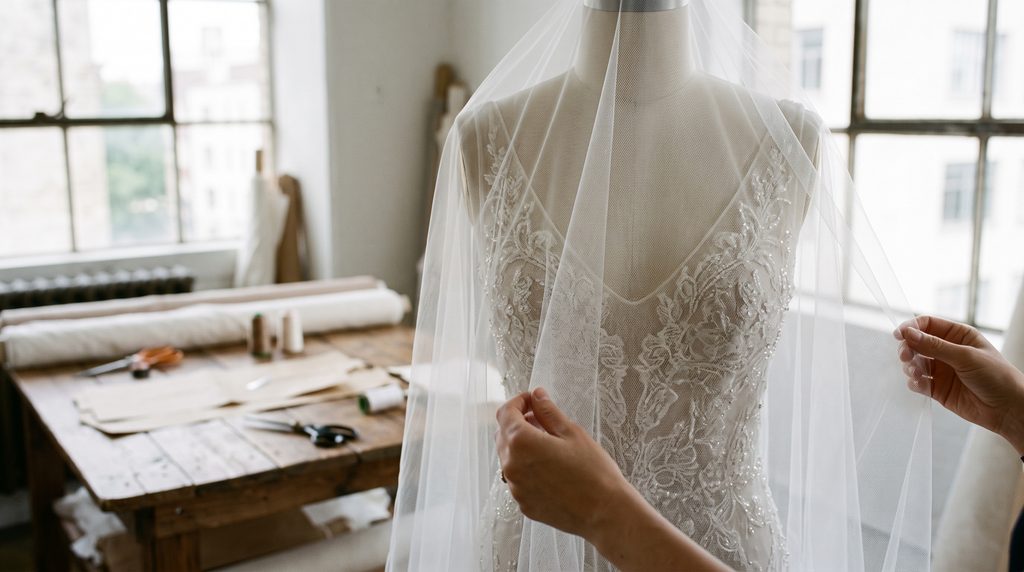
Illusion tulle fabric excels in optical transparency because its high-gauge knitting spreads micro-denier yarns far apart, allowing maximum light passage without optical distortion. Coarse utility nettings diffuse light randomly, producing cloudy barriers that obscure bridal facial expressions. Sourcing precision-engineered illusion tulle fabric ensures wedding photographers capture razor-sharp portrait focus straight through delicate blusher layers.
How Do Aperture Gauges Eliminate Camera Moiré?
Fine fifty-gauge knitting machines produce microscopic aperture walls that drop below digital camera sensor resolutions. Coarse netting creates optical interference lines known as moiré patterns when flash photography strikes regular mesh grids.
Here is the deal: ultra-fine knitting gauges keep digital wedding portraits crisp, clean, and free of distracting digital banding.
- Microscopic aperture boundaries diffuse camera flash into a gentle glow.
- Tight yarn interlooping prevents dark optical grid shadows across cheekbones.
- Fifty-gauge construction prevents digital camera sensor moiré interference.
Can Fine Denier Filaments Create Barely-There Illusions?
Filaments measuring twelve to fifteen denier are so slender that they become virtually invisible when held against skin. This microscopic yarn diameter creates the optical sensation that lace motifs float unsupported on collarbones and sleeves.
What is the real story? You can design dramatic illusion necklines that look completely seamless from two feet away.
- Fifteen-denier nylon threads match human skin light absorption properties.
- Low filament reflectivity eliminates artificial synthetic sheen under venue lighting.
- Open cellular voids let natural skin tones project cleanly through the textile.
| Knitting Machine Gauge | Aperture Pitch (mm) | Light Transmittance | Photographic Clarity |
| 50-Gauge High-Speed | 0.8 mm Hexagonal | 94% Transmittance | Zero Moiré Distortion |
| 36-Gauge Standard | 1.4 mm Diamond | 82% Transmittance | Occasional Moiré Lines |
| 28-Gauge Utility Net | 2.2 mm Square | 68% Transmittance | High Optical Cloudiness |
This technical optical data demonstrates how machine knitting gauge dictates photographic transparency and eliminates sensor interference.
Key Takeaway: Insisting on fifty-gauge warp-knitted textiles protects your bridal clients from cloudy wedding photos and annoying digital moiré artifacts.
What Makes Illusion Tulle Fabric Ideal for Necklines?
Illusion tulle fabric is ideal for bodices and necklines because its balanced four-way mechanical elasticity hugs anatomical contours smoothly without wrinkles or bagging. Standard woven fabrics buckle when cut along curved necklines, creating unsightly gapes along collarbones. Choosing supple illusion tulle fabric gives couture dressmakers a stable foundation that secures plunging necklines comfortably against the skin.
Why Do Skin-Tone Shades Prevent Visible Seam Lines?
Dyehouses calibrate illusion netting across extensive nude palettes to match fair, olive, and deep skin undertones flawlessly. When netting matches skin undertones, neckline seams vanish completely, leaving embroidered motifs to command center stage.
Think about this: a tonal mismatch creates an obvious fabric border that distracts from luxury bridal lace.
- Neutral undertone formulations prevent grayish cast under fluorescent bulbs.
- Warm tan shades harmonize naturally with golden skin tones.
- Deep mocha hues ensure complete visual invisibility for brides of color.
How Does Four-Way Stretch Stabilize Fitted Bodices?
Knitted elastic loops yield dynamic elongation that moves in harmony with breathing, dancing, and arm lifting. The material springs back into position without bagging or pushing bodices downward throughout active events.
Look at the facts: flexible mesh stabilizes deep plunge bodices without relying on restrictive boning channels.
- Controlled elongation secures corsetry firmly against chest walls.
- Resilient recovery prevents gaping when brides bend or sit down.
- Soft thread nodes avoid digging into sensitive armpit tissue.
| Skin Matching Category | Target Undertone Curve | Dye Spectrophotometer Standard | Visual Result |
| Fair Porcelain | Neutral Pink / Yellow | Delta E Below 0.4 | Seamless Collarbone Blending |
| Warm Olive | Golden Yellow / Tan | Delta E Below 0.4 | Invisible Shoulder Straps |
| Deep Espresso | Rich Red / Brown | Delta E Below 0.4 | Natural Floating Lace Effect |
This colorimetric calibration confirms that precise undertone formulation eliminates visible fabric boundaries across diverse bridal skin types.
Key Takeaway: Stocking an inclusive range of skin-matched illusion meshes empowers your atelier to create plunging necklines that look completely invisible on every bride.
How Does Weight Dictate Illusion Tulle Fabric Drape?
Fabric weight measured in grams per square meter dictates whether illusion tulle fabric floats like a cloud or anchors cathedral veils with steady downward momentum. Netting weighing fifteen grams per square meter produces featherlight drop blushers, while thirty grams per square meter provides crisp structural tiers. Selecting the right weight of illusion tulle fabric prevents heavy headpieces from sliding out of bridal hair during ceremonies.
What Fabric Densities Work for Royal Cathedral Veils?
Cathedral veils stretching three to four meters behind the bride require lightweight netting between sixteen and twenty grams per square meter. Heavier materials drag heavily against aisle runners, pulling headpieces backward and causing severe scalp discomfort.
Ready for the good part? You can craft dramatic royal-length veils that weigh under one hundred grams total.
- 14 to 18 GSM netting glides effortlessly across carpeted ceremony aisles.
- Lightweight yardage prevents hair combs from loosening during processions.
- Slender filament densities eliminate neck strain during extended formal ceremonies.
How Does Finishing Resin Govern Mechanical Loft?
Chemical finishing baths coat knitted greige netting with controlled concentrations of water-based stabilizing resins. Higher resin concentrations increase filament bending stiffness, transforming soft netting into self-supporting structural tiers.
You might wonder: how do mills control crispness without making the netting brittle?
- Thermal stenter frames bake resins permanently into yarn intersections.
- Regulated bath pickups create uniform springiness across entire fabric bolts.
- Low-odor finishing chemistries eliminate offensive chemical fish smells completely.
| Mass Density Range | Yarn Count (Denier) | Primary Accessory Match | Drape Profile |
| Ultra-Light (14 – 17 GSM) | 12D – 15D Monofilament | Cathedral & Drop Veils | Floating Weightless Cloud |
| Medium (18 – 24 GSM) | 18D – 20D Monofilament | Fingertip & Elbow Tiers | Balanced Crisp Contour |
| Heavy (25 – 32 GSM) | 25D – 30D Monofilament | Tiered Crinoline Veils | Outward Self-Supporting Body |
This weight distribution guide helps designers match fabric mass with specific veil lengths to guarantee bride comfort and graceful movement.
Key Takeaway: Matching fabric mass to target veil length eliminates comb slippage and ensures expansive royal trains glide effortlessly down the aisle.
Can Illusion Tulle Fabric Support Heavy Embroidery?
Illusion tulle fabric supports dense embroidery and beaded lace appliques when produced on warp-knitting raschel machines that lock fiber intersections against needle puncture stress. Standard non-woven or circular knits rip when pierced thousands of times by heavy industrial embroidery needles. Choosing high-tenacity illusion tulle fabric ensures delicate mesh handles heavy crystal beadwork without sagging or tearing.
Can Locked Warp Knits Withstand Machine Needle Punching?
Raschel warp knitting binds adjoining courses together with interlocking chain loops that isolate needle damage to individual pores. When high-speed multi-head embroidery needles penetrate the netting, neighboring loops absorb mechanical impact without laddering.
Here is the bottom line: locked knit nodes prevent embroidery tear-outs that ruin hours of meticulous atelier handwork.
- Dual-bar warp knitting prevents needle holes from propagating into runs.
- Heat-stabilized yarns resist fiber friction generated by high-speed sewing threads.
- High filament tenacity holds heavy metallic embroidery threads securely.
How Do Stabilized Nodes Support Beaded Appliques?
Dense rows of glass seed beads, sequins, and pearl trims concentrate significant downward weight along narrow border seams. Stabilized warp nodes distribute this localized gravitational tension across surrounding hexagonal cells evenly.
What is the real story? You can apply lavish Alençon lace trims without worrying about wavy, distorted veil perimeters.
- Interlocking nodes disperse bead weight across wide fabric surface areas.
- High dimensional stability keeps scalloped lace borders lying perfectly flat.
- Minimal residual shrinkage prevents fabric puckering during post-embroidery pressing.
| Stitch Density (Stitches/cm²) | Tear Resistance Rating | Bead Load Capacity | Seam Puckering Risk |
| Low (10 – 25 Stitches) | Flawless Stability | Up to 150g per meter | Zero Puckering |
| Medium (26 – 50 Stitches) | Verified High Retention | Up to 350g per meter | Minimal Under Pressing |
| Heavy (50+ Stitches) | Specialized Net Required | Exceeds 500g per meter | Requires Stabilizer Backing |
This structural embroidery test data proves that locked warp-knit intersections provide the mechanical backbone needed to carry heavy beaded motifs safely.
Key Takeaway: Specifying locked-node warp netting protects your atelier from catastrophic embroidery tears and ensures lavish lace veils stay smooth.
How Do You Test Illusion Tulle Fabric Quality in Labs?
Testing illusion tulle fabric quality in laboratories requires standardized evaluations measuring seam burst strength, lightfastness, and optical brightening agent concentrations before cutting bolts. Relying solely on tactile inspections risks sending garments down the runway that glow purple under venue lighting or tear at comb attachments. Performing rigorous audits on your illusion tulle fabric guarantees consistent roll-to-roll performance across busy wedding seasons.
Which Lab Audits Measure Seam Burst and Tear Limits?
Mechanical tensile testing clamps pull standardized mesh swatches until yarn rupture to record maximum breaking force in Newtons. Cyclic pull testing ensures the netting withstands the vigorous handling brides inflict during dressing and dancing.
Here is the deal: verifying certified tensile strength keeps your atelier free from frantic fitting-room repair emergencies.
- ASTM D5034 grab testing measures breaking strength along warp and weft directions.
- Ball burst audits evaluate resistance to localized punctures from sharp hairpins.
- Elongation recovery tests track elasticity decay over repetitive stretch cycles.
How Do Spectrophotometers Prevent Fluorescent Glare?
Spectrophotometers analyze light reflectance curves to detect excessive optical brighteners that ruin photographic portrait shoots. Too much brightener absorbs ambient ultraviolet light and fluoresces as a garish bluish glow next to natural silk gowns.
This is where it gets interesting… scientific color audits prevent bridal veils from turning fluorescent purple in outdoor photography.
- Calibrated D65 light booths reveal subtle yellow-to-blue shade discrepancies.
- Spectrophotometer Delta E readings maintain color variance below 0.5 points.
- UV-filtered audits guarantee netting harmonizes with untreated silk threads.
| Laboratory Test Method | Industry Benchmark Standard | Acceptance Threshold | Production Risk Avoided |
| ASTM D5034 Breaking Force | Minimum 25 N Warp / 22 N Weft | Grade 1 Approval | Edge Tearing During Assembly |
| AATCC 16.3 Colorfastness | Xenon Lamp Exposure (40 hrs) | Class 4.5 Minimum | Solar Fading at Outdoor Events |
| Spectrophotometer Delta E | CIE Lab Color Space Variance | Delta E Under 0.5 | Mismatched Gown & Veil Hues |
This quality assurance matrix shows how systematic lab evaluations prevent costly material failures before rolls reach garment cutting tables.
Key Takeaway: Requiring documented tensile and colorimetric test certificates protects your brand reputation against tearing seams and embarrassing color mismatches.
How Can Ateliers Source Illusion Tulle Fabric in Bulk?
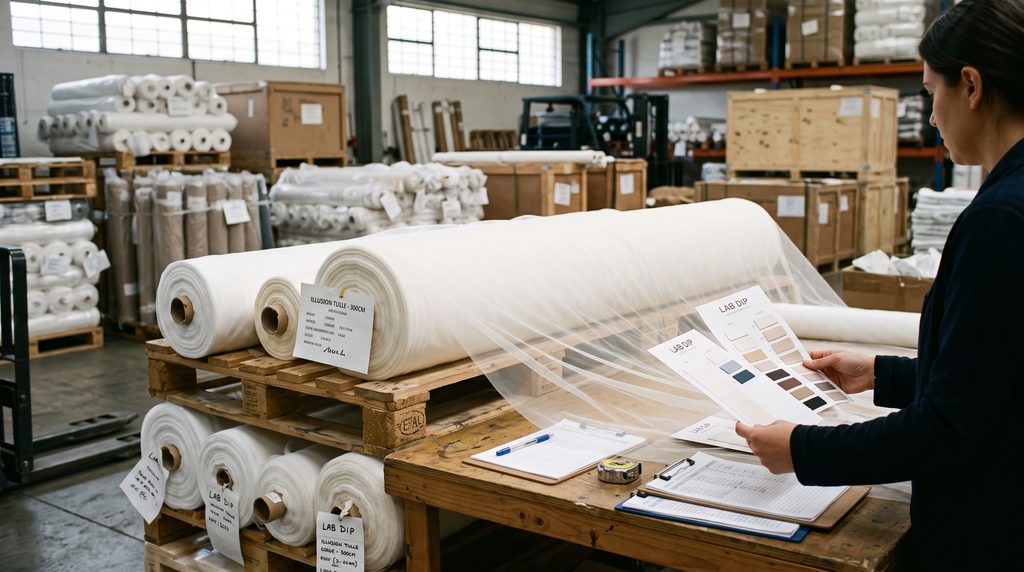
Ateliers can source illusion tulle fabric in bulk by partnering directly with dedicated warp-knitting mills that offer seamless wide widths, custom color lab dips, and flexible trial minimums. Bypassing retail jobbers eliminates high markups and provides access to consistent dye lots that match seasonal collections. Sourcing dependable illusion tulle fabric directly from primary manufacturers gives your fashion house a dependable material pipeline.
Why Do Seamless Wide Bolts Accelerate Workshop Cutting?
Sourcing extra-wide three-meter fabric rolls allows pattern cutters to nest circular cathedral veils without piecing ugly center seams together. Wide bolts reduce fabric scrap waste by up to thirty percent compared to narrow retail yardage.
Think about this: seamless veils look significantly more luxurious and save hours of workshop assembly time.
- 300 cm widths accommodate expansive circular drop veils without seams.
- Wide pattern layouts maximize nesting efficiency across bulk production runs.
- Flat selvage edges eliminate curl during automated spreading machine cycles.
What Factory Certifications Safeguard Bulk Orders?
Verifying international environmental certifications confirms that synthetic textiles contain zero harmful chemical residues that irritate bridal skin. Mills maintaining strict environmental protocols deliver odor-free yardage that requires no pre-washing.
Look at the facts: independent audit certificates guarantee your raw materials satisfy rigorous global trade safety laws.
- OEKO-TEX Standard 100 Class 1 certifies skin-safe chemical safety.
- ISO 9001 factory accreditation ensures rigorous lot-to-lot consistency.
- Documented chain of custody safeguards your business against import delays.
| Sourcing Channel | Minimum Order Size | Production Lead Time | Custom Width Availability |
| Direct Knitting Mill | 100m – 300m Flexible | 10 to 14 Business Days | Full Custom up to 300cm |
| Regional Wholesaler | Single Bolt (50m) | Immediate Stock Pull | Limited Standard Widths |
| Retail Fabric Shop | Cut Yardage by Meter | Immediate In-Store | Pre-Cut 140cm Narrow Bolts |
This sourcing channel comparison illustrates why working directly with primary textile producers yields superior custom widths and healthy gross margins.
Key Takeaway: Partnering directly with certified warp-knitting mills delivers seamless three-meter roll widths that cut workshop waste and raise atelier profitability.
Strategic Sourcing for Couture Bridal Collections
Balancing ethereal transparency against structural loft resolves common atelier challenges regarding scratchy netting, photographic glare, and needle tears during embroidery. Choosing precision-engineered warp-knit constructions protects your bridal line against unsightly runs, seam sagging, and color clashes beside natural wedding silks. Our advanced textile manufacturing facility produces specialized warp-knit netting, versatile three-meter widths, and certified skin-safe fabrics tailored to your exact custom specifications. We stand committed to equipping global bridal brands with resilient, luxurious textiles that inspire absolute wedding elegance. To request premium swatch cards or discuss custom development for your upcoming collection, contact us today and speak with our technical textile specialists.
Frequently Asked Questions
Q1: Can I steam illusion tulle fabric directly?
Yes, you can steam illusion netting safely by holding a garment steamer nozzle four to six inches away on low heat. Direct contact with hot metal plates melts delicate synthetic filaments instantly, whereas diffused indirect steam relaxes packing creases without harming fine hexagonal mesh loops.
Q2: What is the best veil fabric to prevent static cling?
Pure silk tulle and heavy English net are the best textiles for eliminating static cling because natural fibers and weighted open meshes disperse electrical charges quickly. Synthetic netting treated with topical antistatic finishes also prevents veil layers from adhering awkwardly to polyester gown linings during dry winter ceremonies.
Q3: How do I know if netting will clash with ivory silk?
Examine fabric swatches alongside your gown silk inside a standardized D65 daylight box to detect undertone variances. Netting containing heavy optical brighteners fluoresces with a cold bluish glare, while high-grade warm ivory meshes blend smoothly with unbleached natural silk fibers.
Q4: Can I stitch heavy beaded lace borders onto fine mesh?
Yes, you can stitch heavy lace trims onto fine mesh by choosing two-bar warp-knitted netting rather than delicate woven bobbinet. The locked knitted nodes distribute concentrated bead weight evenly across surrounding hexagonal cells, preventing localized tearing along the perimeter hemline.
Q5: What is the best netting weight for cathedral veils?
Lightweight netting measuring between sixteen and twenty grams per square meter is the best choice for royal cathedral veils. This featherlight density lets expansive three-meter trains float effortlessly behind the bride without pulling hair combs or causing uncomfortable neck fatigue.