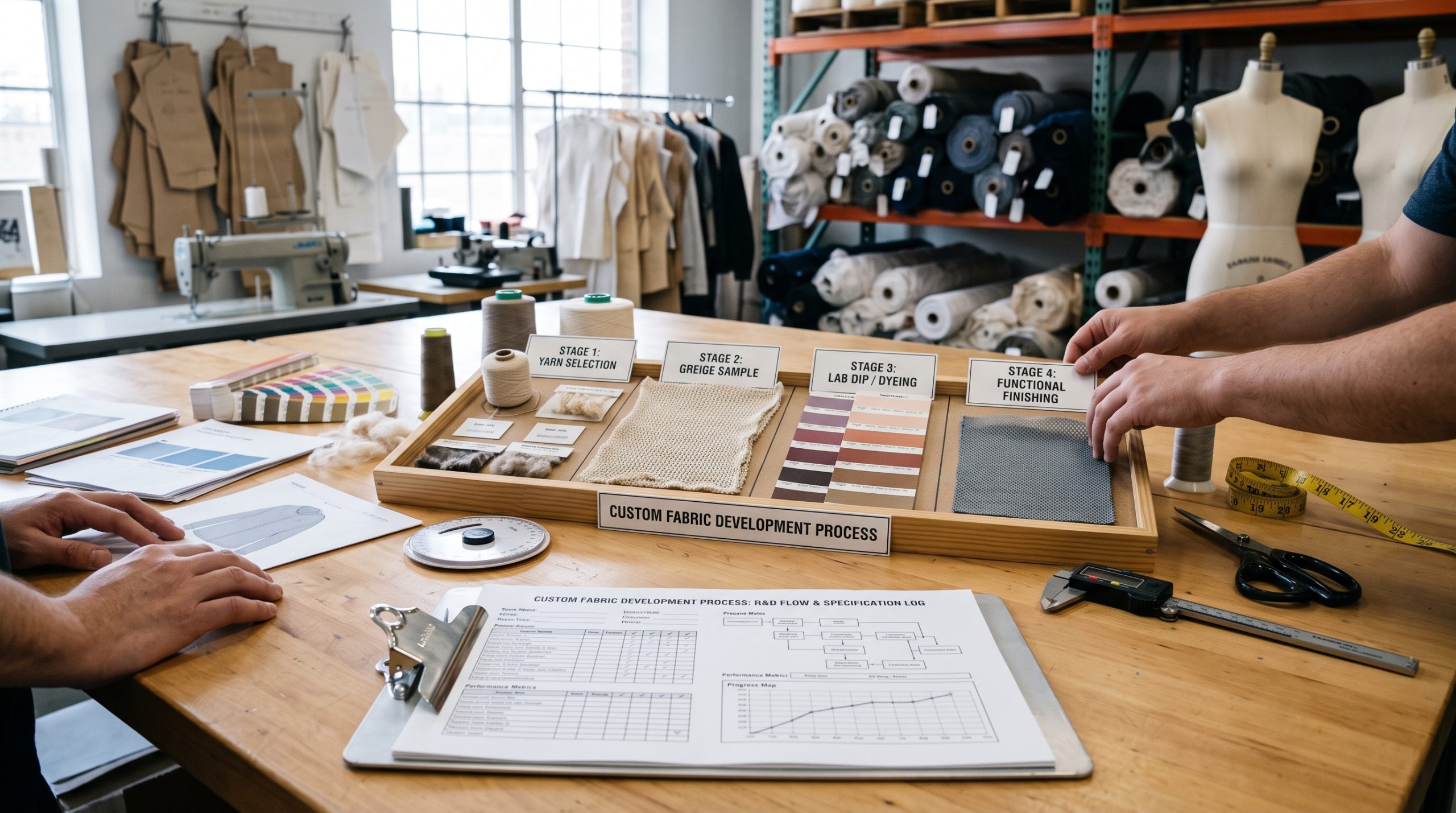
The custom fabric development process is an engineered workflow where apparel brands partner with textile mills to build proprietary knits by customizing yarn composition, aperture geometry, hand feel, and functional performance finishes from raw polymer to bulk roll production. Imagine sourcing stock netting from a fabric market for your new activewear line, only to watch customers return shirts because the synthetic mesh feels abrasive against skin and traps clammy body sweat. Standard commodity textiles force your design team to compromise on drape and thermal airflow, diluting your brand identity in saturated retail markets. Implementing a structured custom fabric development process resolves these manufacturing setbacks by engineering exact softness, stretch recovery, and porosity parameters before cutting production garments.
Why Begin a Custom Fabric Development Process?
Beginning a custom fabric development process gives apparel brands total control over physical yarn construction, allowing you to create exclusive textiles that competitors cannot duplicate from wholesale catalogs. Off-the-shelf fabrics restrict your silhouette options and leave your product lines vulnerable to sudden supplier stockouts. Developing tailored textiles lets you optimize fabric weight, tactile smoothness, and tensile recovery for targeted athletic or formal applications. Committing to a custom fabric development process protects your product margins and reinforces distinct brand positioning across demanding retail channels.
What Limitations Define Commodity Off-the-Shelf Knits?
Commodity fabrics prioritize broad commercial appeal and minimal knitting costs over specialized technical performance. Mills produce generic meshes with cheap synthetic yarns that prioritize rapid loom output rather than skin comfort.
Here is the deal:
Stock market fabrics rarely meet strict requirements for stretch recovery and air permeability.
- Generic textiles suffer from erratic batch-to-batch weight discrepancies.
- Off-the-shelf dye recipes often fail commercial wash fastness standards.
- Publicly available catalog swatches allow rival labels to copy your garments easily.
How Does Proprietary Knitting Secure Brand Value?
Proprietary textiles establish distinct tactile signatures that consumers immediately associate with premium product quality. Customizing stitch loops and filament deniers creates fabrics with proprietary elasticity and breathability.
Think about it:
Athletes return to activewear lines that consistently keep them dry and comfortable.
The Key Takeaway for apparel founders: engineering proprietary textiles shields your product catalog from direct market imitation and builds durable customer loyalty.
| Sourcing Strategy | Design Exclusivity | Performance Control | Supply Chain Security |
| Open Stock Sourcing | Zero (Publicly Available) | Rigid (Fixed Factory Specs) | Low (Subject to Mill Discontinuation) |
| Mill Customization | 100% Brand Proprietary | Complete (Tailored to Need) | High (Guaranteed Re-order Specifications) |
| Surface Modification | Minimal (Stock Base Cloth) | Partial (Finishing Only) | Moderate (Dependent on Base Cloth Batches) |
Investing in dedicated textile construction protects your brand margins from commodity price competition.
How Does a Custom Fabric Development Process Start?
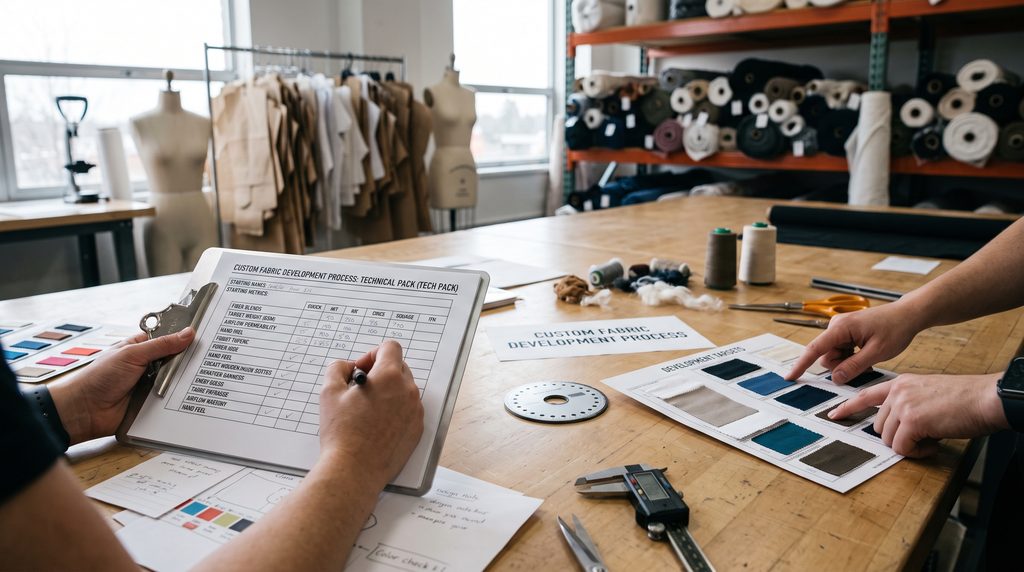
A custom fabric development process starts with drafting a comprehensive technical pack that defines target fiber blends, square meter weight, hand feel targets, and airflow permeability limits. Clear documentation eliminates guesswork between your design department and offshore textile engineers. Vague descriptions like soft or stretchy lead to misaligned lab prototypes and wasted development capital. Grounding your custom fabric development process in measurable physical metrics speeds up sampling cycles.
What Data Belongs in a Textile Tech Pack?
A complete textile specification sheet translates creative design concepts into standardized manufacturing criteria. Knitting engineers require exact tolerances to set needle timing, yarn feeds, and finishing stenter temperatures accurately.
Look:
Precise technical documentation cuts prototyping turnaround times by half.
- Target mass weight specified in grams per square meter with tight tolerances.
- Target dimensional stability limits for commercial washing and steam pressing.
- Required colorfastness grades for perspiration, laundering, and rubbing.
How Do Master Target Swatches Prevent Errors?
Submitting a physical reference swatch provides mill technicians with an unmistakable benchmark for hand feel and mesh porosity. Lab technicians compare experimental strike-offs directly against your physical master swatch under controlled lighting.
Ready for the good part?
Physical reference swatches eliminate communication errors caused by subjective verbal descriptions.
The Key Takeaway for product developers: defining strict technical parameters in your initial tech pack keeps mill sampling runs aligned with your functional performance goals.
| Specification Parameter | Technical Measurement Unit | Target Requirement Example | Manufacturing Purpose |
| Area Mass Density | GSM (Grams / Square Meter) | 145 GSM (+/- 5 GSM) | Prevents sheer panel sagging or excess weight |
| Elastic Recovery Rate | ASTM D3107 Percentage | Over 90% After 30 Seconds | Eliminates bagging around knees and elbows |
| Air Permeability | Frazier CFM Rating | 450 to 600 CFM | Guarantees continuous convective cooling |
Documenting objective physical metrics establishes clear quality standards for prototype evaluations.
How Yarns Guide Custom Fabric Development Process?
Yarns guide the custom fabric development process by defining tensile tenacity, moisture absorption, surface texture, and elasticity through precise fiber composition and filament count selection. Selecting synthetic microfibers creates smooth, irritation-free textures suitable for sensitive skin zones. Combining high-tenacity polyester with elastane delivers resilient stretch memory for compressive sportswear panels. Directing yarn architecture within your custom fabric development process balances durable mechanical strength against lightweight wearing ease.
How Do Filament Deniers Dictate Skin Softness?
Yarn denier measures individual filament thickness, directly influencing bending stiffness and tactile friction against skin. Multi-filament yarns composed of ultra-fine strands bend pliantly across body contours without creating scratchy contact points.
What is the real story?
Fine micro-denier yarns transform rigid athletic meshes into silky second-skin apparel.
- Microfibers disperse contact pressure smoothly across delicate skin zones.
- High filament counts enhance capillary action for accelerated sweat dispersion.
- Coarse monofilaments provide rigid structural support for luggage linings.
Why Balance Synthetic Blends with Spandex?
Blending durable polyester or polyamide filaments with elastane fibers provides both mechanical durability and dynamic stretch recovery. Too much elastane adds excessive weight and slows fabric drying speeds during intense exercise.
Here is why:
A balanced polymer blend maintains garment shape through hundreds of wash cycles.
The Key Takeaway for material engineers: matching filament fineness and elastane percentages to garment usage delivers optimal stretch recovery without sacrificing quick-drying performance.
| Fiber Composition | Filament Structure | Primary Functional Trait | Ideal Garment Placement |
| 100% Micro-Polyester | Multi-Filament (75D/72F) | Rapid Wicking, Ultra-Soft Touch | Performance running tees, base layers |
| 85% Nylon / 15% Spandex | Textured Interlocked Filaments | 4-Way Elasticity, Abrasion Shield | Compression leggings, sports bras |
| 100% Polyester Monofilament | Single Solid Strand (30D) | High Bending Rigidity, Open Porosity | Structural shoe tongues, bag netting |
Selecting appropriate yarn structures ensures your finished fabric delivers targeted flexibility and comfort.
How Knitting Shapes Custom Fabric Development Process?
Knitting shapes the custom fabric development process by calibrating needle beds and guide bar movements to control structural stretch, pore aperture dimensions, and three-dimensional thickness. Adjusting machine gauges determines stitch density and transparency across sheer or opaque fabric panels. Warp knitting produces run-resistant lockstitch nets, while circular knitting creates supple jersey textiles. Managing loom settings in your custom fabric development process guarantees your mesh panels hold their intended geometric shapes under mechanical tension.
How Do Warp Looms Differ from Circular Knits?
Warp knitting machines guide thousands of separate yarn ends through individual needles simultaneously, forming locked zigzag courses that never run when cut. Circular knitting machines knit continuous horizontal courses that yield soft, fluid drape but remain prone to edge curling.
This is what happens:
Warp-knitted meshes allow automated cutting without edge fraying or unraveling stitches.
- Tricot looms produce sleek, stable netting for technical apparel linings.
- Raschel machines create complex geometric openwork and strong athletic meshes.
- Circular single jersey knits provide supple four-way flexibility for lifestyle shirts.
Can Double Needle Bars Create Cushioning Mesh?
Double needle bar warp looms knit two separate surface fabrics simultaneously while connecting them with vertical monofilament pile yarns. Adjusting the distance between needle beds creates three-dimensional spacer meshes ranging from two to fifteen millimeters thick.
Think about it:
These springy internal chambers replace polyurethane foams while boosting natural ventilation.
The Key Takeaway for textile designers: selecting warp-knitted structures prevents seam fraying and allows custom aperture configurations that withstand aggressive sports activities.
| Machine Loom Type | Fabric Structural Behavior | Edge Fray Tendency | Typical Garment Applications |
| High-Speed Warp Raschel | Locked pillar nodes, stable pores | Zero fraying along cut margins | Football jerseys, athletic pinnies |
| Fine-Gauge Circular Knit | Looped courses, supple drape | Prone to roll and run if cut | Everyday active tops, underwear |
| Double Needle Bar Spacer | 3D monofilament core, lofty bounce | Resilient compressed edges | Backpack straps, footwear uppers |
Calibrating knitting machine architectures dictates whether your fabric functions as a fluid drape or a rigid structural cushion.
How to Dye in the Custom Fabric Development Process?
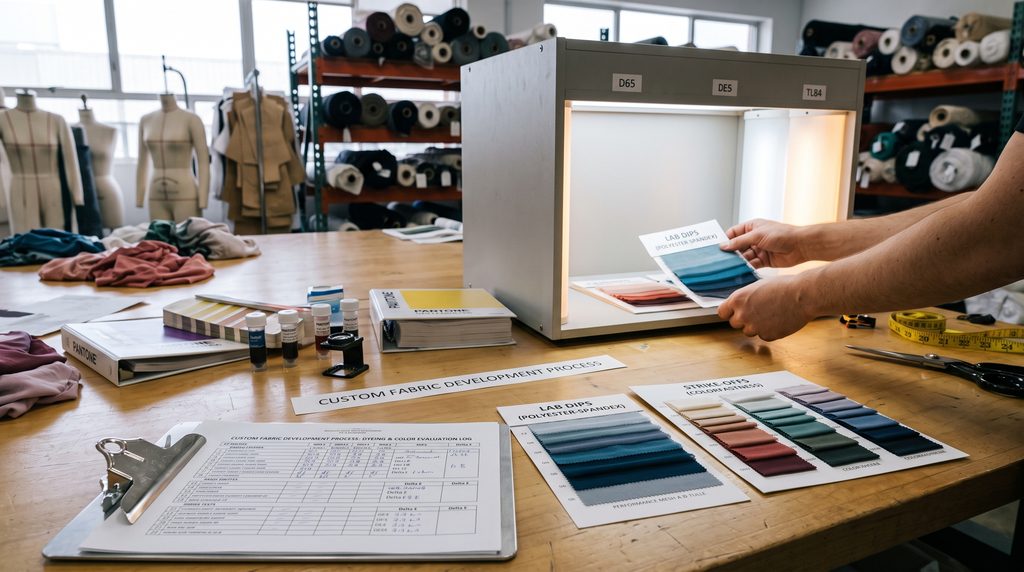
You manage dyeing within the custom fabric development process by ordering progressive lab dips and evaluating strike-off swatches inside calibrated multi-illuminant light booths. Dye recipes react differently across synthetic polymer blends, requiring precise chemical adjustments to achieve uniform coloration. Single-bath dyeing can leave polyester-spandex blends looking heathered if dispersal rates diverge. Rigorous dye evaluation in your custom fabric development process prevents unexpected color shifts between showroom lighting and outdoor sunshine.
How Do Light Booths Prevent Severe Metamerism?
Metamerism causes two fabric cuts to match perfectly under office fluorescent lamps while appearing distinctly mismatched under natural daylight. Inspecting lab dips across multiple lighting standards exposes unstable dye recipes before bulk vats are prepared.
Look:
You protect your retail displays from embarrassing shade mismatches across coordinated sets.
- Artificial daylight (D65) confirms accurate outdoor color saturation.
- Commercial store tubes (TL84) reveal how garments look on retail racks.
- Incandescent home bulbs expose unwanted reddish undertones in evening wear.
Why Verify Wet and Dry Crocking Fastness?
Crocking tests rub dry and wet white cotton cloths across dyed fabric surfaces under mechanical pressure to check for loose pigment transfer. Unstable dyes leach off synthetic filaments during sweaty training sessions, staining wearer skin and athletic shoes.
Ready for the good part?
Catching loose surface pigments early lets mills add corrective post-dye wash cycles.
The Key Takeaway for color directors: standardizing multi-source light audits and crocking fastness tests eliminates customer returns triggered by bleeding dye lots.
| Light Source Standard | Color Temperature | Color Evaluation Focus | Visual Quality Risk Prevented |
| Daylight Illuminant (D65) | 6500 Kelvin | True outdoor color fidelity | Mismatched team uniforms on fields |
| Commercial Store (TL84) | 4000 Kelvin | Retail boutique presentation | Off-color merchandise under spotlights |
| Warm Home Light (Ill A) | 2856 Kelvin | Residential ambient reflection | Discolored evening apparel indoors |
Standardized light booth evaluations ensure your dyed textiles maintain consistent hues across diverse consumer environments.
How Finishing Aids Custom Fabric Development Process?
Finishing aids the custom fabric development process by applying chemical baths and thermal treatments that impart moisture management, antibacterial protection, and dimensional stability to raw greige goods. Raw knitted fabrics contain natural spinning oils and knitting machine lubricants that hinder water absorption. Washing, heat-setting, and chemical padding turn untreated synthetic meshes into high-performance activewear textiles. Tailoring functional finishes in your custom fabric development process elevates base knits into performance-grade apparel materials.
How Do Hydrophilic Finishes Disperse Sweat?
Untreated polyester yarns naturally repel water, causing liquid perspiration to bead up and pool against athlete skin. Applying durable hydrophilic treatments allows synthetic filaments to pull sweat away through active capillary action.
Here is the deal:
Liquid moisture spreads across broad surface areas, evaporating four times faster into ambient air.
- Chemical padding converts hydrophobic surfaces into rapid moisture conduits.
- Fast moisture transport keeps training shirts light and dry during workouts.
- Advanced treatments withstand thirty commercial laundering cycles without losing performance.
Why Is Heat Setting Necessary for Stability?
Synthetic knitted loops store physical mechanical stresses generated during high-speed knitting operations. Feeding greige fabrics through heated stenter frames relaxes these internal stresses, locking roll width and preventing shrinkage.
Think about it:
Heat-stabilized knits protect finished garments from puckering when exposed to commercial steam irons.
The Key Takeaway for apparel technicians: combining hydrophilic chemical finishes with heat-setting ensures your custom textiles deliver fast-drying comfort and reliable wash durability.
| Finishing Application | Chemical / Thermal Mechanism | Performance Deliverable | Consumer Wear Benefit |
| Hydrophilic Wicking Bath | Surface Energy Surfactant | Spreads liquid drops within 2 seconds | Eliminates clammy sweat cling |
| Stenter Heat-Setting | Controlled 190°C Thermal Relaxation | Restricts shrinkage below 2.0% | Preserves garment size after wash |
| Silver-Ion Infusion | Antimicrobial Bacteriostatic Layer | Inhibits odor-causing bacteria growth | Keeps activewear fresh through workouts |
Applying engineered chemical finishes transforms basic synthetic knits into durable, odor-resistant performance textiles.
How to Check Hand in Custom Fabric Development Process?
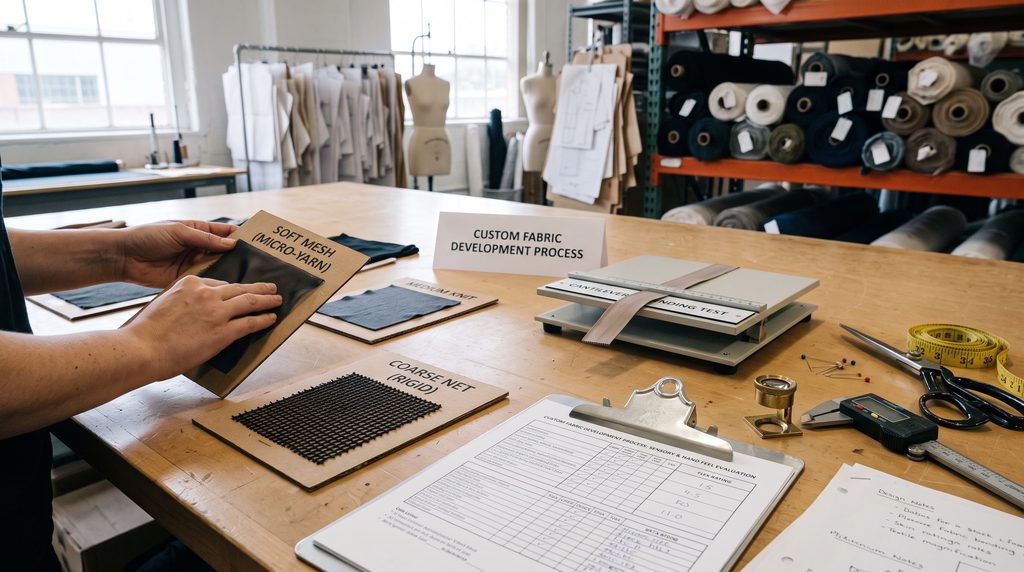
You check hand feel during the custom fabric development process through blind tactile friction trials and cantilever bending tests that quantify softness, skin drag, and drape fluidity. Laboratory data sheets cannot tell you if a technical mesh will feel scratchy around an athlete’s neck. Touching sample swatches with eyes closed removes visual bias and highlights surface roughness. Integrating tactile testing into your custom fabric development process keeps uncomfortably coarse materials from entering production lines.
What Makes Fabric Feel Smooth or Prickly?
Surface smoothness depends on yarn texturing, filament thickness, and chemical softening baths applied during finishing stages. Sharp filament tips protruding from low-grade synthetic yarns create abrasive micro-friction against sensitive skin.
This is what happens:
Premium silicone softeners coat yarn nodes, creating a silky touch that glides smoothly across skin.
- Blind touch tests evaluate surface scuff across sensitive inner wrist skin.
- Pliable knits drape naturally without creating stiff, awkward folds.
- Textured micro-polyester yarns deliver cotton-like softness with synthetic durability.
How Does Bending Modulus Dictate Skirt Loft?
Bending stiffness dictates whether fabric panels yield softly to movement or push firmly outward into structured silhouettes. Bridal tulles require balanced stiffness to build dramatic ballgown volume without feeling brittle.
Look:
You can calibrate yarn heat-setting to achieve exact structural loft for theatrical costumes.
The Key Takeaway for fashion creators: balancing filament softness with structural bending stiffness ensures finished apparel looks structured while feeling gentle on skin.
| Tactile Trait | Physical Driver | Sensory Result | Targeted Apparel Style |
| Supple Fluidity | Micro-denier yarns, low flex modulus | Drapes softly over body contours | Flowing bridal veils, lifestyle tees |
| Springy Cushion | Resilient monofilament spacer core | Absorbs pressure without flattening | Sports bra straps, footwear linings |
| Crisp Architecture | High-denier yarns, firm heat-setting | Holds flared shapes independently | Structured underskirts, tutus |
Standardizing tactile hand feel evaluations prevents uncomfortable, scratchy garments from reaching consumer dressing rooms.
How Airflow Fits Custom Fabric Development Process?
Airflow fits the custom fabric development process by determining the convective cooling rate and moisture evaporation efficiency of your textile through calibrated pore geometry. Open-cell meshes allow ambient air currents to circulate around warm human skin, venting body heat naturally. Dense, tightly knitted fabrics trap humid air against the torso, creating uncomfortable microclimates during workouts. Testing air permeability within your custom fabric development process ensures technical activewear keeps athletes cool in demanding environments.
How Does Aperture Geometry Drive Convection?
Hexagonal and diamond mesh apertures function like miniature ventilation channels across high-sweat body zones. Air currents moving through porous knit openings accelerate the evaporation of surface sweat, cooling wearers through natural convection.
Here is why:
Athletes sustain peak physical endurance when body heat vents freely through porous garments.
- High porosity values promote continuous air circulation across torso panels.
- Uniform aperture structures prevent hot, humid air from pooling beneath fabrics.
- Strategically placed mesh zones provide cooling ventilation during long runs.
Can Magnified Loupes Confirm Mesh Uniformity?
Examining experimental knits under illuminated optical loupes exposes deformed apertures, blocked pores, and irregular loop nodes. Inconsistent mesh openings disrupt uniform air circulation and produce blotchy visual transparency across finished garments.
What is the real story?
Consistent aperture geometry separates high-grade technical meshes from cheap commodity fabrics.
The Key Takeaway for performance wear developers: verifying air permeability metrics on prototype cuts ensures your customized activewear keeps users cool during intense summer workouts.
| Mesh Ventilation Class | Airflow Permeability Rate | Average Aperture Size | Target Performance Gear |
| Micro-Eyelet Knit | 150 to 300 CFM | 0.6 mm to 1.0 mm | Gym training tops, marathon tees |
| Open Athletic Mesh | 450 to 700 CFM | 1.8 mm to 3.2 mm | Basketball jerseys, training pinnies |
| High-Vent Spacer Core | 750 to 1000+ CFM | 3.5 mm to 6.0 mm | Backpack back panels, tactical vests |
Airflow permeability testing confirms open-cell aperture geometries evacuate body heat significantly faster than solid knits.
How Sampling Guides Custom Fabric Development Process?
Sampling guides the custom fabric development process through a progressive ladder of small lab dips, un-dyed greige strikes, and full-width sample yardage runs before bulk commitment. Skipping sampling stages leaves product lines vulnerable to sewing disruptions, shrinkage surprises, and dye discrepancies. Testing continuous sample yardage on factory assembly lines proves whether materials handle high-speed automated sewing smoothly. Structuring sample validation within your custom fabric development process protects production budgets from costly manufacturing errors.
Why Is Continuous Sample Yardage Mandatory?
Small ten-centimeter marketing swatches cannot demonstrate how full fabric rolls behave during automated pattern spreading and cutting. Ordering three to five meters of sample yardage lets pattern makers cut full garment prototypes for fit testing.
Ready for the good part?
Your sewing team catches material feed jams before full manufacturing rolls are cut.
- Multi-meter cuts verify true roll width consistency across full bolts.
- Sample yardage allows thorough multi-cycle commercial laundry testing.
- Cutting room staff evaluate edge curling and selvage stability under production cutters.
How Do Sewing Trials Reveal Hidden Seam Flaws?
Feeding trial fabrics through high-speed sewing machines reveals whether sharp needle points melt synthetic yarns or cause skipped stitches. Seam pull tests show whether knit loops stretch open and expose raw thread paths under physical stress.
Look:
You resolve seam puckering and needle cutting issues before cutting full production garments.
The Key Takeaway for apparel sourcing managers: running sample yardage through production sewing lines identifies stitching defects early, preventing factory assembly disruptions.
| Sampling Milestone | Material Delivered | Turnaround Window | Core Quality Objective |
| Hand Feel Swatch | 15 cm x 15 cm Cut | 2 to 4 Business Days | Confirm yarn softness and aperture geometry |
| Lab Dip Color Match | Small Dyed Strike-Offs | 4 to 6 Business Days | Approve Pantone recipes under multiple lamps |
| Pilot Sample Yardage | 3 to 5 Continuous Meters | 8 to 12 Business Days | Execute full prototype cutting and sewing |
Progressive sampling checkpoints weed out material flaws before mills knit and dye bulk production rolls.
When to Scale Your Custom Fabric Development Process?
You scale your custom fabric development process into volume manufacturing once physical sample yardage passes dimensional shrinkage, colorfastness, seam strength, and retail fitting room tests. Moving to bulk production prematurely risks receiving non-compliant fabric bolts that tie up operating cash in unsellable finished stock. Balancing minimum order quantities with production schedules keeps your working capital liquid while maintaining manufacturing momentum. Scaling your custom fabric development process methodically establishes dependable supply channels for seasonal brand expansions.
How to Balance Factory MOQs with Cash Flow?
Traditional textile brokers often mandate steep order minimums that strain emerging apparel brand budgets. Partnering with flexible warp-knitting mills offering accessible initial minimums lets you test new fabric concepts safely.
Think about it:
Lower trial thresholds keep your working capital free for marketing campaigns and garment assembly.
- Modest order minimums reduce unsold inventory sitting in warehouse aisles.
- Shorter production lead times keep collections aligned with shifting market trends.
- Scalable mill partnerships support rapid volume increases when garment lines succeed.
How Do Golden Samples Protect Supply Contracts?
A golden sample represents the final signed yardage cut that embodies all agreed physical specifications and performance parameters. Splitting a verified sample swatch provides an indisputable benchmark for resolving delivered shipment disputes.
Here is the deal:
You hold clear physical evidence if delivered bulk rolls deviate from approved quality standards.
The Key Takeaway for procurement executives: anchoring bulk production purchase orders to signed golden samples protects your investment and ensures delivered goods match development standards.
| Production Milestone | Deliverable Scope | Acceptance Standard | Supply Chain Protection |
| Golden Swatch Sign-Off | Signed Master Yardage Cut | Complete Tech Pack Compliance | Establishes binding legal quality standard |
| Pilot Production Cut | 100-Meter Trial Batch | Full Sewing Line Compatibility | Validates loom setup under bulk conditions |
| Bulk Shipment Dispatch | Certified Production Rolls | ASTM 4-Point QC Inspection Pass | Guarantees defect-free fabric delivery |
Establishing signed reference standards protects your brand investment and holds overseas textile mills accountable for quality.
Strategic Roadmap for Developing Proprietary Fabrics
Mastering yarn selection, knitting loom setups, color fastness evaluations, and finishing treatments determines the commercial success of your apparel lines. This comprehensive technical guide answered your core questions regarding filament deniers, light booth audits, breathability metrics, and factory sampling protocols. Our specialized textile facility manufactures precision warp-knitted meshes, technical athletic tulles, and breathable three-dimensional spacer fabrics tailored to rigorous international performance specifications. To secure certified proprietary textiles customized to your exact hand feel, elasticity, and airflow specifications, contact us today to speak with textile engineers and order your development sample swatches. We believe exceptional garment collections begin with disciplined textile engineering, and our manufacturing team stands ready to deliver dependable materials for your brand.
FAQ Section
- Q1: Can I begin a custom fabric development process without a physical swatch? Yes, you can initiate development by providing a detailed technical specification pack outlining target fiber blends, square meter weight, and performance metrics. However, supplying a physical reference swatch helps mill engineers match tactile hand feel and drape characteristics much faster.
- Q2: What’s the best sample yardage length to order before bulk production? A continuous cut of three to five meters provides the ideal length for comprehensive pre-production testing. This yardage allows your pattern makers to wash full test panels, measure shrinkage across warp and weft, and run multi-layer seams through factory sewing machines.
- Q3: How do I know if my custom mesh fabric achieves proper airflow? Measure the textile’s air permeability rating using Frazier differential pressure testing instruments in a certified lab. High-performance athletic meshes should achieve between four hundred and seven hundred cubic feet per minute to promote active convective heat venting.
- Q4: Can I adjust fabric hand feel after the greige knitting stage? Yes, applying specialized chemical softeners or mechanical brushing during stenter finishing can modify surface hand feel significantly. However, fundamental structural drape and stretch elasticity remain primarily determined by base yarn denier and knitting tension.
- Q5: What’s the best way to handle color variance across bulk production dye lots? Establish an agreed commercial Delta E color difference tolerance within your manufacturing purchase agreement before bulk dyeing begins. Reviewing pre-shipment strike-offs inside a calibrated multi-illuminant light booth ensures delivered bulk rolls remain within your acceptable visual boundaries.