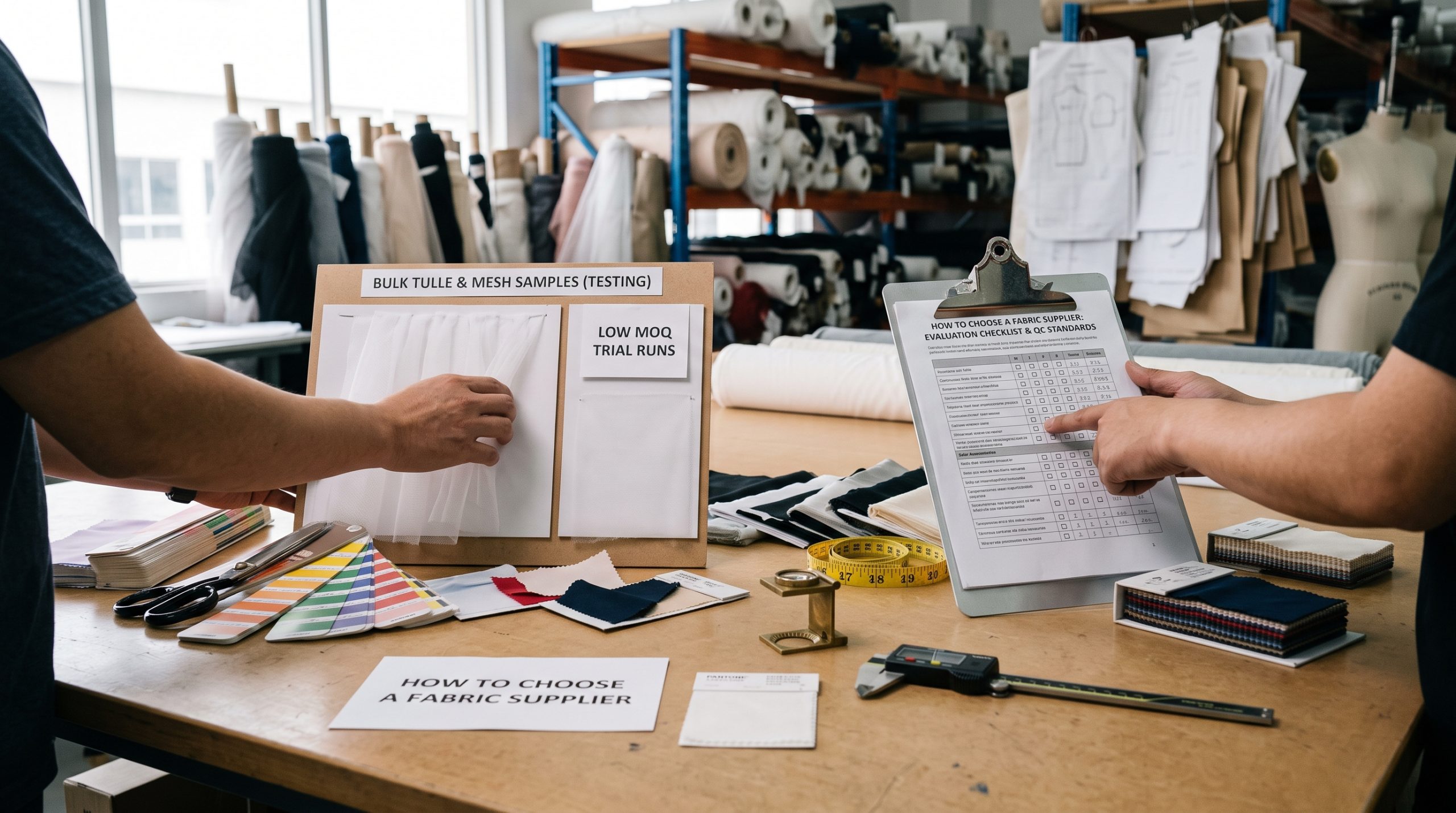
Choosing a fabric supplier for tulle and mesh requires evaluating physical swatch hand feel, testing airflow porosity, and confirming flexible order minimums with certified warp-knitting mills. Imagine receiving forty rolls of imported netting for a high-volume gown line, only to discover the material feels scratchy against bare arms and tears under sewing needles. Unverified yardage ruins production schedules, wastes cutting room labor, and leaves your brand facing angry fitting room returns. Learning how to choose a fabric supplier eliminates these costly procurement failures by giving your technical team measurable methods to verify fiber softness, mesh stability, and seam strength before ordering bulk rolls.
Why Learn How to Choose a Fabric Supplier Early?
Learning how to choose a fabric supplier early protects your manufacturing budget by catching structural netting flaws, toxic resin finishes, and unstable dye batches before factory cutting begins. Sourcing textiles without verified technical audits often results in stiff synthetic bolts that curl along cut edges during pattern nesting. Partnering with a professional mill gives you access to standardized lab reports, consistent fiber formulations, and predictable lead times. Mastering how to choose a fabric supplier early keeps your production lines running smoothly and protects your garment brand reputation.
What Risks Threaten Unverified Fabric Sourcing?
Unverified wholesale distributors frequently mix different yarn lots within a single shipment, creating visible shading bands across completed garment panels. These inconsistent synthetic blends behave erratically when exposed to commercial laundry heat.
Here is the deal:
A single flawed fabric roll can stall your entire sewing schedule for weeks.
- Irregular yarn tension produces wavy selvages that distort automated cutting blades.
- Poorly washed greige goods retain foul chemical odors that ruin customer unboxing.
- Uninspected knits conceal broken loop lines that tear open under slight body tension.
How Do Physical Swatches Protect Your Capital?
Physical swatches let your pattern cutters inspect aperture geometry, tensile recovery, and fiber thickness directly on cutting tables. Feeling material flex between your fingers provides immediate feedback that glossy digital images cannot deliver.
Look:
You can determine whether a lightweight net will collapse or hold its structure within seconds of touching it.
The Key Takeaway for fashion creators: requiring physical swatches from your suppliers eliminates material uncertainty and keeps your development milestones on schedule.
| Sourcing Stage | Verification Format | Core Technical Objective | Manufacturing Hazard Prevented |
| Initial Sourcing | Physical Swatch Book | Evaluate fiber softness and aperture shape | Eliminates abrasive skin-contact textiles |
| Prototype Run | 3m Continuous Yardage | Execute live cutting and sewing trials | Prevents needle jams on high-speed lines |
| Bulk Sign-Off | Golden Sample Swatch | Lock contractual mass weight and color | Stops off-spec rolls reaching warehouses |
Establishing strict physical sample checkpoints provides verifiable criteria that hold offshore textile mills accountable.
Can Hand Feel Guide How to Choose a Fabric Supplier?
Hand feel guides how to choose a fabric supplier because fiber polymers, yarn deniers, and chemical softening baths dictate whether sheer netting glides gently or scratches sensitive human skin. Premium illusion tulles use ultra-fine polyamide microfibers that bend effortlessly across necklines and shoulders. Coarse polyester monofilaments produce springy nets engineered to hold skirt layers outward. Evaluating tactile samples helps pattern cutters select materials that balance structural lift with all-day skin comfort.
How Does Filament Denier Change Skin Friction?
Filament denier measures individual strand thickness, directly dictating bending stiffness and mechanical friction against sensitive skin areas. Multi-filament yarns spread contact pressure across hundreds of microscopic fibers, creating a smooth tactile surface.
Think about it:
Athletes and brides wear their garments through hours of continuous physical motion.
- Fine micro-denier yarns eliminate abrasive redness along armholes and collar lines.
- Multi-filament structures adapt naturally to shifting human body contours.
- Coarse monofilaments provide rigid structural support for luggage and footwear.
Can Blind Touch Tests Separate Soft from Stiff?
Blind touch tests require evaluators to close their eyes while rubbing fabric swatches against their inner wrists to detect surface prickliness. Removing visual bias lets your technical team detect micro-abrasions caused by cheap yarn extrusions.
Ready for the good part?
You instantly filter out harsh nettings before they reach your pattern making department.
The Key Takeaway for apparel technicians: standardizing blind touch tests ensures your chosen sheer materials deliver comfortable wear along sensitive garment edges.
| Netting Category | Base Polymer Structure | Tactile Surface Sensation | Ideal Garment Placement |
| Ultra-Soft Illusion | Multi-Filament Polyamide | Silky, weightless, gentle | Sheer sleeves, bridal veils, necklines |
| Balanced Dress Mesh | Textured Micro-Polyester | Pliable, smooth, durable | Activewear inserts, dancewear panels |
| Stiff Crinoline Net | Coarse Monofilament | Crisp, springy, firm | Ballgown petticoats, theatrical ruffles |
Tactile friction evaluations show yarn denier governs skin comfort while filament thickness establishes architectural skirt volume.
Does Airflow Show How to Choose a Fabric Supplier?
Airflow shows how to choose a fabric supplier because open hexagonal pore dimensions dictate how efficiently excess body warmth and humidity escape through garment layers. Breathable warp-knitted meshes maintain continuous convective air circulation around moving limbs, keeping active wearers dry and cool. Dense, non-porous synthetic weaves trap warm air, making multi-layered bridal gowns and athletic shirts hot and clammy. Testing permeability with how to choose a fabric supplier ensures your seasonal activewear collections deliver reliable thermal regulation.
How Does Mesh Porosity Vent Excess Body Heat?
Human skin releases moisture vapor continuously, especially during intense physical exertion or warm outdoor ceremonies. Wide hexagonal apertures allow this warm air to vent outward naturally before condensing into sweat droplets.
What is the real story?
Generous pore geometries keep wearers comfortable beneath voluminous formal gowns.
- Unobstructed mesh voids promote continuous convective cooling across torso zones.
- High air permeability accelerates the evaporation of trapped surface sweat.
- Breathable inner layers prevent sweat stains on delicate outer silks.
Can Differential Gauges Measure True Airflow?
Differential pressure instruments measure cubic feet of air passing through square feet of mesh fabric each minute under controlled suction. Precise numerical airflow readings eliminate vague supplier descriptions like breathable or airy.
Look:
You verify exact ventilation ratings before authorizing volume textile production runs.
The Key Takeaway for activewear developers: measuring air permeability ratings on prototype swatches ensures your customized meshes deliver genuine convective cooling during workouts.
| Mesh Ventilation Class | Airflow Rating (CFM) | Average Pore Size | Primary Apparel Purpose |
| Micro-Eyelet Mesh | 150 to 300 CFM | 0.6 mm to 1.0 mm | Gym workout shirts, marathon singlets |
| Athletic Jersey Mesh | 450 to 700 CFM | 1.8 mm to 3.2 mm | Team pinnies, basketball jerseys |
| Coarse Open Crinoline | 800 to 1100+ CFM | 3.5 mm to 5.0 mm | High-volume petticoats, costume frames |
Airflow permeability data confirms open hexagonal mesh structures vent trapped body heat significantly faster than solid woven textiles.
How to Choose a Fabric Supplier via Lab Dye Swatches?
You evaluate how to choose a fabric supplier via lab dye swatches by inspecting color consistency under multiple light standards and running mechanical crocking tests. Synthetic polymers react unpredictably to chemical dyestuffs, requiring precise temperature controls to produce uniform shades across rolls. Evaluating strike-off cards inside multi-illuminant light booths prevents unexpected color shifts between indoor showroom lighting and bright outdoor sunshine. Performing systematic dye audits confirms your chosen mill maintains strict color reproduction standards.
Why Do Multi-Light Booths Expose Metamerism?
Metamerism causes two fabric cuts to match perfectly under office fluorescent lamps while looking noticeably mismatched under outdoor daylight. Viewing lab dips across calibrated light standards exposes unstable dye recipes before mills prepare bulk vats.
Here is why:
A bridal veil must match its accompanying satin gown across indoor and outdoor settings.
- Daylight lamps (D65) reveal true outdoor hue fidelity and saturation levels.
- Retail showroom lamps (TL84) display how garments appear on commercial clothing racks.
- Incandescent bulbs expose unwanted yellow or red undertones in evening wear.
How Do Crock Tests Stop Dangerous Dye Bleeding?
Crock testing rubs dry and wet white cotton cloths across dyed mesh surfaces under mechanical pressure to measure loose pigment transfer. Unstable surface dyes wash out during sweaty athletic sessions, staining wearer skin and expensive footwear.
This is what happens:
Catching weak dye bonds early prompts mills to add corrective rinsing treatments.
The Key Takeaway for product managers: verifying lab dips inside multi-source light booths and testing crocking fastness prevents costly customer disputes over bleeding dyes.
| Light Source Standard | Color Temperature | Inspection Focus | Visual Error Prevented |
| Daylight Illuminant (D65) | 6500 Kelvin | True outdoor color fidelity | Mismatched ceremony veils outdoors |
| Retail Store Tube (TL84) | 4000 Kelvin | Boutique display presentation | Off-shade apparel on retail racks |
| Incandescent Lamp (Ill A) | 2856 Kelvin | Indoor evening atmosphere | Discolored evening gowns in ballrooms |
Standardized light booth evaluations ensure your dyed sheer textiles maintain consistent hues across diverse lighting environments.
Can Low MOQs Show How to Choose a Fabric Supplier?
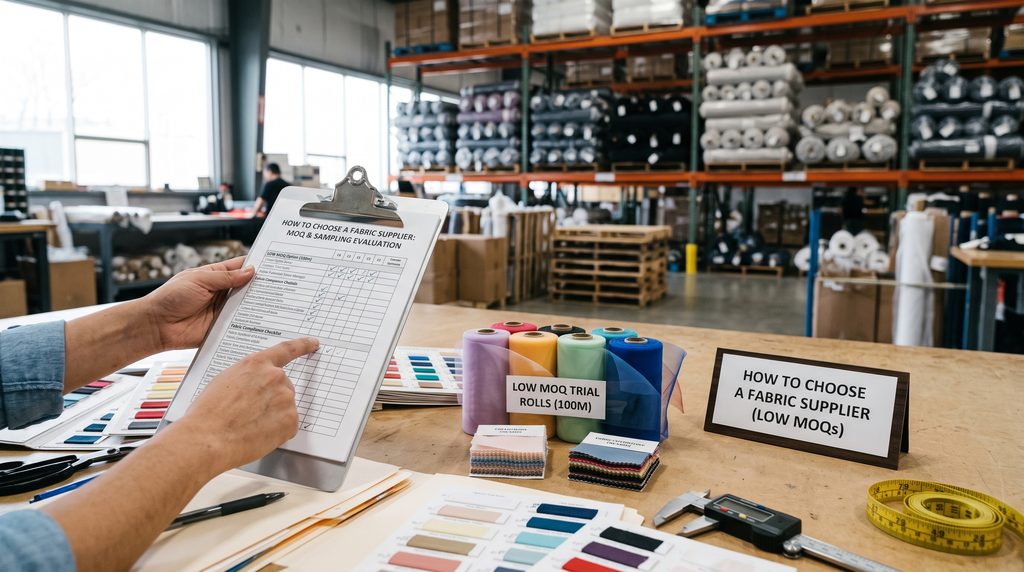
Low order minimums show how to choose a fabric supplier by proving a mill possesses flexible manufacturing schedules capable of supporting emerging fashion labels. Massive brokerage platforms demand large yardage minimums that tie up operating cash in slow-moving warehouse inventory. Flexible manufacturing partners offering sensible trial yardage enable apparel brands to sample seasonal lines without excessive financial risk. Sourcing from agile partners via how to choose a fabric supplier keeps your business agile as market trends evolve.
Why Do Giant Platform MOQs Strain Cash Flow?
Mega-brokers enforce massive purchasing minimums because their business models rely on bulk volume rather than client relationships. Purchasing thousands of meters for a new collection ties up valuable cash that belongs in marketing campaigns.
Think about it:
Unsold fabric inventory sitting in storage depreciates while consumer color preferences shift.
- Large volume minimums force young brands to commit capital to unproven silhouettes.
- Long production queues at mega-mills delay delivery dates by several months.
- Surplus fabric rolls accumulate expensive warehouse storage charges each quarter.
How Do Flexible Mills Support Sample Lines?
Agile warp-knitting factories offer accessible sampling runs starting around one hundred meters per custom colorway. Sourcing smaller trial batches keeps your working capital liquid while you gather pre-orders from boutique buyers.
Ready for the good part?
You test commercial demand with real garment samples before committing to large volumes.
The Key Takeaway for apparel entrepreneurs: partnering with mills that offer low trial minimums preserves your operating cash and accelerates product iteration cycles.
| Sourcing Source | Minimum Order Quantity | Development Flexibility | Financial Capital Risk |
| Bulk Commodity Broker | 3000m to 5000m per color | Rigid (Fixed stock catalog only) | Severe cash flow lockup |
| Agile Warp-Knit Mill | 100m to 300m per color | High (Custom lab dips supported) | Low risk with fast turnaround |
| Retail Fabric Jobber | 1m to 10m cut yardage | Zero (Inconsistent restock lots) | High price per meter, unstable supply |
Flexible minimum order thresholds protect company cash flow while giving designers freedom to prototype innovative garment concepts.
How to Choose a Fabric Supplier by Testing Seams?
You determine how to choose a fabric supplier by testing seam strength under high-speed sewing conditions to verify that stitches will not rupture along sheer panels. Industrial needles piercing synthetic netting at thousands of rotations per minute generate friction heat that can melt fragile yarn loops. Brittle fibers snap under needle impact, leaving microscopic holes that expand into tears along stressed seams. Running sewing trials helps machine operators configure optimal needle gauges, thread tensions, and stitch lengths.
Why Do High-Speed Needles Melt Synthetic Mesh?
Friction generated by rapid needle penetration elevates local temperatures beyond the melting point of delicate synthetic polymers. Overheated yarns fuse into stiff plastic droplets that pierce surrounding knit loops and cause seam puckering.
Here is the deal:
Selecting the right needle geometry prevents thermal damage during high-speed sewing.
- Slender ballpoint needles slide past knitted loops without severing filament cores.
- Controlled machine speeds minimize heat buildup along extended seam paths.
- Smooth thread coatings reduce mechanical friction through needle eyes.
How Can Pull Tests Verify Seam Stretch Recovery?
Tensile seam testing applies calibrated mechanical force across stitched panels to see if knit loops slip or tear away from stitch lines. High-grade netting stretches under pull tension and recovers its shape without leaving permanent gaps.
Look:
You verify that activewear waistbands and armholes will withstand vigorous gym workouts.
The Key Takeaway for sewing room managers: running stitch trials on sample netting identifies needle cutting problems early and prevents seam failures during garment assembly.
| Machine Parameter | Recommended Factory Setting | Substandard Machine Setting | Assembly Failure Prevented |
| Needle Selection | 65/9 or 70/10 Ballpoint | 90/14 Sharp Chisel Needle | Prevents filament punctures and runs |
| Thread Specification | Tex 16 to 24 Polyester Core | Heavy Spun Cotton Thread | Stops bulky seams and thread breaks |
| Stitch Density | 2.0 mm to 2.5 mm Spacing | Under 1.5 mm Spacing | Prevents perforation cuts along seams |
Sewing test metrics confirm ballpoint needles and controlled stitch spacing prevent yarn severance along sheer assembly seams.
Does Backlit QC Show How to Choose a Fabric Supplier?
Backlit quality control inspections show how to choose a fabric supplier by exposing dropped knit stitches, horizontal tension streaks, and oil spots across continuous netting yardage. Small cut swatches can easily hide repetitive loom errors that recur across full manufacturing rolls. Passing continuous yardage over illuminated glass tables reveals yarn slubs, broken filaments, and selvage curling before cutting panels. Insisting on standardized backlit inspection data confirms that your textile supplier delivers dependable, defect-free rolls.
How Do Backlit Tables Expose Knitting Flaws?
Backlit inspection frames shine diffuse light upward through translucent netting, highlighting flaws that remain invisible under standard ceiling lamps. Broken knit loops and yarn slubs appear as dark spots against the glowing glass background.
This is what happens:
Your inspection team isolates defective fabric sections before rolls reach cutting tables.
- Transmitted light exposes faint machine oil spots before heat-setting occurs.
- Dropped stitches show up as distinct light gaps along fabric courses.
- Uneven roll winding tension becomes obvious across wide fabric margins.
Why Use ASTM Four-Point Scoring on Bulk Rolls?
The ASTM D5430 four-point inspection system assigns penalty points to visual defects based on their measured physical size. Totaling penalty points per hundred square yards yields an objective numerical score for accepting or rejecting lots.
What is the real story?
Standardized defect scores eliminate subjective arguments between your buyers and factory suppliers.
The Key Takeaway for quality control directors: establishing backlit table audits and four-point scoring stops flawed yardage from entering your garment production lines.
| Defect Measurement Range | Assigned Demerit Points | Quality Acceptance Action | Production Impact |
| Defect Under 3 Inches (75mm) | 1 Penalty Point | Permitted within standard allowance | Minor trim waste during cutting |
| Defect 3 to 6 Inches (150mm) | 2 Penalty Points | Tracked across total shipment roll yardage | Repositioning of pattern pieces |
| Defect Over 9 Inches (230mm) | 4 Penalty Points | Triggers immediate individual roll rejection | Severe panel destruction averted |
Standardized ASTM four-point evaluations deliver objective data that verifies shipment quality before warehouse intake.
Can Heat Tests Show How to Choose a Fabric Supplier?
Heat tests show how to choose a fabric supplier by revealing how synthetic netting reacts to garment finishing irons, commercial presses, and packaging steamers. Polyamide and polyester fibers soften at specific thermal thresholds, causing netting to pucker or melt when exposed to high heat. Pressing an unverified fabric with a hot metal soleplate can destroy hours of careful sewing work. Testing thermal tolerance helps finishing teams establish safe pressing and steaming protocols for delicate sheer apparel.
Can Direct Soleplate Heat Melt Fine Filaments?
Direct iron contact transfers concentrated conductive heat that exceeds the melting temperature of delicate synthetic polymers. Overheated filaments fuse together instantly, leaving permanent shiny spots or holes across sheer garment panels.
Think about it:
One careless pass of a hot iron can ruin a completed evening gown right before delivery.
- High iron temperatures melt open hexagonal pores into fused plastic films.
- Excessive dry heat causes synthetic fibers to become brittle and crack.
- Uneven heat distribution causes puckering along finished seam edges.
How Does Vertical Steaming Preserve Loftiness?
Vertical steaming releases diffuse moist vapor without pressing heavy metal soleplates directly onto delicate textiles. The gentle heat relaxes packaging creases while allowing open netting loops to expand into full, lofty shapes.
Here is why:
Indirect vertical steaming removes transit wrinkles safely without risking melted fibers.
The Key Takeaway for finishing departments: establishing safe steaming guidelines protects netting volume and prevents melted fibers during final garment pressing.
| Base Fiber Chemistry | Safe Steaming Temp | Max Soleplate Temp | Thermal Failure Symptom |
| Fine Polyamide Net | 110°C (Low Steam) | 120°C (With Press Cloth) | Melts into brittle, glassy holes |
| Warp Polyester Mesh | 130°C (Medium Steam) | 145°C (With Press Cloth) | Puckers, shrinks, and loses elasticity |
| Resin Glitter Tulle | 100°C (Indirect Only) | Zero Direct Contact | Binders melt into sticky yellow residue |
Thermal exposure evaluations confirm indirect vertical steaming smooths out fabric creases safely without damaging delicate synthetic fibers.
How to Choose a Fabric Supplier via Sample Yardage?
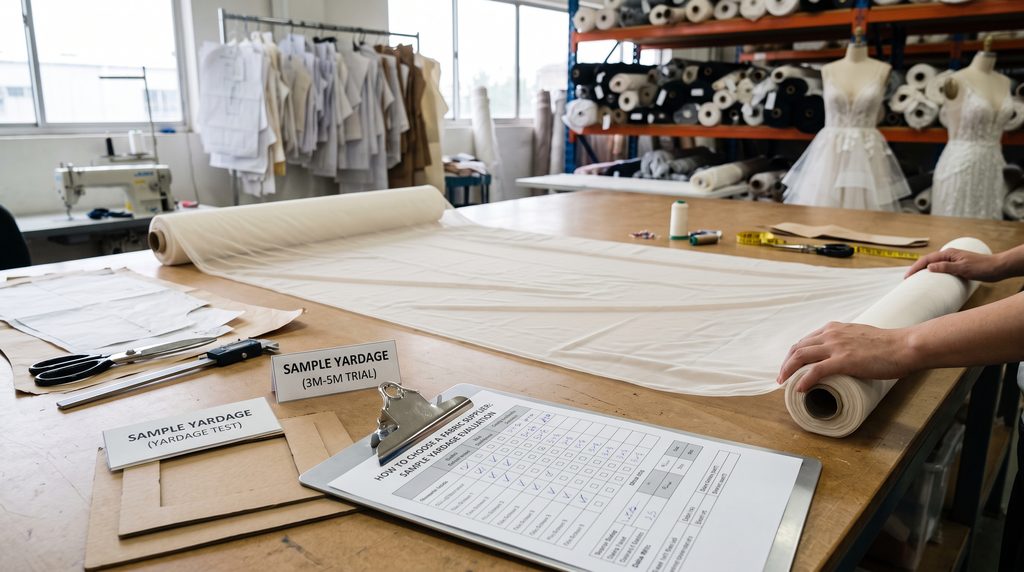
You determine how to choose a fabric supplier via sample yardage by ordering continuous multi-meter cuts to test automated fabric spreading, pattern cutting, and prototype wash durability. Small swatch cards cannot show how full fabric rolls behave under industrial cutting blades. Testing full-width yardage reveals edge curling, tension shrinkage, and pattern distortion before you purchase entire shipping containers. Auditing sample yardage provides your production team with realistic data on how materials perform on factory floors.
Why Run Continuous Yardage Through Cutters?
Spreading several meters of fabric across cutting tables reveals whether loose winding tension causes uneven edges or bowing along fabric lengths. Rotary cutters moving through stacked mesh plies can snag loose loops if the knit structure lacks stability.
Ready for the good part?
Your cutting room crew resolves material feed issues before bulk rolls are unpacked.
- Continuous yardage tests verify width consistency across full manufacturing bolts.
- Sample yardage allows comprehensive multi-cycle commercial laundry testing.
- Automated cutting trials check for edge fraying and panel distortion along raw margins.
How Do Pre-Production Rolls Stop Fitting Delays?
Sewing full garment prototypes from pre-production yardage lets fit models wear test designs through normal daily movements. This live testing reveals whether waistbands chafe, seams pull open, or skirts collapse over hours of wear.
Look:
You make pattern adjustments on sample garments rather than fixing hundreds of finished dresses.
The Key Takeaway for sourcing directors: ordering continuous sample yardage catches fabric handling flaws early, preventing costly assembly line disruptions.
| Sampling Milestone | Material Delivered | Turnaround Window | Quality Verification Objective |
| Swatch Book Review | 15cm x 15cm Swatch | 2 to 4 Business Days | Verify basic fiber softness and aperture size |
| Lab Dip Strike-Off | Dyed Lab Swatches | 4 to 6 Business Days | Approve Pantone color recipes under light booths |
| Pilot Sample Yardage | 3m to 5m Continuous | 8 to 12 Business Days | Execute full prototype cutting and wear tests |
Progressive sampling checkpoints weed out fabric handling issues before mills knit and dye bulk production shipments.
How to Choose a Fabric Supplier for Volume Scaling?
You choose a fabric supplier for volume scaling by establishing signed golden reference swatches, agreeing on strict defect allowances, and confirming batch-to-batch color repeatability. Scaling up production without signed quality benchmarks leaves your brand vulnerable to unexpected material substitutions. Reputable knitting mills document standard operating procedures and provide transparent quality inspection logs with every shipment. Following this structured evaluation strategy protects your manufacturing investments as your business expands.
How Does a Signed Golden Swatch Prevent Claims?
A golden swatch represents the mutually approved physical yardage cut that embodies all agreed technical specifications, color values, and hand feel attributes. Splitting a verified sample provides an undisputed standard for resolving shipment disputes.
Here is the deal:
You hold clear physical proof if delivered bulk rolls deviate from approved quality standards.
- Golden swatches establish binding contractual standards for mass density and width.
- Reference samples settle color tolerance disagreements under laboratory light booths.
- Signed benchmark swatches prevent unauthorized yarn substitutions by overseas mills.
What Milestones Secure On-Time Bulk Deliveries?
Professional textile mills provide detailed production schedules tracking yarn spinning, greige knitting, dye lot approvals, and final packaging. Monitoring these milestones helps your procurement team identify potential delays before shipping deadlines pass.
This is what happens:
Your brand maintains dependable delivery dates across wholesale and retail sales channels.
The Key Takeaway for apparel sourcing executives: anchoring bulk production purchase orders to signed golden swatches ensures delivered goods match your approved prototypes.
| Production Milestone | Deliverable Scope | Acceptance Standard | Supply Chain Protection |
| Golden Swatch Sign-Off | Signed Master Yardage Cut | Full Tech Pack Compliance | Establishes binding quality baseline |
| Pilot Production Run | 100m Trial Batch | Factory Assembly Line Success | Validates loom setup under volume conditions |
| Bulk Shipment Dispatch | Certified Production Rolls | ASTM 4-Point QC Pass | Guarantees defect-free fabric delivery |
Establishing clear production milestones and signed reference swatches protects your brand investment and holds suppliers accountable.
Final Sourcing Strategy on How to Choose a Fabric Supplier
Evaluating tactile hand feel, open-pore breathability, color consistency, and production seam strength determines the long-term success of your garment lines. This guide answered your core questions regarding fiber deniers, multi-light booth audits, airflow metrics, and factory inspection protocols. Our specialized textile facility manufactures precision warp-knitted meshes, ultra-soft bridal illusion tulles, and breathable spacer fabrics tailored to strict international performance standards. To secure certified textiles customized to your exact denier, stiffness, and colorway specifications, contact us today to speak with technical specialists and order development sample swatches. We believe exceptional garment collections begin with disciplined textile engineering, and our manufacturing team stands ready to deliver dependable materials for your brand.
FAQ Section
- Q1: Can I evaluate fabric quality solely through online digital catalogs? No, digital computer monitors cannot display accurate sheer mesh opacity, subtle dye undertones, or tactile skin friction. You must inspect physical swatch swatches under calibrated daylight lamps and test hand feel directly before approving bulk production dye lots.
- Q2: What’s the best yardage length to order for production sewing trials? A continuous cut of three to five meters provides sufficient material for thorough factory testing. This yardage allows your pattern cutters to lay out complete marker panels, measure wash shrinkage across warp and weft, and run multi-layer seams through production sewing machines.
- Q3: How do I know if a mesh textile provides sufficient air permeability? Measure the fabric’s air permeability using Frazier differential pressure testing instruments in a certified lab. High-performance activewear meshes should achieve between four hundred and seven hundred cubic feet per minute to promote active convective heat venting.
- Q4: Can I negotiate lower order minimums when sampling new seasonal designs? Yes, agile warp-knitting mills routinely provide sampling programs starting around one hundred meters per custom colorway. Partnering with flexible factories keeps your working capital liquid while you validate consumer demand across retail boutiques.
- Q5: What’s the best way to handle color variance between strike-offs and bulk rolls? Establish an agreed commercial Delta E color tolerance in your purchasing agreement before bulk dyeing begins. Reviewing pre-shipment strike-offs inside a calibrated multi-illuminant light booth ensures delivered bulk rolls remain within your acceptable visual boundaries.