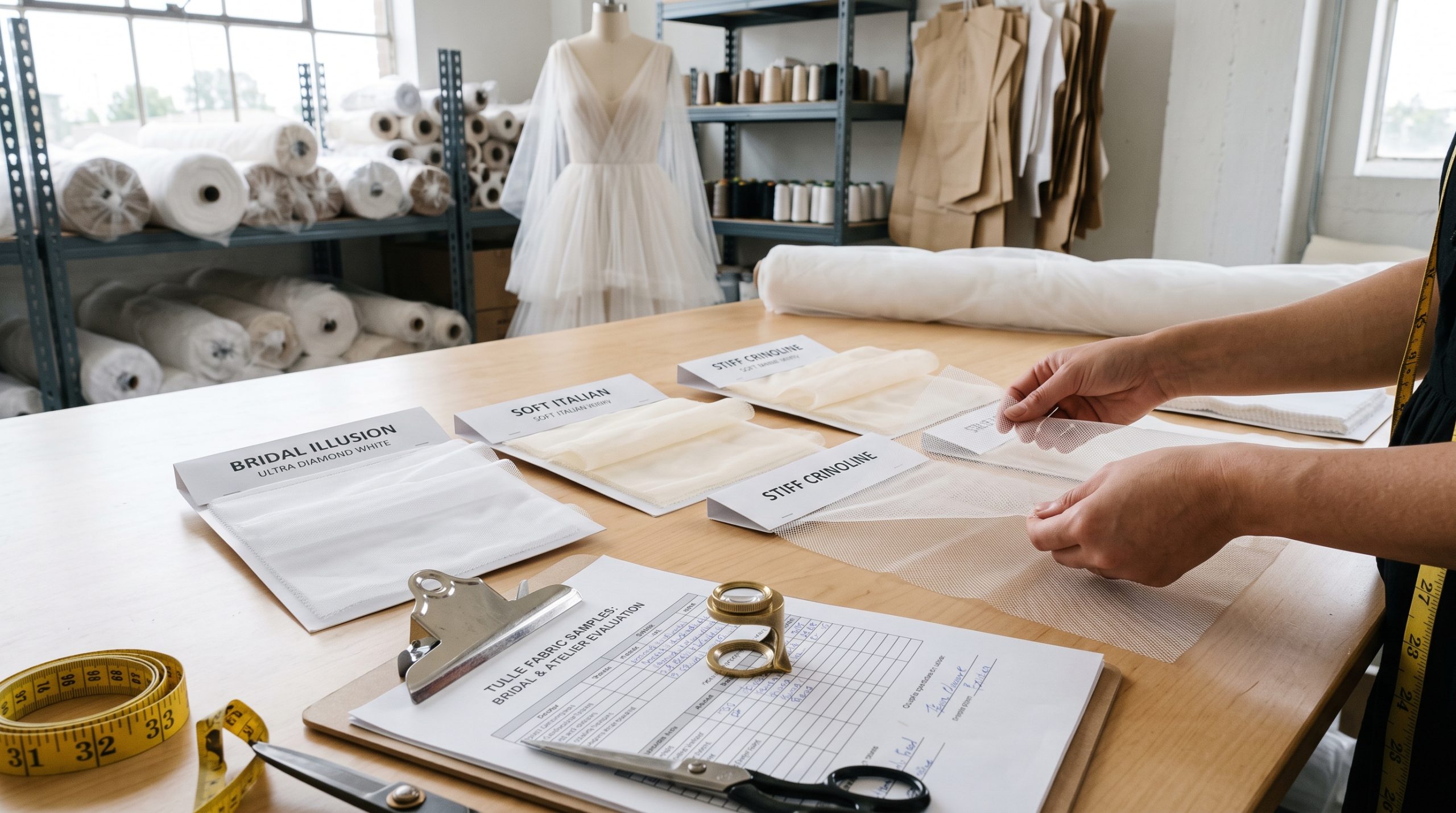
Tulle fabric samples are physical swatches of lightweight hexagonal netting that apparel makers evaluate to verify stiffness, color tone, air circulation, and structural seam resilience prior to purchasing volume yardage. Imagine approving a shipment of bridal veils based purely on a phone photograph, only to unpack rolls of coarse netting that feel scratchy on bare skin and tear when touched by machine needles. Rough yardage creates severe fitting room complaints and ruins manufacturing delivery deadlines. Ordering certified tulle fabric samples resolves these production disasters by letting your technical team inspect fabric hand feel and stitch behavior before committing company capital.
What Are Tulle Fabric Samples and Why Order Swatches?
Tulle fabric samples are physical cuts of open mesh textiles used by garment designers to examine yarn tension, transparency, and mechanical elongation before placing bulk orders. Relying entirely on digital catalogs risks receiving brittle synthetic rolls that curl along cut borders during pattern nesting. Hands-on sample testing reveals actual fiber softness, porosity distribution, and structural recovery. Procuring genuine tulle fabric samples protects procurement teams from expensive cutting room rejects and keeps product launches running smoothly.
How Do Physical Swatches Prevent Sourcing Failures?
Ordering physical swatch cards exposes substandard yarn quality, irregular aperture geometry, and offensive chemical finishes before mass manufacturing begins. Uninspected textile bolts frequently create hidden production delays when loaded onto factory cutting lines.
Here is the deal:
A small physical swatch reveals mechanical flaws that digital photos hide completely.
- Physical testing confirms actual yarn tensile resistance under manual pull tension.
- Swatch inspection identifies oily residue left by poorly maintained factory looms.
- Direct touch reveals microscopic fiber spurs that irritate bare skin surfaces.
Why Does Touch Outperform Screen Images?
Digital monitors distort subtle distinctions in fiber softness, weave density, and light reflection. Feeling physical net swatches between your fingers delivers instant data regarding surface friction, mechanical stiffness, and grain resilience.
Look:
You can determine whether a sheer net will support a fluffy ruffle within two seconds of touching it.
The Key Takeaway for bridal designers: hands-on tactile evaluations eliminate guesswork and ensure your selected mesh matches your silhouette requirements.
| Sourcing Stage | Sample Size Format | Core Inspection Goal | Production Risk Averted |
| Swatch Book Review | 10 cm x 10 cm Card | Confirm hand softness and basic hue | Eliminates unsuitable fiber grades |
| Sample Yardage Run | 3 m – 5 m Continuous | Execute live cutting and sewing trials | Prevents needle jams on sewing lines |
| Pre-Shipment Cut | 1 Full Width Meter | Verify mass density against signed standards | Stops off-spec rolls reaching ports |
Establishing signed sample cards provides clear contractual standards that safeguard your factory against substandard bulk shipments.
Why Do Tulle Fabric Samples Vary in Hand Feel?
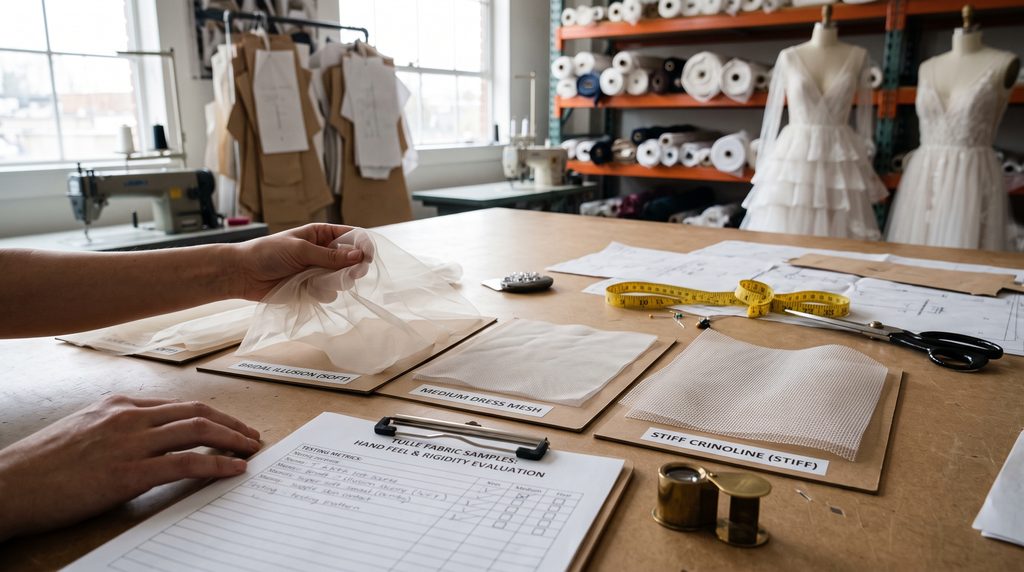
Tulle fabric samples vary in hand feel because polymer formulas, filament diameters, and heat-setting temperatures directly dictate whether netting bends softly or maintains rigid structural stiffness. Ultra-fine micro-denier polyamide produces silky smooth sheer veils that slide gently across bare skin. Coarse high-tenacity polyester monofilaments yield firm netting engineered to lift heavy skirt skirts away from legs. Sourcing verified tulle fabric samples allows pattern cutters to match textile rigidity with specific garment locations.
Can Soft Illusion Netting Prevent Skin Rashes?
Plush illusion nettings utilize supple textured synthetic yarns that eliminate friction against delicate human neck and shoulder skin. These smooth materials drape gently over collarbones without leaving unsightly abrasion marks.
Think about it:
Brides wear their wedding dresses through ten continuous hours of active movement.
- Microscopic filaments glide harmlessly across sensitive shoulder curves.
- Soft netting borders eliminate friction along armholes and neckline facings.
- Supple yarn loops conform naturally around intricate bodice lace trims.
How Does Rigid Crinoline Build Ballgown Loft?
Crinoline netting relies on stiff monofilament fibers that resist bending under downward gravitational pull. Stacking multiple tiers of stiff netting creates an expansive architectural framework that holds full skirts outward.
Ready for the good part?
You gain dramatic princess skirt puffiness without sewing heavy metal hoop wires.
The Key Takeaway for apparel technicians: allocating soft micro-netting to body contact zones and rigid crinoline to inner underskirts balances plush skin comfort with crisp volume.
| Netting Category | Base Polymer | Tactile Hand Feel | Structural Function |
| Bridal Illusion | 100% Fine Polyamide | Silky, fluid, gentle | Face veils, sheer sleeves, necklines |
| Medium Dress Mesh | 100% Polyester Multi | Balanced, pliable, light | Tiered bridesmaid skirts, costume trims |
| Stiff Crinoline Net | High-Denier Monofilament | Crisp, scratchy, firm | Inner ballgown petticoats, structured ruffles |
Tactile friction evaluations show yarn denier governs skin comfort while filament thickness establishes architectural skirt volume.
Can Tulle Fabric Samples Expose Color Layering?
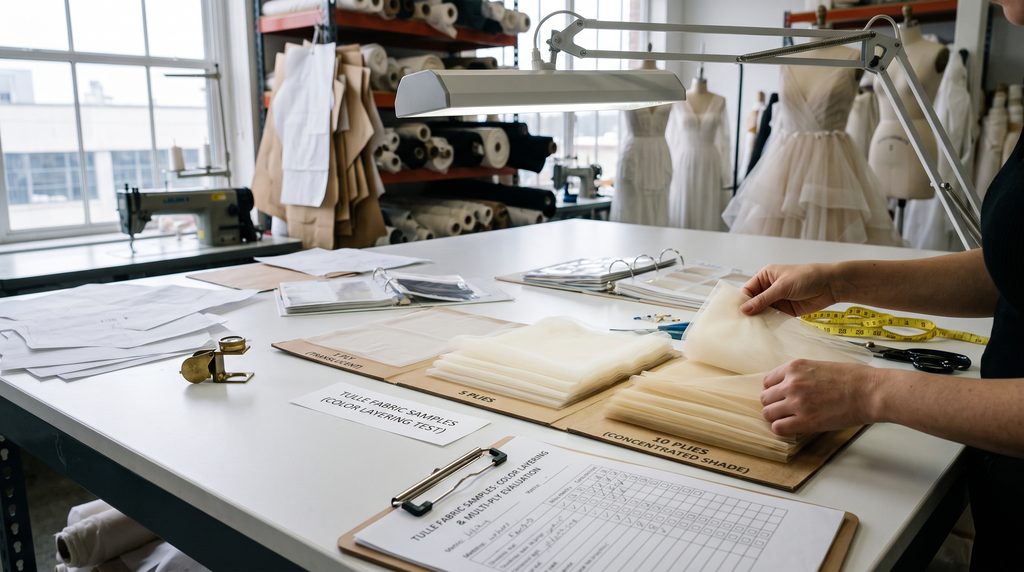
Tulle fabric samples expose color layering because stacking multiple translucent plies concentrates subtle dye pigments, revealing the true background tone of sheer fabrics. A single layer of sheer tulle appears nearly invisible when spread flat over a white worktable. Stacking five to ten layers inside your workshop concentrates subtle dye pigments into their true background shade. Evaluating physical tulle fabric samples under multiple illumination lamps stops embarrassing tone clashes between wedding dresses and matching bridal veils.
Why Does Multi-Ply Stacking Reveal True Color?
Single-layer mesh swatches transmit high ambient light, washing out faint pigment saturation to casual observers. Stacking multiple swatch folds blocks transmitted glare and exposes underlying yellow, pink, or grey undertones.
What is the real story?
An airy veil that appears pure white on a hanger can look noticeably yellow over silk satin.
- Stacking eight swatch plies matches the visual density of gathered waistbands.
- Color depth builds gradually across gathered skirt tiers.
- Multi-ply checks ensure custom dyed nettings match brand Pantone targets accurately.
How Do D65 Light Booths Expose Metamerism?
Metamerism occurs when two dyed fabric swatches match under fluorescent factory lamps yet clash under natural outdoor sun. Examining swatch cards inside calibrated light booths exposes these color shifts before cutting panels.
Look:
You ensure your bridal gowns match their accompanying veils across church, hall, and garden venues.
The Key Takeaway for color stylists: stacking sample swatches inside multi-source light booths prevents unappealing hue shifts between gowns and matching sheer accessories.
| Lighting Environment | Color Temperature | Color Evaluation Focus | Visual Error Prevented |
| Daylight Booth (D65) | 6500 Kelvin | True outdoor hue depth | Mismatched outdoor ceremony veils |
| Store Light (TL84) | 4000 Kelvin | Commercial retail showroom appearance | Off-tone boutique window presentations |
| Warm Tungsten (Ill A) | 2856 Kelvin | Indoor residential and ballroom warmth | Unwanted yellow casts in banquet halls |
Controlled light evaluations demonstrate multiple swatch plies expose subtle undertones that single transparent plies hide from view.
Which Tulle Fabric Samples Resist Edge Fraying?
Warp-knitted tulle fabric samples resist edge fraying because continuous pillar loops interlock synthetic yarns into non-raveling mechanical nodes. When technicians slice through warp-knitted hexagonal netting, the cut loop stitches remain secure without shedding loose strands. Plain woven nettings lack these interlocked pillar chains and unravel rapidly when handled. Testing durable tulle fabric samples on cutting tables confirms whether raw margins can remain exposed on finished dresses.
How Do Warp Hexagonal Knits Stop Laddering?
Modern warp looms guide multiple warp yarns simultaneously through compound needles, creating locked hexagonal loop cells. An accidental tear remains localized within a single cell rather than running down the entire skirt panel.
Here is why:
Interlocking knit nodes withstand aggressive handling without losing structural shape.
- Compound stitches lock filament intersections against mechanical shear tension.
- Raw cut edges stay neat along automated rotary blade cutting lines.
- Punctured cells isolate tears and prevent continuous fabric runs.
Can Microtex Needles Guard Delicate Seams?
Standard domestic sewing needles have rounded tips that can snag delicate synthetic mesh loops during high-speed sewing passes. Slender Microtex needles pierce through open mesh nodes cleanly, preserving yarn stability along stressed seams.
This is what happens:
Your sewing room produces smooth seamlines without puckering or fiber tears.
The Key Takeaway for factory managers: selecting warp-knitted mesh constructions prevents edge fraying and simplifies pattern cutting across automated garment lines.
| Knitting Method | Stitch Architecture | Fray Resistance Index | Cut Edge Processing Required |
| Warp-Knit Raschel | Interlocked Pillar Loops | Exceptionally High | Raw edge left unhemmed |
| Woven Leno Net | Crossed Warp & Weft | Low to Moderate | Edge binding or serging mandatory |
| Circular Knit Mesh | Looped Continuous Weft | Moderate (Prone to Runs) | Heat sealing or hem folding needed |
Stitch architecture data confirms warp-knitted loop structures eliminate edge raveling, cutting factory labor expenses on hem finishes.
How Do Tulle Fabric Samples Measure True Airflow?
Tulle fabric samples measure true airflow by quantifying air permeability through open pore areas using calibrated differential pressure gauges. Porous hexagonal mesh structures permit ambient breezes to flow through gathered skirt tiers, venting body warmth away from skin. Dense, non-porous synthetic weaves trap warm air, making voluminous bridal dresses uncomfortably warm during summer events. Testing ventilated tulle fabric samples ensures multi-layer evening dresses maintain comfortable breathability for clients.
Why Do Open Pores Accelerate Vapor Release?
Human skin releases moisture vapor continuously, especially beneath heavy multi-layer formal garments. Broad hexagonal mesh voids let this warm vapor vent outward naturally before condensing into sweat droplets.
Think about it:
Brides stay cool and comfortable while wearing twenty yards of gathered underskirt layers.
- Unobstructed apertures promote continuous convective air circulation around the body.
- High porosity values speed up moisture vapor release into surrounding air.
- Breathable layers eliminate wet sweat stains across delicate silk undergarments.
Can Magnified Loupes Verify Aperture Shape?
Examining swatch apertures through illuminated textile loupes reveals malformed knit loops, clogged pores, and uneven cell geometries. Consistent pore dimensions ensure uniform transparency and predictable ventilation across entire fabric bolts.
Look:
Uniform hexagonal pores give finished garments a balanced, refined surface texture.
The Key Takeaway for sportswear engineers: measuring air permeability on sample cuts ensures multi-layered formalwear remains breathable and pleasant during warm weather celebrations.
| Mesh Density Grade | Pore Aperture Size | Air Permeability | Breathability Comfort Level |
| Sheer Micro-Net | 0.4 mm – 0.8 mm | 350 – 500 cm³/cm²/s | Lightweight breathability for veils |
| Standard Bridal Tulle | 1.2 mm – 2.0 mm | 650 – 850 cm³/cm²/s | Excellent cross-ventilation in skirts |
| Open Coarse Crinoline | 2.5 mm – 4.5 mm | Over 1100 cm³/cm²/s | Maximum airflow beneath full petticoats |
Differential air permeability metrics show open hexagonal mesh architectures vent accumulated body heat four times faster than solid textiles.
How Can Tulle Fabric Samples Reveal True Drape?
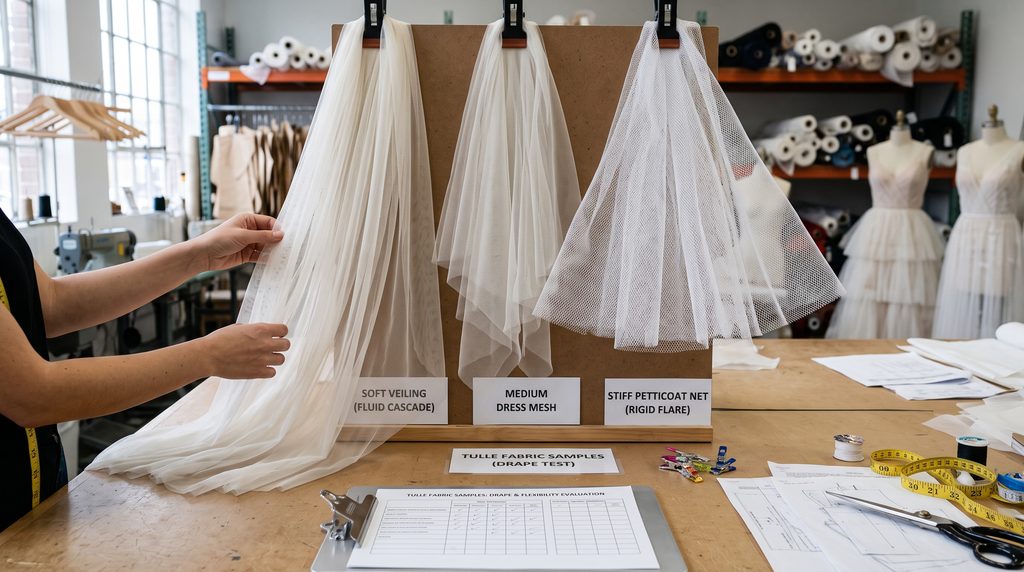
Tulle fabric samples reveal true drape by measuring flexural bending resistance and observing how gathered folds fall under gravitational pull. Rigid petticoat nets stand outward in sharp, structured pleats, whereas fluid veiling fabrics cascade downward in smooth, continuous ripples. Digital flat images fail to convey whether a textile hangs like water or holds its shape like cardboard. Sourcing verified tulle fabric samples allows pattern makers to test whether their garment silhouettes will flare crisply or fall softly.
How Does Flexural Rigidity Alter Skirt Movement?
The bending modulus of synthetic yarn determines whether cut fabric panels yield to human movement or push firmly outward. Soft polyamide yarns yield immediately to body contours, creating graceful motion on dance floors.
Ready for the good part?
You can create cascading trains that flow naturally behind walking brides.
- Low bending stiffness lets long veils glide smoothly over satin trains.
- Supple netting moves fluidly without forming awkward kinks or bulges.
- Gentle gathering produces soft, rounded folds that flatter body lines.
Can Gathering Tests Expose Silhouette Ballooning?
Gathering one meter of test sample along a stitching thread reveals its actual gathered volume before you cut whole dresses. Pliable nettings drape close to dress forms, while stiff nettings flare dramatically outward.
Here is the deal:
A quick gathering trial stops you from picking materials that puff outward excessively.
The Key Takeaway for fashion creators: gathering swatch samples across test mannequins lets you verify skirt loft and silhouette drape before cutting expensive production yardage.
| Drape Character | Bending Stiffness | Pleat Behavior | Target Gown Silhouette |
| Liquid Cascade | Extremely Low | Falls into rounded vertical waves | Slinky mermaid capes, romantic soft veils |
| Balanced Cloud | Moderate | Holds gentle airy volume | A-line skirts, gathered ballet tutus |
| Architectural Loft | High | Flares outward rigidly | High-volume ballgowns, theatrical costumes |
Cantilever bending evaluations confirm low-rigidity netting creates fluid drapery while high-rigidity yarn matrices maintain crisp architectural flare.
Why Test Tulle Fabric Samples on Sewing Machines?
Testing tulle fabric samples on sewing machines uncovers needle hole punctures, skipped stitches, and seam puckering before production rolls hit the factory floor. High-speed industrial needles generate intense friction heat that can melt delicate synthetic net intersections. Brittle yarns snap under needle impacts, leaving unsightly holes along critical waistline seams. Sourcing production-grade tulle fabric samples allows machine technicians to fine-tune needle styles, thread tensions, and stitch lengths.
Why Do High-Speed Needles Melt Synthetic Nodes?
Sewing needles piercing fabrics at several thousand stitches per minute generate substantial thermal energy through surface friction. This concentrated heat can melt thermoplastic netting filaments, welding layers into stiff puckered lumps.
What is the real story?
Incorrect needle choices ruin delicate sheer panels during initial assembly passes.
- Fine ballpoint needles slip past knitted loops without piercing filament cores.
- Controlled machine speeds minimize friction heat buildup during long runs.
- Teflon-coated presser feet glide over sheer netting without stretching seams.
How Does Stabilizer Paper Prevent Feed Jams?
Thin netting easily gets sucked downward into industrial throat plate holes by moving sewing needles. Placing thin tear-away paper beneath delicate seams supports sheer netting and feeds panels smoothly through feed dogs.
Look:
You pull the tear-away paper cleanly away after stitching, leaving flat, flawless seams.
The Key Takeaway for factory line managers: running live machine stitch tests uncovers thread tension imbalances and prevents fabric puckering along long seams.
| Machine Parameter | Optimal Factory Setting | Poor Alternative Choice | Production Issue Avoided |
| Needle Gauge | 65/9 or 70/10 Ballpoint | 90/14 Sharp Needle | Prevents filament punctures and runs |
| Thread Selection | Tex 16 – 24 Polyester Core | Heavy Spun Cotton | Eliminates bulky seams and thread breaks |
| Stitch Length | 2.0 mm – 2.5 mm Spacing | Under 1.5 mm Spacing | Stops perforation tears along seam paths |
Machine trial data confirms ballpoint needles and controlled stitch lengths prevent needle cutting along delicate sheer seams.
How Do Tulle Fabric Samples React to Iron Heat?
Tulle fabric samples react to iron heat by melting, shrinking, or puckering if soleplate temperatures exceed the melting threshold of their base synthetic polymers. Polyester netting withstands moderate steam heat, whereas fine nylon mesh begins softening at lower temperatures. Pressing hot metal directly onto sheer netting collapses its open hexagonal structure into a shiny, deformed plastic mass. Testing thermal limits on tulle fabric samples establishes safe finishing guidelines for factory pressing departments.
Can Hot Soleplates Liquefy Synthetic Filaments?
Direct iron contact transfers concentrated conductive heat that exceeds the glass transition temperature of synthetic fibers. Overheated yarns fuse together instantly, leaving permanent shiny scorch marks across delicate garment panels.
Think about it:
One careless iron pass can destroy a completed couture gown hours before delivery.
- High iron heat turns open hexagonal pores into fused plastic films.
- Excessive steam pressure shrinks synthetic netting unevenly along seams.
- Dry iron heat causes permanent embrittlement that cracks under stress.
Why Does Vertical Steaming Protect Soft Lofts?
Vertical steamers release diffuse convective steam without pressing heavy metal soleplates onto delicate textiles. The moist heat relaxes stored packaging wrinkles while allowing netting fibers to expand into lofty, full shapes.
Here is why:
Indirect vertical steaming removes transit wrinkles without risking melted fibers.
The Key Takeaway for finishing departments: establishing safe steaming distances preserves netting loft and prevents melted spots during final garment pressing.
| Base Material | Safe Steaming Temp | Max Soleplate Temp | Thermal Failure Symptom |
| Polyamide Netting | 110°C (Low Steam) | 120°C (With Press Cloth) | Melts into brittle plastic holes |
| Polyester Hex Mesh | 130°C (Medium Steam) | 145°C (With Press Cloth) | Puckers, shrinks, and discolors |
| Glitter-Bonded Net | 100°C (Indirect Only) | Zero Direct Contact | Binders melt into sticky yellow smears |
Thermal exposure evaluations prove indirect vertical steaming releases fabric wrinkles safely without risking melted fibers.
How Can You Audit Tulle Fabric Samples for Flaws?
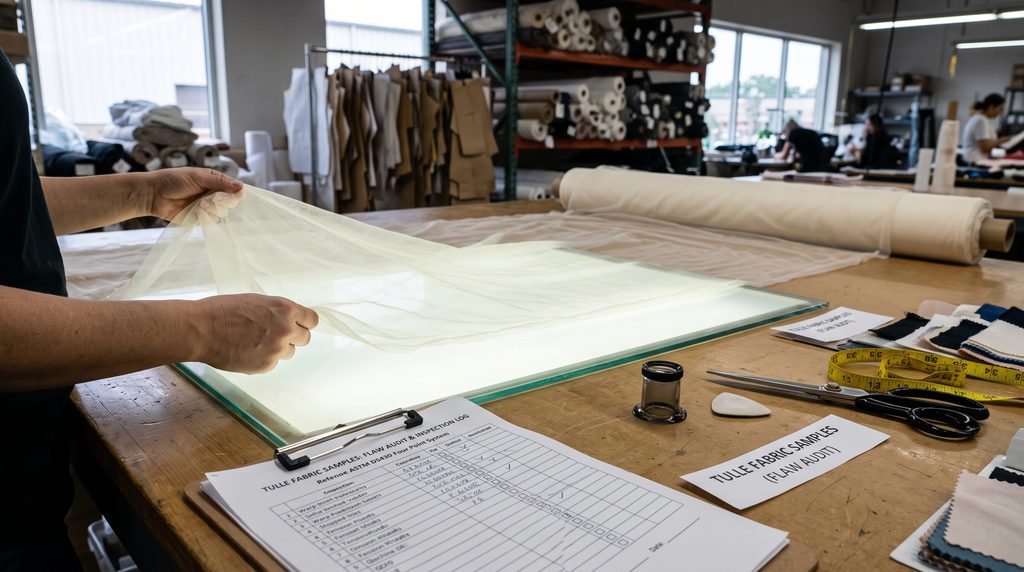
You audit tulle fabric samples for flaws by passing yardage over illuminated inspection tables to identify dropped stitches, oil contamination, and width variations. Small cut swatches can easily conceal repetitive knitting defects that recur across large fabric rolls. Inspecting continuous sample yardage reveals tension streaks, broken filaments, and edge curling that damage pattern cutting. Auditing bulk tulle fabric samples using international defect point frameworks ensures your factory receives dependable materials.
How Do Backlit Inspection Tables Find Defects?
Backlit inspection frames illuminate transparent netting from below, highlighting yarn flaws that remain invisible in overhead room lighting. Dropped loops and thick slub yarns show up clearly as irregular spots against the illuminated glass.
This is what happens:
Your quality control team identifies defective yardage before spreading fabric on cutting tables.
- Transmitted illumination exposes faint machine oil spots before heat setting.
- Broken knit loops appear as distinct bright voids along fabric courses.
- Selvage curling and uneven winding tension show up clearly during unrolling.
What Does ASTM Four-Point Scoring Calculate?
The ASTM D5430 four-point inspection framework assigns penalty points to visual defects based on their measured length. Totaling penalty points per hundred square yards yields an objective numerical score for accepting or rejecting lots.
Here is the deal:
Standardized scoring eliminates subjective arguments between your buyers and textile mills.
The Key Takeaway for quality assurance managers: standardizing backlit table audits and four-point scoring stops defective mesh rolls from entering production cutting rooms.
| Defect Severity Type | Measured Defect Size | Penalty Points Assigned | Acceptance Action |
| Minor Dropped Loop | Under 3 Inches (75 mm) | 1 Point | Allowed within standard tolerance |
| Medium Slub Streak | 3 to 6 Inches (150 mm) | 2 Points | Monitored across overall roll count |
| Severe Oil Contamination | Over 9 Inches (230 mm) | 4 Points | Triggers immediate roll rejection |
Standardized ASTM four-point evaluations provide clear numerical thresholds for validating shipment quality.
How Can You Source Bulk Tulle Fabric Samples?
You can source bulk tulle fabric samples safely by partnering with reliable warp-knitting mills that provide low minimum order quantities, custom lab dips, and open quality inspection logs. Massive fabric brokers often impose high minimums that tie up operating cash in slow-moving warehouse inventory. Flexible manufacturing partners offering sensible trial yardage enable emerging apparel labels to prototype collections safely. Reviewing verified tulle fabric samples ensures your bulk orders deliver the exact hand feel, color depth, and pore stability your brand requires.
What Flexible Order Minimums Protect Budgets?
Progressive warp-knitting mills offer reasonable sampling programs starting around one hundred meters per custom shade. Sourcing smaller trial batches keeps your working capital liquid while you test new designs across retail boutiques.
Look:
You can validate market demand across fashion boutiques before purchasing container quantities.
- Low minimums reduce the capital tied up in slow-moving warehouse stock.
- Shorter production lead times keep your collections aligned with bridal trends.
- Flexible dye lots let you prototype ivory, champagne, and blush shades simultaneously.
How Do Swatch Binders Streamline Production?
Comprehensive swatch binders assemble physical swatches of varied weights, hand feels, and color options into one organized reference tool. Your design and pattern teams can review real material swatches directly during technical fit sessions.
Ready for the good part?
Your workshop speeds up prototype development and eliminates fabric selection mistakes.
The Key Takeaway for fashion procurement directors: pairing low trial minimums with organized swatch binders speeds up development and maintains healthy production margins.
| Sourcing Stage | Standard Lead Time | Primary Deliverable | Sourcing Safety Benefit |
| Swatch Book Review | 24 – 48 Hours | Comprehensive hand feel swatch collection | Verifies softness and pore dimensions |
| Custom Lab Dip Match | 3 – 5 Business Days | 3-shade Pantone dip recipes | Secures exact shade matching for gowns |
| Bulk Production Run | 12 – 16 Business Days | Certified yardage rolls with QC reports | Delivers uniform quality across shipments |
Structured procurement milestones reduce supply chain vulnerabilities and ensure dependable delivery of specialized bridal textiles.
Final Sourcing Strategy for Tulle Fabric Samples
Balancing tactile hand feel, open-pore breathability, color consistency, and production sewability determines the long-term success of your bridal and formalwear collections. This technical guide answered your core questions regarding warp-knit mechanics, multi-ply color verification, needle selection, and machine inspection protocols. Our specialized textile facility supplies precision warp-knitted nettings, ultra-soft bridal illusion tulles, and structured petticoat meshes tailored to strict international performance standards. To secure certified quality yardage customized to your exact denier, stiffness, and colorway specifications, contact us today to speak with technical specialists and order physical sample swatches. We believe exceptional formalwear begins with disciplined textile engineering, and our manufacturing team stands ready to deliver dependable materials for your brand.
FAQ Section
- Q1: Can I confirm bridal tulle colors using digital computer screens? No, digital computer monitors cannot display accurate sheer mesh opacity, subtle dye undertones, or ambient light reflections. You must evaluate physical swatch cuts stacked in multiple plies under standardized daylight lamps before approving production dye lots.
- Q2: What’s the best sample size to test fabric drape and sewability? A continuous sample cut of three to five meters provides sufficient material for reliable testing. This yardage allows your pattern cutters to gather full tiers, measure hanging drape, and run multi-layer seams through factory sewing machines.
- Q3: How do I know if a tulle sample is soft enough for direct skin contact? Perform a blind touch test by rubbing the swatch across your sensitive inner wrist and neck skin. If you feel any micro-abrasive prickliness, the netting contains coarse filaments that will cause chafing along garment necklines and sleeves.
- Q4: Can I wash delicate tulle fabric samples in commercial washing machines? Yes, but you should place sheer swatches inside fine mesh wash bags and use cold, gentle laundry cycles. Avoid tumble drying with heat because high dryer temperatures shrink synthetic filaments and warp open mesh pores.
- Q5: What’s the best way to handle color variance between sample swatches and bulk rolls? Establish an agreed Delta E color tolerance within your purchasing contract before production begins. Reviewing pre-shipment top-of-production cuts inside a calibrated light booth ensures delivered bulk rolls match your signed reference sample.