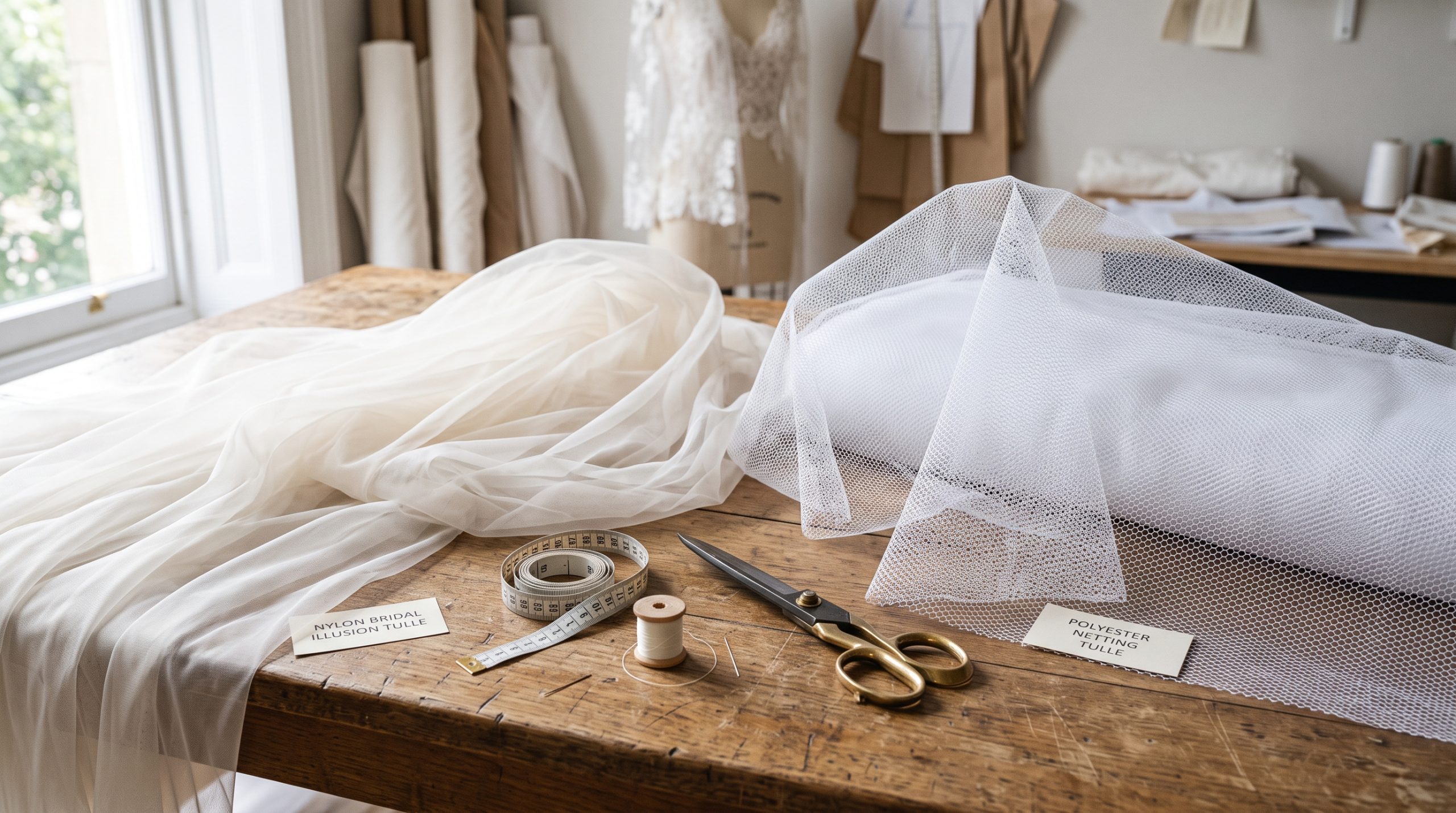
What Is Nylon Tulle vs Polyester Tulle in Bridal Wear? The core difference lies in tactile softness versus architectural volume. Sourcing netting fabrics for bridal collections often leads to costly cut-room surprises. Picture sewing hundred-yard couture gowns only to discover the netting scratches sensitive skin or collapses under heavy lace appliques, wrecking your production schedule and client trust. Evaluating nylon tulle vs polyester tulle solves these manufacturing headaches by matching specific polymer properties directly to garment silhouette demands. We supply tested mesh rolls to garment houses worldwide, providing dependable performance yard after yard.
Why Compare nylon tulle vs polyester tulle for Bridal?
Comparing nylon tulle vs polyester tulle prevents structural collapse and eliminates skin irritation complaints from brides. Nylon offers delicate drape for floating veils while polyester delivers rigid volume for supporting multi-tiered ballgowns.
Choosing the wrong net compromises your entire design aesthetic. Production managers must balance tactile comfort against structural requirements before issuing factory purchase orders.
Why Does Fiber Choice Define Bridal Gown Quality?
Fiber composition directly determines how netting behaves against skin and behaves under heavy decorative beadwork. Polyamide yarns yield silky fluidity suitable for sheer sleeves or illusion necklines.
Here’s the deal: bridal clients notice scratchy netting immediately during fittings. When your atelier selects raw netting, evaluate these physical attributes:
- Yarn softness across skin contact zones
- Flexibility under layered lace appliques
- Crease resistance during overseas transit
Selecting fine polyamide prevents chafing across delicate shoulders and maintains an airy silhouette.
How Do Production Delays Arise from Wrong Mesh?
Mismatched fabric weights create sewing puckers and force garment factories to halt assembly lines for needle adjustments. Polyester yarns dull standard sewing needles rapidly during intense high-speed stitch runs.
Think about this: a sudden fabric tear during final garment pressing ruins weeks of intensive pattern work. You can prevent costly remakes by testing tensile properties prior to batch cutting.
| Evaluation Metric | Polyamide Netting | Polyester Netting |
| Skin Sensitivity | Hypoallergenic, smooth | Coarser edges, stiff |
| Silhouette Style | Fluid, clinging, draping | Sculptured, self-supporting |
| Cut-Room Waste | Minimal edge curling | Stable, clean cut lines |
Selecting suitable textile foundations eliminates emergency garment alterations and secures delivery deadlines.
Key Takeaway: Choosing the right base fiber protects your production schedule and prevents expensive garment returns caused by skin irritation.
How Does Hand Feel Differ in nylon tulle vs polyester tulle?
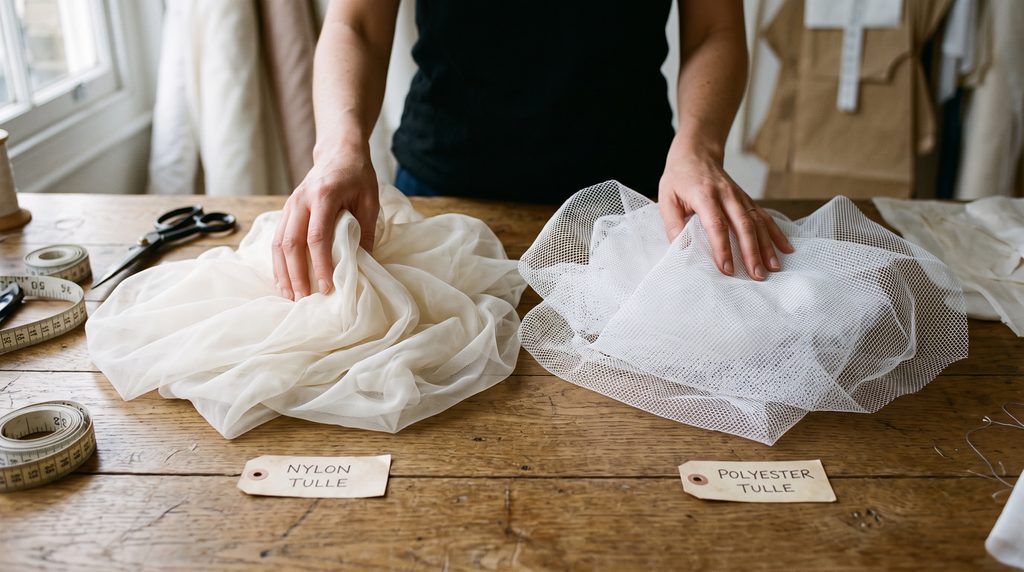
Nylon tulle feels exceptionally soft and supple against bare skin while polyester tulle exhibits a crisp, stiffer texture. The polymer molecular chain in nylon creates flexible filaments that bend effortlessly across curves.
This tactile distinction remains apparent when assessing raw sample swatches. The comparison of nylon tulle vs polyester tulle highlights why luxury brands reserve nylon for intimate garment layers.
What Makes Polyamide Threads Feel Silky Soft?
Polyamide filaments possess lower bending modulus values than polyester equivalents of identical denier ratings. This flexibility allows individual mesh hexagons to glide across sensitive skin without scratching.
What’s the real story? Luxury veils require effortless glide without snagging delicate hair accessories. You should examine yarn specifications closely when ordering sample yardage:
- Denier thickness below 20D for sheer lightness
- Multifilament spinning for enhanced suppleness
- Gentle chemical scouring for smooth surface finishes
These yarn treatments produce a whisper-soft touch ideal for luxury bridal veils.
Why Does Polyester Produce a Scratchy Sensation?
Polyester fibers feature a rigid molecular structure that resists bending under light touch. Cut raw edges on polyester net remain sharp, creating prickling sensations against skin surfaces.
See for yourself: brush a polyester edge across your inner wrist to feel the abrasive resistance. Bulk production runs of budget party dresses often compromise comfort by using stiff polyester where soft polyamide belongs.
| Tactile Attribute | Nylon Mesh Swatch | Polyester Mesh Swatch |
| Surface Friction | Low, glide-friendly | Moderate to abrasive |
| Bending Recovery | Instant, pliable | Firm, spring-like |
| Skin Contact Rating | Superior for bodices | Restricted to linings |
Tactile softness testing confirms polyamide provides the gentle hand required for bridal skin contact.
Key Takeaway: Prioritizing soft polyamide for direct skin contact prevents customer discomfort and elevates the luxury perception of your gowns.
Which Fiber Holds Shape in nylon tulle vs polyester tulle?
Polyester holds structural shape far better than nylon because its rigid crystalline polymer structure resists compression under weight. This inherent springiness enables polyester netting to sustain voluminous shapes without sagging.
Balancing nylon tulle vs polyester tulle requires recognizing that soft nylon collapses under its own weight when gathered into large skirts. Designers rely on polyester when creating dramatic architectural silhouettes.
How Does Polyester Maintain Dramatic Ballgown Fluff?
Polyester netting acts like microscopic scaffolding beneath heavy outer silks and jacquards. The yarn maintains its bent geometry after heat-setting, resisting flattening even after hours of seating.
Ready for the good part? You need fewer total yards of polyester netting to achieve dramatic skirt expansion. Review these construction efficiencies when calculating material usage:
- 30% fewer gathered tiers required for volume
- Extended shape retention under heavy train weights
- Reduced moisture absorption in humid ballrooms
These structural features make polyester indispensable for voluminous petticoats and stage costumes.
Why Does Nylon Flaccidity Threaten Petticoat Rigidity?
Nylon filaments absorb ambient atmospheric moisture, causing the fibers to relax and lose tensile stiffness over time. A ballgown petticoat constructed entirely from soft nylon gradually droops as humidity rises.
Here is why: moisture molecules penetrate the amorphous regions of polyamide chains, acting as plasticizers that soften the fabric. Your workshop must reinforce nylon tiers with horsehair braid or stiff polyester under-layers to avoid silhouette collapse.
| Structural Property | Nylon Netting Yardage | Polyester Netting Yardage |
| Compression Resistance | Low, prone to sagging | High, snaps back into position |
| Humidity Resistance | Loses crispness rapidly | Retains rigidity in damp air |
| Layering Efficiency | Requires multiple tiers | Achieves volume in fewer passes |
Data confirms polyester provides superior structural resilience under heavy decorative gown components.
Key Takeaway: Specifying polyester netting for underskirts guarantees long-lasting silhouette volume without requiring excessive material layering.
Can You Spot Weave Marks in nylon tulle vs polyester tulle?
Weave clarity differs noticeably because nylon produces smooth rounded hexagonal cells while polyester forms sharply defined, geometric apertures. Both fabrics use warp-knit tricot machines yet yield distinct cell appearances.
Examining nylon tulle vs polyester tulle under magnification reveals how filament tension shapes hole geometry. Clear mesh patterns allow designers to match sheer aesthetics to specific bridal themes.
Can You Detect Hexagonal Aperture Distortions?
Warp-knit loops in nylon flex smoothly when pulled diagonally, creating uniform cell expansion across curved body panels. This structural flexibility provides invisible blending against diverse skin tones.
Check this out: stretch an illusion panel across your hand and watch the cell openings expand evenly. Quality mesh displays specific structural markers under close inspection:
- Symmetrical hexagonal geometry across the warp
- Minimal needle lines or vertical streak bars
- Uniform knotting at connecting pillar stitches
Consistent knitting ensures invisible coverage across sheer back panels and illusion necklines.
Which Mesh Structure Offers Optimal Tensile Strength?
Polyester mesh resists diagonal elongation, maintaining strict hole dimensions even under heavy machine tension. This dimensional stability simplifies automated pattern cutting and computerized multi-head embroidery processes.
Here is the catch: rigid polyester mesh can distort when stretched across bias seams, creating puckers along zipper closures. Matching stretch direction to garment grainlines prevents unsightly distortion across fitted silhouettes.
| Mesh Construction | Fine Polyamide Net | Rigid Polyester Net |
| Hole Geometry | Softened hexagon | Crisp diamond or hexagon |
| Multi-Directional Stretch | Moderate mechanical give | Rigid, minimal bias stretch |
| Run Resistance | Excellent loop lock | High, clean edge stability |
Analysis reveals polyamide offers smoother mechanical compliance while polyester delivers precise dimensional stability.
Key Takeaway: Checking aperture geometry guarantees your sheer pattern pieces remain invisible and retain uniform tension during sewing.
How Do Heat Limits Differ in nylon tulle vs polyester tulle?
Polyester handles significantly higher temperatures than nylon, tolerating heat settings up to 150°C without filament degradation. Nylon softens near 120°C and melts into brittle plastic beads under careless iron contact.
Thermal tolerance in nylon tulle vs polyester tulle dictates your factory finishing protocols. Garment facilities must enforce strict ironing rules to avoid costly press-room damages.
What Happens When You Apply High Steam to Polyamide?
Direct contact with hot irons instantly burns polyamide netting, leaving glossy discolored patches or holes on couture gowns. Steam irons set too high will shrink nylon veils unpredictably.
Don’t overlook this: a single thermal accident ruins finished gowns moments before warehouse packaging. Train your pressing operators to maintain these thermal guidelines:
- Set irons strictly to low synthetic settings
- Always place a damp press cloth over seams
- Rely on upright vertical steamers for final smoothing
Adhering to conservative heat settings preserves delicate bridal netting through final finishing.
Why Does Polyester Withstand Commercial Pressing Cycles?
Polyester possesses higher thermal melting thresholds, allowing faster automated pressing operations in industrial finishing departments. Garment manufacturers run heated pleating machines without melting polyester mesh fibers.
Here is what matters: permanent pleats remain sharp in polyester netting even after repeated commercial cleaning cycles. You can apply heat-transfer rhinestones directly onto polyester mesh without damaging yarn integrity.
| Thermal Characteristic | Nylon Net Spec | Polyester Net Spec |
| Melting Temperature | ~215°C (softens at 120°C) | ~255°C (softens at 150°C) |
| Steam Sensitivity | Shrinks under high heat | Stable under heavy steam |
| Pleat Retention | Poor, requires chemical fix | Exceptional heat-set memory |
Thermal testing proves polyester offers safer tolerances for high-speed industrial pressing and heat-set detailing.
Key Takeaway: Establishing strict pressing temperatures protects delicate nylon from melting while enabling fast commercial processing for polyester components.
Which Fabric Drapes Best in nylon tulle vs polyester tulle?
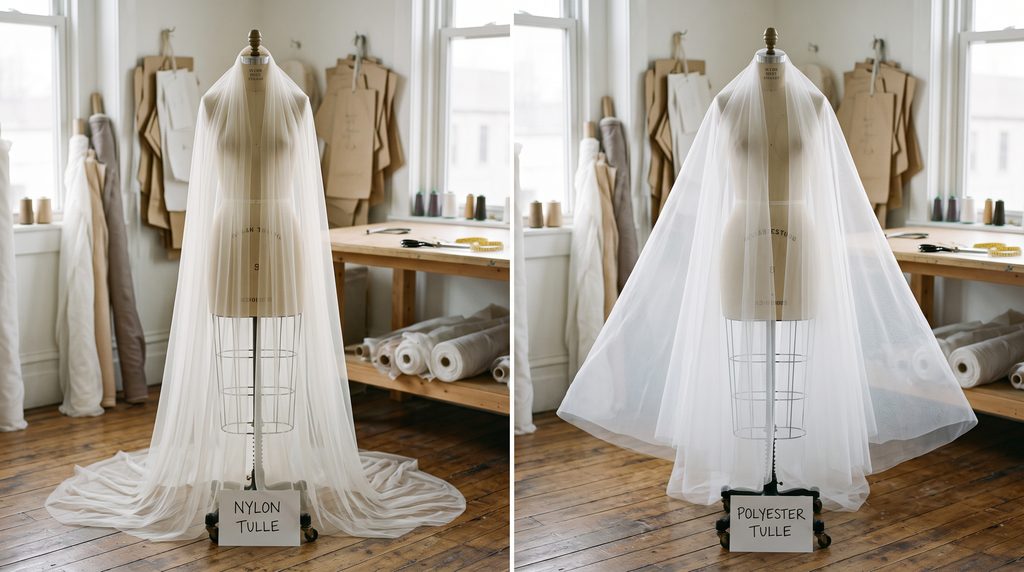
Nylon tulle drapes far better than polyester, flowing in gentle cascades that follow body movements naturally. Polyester tulle tends to project outward away from the body, producing stiff flares rather than supple ripples.
The fluid drape of nylon tulle vs polyester tulle makes polyamide the undisputed selection for royal-length cathedral veils. Evaluating suspension dynamics ensures your gown overlays drift gracefully down wedding aisles.
Which Textile Delivers Liquid Cascades for Veils?
Fine nylon netting floats weightlessly on air currents, settling into soft folds that complement intricate bridal trains. Its low bending stiffness prevents harsh creasing when brides turn or gather their skirts.
Notice the difference: drop a square of nylon and polyester from shoulder height to witness air resistance in action. Nylon settles like mist while polyester lands with rigid edges. Premium veils require these physical qualities:
- Weightless floating response during motion
- Soft draping over bridal bouquets without snagging
- Smooth pooling along floor transitions
These dynamic attributes give bridal veils their timeless, romantic elegance.
How Does Synthetic Density Affect Fluid Movement?
Synthetic fiber density and yarn crimp govern how mesh panels move under gravity. Lower-denier polyamide allows individual filaments to settle closely together without creating static air pockets.
Here is the reality: stiff polyester netting traps air between layers, creating excessive ballooning around walking brides. Garment patternmakers prefer supple nylon when crafting flowing Grecian goddess gowns or romantic draped sleeves.
| Drape Metric | Polyamide Veiling | Polyester Craft Net |
| Drape Coefficient | Low (highly fluid) | High (rigid, stiff) |
| Air Floatation | Prolonged, gentle settle | Abrupt, flat landing |
| Static Cling Tendency | Low with anti-static wash | Moderate to high cling |
Dynamic flow analysis demonstrates polyamide delivers superior fluidity for luxury accessories and moving garment panels.
Key Takeaway: Choosing supple nylon for veils and flowing overlays guarantees graceful movement without stiff, unsightly ballooning.
How Does Dyeing Work in nylon tulle vs polyester tulle?
Nylon absorbs dye readily through atmospheric acid dyeing baths while polyester demands high-pressure, high-temperature disperse dye systems. Nylon’s polymer structure contains amine end-groups that bond securely with color molecules.
Understanding color dynamics in nylon tulle vs polyester tulle allows production teams to match seasonal bridal palettes accurately. Precise color absorption prevents mismatched shades across multi-layered gown components.
Can Acid Dyes Penetrate Polyamide Fibers Uniformly?
Polyamide fibers accept color easily at boiling temperatures without requiring harsh chemical carriers or high-pressure autoclaves. Small dye houses can formulate custom champagne, blush, or nude shades rapidly in atmospheric vats.
Keep this in mind: matching sheer netting precisely to fair, olive, and deep skin tones requires subtle dye control. Dyeing polyamide offers several practical production advantages:
- Vibrant shade saturation at lower bath temperatures
- Precise tone adjustments during dye sampling
- Clean post-dye washouts with clear rinse water
These processing characteristics make nylon mesh suitable for custom-matched nude illusion backings.
Why Do Disperse Dyes Keep Polyester Hues Resilient?
Polyester requires specialized disperse dyes applied at temperatures above 130°C to open the dense crystalline fiber matrix. Once embedded, these dye molecules lock within the polymer chain, resisting fading from intense sunlight.
Look closer: outdoor wedding decorations made from polyester net retain bright colors throughout sun-drenched ceremonies. Polyester avoids chemical degradation when exposed to chlorine pool water or outdoor weather conditions.
| Dyeing Parameter | Nylon Netting Process | Polyester Netting Process |
| Dye Class | Acid or pre-metallized dyes | Non-ionic disperse dyes |
| Temperature Needs | 98°C to 100°C (atmospheric) | 130°C to 135°C (pressurized) |
| UV Lightfastness | Moderate (tends to yellow) | Excellent color stability |
Dye house data indicates nylon enables fast bespoke color development while polyester ensures long-term outdoor lightfastness.
Key Takeaway: Selecting nylon enables rapid custom nude matching for gowns, while polyester provides UV-resistant color for outdoor decor.
What Are Cost Margins for nylon tulle vs polyester tulle?
Polyester tulle costs approximately 40% to 60% less per bolt than comparable nylon tulle due to cheaper petrochemical refining and higher extrusion volume worldwide. Polyamide chips demand costlier chemical precursors and specialized polymerization equipment.
Analyzing procurement expenses in nylon tulle vs polyester tulle directly impacts wholesale garment margins. Savvy manufacturers calculate cost per yard across large production runs to maintain healthy profitability.
Where Do Yarn Production Expenses Diverge Most?
Caprolactam synthesis for nylon 6 and hexamethylenediamine for nylon 6,6 require complex multi-step chemical reactions that drive up yarn costs. In contrast, purified terephthalic acid used in polyester remains a massive global commodity produced at lower margins.
Count the cost: when producing thousands of party skirts, a price variance of thirty cents per yard shifts project budgets substantially. Textile buyers balance these supply chain factors:
- Higher raw polymer chip purchasing costs
- Slower spinneret throughput for ultra-fine nylon
- Specialized packaging to protect delicate nylon bolts
These raw material factors make nylon an investment reserved for high-value garment collections.
How Can You Protect Wholesale Profit Margins?
Bridal brands protect margins by employing hybrid fabric configurations within individual gown designs. Designers use fine nylon for visible bodices and switch to budget polyester for interior skirt foundations.
Here is your edge: cutting interior volume layers from polyester reduces bill-of-materials costs without sacrificing exterior luxury touch. Your sourcing department can optimize procurement through strategic inventory allocation:
| Sourcing Tier | Primary Fiber | Ideal Wholesale Application |
| Premium ($$$) | Polyamide / Nylon | Veils, illusion necklines, sheer sleeves |
| Mid-Tier ($$) | Nylon/Poly Blends | Multi-layered skirts, gathered ruffles |
| Economy ($) | 100% Polyester | Interior crinolines, event drapes, favor bags |
Smart material placement maximizes profit margins while preserving customer-facing luxury standards.
Key Takeaway: Strategic material placement using polyester for structural underskirts and nylon for skin-contact areas keeps production budgets profitable.
How Do Garments Wash with nylon tulle vs polyester tulle?
Polyester tulle withstands repetitive washing and tumble drying far better than nylon, maintaining crispness without stretching or fraying. Nylon requires delicate hand-washing protocols to prevent surface fuzzing and moisture-induced stretching.
Post-purchase durability in nylon tulle vs polyester tulle determines bridal gown preservation success. Bridal dry cleaners select specialized solvents based on these synthetic fiber compositions.
Does Frequent Laundry Cause Structural Snagging?
Polyamide yarns possess high tensile strength yet snag easily on zipper teeth, jewelry clasps, and rough fingernails during cleaning. Agitation inside standard washing machines pulls fine nylon loops, creating visible horizontal runs across sheer panels.
Watch out here: aggressive cleaning cycles can turn heirloom bridal veils into tangled, frayed messes. Protecting delicate netting requires strict care routines:
- Enclose sheer garments in protective mesh laundry bags
- Wash strictly in cold water using neutral detergents
- Air-dry flat away from direct sunlight or radiant heaters
Gentle laundering preserves delicate mesh structures across years of keepsake storage.
Which Synthetic Blend Repels Moisture and Stains?
Polyester fibers absorb virtually zero moisture from wine spills or muddy wedding lawns, allowing stains to release during gentle spot-cleaning. The hydrophobic fiber keeps waterborne dirt on surface levels rather than letting it penetrate internal filament cores.
Make no mistake: wedding receptions present countless spill hazards that threaten delicate gown hems. Polyester netting releases food greases and grass stains with minimal solvent treatment.
| Maintenance Factor | Nylon Netting Fabric | Polyester Netting Fabric |
| Moisture Regain | ~4.0% to 4.5% (absorbent) | ~0.4% (hydrophobic) |
| Snag Tendency | High under mechanical wash | Low to moderate |
| Stain Release | Demands specialized solvents | Releases soil easily in wash |
Laundering trials show polyester provides superior resilience against spills, tears, and mechanical washing stress.
Key Takeaway: Recommending proper care procedures prevents accidental garment snagging and extends the wearable lifespan of delicate designs.
What Should You Pick Between nylon tulle vs polyester tulle?
Select nylon tulle when your project demands soft luxury drape, delicate skin contact, and invisible illusion panels. Choose polyester tulle when your priority centers on structural volume, crisp shape retention, budget efficiency, and outdoor weather resistance.
Solving the sourcing challenge of nylon tulle vs polyester tulle comes down to aligning material properties with your brand’s market positioning. Successful ateliers maintain rolls of both synthetic textiles in stock to address diverse creative briefs.
How Do You Balance Sensory Touch and Project Budgets?
Bridal couture demands sensory perfection because brides will not tolerate prickly tulle against their skin during an emotional ten-hour wedding day. Event decorators and party planners, however, waste valuable capital if they specify expensive nylon for overhead ceiling swags or favor bags.
Here is the bottom line: match textile performance directly to user interaction points. Your sourcing checklist should weigh these practical factors:
- Direct skin touch points demand 100% fine polyamide
- Hidden petticoat tiers perform best with crisp polyester
- High-volume decorative swags require low-cost polyester bolts
Applying this selective sourcing formula protects both garment comfort and production profitability.
What Custom Textile Sourcing Roadmap Fits Your Brand?
Garment brands scale successfully by establishing reliable supply chains with textile mills capable of providing certified, consistent mesh yardage. Requesting lab dip swatches and inspecting sample bolts protects your brand against batch variations.
Ready for action? Securing consistent, premium netting requires dependable manufacturing partnerships. Review this production selection framework before placing bulk orders:
| Production Category | Recommended Fiber | Key Specification Requirement |
| Bridal Veil Lines | 100% Polyamide (Nylon) | 15D ultra-sheer, soft hand, 300cm wide |
| Illusion Bodices | Nylon Spandex Tricot | 20D micro-mesh, four-way mechanical stretch |
| Ballgown Crinolines | 100% Polyester Netting | 50D+ stiff hexagonal cell, high resilience |
| Event Ceiling Drapes | 100% Polyester Tulle | Flame-retardant treated, 54-inch bulk rolls |
Matching exact fiber specifications to garment functions ensures flawless aesthetic delivery and eliminates factory bottlenecks.
Key Takeaway: Implementing a tiered fabric specification strategy guarantees superior client comfort where it matters while safeguarding wholesale production margins.
This guide resolved your material selection dilemmas by evaluating fiber science, tactile comfort, pressing limits, and production cost calculations across both synthetic fabrics. We support garment manufacturers and fashion labels by delivering custom-dyed, precision-inspected netting rolls tailored to your exact manufacturing requirements. To review certified fabric swatches or discuss container-load bulk pricing for your next collection, please contact us today. Elevating global apparel standards through dependable textile craftsmanship remains our foundational commitment to your growing business.
FAQ
Q1: What’s the best fabric choice between nylon and polyester tulle for making bridal veils?
Nylon tulle serves as the premier choice for bridal veils because its soft filaments create an airy cascade that flows smoothly without stiff edges or scratchy textures.
Q2: Can I iron nylon tulle with a standard household steam iron?
No, standard irons on medium or high heat will melt nylon filaments instantly. You must use the lowest synthetic temperature setting with a damp pressing cloth or rely on upright garment steamers.
Q3: How do I know if my netting swatch is nylon or polyester?
Perform a careful flame test on a scrap thread; nylon burns slowly with a celery-like odor leaving a soft brown bead, whereas polyester burns quickly with sweet smoke leaving hard black residue.
Q4: What’s the best option for adding volume to heavy ballgown petticoats?
Polyester netting provides the best structural volume because its stiff molecular structure resists flattening under heavy skirt layers.
Q5: Can I dye polyester tulle using home fabric dye kits?
No, household acid or all-purpose dye kits will not penetrate polyester fibers because they lack open molecular bonding sites; polyester requires specialized industrial disperse dyes applied under high heat and pressure.