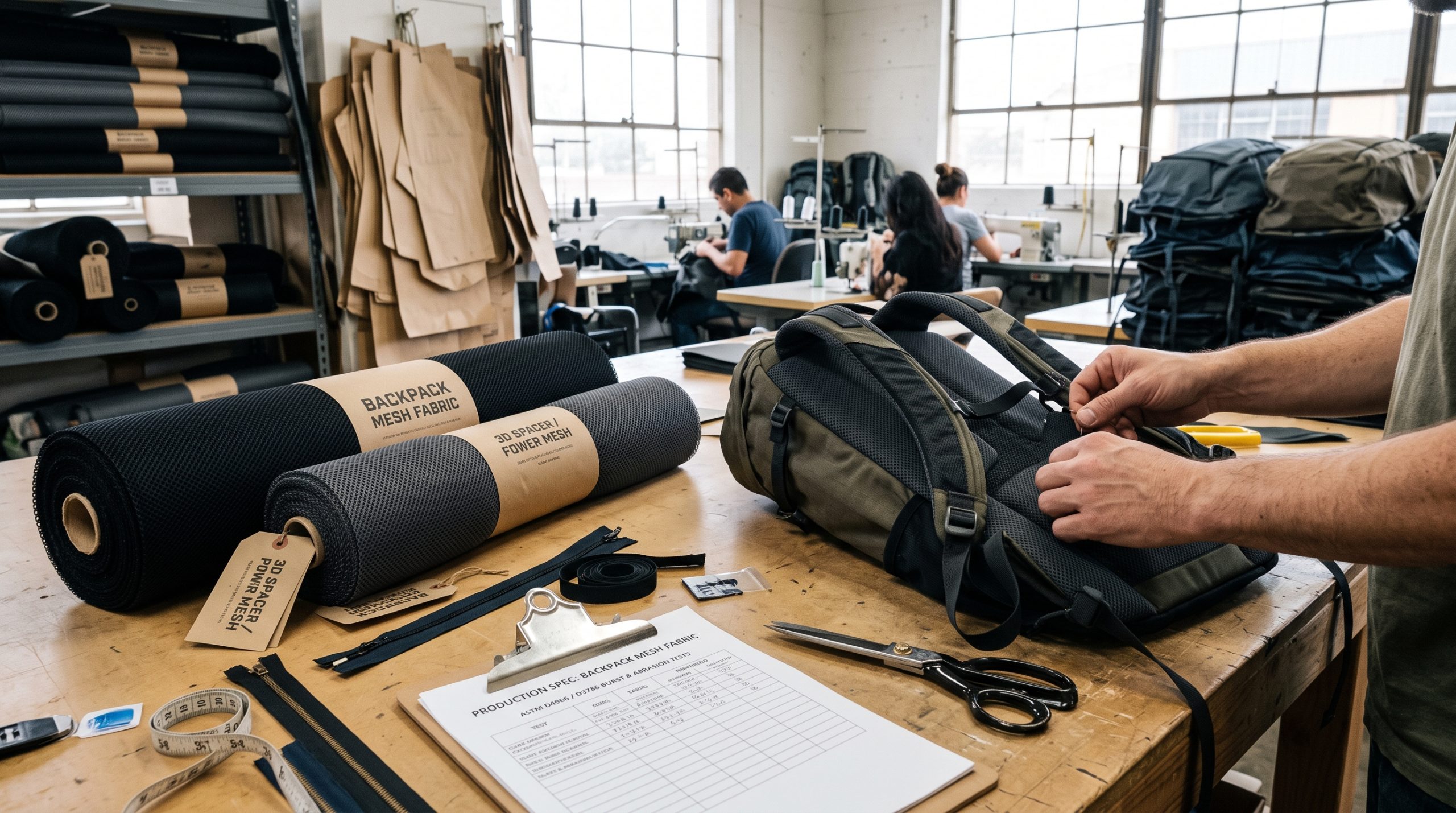
The best backpack mesh fabric combines high-tenacity nylon or polyester filaments with locked warp-knit loop nodes to deliver exceptional puncture resistance, dynamic stretch, and cushioned breathability. Outdoor gear developers repeatedly encounter ruined prototypes when flimsy side pockets tear open on sharp twigs or shoulder harness pads collapse under twenty-pound loads. Sweaty hikers suffer from soaked shirts, and frayed pocket borders cause severe brand reputation damage among passionate thru-hikers. Specifying factory-tested backpack mesh fabric engineered on multi-bar raschel knitting machines resolves premature tearing, preserves structural ventilation, and guarantees dependable field longevity.
What Defines Tough Backpack Mesh Fabric in Packs?
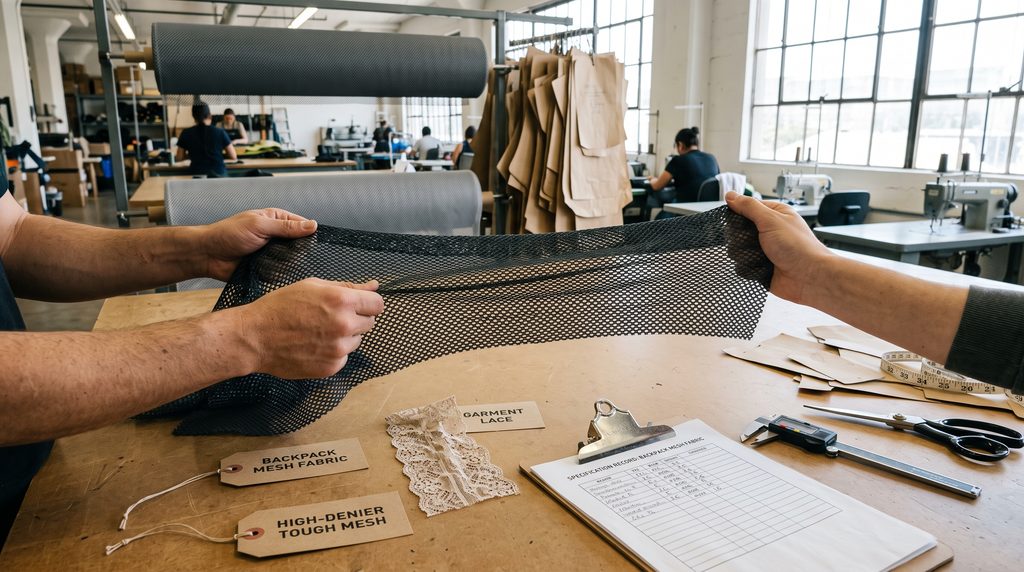
Tough backpack mesh fabric defines an open-cell technical knit manufactured from high-denier synthetic yarns that lock together to resist abrasive rubbing and localized punctures. This structural durability separates industrial pack netting from fragile garment lace by providing dimensional stability under extreme tension. Selecting certified backpack mesh fabric prevents unexpected blowouts along pocket attachment seams, ensuring gear stays secure across challenging wilderness terrain.
What Yarn Structures Stop Punctures from Trail Branches?
Continuous multi-filament yarns disperse pointed puncture stress across adjacent loop junctions rather than letting individual strands snap. When you push through dense brush, the flexible mesh nodes expand slightly to absorb branch strikes without snagging.
Here is the deal: locked yarn intersections deflect external friction and stop sharp thorns from tearing open pocket faces.
- Dense synthetic filament bundles absorb localized abrasion without shredding.
- Interlocking raschel nodes isolate point impacts across adjoining courses.
- Resilient polymer chains snap back into uniform pore geometry after heavy branch impacts.
Which Knit Meshes Prevent Unraveling Along Zipper Seams?
Warp-knitted constructions link vertical pillar stitches together to prevent individual broken loops from laddering downward into long tears. In contrast, common circular knits run rapidly once a zipper tooth snags a surface thread.
What is the real story? You protect warranty margins because locked mesh stays intact even if a stitch sustains mechanical damage.
- Vertical tricot chains stop horizontal tear propagation during pack loading.
- Stable selvage borders hold sewing stitches firmly without pulling loose.
- Heat-stabilized finishing prevents edge curling during perimeter zipper assembly.
| Knit Architecture | Puncture Threshold | Run Propagation | Edge Integrity |
| Warp-Knitted Raschel | 310 N Resistance | Non-Laddering Loops | Stable Raw Border |
| Circular Double Knit | 115 N Resistance | Severe Vertical Ladder | Curls Under Tension |
| Woven Gauze Screen | 160 N Resistance | Shifting Thread Nodes | Frays Fast at Cut Line |
This engineering comparison proves that warp-knitted meshes deliver superior mechanical stability for rugged outdoor gear compartments.
Key Takeaway: Choosing warp-knit meshes with non-laddering nodes safeguards your pack designs against costly seam failures and trail blowouts.
Why Is 3D Spacer the Top Backpack Mesh Fabric?
Three-dimensional spacer mesh represents the top backpack mesh fabric because its dual-surface sandwich structure uses vertical monofilament pile yarns to provide continuous ventilation and impact cushioning. Traditional foam padding traps body heat and sweat against a hiker back, leading to painful chafing during strenuous climbs. Integrating high-performance backpack mesh fabric on shoulder straps and back panels maintains structural airflow channels under sustained pack compression.
How Do Spacer Monofilaments Preserve Air Channels Under Load?
Millions of spring-like polyester monofilament bridge yarns stand perpendicular between outer mesh skins to push back against pack weight. When you tighten your hip belt, these resilient pillars compress slightly while maintaining continuous micro-climate air circulation.
Think about this: closed-cell foam blocks airflow completely, but spacer monofilaments allow trapped heat to escape sideways.
- Vertical monofilament piles resist crushing forces up to fifteen kilopascals.
- Open interior air pathways facilitate continuous chimney-effect heat venting.
- Resilient micro-springs distribute shoulder strap load evenly across collarbone contours.
Why Do Breathable Cushions Reduce Shoulder Pressure Points?
Dual-faced knitted surfaces distribute concentrated pack weight across broad muscular contact zones to prevent nerve pinching. The soft interior face wicks perspiration away from clothing layers, minimizing wet-fabric friction that causes blistering.
Look at the facts: you prevent customer discomfort because resilient cushion layers eliminate painful pressure hot spots.
- Smooth skin-contact liners eliminate abrasive friction against base layer shirts.
- Hydrophobic pile filaments resist sweat absorption to prevent foul odor buildup.
- Dynamic surface flexibility molds naturally to varied torso shapes.
| Cushioning Material | Air Permeability (mm/s) | Compression Recovery | Moisture Absorption |
| 3D Spacer Mesh (8 mm) | 380 mm/s Throughput | 92% Loft Retention | Under 0.5% Regain |
| Perforated EVA Foam | 45 mm/s Throughput | 70% Loft Retention | Zero Surface Wicking |
| Open-Cell Polyurethane | 120 mm/s Throughput | 60% Loft Retention | Sponges Sweat Heavily |
This airflow and resilience data shows why 3D spacer mesh outperforms traditional foam inserts across demanding carry systems.
Key Takeaway: Utilizing 3D spacer mesh across shoulder harnesses cushions heavy loads while keeping hikers cool and dry.
How Does Power Mesh Act as Backpack Mesh Fabric?
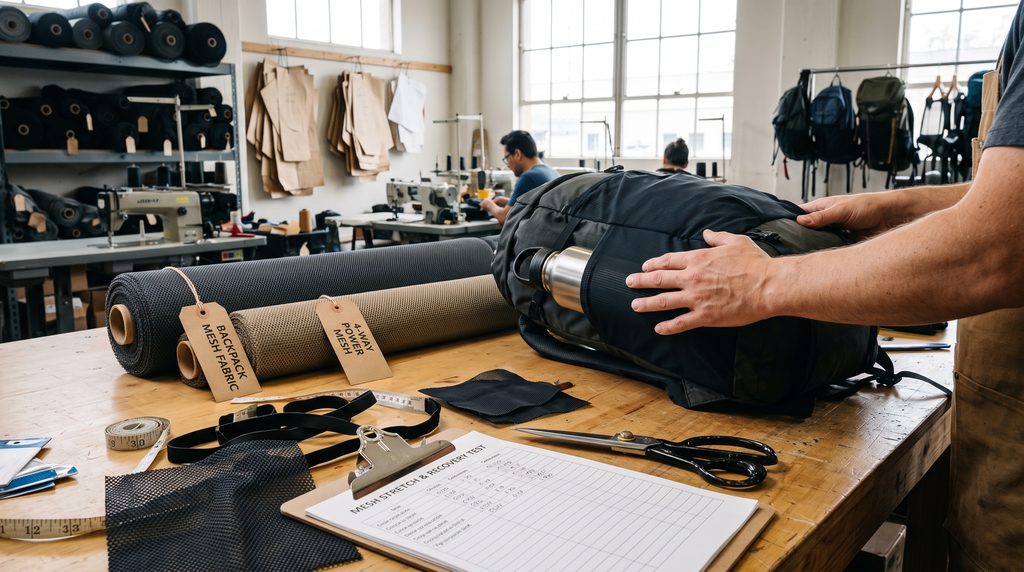
Power mesh acts as an indispensable backpack mesh fabric by blending high-grade elastane with durable polyamide to create high-rebound stretch pockets that grip bulky water bottles tightly. Inelastic utility netting flaps loosely when contents are removed, allowing small items to bounce out on rough downhill trails. Sourcing tested backpack mesh fabric guarantees that expandable stash pouches hold gear snugly without sagging over multi-day treks.
Why Does Four-Way Stretch Net Hold Water Bottles Firmly?
Knitted elastane loops provide multidirectional expansion that wraps around wide-mouth bottles and rolled rain jackets like a second skin. When you scramble over boulders, the inward elastic tension prevents heavy containers from popping loose.
You might wonder: how do lightweight stretch panels secure heavy metal thermoses without tearing along lower attachment seams?
- Dynamic four-way flexibility accommodates irregular gear shapes smoothly.
- High retractive tension pulls empty pockets flat against the pack body.
- Controlled lateral elasticity stops tall water bottles from tipping outward.
How Do Reinforced Loops Retain Elastic Recovery Over Years?
Warp-knit power nets lock elastane strands within protective polyamide jackets, preventing bare elastic cores from breaking down under sunlight or trail grit. This composite yarn geometry prevents baggy pocket syndrome after hundreds of packing cycles.
Ready for the good part? You avoid sloppy exterior pouches because protected elastane preserves snapback recovery across seasons.
- Covered elastane yarns resist UV degradation during long days in alpine sunshine.
- Locked loop nodes prevent elastic fibers from pulling free at hem seams.
- Uniform course tension maintains firm pocket tension after thousands of stretches.
| Stretch Mesh Spec | Elastane Percentage | Elastic Recovery Rate | Primary Trail Purpose |
| Heavy Power Mesh | 20% Spandex / 80% Nylon | 96% Snapback Rating | Deep Water Bottle Sleeves |
| Lightweight Stretch Net | 12% Spandex / 88% Poly | 88% Snapback Rating | Front Map & Windshirt Stash |
| Rigid Cargo Netting | 0% Spandex (Non-Stretch) | Zero Dynamic Flex | Inelastic Base Tool Loops |
This elastic performance matrix illustrates how proper elastane integration ensures exterior pockets retain their gripping power over time.
Key Takeaway: Specifying high-recovery power mesh creates responsive exterior pockets that secure awkward gear without stretching out of shape.
Which Polymer Fibers Build Tough Backpack Mesh Fabric?
High-tenacity nylon 6.6 and premium polyester build tough backpack mesh fabric by delivering superior tensile strength, chemical resistance, and abrasion endurance. Budget gear brands often use unrefined commodity polymers that scuff quickly against granite rocks or degrade under damp storage conditions. Selecting the right polymer base within backpack mesh fabric ensures your bags withstand rough handling, muddy trails, and frequent field cleanings.
Why Does High-Tenacity Nylon Outlast Generic Polyester?
Nylon 6.6 features tightly packed polymer chains that provide outstanding resistance to friction and repeated scraping against rocks. When you haul packs up narrow canyons, nylon filaments resist surface scuffing that would sever weaker threads.
Here is the bottom line: nylon fibers survive harsh trail scrapes, keeping your packs looking professional after grueling expeditions.
- High molecular tenacity resists severe rock scrapes during alpine climbing.
- Exceptional flex fatigue resistance prevents fibers from snapping at fold lines.
- Smooth yarn surfaces shed abrasive grit before particles grind into knit pores.
How Does Hydrophobic Treatment Stop Moisture Accumulation?
Durable water repellent finishes coat synthetic yarn filaments with hydrophobic barriers that cause water droplets to bead up and roll off. This chemical shield prevents wet pockets from absorbing trail rain and adding unnecessary pack weight.
What is the real story? You keep pack weight low during storms because treated fibers shed rainwater instead of soaking it up.
- Fluorine-free water repellents stop moisture from saturating interior yarn voids.
- Fast-drying characteristics prevent mildew growth during humid forest treks.
- Soil-resistant surface treatments allow dried mud to brush off easily.
| Polymer Backbone | Tensile Strength (g/d) | Abrasion Rub Cycles | Wet Weight Gain |
| Polyamide Nylon 6.6 | 8.8 g/denier | 30,000 Rub Cycles | Under 4.0% Moisture |
| High-Tenacity Polyester | 7.2 g/denier | 18,000 Rub Cycles | Under 0.4% Moisture |
| Standard Polypropylene | 4.8 g/denier | 9,000 Rub Cycles | Near Zero Moisture |
This polymer evaluation proves that nylon 6.6 delivers the greatest mechanical protection against abrasive rock friction on backcountry trails.
Key Takeaway: Choosing high-tenacity nylon 6.6 netting gives your packs the rugged durability required to survive demanding alpine environments.
How Does Pore Shape Influence Backpack Mesh Fabric?
Pore shape influences backpack mesh fabric by determining directional load capacity, dirt shedding efficiency, and interior pocket transparency. Round pores provide balanced stretch in all directions, while acute diamond meshes lock tightly to resist downward sag. Sourcing precision-engineered backpack mesh fabric allows product designers to tailor ventilation and load retention to specific pack zones.
How Do Hexagonal Cells Balance Tonal Clarity and Strength?
Hexagonal knit cells create wide, open viewing windows that allow hikers to locate first-aid kits and trail snacks quickly without unzipping compartments. The symmetrical angles distribute outward packing pressure evenly across the fabric face.
Think about this: dense micro-meshes hide small items, but open hexagonal pores let you spot essentials instantly.
- Six-sided cell geometry provides clear visibility into zippered internal pouches.
- Balanced aperture borders flex naturally without puckering surrounding seams.
- Smooth open pores let damp gear drain and dry while hiking under sunny skies.
Why Does Diamond Netting Provide High Vertical Tensile Hold?
Acute diamond angles align along vertical grainlines to resist downward stretching when pockets are packed with heavy tools. This structural geometry prevents external shovels and snowshoes from pulling pocket tops down toward the ground.
Ready for the good part? You can carry heavy tools securely because diamond netting channels weight straight into bottom seams.
- Narrow aperture angles limit vertical sag under dense metal gear loads.
- Firm node connections distribute heavy loads evenly toward pack frame stays.
- Angular mesh walls shed dry leaves and dirt before debris collects in pockets.
| Pore Configuration | Visual Openness | Directional Stability | Drainage Efficiency |
| Hexagonal Open Cell | 88% High Clarity | Multi-Directional Flex | Rapid Liquid Drainage |
| Vertical Diamond Net | 65% Semi-Visible | High Vertical Rigidity | Moderate Debris Shedding |
| Square Micro-Pore | 40% Low Clarity | Rigid Static Boundary | Slow Drainage Profile |
This aperture comparison demonstrates how selecting specific pore geometries tailors visibility and structural load hold across different pack pockets.
Key Takeaway: Pairing hexagonal pores for visual pockets with diamond netting for load-bearing zones creates an organized, durable backpack layout.
What Weights Distinguish Durable Backpack Mesh Fabric?
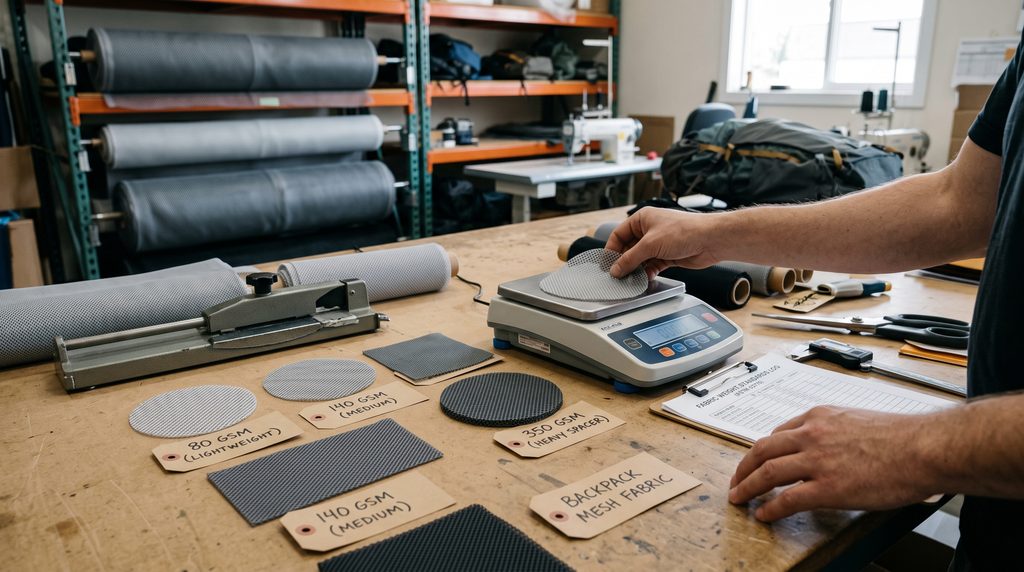
Fabric weights ranging from eighty to three hundred and fifty grams per square meter distinguish durable backpack mesh fabric by balancing ultralight speed against rugged abrasion resistance. Gossamer sixty-gram nettings suit internal toiletry sleeves but rip quickly when dragged across rough granite boulders. Establishing clear fabric weight standards within backpack mesh fabric ensures each pack panel delivers reliable strength without adding unnecessary trail weight.
What Gram Weights Separate Front Shovels from Side Pouches?
Front stash shovels require medium one hundred and twenty to one hundred and sixty gram mesh to hold damp rain jackets, while side water bottle holsters demand heavier two hundred gram fabrics to withstand rock friction. Matching fabric density to pocket location keeps packs light while reinforcing high-wear areas.
Look at the facts: putting lightweight mesh on high-wear side pockets leads to shredded gear before your first hiking season ends.
- 90 to 110 GSM netting creates lightweight interior organizer sleeves.
- 130 to 160 GSM mesh forms flexible front stash panels for rain jackets.
- 190 to 240 GSM heavy net builds rugged water bottle sleeves and tool loops.
How Does High Denier Thwart Abrasion from Rough Rocks?
Filaments extruded at two hundred to four hundred denier possess the physical bulk needed to resist abrasive friction from rough granite walls. Thick filament cores prevent external scuffs from cutting through structural yarn loops.
What is the real story? You eliminate warranty repairs because heavy yarns keep pocket panels intact through rough trail conditions.
- 210D monofilaments resist friction when packs scrape through narrow slot canyons.
- Robust filament diameters stop sharp trekking pole tips from piercing pockets.
- High thread mass anchors firmly into seam stitches without pulling loose under load.
How Do Birdseye and Pique Structures Compare for Airflow?
Birdseye mesh features a compact micro-eyelet pattern that provides a silky hand feel and excellent snag resistance against clothing, while pique knit uses a raised geometric honeycomb structure that creates physical air gaps for superior ventilation. When choosing contact fabrics, birdseye knits excel in shoulder strap linings where smooth skin contact and zero-friction sliding prevent shirt piling, whereas pique knits perform best on lumbar back pads where open channels must actively vent heavy sweat. Comparing these structural characteristics allows gear designers to match fabric textures to specific body contact areas.
- Birdseye micro-pores prevent hiking shirt fibers from catching and fuzzing.
- Pique honeycomb relief lifts pack pads slightly off your back to promote passive airflow.
- Balanced yarn densities ensure both knit structures maintain shape stability under load.
| Mesh Structure Type | Handfeel & Texture | Snag Resistance | Airflow Channeling | Primary Pack Application |
| Birdseye Micro-Eyelet | Silky Smooth Contact | High (Anti-Friction) | Moderate Through-Pore | Shoulder Harness Liners |
| Pique Honeycomb Relief | Textured 3D Waffle | Moderate (Stands Off) | Superior Air Channels | Lumbar Pads & Back Panels |
| Heavy Raschel Cargo | Rigid Corded Grid | Maximum (Rough Face) | Passive Drainage Voids | Exterior Stash Pockets |
This comparative breakdown demonstrates how selecting between birdseye and pique knits balances contact comfort with active back ventilation.
Key Takeaway: Specifying smooth birdseye knits for strap linings and textured pique meshes for back panels optimizes wearer comfort and breathability.
How Do Pack Panels Incorporate Backpack Mesh Fabric?
Pack panels incorporate backpack mesh fabric by bonding flexible open knits over molded foam cores and perimeter webbing bands to create breathable, weight-bearing suspension harnesses. Without proper mesh integration, packs trap heat against hikers’ bodies and cause severe hot spots during uphill travel. Designing high-tenacity backpack mesh fabric into shoulder straps and hip belts cushions heavy loads while keeping hikers comfortable on long trails.
How Do Padded Harness Straps Channel Heat Away from Skin?
Perforated foam cores wrapped in breathable mesh pull sweat away from clothing and vent moisture outward through open surface pores. As you walk, natural shoulder movements pump air through the open mesh to keep strap contact points dry.
You might wonder: how do soft mesh linings withstand years of friction against sweaty shirts without pilling or abrading?
- Open surface pores facilitate continuous evaporation during strenuous climbs.
- Smooth yarn finishes prevent fabric pilling against technical merino wool shirts.
- Reinforced edge bindings hold mesh covers securely around internal foam cores.
Why Does Ventilated Lumbar Padding Prevent Wet Shirt Cling?
Suspended mesh back panels hold the pack body away from a hiker’s spine, creating a wide ventilation chimney that lets breezes sweep away rising body heat. This tensioned barrier prevents sweaty shirts from sticking uncomfortably against your skin.
Ready for the good part? You avoid sweaty, chilled backs during summit breaks because suspended mesh keeps air flowing constantly.
- Tensioned mesh panels hold heavy pack loads away from direct spinal contact.
- Spring-loaded perimeter frames maintain air gap spacing under heavy loads.
- Breathable lumbar pads cushion tailbone contact points without trapping moisture.
| Suspension Component | Mesh Covering Type | Structural Role | Thermal Benefit |
| Contoured Shoulder Strap | 3D Air Spacer (4 mm) | Distributes Collarbone Load | Vents Rising Shoulder Heat |
| Ventilated Lumbar Pad | Pique Textured Knit | Cushions Lower Spinal Base | Prevents Sweat Accumulation |
| Trampoline Back Panel | High-Tension Raschel | Suspends Pack Off Body | Maximum Chimney Airflow |
This suspension overview demonstrates how combining distinct mesh structures creates an ergonomic carry system that keeps hikers cool and dry.
Key Takeaway: Integrating breathable mesh across straps and back panels cushions heavy pack weights while venting perspiration on the trail.
Can Clean Edges Accelerate Cutting Backpack Mesh Fabric?
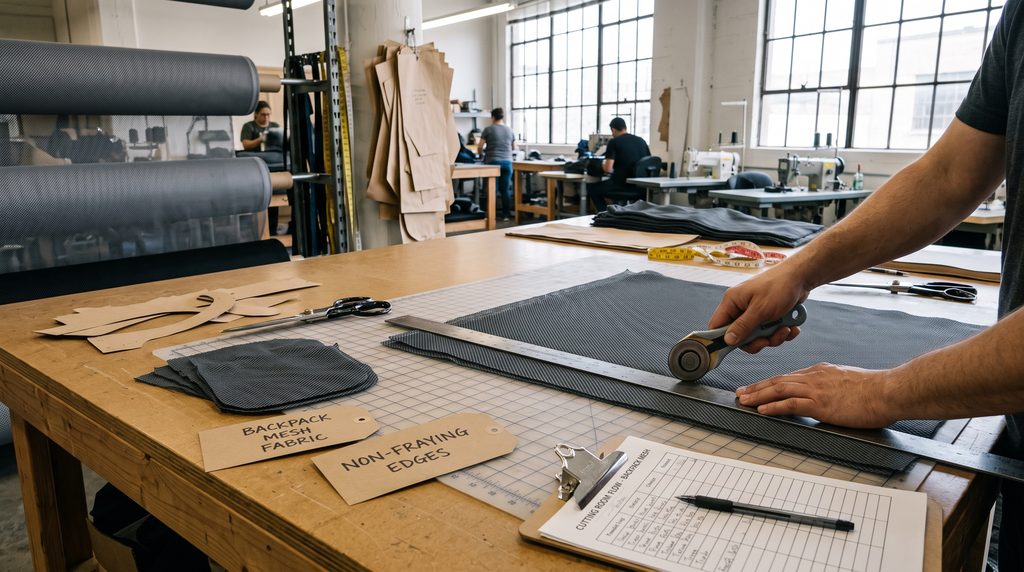
Locked warp-knitted nodes provide clean, non-fraying edges that accelerate cutting backpack mesh fabric by enabling factory technicians to cut hundreds of pocket blanks without edge overlocking. Woven fabrics require folded hems or bias binding tapes to prevent loose threads from jamming sewing machines, adding minutes of labor to each bag. Specifying genuine non-fraying backpack mesh fabric streamlines cutting room workflows and lowers unit manufacturing costs across large production runs.
Why Do Interlocking Knit Nodes Eliminate Hem Binding Labor?
Raschel needles loop threads continuously through interconnected pillar chains, trapping cut yarn ends firmly inside adjacent knit knots. Slicing through panels leaves raw borders completely stable, eliminating the need to fold or overcast cut edges before sewing.
Here is the deal: raw cut edges stay clean and intact without unraveling into loose threads during automated sewing assembly.
- Interlocking loop nodes trap cut yarn tips securely inside surrounding knit chains.
- Raw cut borders eliminate thick, bulky fabric ridges along internal pocket seams.
- Eliminating edge overlocking trims up to fifteen percent from pocket assembly labor.
How Does Automated Blade Cutting Boost Assembly Throughput?
Automated CNC cutting tables slice through stacks of sixty mesh plies simultaneously without pulling or distorting delicate pore geometries. Precise digital knives follow CAD patterns accurately, ensuring that thousands of pocket panels match zipper tape dimensions down to the millimeter.
What is the real story? You boost factory output because clean, automated cutting speeds up sewing workstation feeding.
- Vacuum compression beds hold slippery synthetic netting flat during high-speed cutting.
- Carbide oscillating blades slice clean edges without fusing synthetic yarns together.
- Identical panel dimensions eliminate tedious manual trimming at sewing stations.
| Edge Processing Method | Labor Time per 100 Pockets | Edge Thickness Profile | Yarn Fraying Risk |
| Raw Rotary CNC Cut | 5 Minutes Total | Ultra-Thin 0.8 mm Flat | Zero Thread Unraveling |
| Overlocked Serged Edge | 50 Minutes Total | Bulky 2.6 mm Seam | Low (Adds Thread Clutter) |
| Folded Bias Tape Binding | 95 Minutes Total | Stiff 3.4 mm Ridge | Zero (High Material Cost) |
This manufacturing speed comparison demonstrates that raw-cut warp knits save significant sewing time while maintaining clean, durable interior seams.
Key Takeaway: Adopting clean-cutting warp knits cuts pocket assembly labor hours and eliminates bulky interior seam allowances that crowd pack space.
How Do Labs Audit Heavy-Duty Backpack Mesh Fabric?
Accredited quality laboratories audit heavy-duty backpack mesh fabric through standardized Martindale abrasion tests, diaphragm burst audits, and cyclic tensile fatigue evaluations. Relying merely on manual touch risks approving mesh rolls that shred against abrasive rocks or pop open under trail loads. Demanding documented laboratory test certificates for your backpack mesh fabric protects your brand against catastrophic pack failures and costly retail warranty claims.
Which Martindale Rub Cycles Verify Bushwhacking Durability?
Martindale testing machines rub wool abradant discs against clamped mesh samples in complex Lissajous patterns, recording the exact cycle count before two yarn loops snap. Passing high cycle benchmarks proves that pocket netting can endure constant friction from branches and rough granite.
Think about this: verified abrasion testing guarantees that your exterior pockets will never wear through during years of frequent trail use.
- ASTM D4966 testing benchmarks quantify pocket rub endurance accurately.
- Passing 25,000 rub cycles guarantees multi-year resistance against branch scrapes.
- Microscopic thread checks confirm that yarn coatings remain bonded after abrasion.
How Do Burst Pressure Audits Guarantee Seam Pull Resistance?
Hydraulic diaphragm burst testers apply fluid pressure beneath clamped seamed mesh samples, measuring the exact force in kilopascals needed to rupture the fabric. This audit confirms that delicate netting will not tear away from seam stitches when hikers overstuff pockets.
This is where it gets interesting… scientific burst testing prevents seams from ripping open when hikers cram bulky gear into full packs.
- ASTM D3786 hydraulic pressure audits quantify omnidirectional burst limits.
- Minimum 260 kPa ratings ensure mesh seams withstand aggressive trail packing.
- Cyclic stretch audits verify that pocket seams spring back after heavy loads.
| Quality Laboratory Audit | Test Standard Protocol | Acceptance Benchmark | Practical Failure Avoided |
| Martindale Abrasion Test | ASTM D4966 Lissajous | Minimum 25,000 Cycles | Worn Holes from Rock Scraping |
| Hydraulic Diaphragm Burst | ASTM D3786 Bursting | Minimum 260 kPa Pressure | Ripped Seams from Overstuffing |
| Seam Yarn Slippage Test | ASTM D434 Seam Pull | Minimum 130 N Force | Pocket Netting Pulling Off Seams |
This laboratory benchmark overview confirms that rigorous physical testing protects bulk production runs from embarrassing in-field failures.
Key Takeaway: Demanding certified laboratory test reports guarantees that every roll of pocket netting delivers proven abrasion defense and burst resistance.
How Do Bag Brands Source Wholesale Backpack Mesh Fabric?
Bag brands source wholesale backpack mesh fabric by partnering directly with primary warp-knitting textile mills that offer seamless wide widths, custom colorways, and certified quality standards. Buying through secondary jobbers inflates fabric costs and introduces unpredictable batch variations that disrupt automated factory cutting rooms. Securing high-volume backpack mesh fabric directly from modern knitting plants guarantees consistent roll tension, stable dye lots, and healthy gross margins.
Why Do Seamless Wide Master Widths Cut Cutting Waste?
Extra-wide two-meter and three-meter master rolls permit computerized cutting rooms to nest large back panel patterns efficiently alongside small accessory pouches. Wide rolls reduce off-cut fabric scrap by up to twenty-five percent compared to narrow retail bolts.
Ready for the good part? You save thousands of dollars annually on raw materials by optimizing pattern layouts across wide master rolls.
- 220 cm to 300 cm roll widths support efficient pattern nesting for large back panels.
- Continuous roll lengths feed smoothly through automated multi-ply fabric spreaders.
- Stable roll selvages eliminate uneven edge waste during automated cutting cycles.
What Environmental Credentials Verify Pure Chemical Safety?
International textile certifications verify that synthetic raw materials contain zero toxic heavy metals, azo dyes, or harmful plasticizers. Sourcing from certified mills gives outdoor brands confidence that their gear complies with strict international environmental and retail regulations.
Look at the facts: independent supplier certifications protect your brand from border delays and retail compliance fines.
- OEKO-TEX Standard 100 confirms fabrics are free from harmful volatile chemicals.
- Bluesign system partner accreditations satisfy consumer demand for sustainable outdoor gear.
- ISO 9001 factory management audits guarantee consistent roll-to-roll tensile strength.
| Supply Channel Tier | Minimum Order Volume | Lead Time Window | Available Roll Widths |
| Direct Warp-Knitting Mill | 500 – 1,000 Meters | 12 to 16 Business Days | Custom Widths to 300 cm |
| Regional Wholesale Agent | 100 – 200 Meters | Immediate Stock Pull | Limited Standard 150 cm |
| Retail Fabric Jobber | Cut Yardage by Meter | Immediate In-Store | Expensive Narrow 120 cm |
This sourcing analysis shows why direct mill partnerships deliver superior roll widths, reliable inventory schedules, and substantial volume savings.
Key Takeaway: Sourcing extra-wide rolls directly from certified warp-knitting mills reduces cutting scrap while securing sustainable, eco-compliant textiles for your pack line.
Strategic Sourcing for High-Performance Outdoor Collections
Balancing trail abrasion resistance with breathable carry comfort solves the common gear manufacturing struggles of torn pockets, collapsed straps, and customer warranty claims. Selecting precision-engineered warp-knit netting treated with clean water-repellent finishes protects your packs against heavy brush and seam failures on the trail. Our modern textile knitting facilities produce high-tenacity power mesh, cushioned 3D spacer knits, and eco-certified wide rolls tailored to your exact pack specifications. We stand committed to equipping global outdoor brands and pack makers with resilient, expedition-tested textiles that inspire total hiker confidence on every summit. To request certified laboratory swatch books or discuss custom roll specifications for your upcoming collection, contact us today and consult with our technical pack fabric specialists.
Frequently Asked Questions
Q1: Can I use polyester mesh instead of nylon for backpack side pockets?
Yes, you can use high-tenacity polyester mesh for side pockets because polyester resists UV degradation and will not stretch out when exposed to rain. While nylon offers slightly higher rock abrasion resistance, modern high-denier polyester warp knits provide excellent trail durability with superior moisture stability.
Q2: What is the best thickness for 3D spacer mesh on shoulder straps?
A thickness between six and eight millimeters is the best choice for pack shoulder straps carrying moderate to heavy loads. This thickness provides enough vertical monofilament cushion to distribute pack weight evenly across collarbones while maintaining open airflow channels to vent heat.
Q3: How do I know if backpack mesh will snag on sharp trail brush?
Check that the fabric uses continuous multi-filament yarns rated at one hundred and fifty denier or higher with tight raschel warp-knit nodes. Interlocking knit nodes prevent individual broken loops from running, while smooth, high-denier filaments deflect sharp branches without snagging.
Q4: Can I cut warp-knitted backpack mesh without binding hem borders?
Yes, you can cut warp-knitted mesh with raw borders because interconnected pillar stitches lock cut yarn ends securely inside surrounding knit knots. This non-fraying property allows factory cutters to slice clean panels using automated blades without requiring costly edge overlocking or folded bindings.
Q5: What is the best method to clean trail dirt from pack mesh?
The best method is to scrub the mesh gently with a soft nylon brush and lukewarm water mixed with mild soap before air drying completely. Avoid using aggressive bleach solvents or high-heat tumble dryers because extreme heat degrades the elastic recovery of spandex fibers and damages water-repellent coatings.