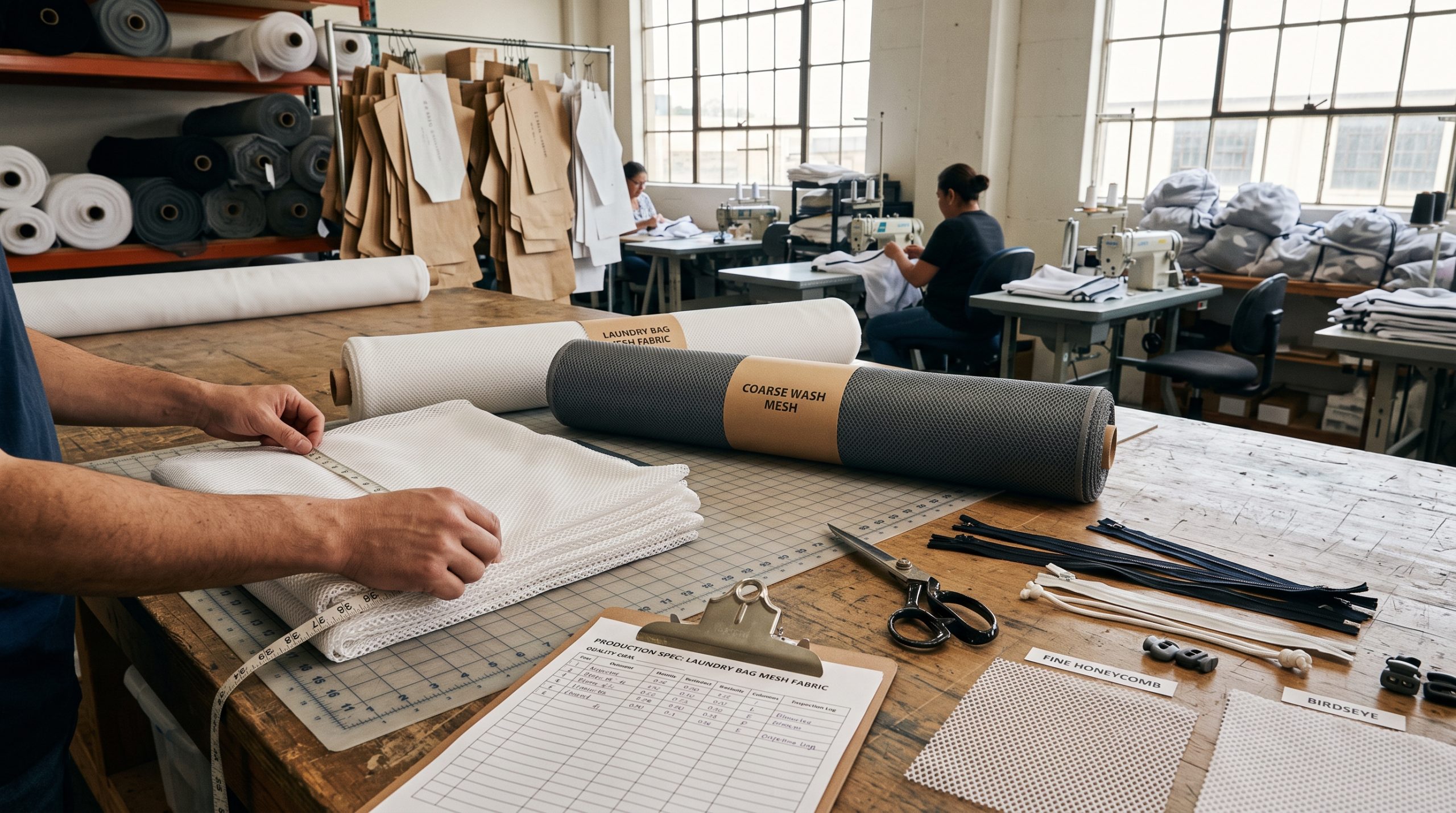
The best laundry bag mesh fabric combines high-tenacity polyester warp knitting with heat-stabilized loop nodes to deliver extreme tear resistance, rapid suds drainage, and low dryer shrinkage. Commercial laundry operators frequently experience ripped wash nets when thin pocket netting snags inside industrial centrifuge extractors. Delicate silk blouses rub against abrasive seams and get shredded, while distorted wash pouches jam conveyor belts and trigger expensive sorting shutdowns. Specifying certified laundry bag mesh fabric engineered on multi-bar raschel knitting equipment shields fragile textiles, maintains structural permeability across hundreds of wash cycles, and protects commercial bottom lines.
What Defines Durable Laundry Bag Mesh Fabric?
Durable laundry bag mesh fabric defines an open-aperture technical textile knitted from high-tenacity synthetic yarns to withstand violent tumbling agitation and high-temperature water baths. Commercial laundries distinguish heavy wash netting from ordinary craft fabric by inspecting thermal dimensional stability and locked warp loops. Sourcing verified laundry bag mesh fabric prevents catastrophic seam tears around closure zippers, keeping mixed garment batches sorted through vigorous extraction cycles.
What Mechanical Knits Resist High Tumble Friction?
Locked multi-bar raschel knits disperse mechanical rubbing forces across neighboring yarn nodes rather than concentrating wear on a single strand. When loaded wash bags collide against perforated metal wash drums, flexible mesh loops absorb surface friction without abrading.
Here is the deal: interlocked knit nodes dissipate rotational friction and stop small scuffs from developing into large holes.
- Multi-filament polyester bundles resist continuous drum abrasion without shedding microfibers.
- Interconnected warp stitches absorb multi-directional torque during high-speed extraction spins.
- Smooth filament surfaces prevent friction fuzzing against adjacent wash load surfaces.
Which Locked Loops Stop Unraveling at Zipper Seams?
Warp-knitted pillar stitches anchor raw yarn ends firmly within interlocking loops, preventing cut borders from fraying along heavy zipper lines. In contrast, cheap circular knits run rapidly once a zipper slider catches a loose loop.
What is the real story? You avoid bag blowouts because locked mesh preserves seam stability even if an individual loop breaks.
- Vertical tricot chains halt lateral tear propagation under heavy wet laundry loads.
- Reinforced selvage borders secure sewing stitches without tearing away from zipper tape.
- Heat-set finishing eliminates border rolling during high-speed automated sewing operations.
| Textile Knit System | Wet Friction Endurance | Ladder Run Tendency | Edge Fray Resistance |
| Warp-Knitted Raschel | 450 Heavy Wash Cycles | Non-Running Structure | Fray-Free Raw Border |
| Circular Weft Knit | 90 Standard Cycles | Fast Vertical Ladder | Rolls and Curls Tight |
| Woven Leno Screen | 160 Gentle Cycles | Shifting Yarn Grids | Unravels at Raw Border |
This mechanical comparison confirms that warp-knitted meshes offer superior dimensional endurance for industrial wash facilities.
Key Takeaway: Choosing warp-knit meshes with non-laddering nodes safeguards your laundry bags against expensive blowouts inside commercial washer extractors.
Why Is Polyester Warp Knit the Top Laundry Bag Mesh Fabric?
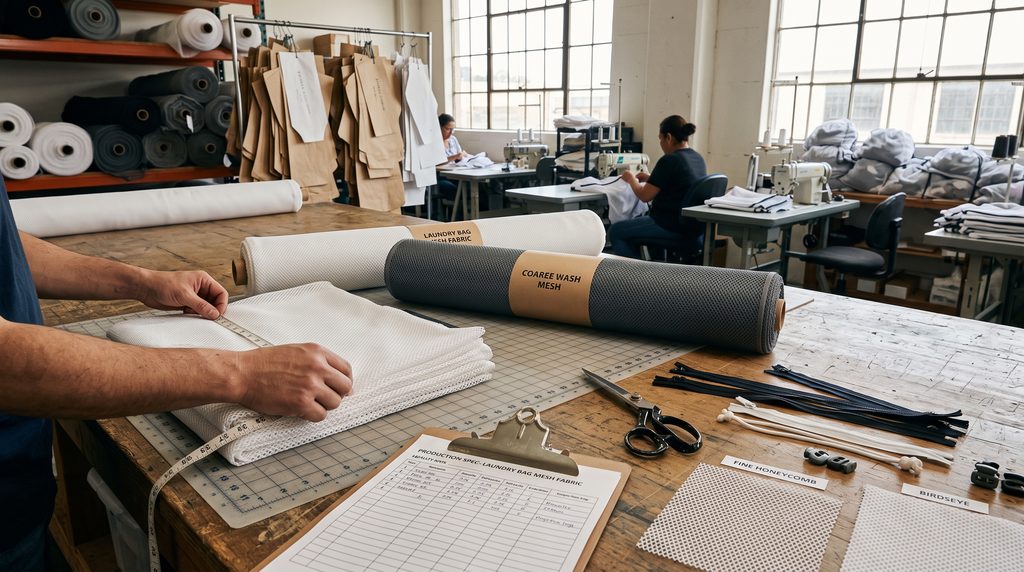
Polyester warp knit represents the premier laundry bag mesh fabric selection because its hydrophobic molecular structure resists chemical detergents, boiling water, and severe dryer heat. Natural cotton fibers absorb moisture, rot in damp hampers, and shrink drastically during routine drying cycles. Sourcing stable polyester laundry bag mesh fabric guarantees that wash sacks maintain exact internal capacities across consecutive commercial wash formulas.
Why Does 100% Polyester Outlast Cotton in Washers?
Synthetic polyester filaments absorb virtually no moisture, allowing wash bags to dry swiftly without harboring damp mildew odors. The continuous synthetic polymer maintains full tensile rigidity whether dry or submerged in warm wash baths.
Think about this: cotton bags soak up dirty wash water and weaken, but polyester netting sheds grime and maintains maximum tensile strength.
- Moisture regain below 0.4 percent stops heavy water retention during centrifuge extraction.
- High initial modulus resists stretching out of shape under soaked towel loads.
- Smooth synthetic surfaces prevent detergent residues from crusting inside yarn crevices.
How Does Chemical Resistance Defend Against Bleach?
Polyester polymer backbones resist oxidative breakdown from sodium hypochlorite bleach and industrial peracetic acid sanitizers. This chemical shield prevents commercial hospital wash bags from deteriorating during rigorous thermal disinfection washes.
Look at the facts: you reduce replacement expenses because chemical-resistant polyester netting withstands daily chlorine bleaching protocols.
- Polymer chains resist fiber embrittlement during aggressive chlorine sanitizing runs.
- Low reactivity stops synthetic yarns from yellowing under concentrated alkaline detergents.
- Stable molecular bonds withstand boiling wash temperatures up to ninety degrees Celsius.
| Fiber Performance Index | 100% High-Tenacity Polyester | Natural Carded Cotton | Commercial Nylon 6 |
| Chlorine Bleach Defense | High Chemical Immunity | Degrades and Thins | Yellows and Weakens |
| Tumble Dry Shrinkage | Under 1.5% Area Loss | 12% to 18% Severe Loss | 4% to 6% Moderate Loss |
| Mildew Resistance Index | Complete Fungal Defense | Rots in Damp Hampers | High Fungal Resistance |
This fiber comparison illustrates why high-tenacity polyester remains the premier polymer selection for high-turnover wash operations.
Key Takeaway: Specifying 100% polyester netting protects your wash bags from chemical rotting and minimizes dimensional shrinkage in commercial dryers.
How Does Coarse Pore Size Benefit Laundry Bag Mesh Fabric?
Coarse pore size benefits laundry bag mesh fabric by facilitating rapid soap water penetration and swift lint flushing around bulky soiled textiles. Compact tight knits act like solid walls that trap dirty rinse water inside, leaving heavy garments partially soapy after short wash cycles. Specifying wide-aperture laundry bag mesh fabric allows industrial laundries to clean dense uniforms and hotel linens thoroughly without extending wash cycle runtimes.
How Do Wide Apertures Accelerate Suds Flow and Rinse?
Four-millimeter open apertures allow detergent suds and fresh rinse water to surge freely through pocket barriers, dislodging ground-in soil effortlessly. Unrestricted liquid circulation washes away suspended dirt particles before the high-speed spin cycle locks grime back into fabric weaves.
You might wonder: why do commercial laundries prefer open netting over tight gauze for industrial uniform washing?
- Wide diamond apertures maximize dynamic water exchange inside commercial wash wheels.
- High flushing velocity sweeps loose hair and particulate debris out of bags cleanly.
- Unhindered water flow shortens required rinse cycles, saving water and utility electricity.
Why Does Coarse Mesh Suit Heavy Towels and Uniforms?
Thick yarn borders around coarse pores withstand abrasive rubbing from dense canvas overalls, denim workwear, and heavy terry towels. The rugged structural geometry holds wet, bulky laundry items securely without tearing along stressed corner folds.
Ready for the good part? You wash heavy coveralls alongside towels without worrying about ripped seams or trapped soapy residues.
- Thick yarn cords resist cutting pressure from heavy brass zippers and metal buttons.
- Rigid open apertures prevent heavy wet items from forming dense, unbalance-causing balls.
- Open grid architectures allow hot dryer air to penetrate deep into wet towel bundles.
| Aperture Category | Pore Dimension | Water Flow Permeability | Target Wash Garment |
| Coarse Open Diamond | 4.0 mm to 6.0 mm | 1,400 L/m²/s Flush Rate | Heavy Towels & Work Overalls |
| Medium Square Grid | 2.0 mm to 3.0 mm | 850 L/m²/s Flush Rate | Mixed Casual Shirts & Socks |
| Micro Fine Honeycomb | 0.8 mm to 1.2 mm | 420 L/m²/s Flush Rate | Silk Blouses & Undergarments |
This aperture flow matrix shows how open pore geometry accelerates wash fluid circulation across heavy-duty laundry categories.
Key Takeaway: Matching coarse mesh openings to heavy workwear and towels maximizes detergent penetration and cuts commercial rinse durations.
How Does Fine Mesh Protect Delicate Laundry Bag Mesh Fabric?
Fine mesh protects delicate laundry bag mesh fabric by creating a smooth micro-barrier that prevents loose bra hooks, snaps, and sequins from catching adjoining garments. Exposed lingerie clasps easily hook into coarse netting, stretching delicate lace and pulling expensive silk threads out of alignment. Choosing fine-aperture laundry bag mesh fabric keeps intimate apparel pristine while allowing gentle soapy water circulation.
How Do Honeycomb Micro Pores Shield Intimate Lingerie?
Sub-millimeter honeycomb pores block fine underwire ends and tiny hook closures from poking through into the general wash drum. The ultra-smooth face cushions fine lace against the abrasive action of surrounding cotton garments.
Here is the bottom line: micro-mesh surrounds delicate garments like a protective shield, preventing expensive lace from snagging during wash agitation.
- Tight aperture geometry stops small metal hooks from poking outside the pouch.
- Smooth knit textures minimize surface friction against fine knit modal garments.
- Controlled water exchange cushions delicate underwires from violent mechanical drops.
Why Does Snag-Proof Weft Guard Against Bra Wire Tears?
Dense filament arrangements cushion sharp metal underwires when bras flex during rotational spin cycles, containing broken wire tips safely inside. This internal containment protects expensive commercial washing machine rubber seals from puncture damage.
What is the real story? You protect both garments and washing equipment because dense netting traps stray metal pieces securely.
- Multi-filament barriers deflect sharp underwire tips before metal touches wash drums.
- Dense mesh walls prevent decorative beadwork from pulling off expensive nightwear.
- Non-abrasive inner surfaces preserve delicate embroidery and screen-printed graphics.
| Protective Attribute | Fine Honeycomb Micro-Mesh | Standard Coarse Open Net |
| Hook Snag Prevention | 99% Snag Barrier Rating | High Risk of Hook Entanglement |
| Underwire Containment | Blocks Escaping Wire Tips | Allows Wires to Poke Through |
| Surface Friction on Silk | Near-Zero Friction Pilling | Moderate Abrasive Rubbing |
This protection overview demonstrates how fine-pore construction shields fragile lingerie garments from destructive mechanical agitation.
Key Takeaway: Specifying fine honeycomb micro-mesh for intimate apparel collections prevents hook snags and stops escaped underwires from puncturing wash drums.
Which Fabric Weights Strengthen Laundry Bag Mesh Fabric?
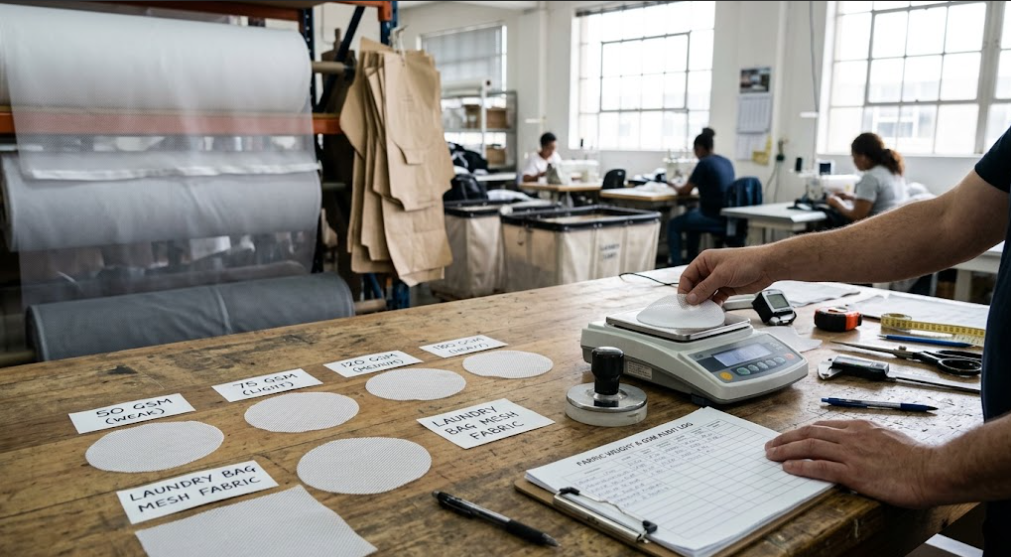
Fabric weights between seventy and one hundred and eighty grams per square meter strengthen laundry bag mesh fabric by balancing structural burst strength against wet water drainage speed. Thin fifty-gram craft netting disintegrates under the weight of wet bedsheets, while excessively dense fabrics trap water and overload extraction motors. Selecting balanced weight ratings within laundry bag mesh fabric guarantees reliable performance across diverse laundering tasks.
What Gram Weights Separate Home Bags from Hospital Nets?
Domestic retail wash sacks use lightweight seventy to ninety gram netting, whereas industrial hospital laundry bags require heavy one hundred and fifty gram meshes. Institutional facilities subject wash sacks to continuous automated sling transport, requiring thick textile walls to support wet loads.
Look at the facts: pairing lightweight domestic mesh with commercial healthcare sorting systems leads to split seams on the first wash run.
- 70 to 90 GSM netting suits consumer retail delicate wash pouches.
- 100 to 130 GSM mesh provides balanced strength for commercial hospitality linen bags.
- 140 to 180 GSM heavy net builds rugged institutional hospital sorting sacks.
How Does High Denier Thwart Seam Burst Under Wet Loads?
Yarns extruded at one hundred and fifty to two hundred and fifty denier supply the tensile strength needed to hold forty pounds of wet textiles without seam rupture. Thick yarn cores hold sewing stitches securely, preventing needle holes from widening under heavy tension.
This is where it gets interesting… heavy denier yarns prevent seam stretching, allowing wash bags to survive hundreds of heavy extraction cycles.
- 150D filaments resist bursting force when saturated laundry presses against bag walls.
- High filament counts absorb lateral pull forces during mechanical hoist unloading.
- Strong yarn perimeters maintain structural shape when workers drag heavy bags across floors.
| Commercial Service Tier | Target Fabric Weight | Yarn Denier Rating | Maximum Wet Capacity |
| Institutional Healthcare | 150 – 180 GSM | 200D to 250D Warp | 25 kg Heavy Wet Linen |
| Commercial Hospitality | 110 – 130 GSM | 150D High Tenacity | 15 kg Mixed Towel Load |
| Domestic Retail Delicate | 75 – 90 GSM | 75D to 100D Filament | 5 kg Light Apparel Load |
This weight and denier guide clarifies how allocating fabric mass properly establishes rugged wash sacks capable of supporting heavy commercial loads.
Key Takeaway: Sourcing high-denier fabrics matched to your commercial weight tier prevents sudden seam ruptures during crane hoists and spin extraction.
What Knit Structures Distinguish Laundry Bag Mesh Fabric?
Knit structures like birdseye and pique distinguish laundry bag mesh fabric by producing distinct surface textures, water drainage velocities, and snag resistance profiles. Selecting the right knit structure determines whether wash bags glide smoothly over laundry chutes or grip wash drums during spin extraction. Evaluating technical knit architectures within laundry bag mesh fabric helps product developers select the right balance of hand feel and water permeability.
How Do Birdseye and Pique Structures Compare for Wash Bags?
Birdseye mesh features a compact micro-eyelet pattern that creates a silky hand feel and high snag resistance, while pique knit uses a raised geometric honeycomb structure that creates physical channels for water flow. For delicate garment wash bags, birdseye knits prevent fine lingerie hooks and jewelry from catching on pocket walls, whereas pique structures excel in commercial sorting sacks where rapid water drainage and rugged grip matter. Comparing these tactile and structural differences helps product managers select the exact hand feel and drainage balance needed for modern laundry lines.
- Birdseye micro-apertures prevent clothing tags, bra hooks, and decorative lace from snagging.
- Pique honeycomb relief creates open water channels that accelerate suds drainage during spin cycles.
- Calibrated loop densities ensure both knit structures maintain shape stability under boiling water.
Which Textures Balance Smooth Touch with Water Drainage?
Birdseye knits present an ultra-flat surface that glides smoothly across wet garments, minimizing abrasive friction during mechanical tumbling. Pique textures provide a three-dimensional waffle relief that prevents wet bags from suctioning flat against the inner walls of washing drums.
Think about this: choosing textured pique netting stops wet wash bags from sticking to extractor drums, speeding up unloading times.
- Smooth birdseye faces protect fine silk linings from abrasive surface scuffing.
- Textured pique waffles promote continuous water flow around packed garment surfaces.
- Both knit styles dry rapidly in warm air streams without retaining damp odors.
| Knit Architecture Profile | Tactile Hand Feel | Water Drainage Speed | Snag Defense Rating | Target Laundry Application |
| Birdseye Micro-Eyelet | Silky Smooth Flat | Moderate Permeability | Maximum Snag Proof | Lingerie & Silk Delicates |
| Pique Honeycomb Waffle | Textured 3D Relief | Rapid Flow Drainage | High Friction Grip | Commercial Linen Sacks |
| Hexagonal Open Raschel | Open Corded Mesh | Maximum Flow Velocity | Moderate Hook Defense | Heavy Towels & Overalls |
This structural comparison demonstrates how selecting between birdseye and pique knits balances surface delicacy with dynamic water drainage.
Key Takeaway: Specifying smooth birdseye knits for intimate wear and textured pique knits for bulk linen bags optimizes protection and wash efficiency.
How Does Heat Setting Stabilize Laundry Bag Mesh Fabric?
Heat setting stabilizes laundry bag mesh fabric by passing greige knitted netting through high-temperature stenter ovens to lock molecular polymer chains into place. Unstabilized polyester shrinks drastically when exposed to boiling wash water, warping rectangular bags into distorted shapes. Processing laundry bag mesh fabric through controlled thermal stenter frames guarantees that finished pouches maintain exact dimensional tolerances across hundreds of commercial laundry cycles.
How Does Hot Stenter Curing Prevent Tumble Dryer Shrink?
Stenter frames pin fabric borders securely while circulating superheated air at two hundred degrees Celsius, relieving internal yarn tensions frozen during knitting. This thermal treatment prevents fibers from contracting later during hot commercial tumble drying.
You might wonder: how do commercial laundry bags endure eighty-degree drying cycles without shrinking or puckering?
- High-temperature stenter curing eliminates residual polymer shrinkage before garment assembly.
- Precision pin chains maintain square grainline alignment across wide fabric widths.
- Thermal relaxation prevents edge curling, simplifying automated cutting room handling.
Why Does Dimension Stability Protect Zipper Slider Paths?
Thermally stabilized netting maintains straight seam perimeters, preventing wavy fabric ripples from jamming plastic zipper sliders during opening. When fabric dimensions remain constant, closure zippers operate smoothly across the entire service life of the bag.
Ready for the good part? You eliminate stuck zipper complaints because flat, stabilized fabric borders prevent zipper path distortion.
- Flat seam allowances guide zipper sliders smoothly without snagging mesh loops.
- Stable bag borders prevent zipper coil distortion under high centrifugal extraction.
- Uniform dimensions preserve neat folding profiles on automated laundry packing tables.
| Thermal Treatment Phase | Processing Temperature | Residual Shrinkage Rate | Long-Term Seam Performance |
| Stenter Heat-Set Finish | 195°C to 205°C Air | Under 1.0% Area Loss | Flat Non-Puckering Seams |
| Standard Calender Press | 140°C Drum Contact | 4.5% to 6.0% Area Loss | Moderate Seam Waviness |
| Unset Greige Netting | Zero Thermal Setting | 10% to 15% Severe Shrink | Severely Distorted Bags |
This thermal processing analysis confirms that controlled stenter heat setting prevents shrinkage and preserves flat zipper seams.
Key Takeaway: Demanding stenter heat-set textiles protects your laundry bags against thermal shrinkage and prevents frustrating zipper slider jams.
Can Clean Edges Accelerate Cutting Laundry Bag Mesh Fabric?
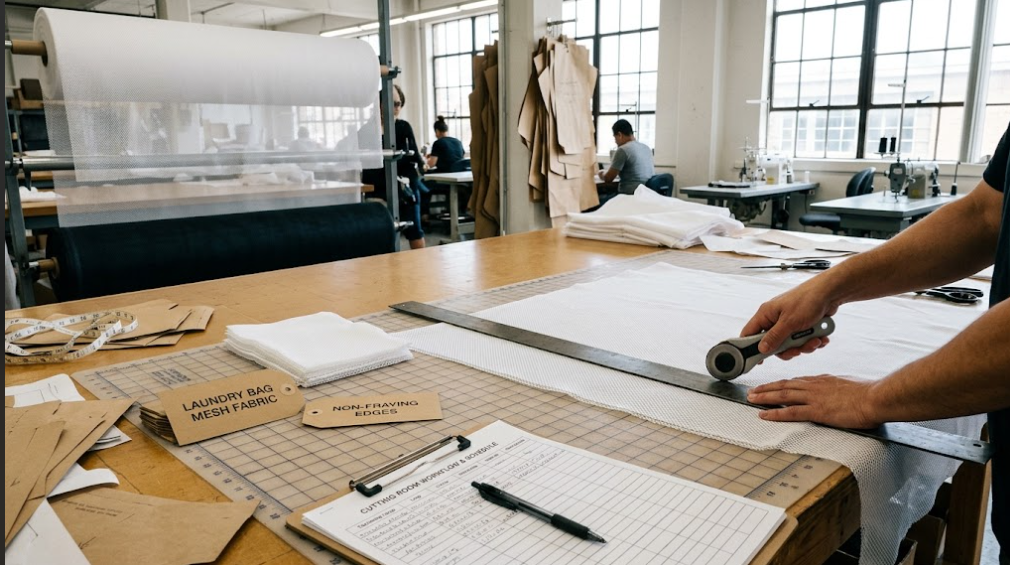
Locked warp-knitted loops provide clean edges that accelerate cutting laundry bag mesh fabric by enabling factory technicians to cut hundreds of bag blanks without edge overlocking. Woven fabrics require folded hems or bias binding tapes to prevent loose threads from jamming sewing machines, adding minutes of labor to each bag. Specifying genuine non-fraying laundry bag mesh fabric streamlines cutting room workflows and lowers unit manufacturing costs across large production runs.
Why Do Raschel Loop Nodes Eliminate Folded Edge Hems?
Raschel needles loop threads continuously through interconnected pillar chains, trapping cut yarn ends firmly inside adjacent knit knots. Slicing through panels leaves raw borders completely stable, eliminating the need to fold or overcast cut edges before sewing.
Here is the deal: raw cut edges stay clean and intact without unraveling into loose threads during automated sewing assembly.
- Interlocking loop nodes trap cut yarn tips securely inside surrounding knit chains.
- Raw cut borders eliminate thick, bulky fabric ridges along internal bag seams.
- Eliminating edge overlocking trims up to fifteen percent from bag assembly labor.
How Does Automated Blade Slicing Boost Factory Output?
Automated CNC cutting tables slice through stacks of sixty mesh plies simultaneously without pulling or distorting delicate pore geometries. Precise digital knives follow CAD patterns accurately, ensuring that thousands of bag panels match zipper tape dimensions down to the millimeter.
What is the real story? You boost factory output because clean, automated cutting speeds up sewing workstation feeding.
- Vacuum compression beds hold slippery synthetic netting flat during high-speed cutting.
- Carbide oscillating blades slice clean edges without fusing synthetic yarns together.
- Identical panel dimensions eliminate tedious manual trimming at sewing stations.
| Edge Processing Method | Labor Time per 100 Bags | Seam Ridge Thickness | Yarn Fraying Risk |
| Raw Rotary CNC Cut | 6 Minutes Total | Ultra-Thin 0.8 mm Flat | Zero Thread Unraveling |
| Overlocked Serged Edge | 45 Minutes Total | Bulky 2.6 mm Seam | Low (Adds Thread Clutter) |
| Folded Bias Tape Binding | 90 Minutes Total | Stiff 3.4 mm Ridge | Zero (High Material Cost) |
This manufacturing speed comparison demonstrates that raw-cut warp knits save significant sewing time while maintaining clean, durable interior seams.
Key Takeaway: Adopting clean-cutting warp knits cuts bag assembly labor hours and eliminates bulky interior seam allowances that trap lint.
How Do Commercial Labs Audit Laundry Bag Mesh Fabric?
Commercial laboratories audit laundry bag mesh fabric through standardized Mullen burst tests, tensile grab audits, and cyclic high-temperature wash evaluations. Relying merely on manual touch risks approving mesh rolls that split open under heavy wet extraction or degrade under commercial laundry chemicals. Demanding documented laboratory test certificates for your laundry bag mesh fabric protects your brand against catastrophic bag failures and costly commercial client claims.
Which Tensile Load Audits Test Wet Seam Tear Limits?
Universal tensile testing machines clamp wet seamed mesh swatches, pulling samples until rupture to record maximum breaking force in Newtons. Testing confirms that delicate open netting withstands the intense centrifugal forces generated during commercial spin extraction.
Look at the facts: verified wet tensile ratings guarantee that wash bags survive intense extraction cycles without splitting along seams.
- ASTM D5034 grab tensile audits measure breaking strength under heavy wet loads.
- Digital load cells measure exact Newton thresholds across longitudinal seams.
- Wet pull tests verify that stitches do not pull through open mesh pores under tension.
How Do Thermal Wash Cycles Verify Colorfastness Ratings?
Laboratory washing machines subject dyed mesh swatches to repeated ninety-degree wash cycles using concentrated alkaline detergents and chlorine bleach. Spectrophotometer audits verify that colored identification trims do not bleed dyes onto white linens during thermal disinfection runs.
This is where it gets interesting… scientific colorfastness testing prevents colored identification trims from ruining expensive white hotel sheets.
- AATCC 61 accelerated wash testing simulates fifty commercial laundering cycles.
- Spectrophotometer audits confirm zero dye transfer onto adjacent white textiles.
- Fiber examinations confirm that synthetic yarns retain full tensile strength after repeated chemical exposures.
| Laboratory Audit Protocol | Standard Test Method | Minimum Passing Threshold | Operational Failure Avoided |
| Hydraulic Diaphragm Burst | ASTM D3786 Wet State | Above 280 kPa Pressure | Split Bags in Centrifuges |
| Grab Breaking Strength | ASTM D5034 Wet Grab | Above 320 N Tensile Force | Ripped Seams During Unloading |
| Colorfastness to Laundering | AATCC 61 Method 4A | Class 4.5 Staining Grade | Dye Bleeding onto White Linens |
This laboratory benchmark overview confirms that rigorous physical testing protects bulk production runs from premature in-wash failures.
Key Takeaway: Demanding certified laboratory test reports guarantees that every roll of wash netting delivers proven burst defense and zero dye bleed.
How Do Garment Brands Source Bulk Laundry Bag Mesh Fabric?
Garment brands source bulk laundry bag mesh fabric by partnering directly with primary warp-knitting textile mills that offer seamless wide widths, custom colorways, and certified quality standards. Buying through secondary jobbers inflates fabric costs and introduces unpredictable batch variations that disrupt automated factory cutting rooms. Securing high-volume laundry bag mesh fabric directly from modern knitting plants guarantees consistent roll tension, stable dye lots, and healthy gross margins.
Why Do Wide Master Rolls Cut Down Cutting Scrap Rates?
Extra-wide two-meter and three-meter master rolls permit computerized cutting rooms to nest large laundry bag panels efficiently alongside small accessory pouches. Wide rolls reduce off-cut fabric scrap by up to twenty-five percent compared to narrow retail bolts.
Ready for the good part? You save thousands of dollars annually on raw materials by optimizing pattern layouts across wide master rolls.
- 220 cm to 300 cm roll widths support efficient pattern nesting for large institutional bags.
- Continuous roll lengths feed smoothly through automated multi-ply fabric spreaders.
- Stable roll selvages eliminate uneven edge waste during automated cutting cycles.
What Safety Audits Confirm Safe Skin Contact for Washers?
International textile certifications verify that synthetic raw materials contain zero toxic heavy metals, azo dyes, or harmful finishing residues. Sourcing from certified mills gives laundry brands confidence that their wash bags comply with strict international consumer and healthcare regulations.
Think about this: independent supplier certifications protect your brand from chemical liability and customs import rejections.
- OEKO-TEX Standard 100 confirms fabrics are free from harmful volatile chemicals.
- REACH compliance verifies zero banned plasticizers or hazardous finishing agents.
- ISO 9001 factory management audits guarantee consistent roll-to-roll tensile strength.
| Supply Channel Tier | Minimum Order Volume | Lead Time Window | Available Roll Widths |
| Direct Warp-Knitting Mill | 500 – 1,000 Meters | 12 to 16 Business Days | Custom Widths to 300 cm |
| Regional Wholesale Agent | 100 – 200 Meters | Immediate Stock Pull | Limited Standard 150 cm |
| Retail Fabric Jobber | Cut Yardage by Meter | Immediate In-Store | Expensive Narrow 120 cm |
This sourcing analysis shows why direct mill partnerships deliver superior roll widths, reliable inventory schedules, and substantial volume savings.
Key Takeaway: Sourcing extra-wide rolls directly from certified warp-knitting mills reduces cutting scrap while securing clean, skin-safe textiles for your laundry line.
Strategic Sourcing for Commercial Wash Gear Collections
Balancing rapid water drainage with rugged burst resistance resolves common laundry manufacturing struggles regarding torn mesh, shredded delicates, and customer warranty claims. Selecting precision-engineered warp-knit polyester netting treated with high-temperature stenter stabilization protects your wash bags against severe dryer shrinkage and seam blowouts during industrial wash cycles. Our modern textile knitting facilities produce coarse diamond meshes, snag-proof birdseye knits, and eco-certified wide rolls tailored to your exact laundry gear specifications. We stand committed to equipping global laundry brands and commercial wash gear makers with resilient, wash-tested textiles that inspire total client confidence across thousands of laundering runs. To request certified laboratory swatch books or discuss custom roll specifications for your upcoming collection, contact us today and consult with our technical wash fabric specialists.
Frequently Asked Questions
Q1: Can I use nylon mesh instead of polyester for commercial laundry bags?
No, you should avoid nylon mesh for commercial laundry bags because nylon absorbs water, weakens under heat, and degrades rapidly when exposed to chlorine bleach. High-tenacity polyester warp knits maintain dimensional stability in hot water baths and withstand repeated chemical sanitizing without fiber breakdown.
Q2: What is the best pore size for washing delicate silk and lingerie?
A fine honeycomb mesh with pore openings between 0.8 millimeters and 1.2 millimeters is the best choice for delicate silk and lingerie. This fine opening allows soap and water to flow freely while preventing bra underwires, hooks, and clothing tags from poking through and snagging adjoining garments.
Q3: How do I know if laundry bag mesh will shrink in commercial dryers?
Check the manufacturing specifications to verify that the fabric underwent high-temperature stenter heat setting at temperatures approaching two hundred degrees Celsius. Netting stabilized with proper thermal finishing maintains area shrinkage below one percent during routine commercial tumble drying.
Q4: Can I cut warp-knitted laundry mesh without stitching hem bindings?
Yes, you can cut warp-knitted mesh with raw borders because interconnected raschel loop nodes lock cut yarn ends securely inside surrounding knit knots. This non-fraying property allows factory cutters to slice clean panels using automated knives without requiring costly edge overlocking or folded bindings.
Q5: What is the best method to clean stained commercial laundry mesh?
The best method is to run the mesh bags through an industrial wash cycle with warm water and mild alkaline detergent, followed by thorough rinsing. For hospital disinfection, standard sodium hypochlorite or peracetic acid wash formulas can be applied safely to 100% polyester netting without degrading fiber tensile strength.