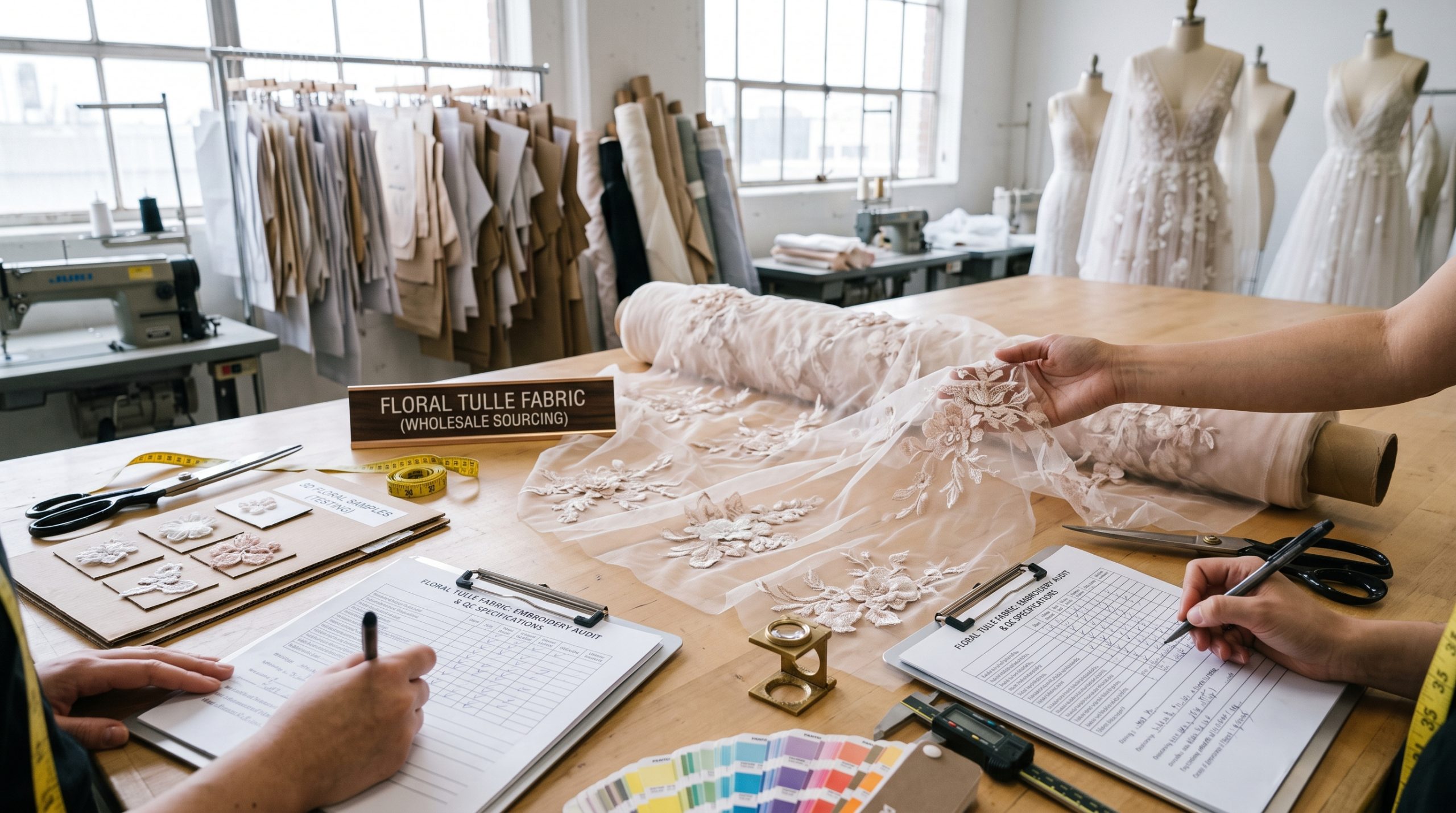
Floral tulle fabric is an open warp-knitted hexagonal netting embellished with embroidered blossoms, corded floral motifs, or three-dimensional appliqués engineered for bridal gowns, evening attire, and theatrical costumes. Sourcing decorative sheer yardage from unknown brokers often leads to dense, scratchy netting or loose floral embroidery that snags under cutting tools. Flawed yardage causes severe stitching jams, breaks expensive needles, and makes finished garments look cheap and distorted under retail showroom spotlights. Sourcing verified floral tulle fabric eliminates these production disasters by providing stable mesh substrates, balanced hand-feel, and certified breathability ratings before you commit to bulk rolls.
Why Use Floral Tulle Fabric for Bridal Gowns?
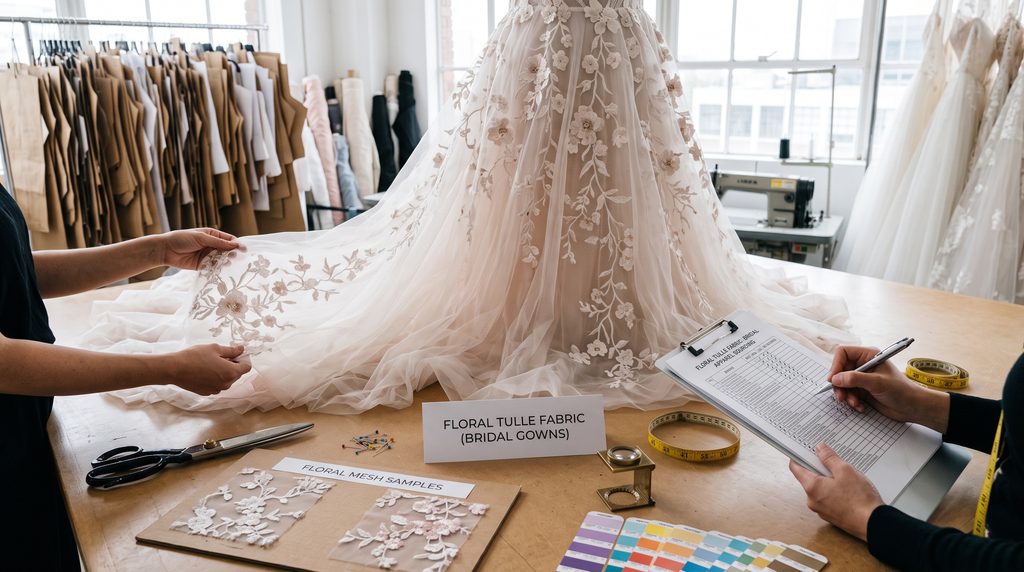
Floral tulle fabric enriches bridal gowns by combining dimensional botanical aesthetics with lightweight structural support that maintains skirt shape without adding heavy bulk. Plain flat netting lacks the visual texture required for couture collections, while dense jacquard brocades feel stiff and suffocating on warm wedding days. Incorporating verified floral tulle fabric into gown skirts lifts outer drapery into graceful silhouettes that captivate clients throughout day-long ceremonies. Professional atelier cutters rely on this versatile base to create layered botanical cascades that hold their shape through packing and shipping.
How Do Embroidered Motifs Transform Gown Drape?
Embroidered botanical patterns add localized surface mass to lightweight netting, giving sheer panels controlled fall and fluid movement. The contrast between open mesh fields and dense thread embroidery creates natural wave folds along sweeping skirt margins.
Here is the deal:
Strategic pattern spacing gives garments flowing drape without collapsing delicate silhouettes.
- Dense floral borders weigh down skirt hems to create clean, straight lines.
- Scattered petal motifs preserve sheer transparency across flowing bodice panels.
- Directional botanical vines guide the viewer’s eye along gown seams.
Can Layered Appliques Prevent Pattern Sagging?
Layering lightweight three-dimensional petals across supportive warp-knitted bases gives skirts sculptural dimension without weighing down inner petticoats. The stable hexagonal knit structure distributes the weight of beads and threads evenly, stopping pattern droop over long wear.
Look:
You can build striking floral depth without adding heavy internal stays.
The Key Takeaway for bridal designers: selecting dimensionally stable embroidered nettings allows you to construct voluminous botanical gowns that retain their shape through storage and wear.
| Floral Application Style | Base Mesh Density | Visual Volume Level | Target Apparel Application |
| Flat Corded Embroidery | 20 to 28 GSM | Sleek, fluid silhouette | Fitted trumpet skirts, cathedral veils |
| Dimensional 3D Petals | 30 to 45 GSM | High dramatic loft | Ballgown skirt overlays, statement sleeves |
| Scattered Floral Glitz | 25 to 35 GSM | Shimmering surface sheen | Romantic evening wear, prom bodices |
Evaluating embroidery placement confirms that balanced botanical layouts provide sculptural volume while preserving graceful garment drape.
Can Floral Tulle Fabric Deliver Soft Hand Feel?
Floral tulle fabric delivers soft hand feel when manufactured with fine microfiber substrate yarns and backed with supple protective linings that prevent coarse embroidery threads from rubbing against skin. Cheap novelty meshes frequently incorporate coarse monofilament bases that feel abrasive against bare shoulders and necklines. High-grade sheer netting uses supple multi-filament polyamide strands that bend smoothly across delicate skin contours. Evaluating tactile swatches of floral tulle fabric helps garment technicians select comfortable textiles for sheer bodices and sleeves.
Why Does Substrate Yarn Dictate Skin Comfort?
Substrate yarn denier defines the physical thickness of individual filaments, directly governing bending flexibility and skin contact friction. Fine multi-filament synthetic strands flex effortlessly against skin, while thick monofilament threads poke and chafe sensitive areas.
Think about it:
Brides wear formal wedding dresses through twelve hours of continuous celebration.
- Fine microfiber netting eliminates redness along illusion necklines and wrists.
- Supple multi-filament mesh flexes smoothly with natural body movement.
- Coarse base nets cause uncomfortable chafing beneath decorative floral embroidery.
Can Smooth Linings Isolate Scratchy Embroidery?
Placing silk habotai or breathable knit lining beneath embroidered panels creates a smooth tactile barrier against bare skin. This layered construction seals off stiff embroidery backing knots and bobbin threads, stopping mechanical irritation during wear.
Ready for the good part?
You can incorporate complex beaded florals without irritating sensitive skin.
The Key Takeaway for apparel technicians: combining micro-denier substrate netting with soft inner linings isolates stiff embroidery threads and ensures all-day wearing comfort.
| Netting Fiber Construction | Tactile Friction Rating | Skin Comfort Level | Recommended Garment Zone |
| Micro-Denier Polyamide | Low surface drag | Silky next-to-skin touch | Illusion yokes, sheer sleeve panels |
| Standard Polyester Knit | Moderate surface grip | Gentle with soft lining | Tiered overskirts, back draperies |
| Stiff Metallic Monofilament | High abrasive friction | Coarse, requires barrier | Outer structural crinoline ruffles |
Tactile friction evaluations show that micro-denier substrate knits eliminate surface prickliness, allowing comfortable wear across delicate contact zones.
Does Floral Tulle Fabric Allow High Airflow?
Floral tulle fabric allows high airflow because open hexagonal warp-knitted mesh pores permit ambient air currents to pass freely through gathered skirt layers. Solid woven linings trap humid body heat, turning multi-layered gowns into stuffy, uncomfortable garments. Breathable warp-knitted meshes maintain continuous convective heat dispersion, keeping wearers cool during outdoor receptions. Testing air permeability on floral tulle fabric confirms that your layered formalwear keeps clients fresh during warm summer celebrations.
How Do Open Mesh Pores Release Trapped Heat?
Moving human skin releases continuous moisture vapor that condenses into uncomfortable sweat when blocked by dense fabrics. Generous hexagonal apertures around floral motifs create chimney pathways that vent warm humidity away from the body.
What is the real story?
Open mesh geometry keeps wearers cool beneath voluminous gathered gowns.
- Open hexagonal pores circulate fresh air across lower body zones.
- High air permeability accelerates the evaporation of skin moisture.
- Ventilated outer tiers protect delicate inner silks from sweat marks.
Can Differential Pressure Gauges Check Airflow?
Differential pressure instruments measure the cubic feet of air passing through square feet of mesh per minute under mechanical suction. Precise Frazier airflow numbers replace vague marketing claims like airy or breathable with verifiable engineering metrics.
Look:
You verify exact ventilation ratings before ordering production bolts.
The Key Takeaway for activewear developers: confirming measured Frazier air permeability ratings ensures your decorative layered skirts provide effective thermal cooling during wear.
| Substrate Mesh Porosity | Average Cell Diameter | Frazier Airflow Rating | Thermal Cooling Efficiency |
| Fine Hexagonal Mesh | 1.0 mm to 1.5 mm | 550 to 720 CFM | Rapid heat dispersal under ruching |
| Medium Petticoat Net | 2.0 mm to 3.0 mm | 780 to 950 CFM | Continuous air circulation in skirts |
| Dense Beaded Netting | 0.6 mm to 1.0 mm | 320 to 460 CFM | Moderate airflow across bodices |
Air permeability measurements prove that open hexagonal mesh foundations vent trapped heat twice as fast as solid woven linings.
How to Audit Floral Tulle Fabric Under Light?
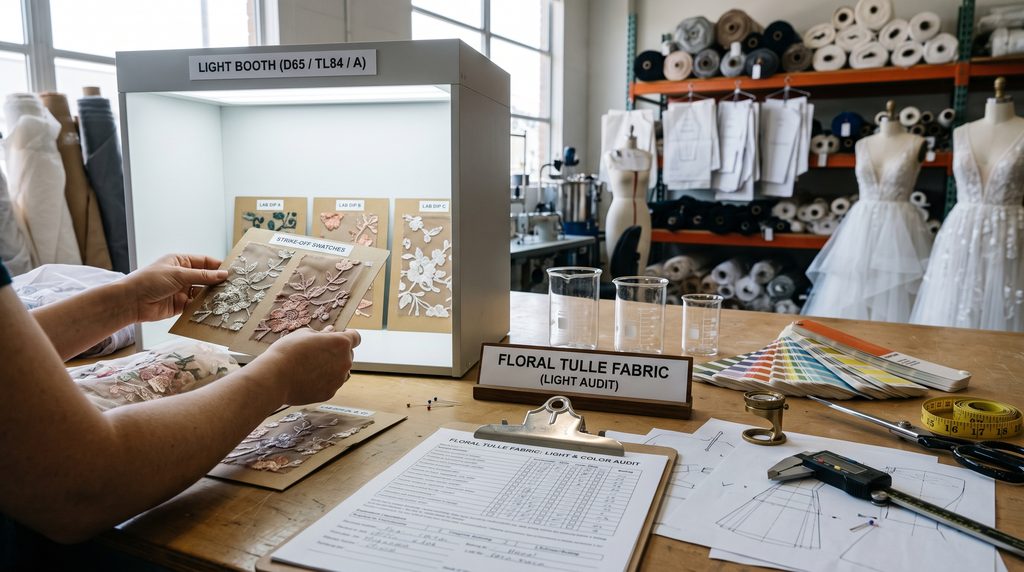
You audit floral tulle fabric under light by placing production cuts inside calibrated multi-illuminant light booths to verify exact dye values and detect metamerism across diverse environments. Synthetic fibers and rayon embroidery threads absorb dyes differently, causing unexpected shade mismatches between indoor bulbs and outdoor sun. Inconsistent dye vat temperatures create tone shifts between sheer netting grounds and raised floral petals. Evaluating strike-off cuts of floral tulle fabric protects your brand from expensive garment returns caused by off-shade lots.
Why Do Multi-Light Booths Expose Metamerism?
Metamerism causes embroidered petals and plain base netting to match under showroom fluorescent tubes but clash noticeably outdoors. Inspecting lab dips across multiple lighting standards exposes unstable dye recipes before mills run production vats.
Here is why:
A bride’s veil must match her gown across churches, gardens, and ballrooms.
- Daylight lamps (D65) expose true outdoor color fidelity and undertones.
- Retail store tubes (TL84) display how gowns look on boutique sales racks.
- Incandescent bulbs reveal unwanted reddish undertones in evening lighting.
How Do Crocking Tests Catch Loose Dye Bleed?
Crock testing rubs dry and wet white test cloths across embroidered netting under calibrated pressure to measure loose dye transfer. Unstable surface dyestuffs can leach off dark floral petals, staining white gown linings and expensive undergarments.
This is what happens:
Catching loose dye bonds early allows finishing mills to apply corrective wash baths.
The Key Takeaway for quality directors: performing multi-illuminant light checks and mechanical crock tests prevents color fading and dye bleed on multi-toned bridal wear.
| Light Inspection Source | Correlated Color Temp | Audit Focus Area | Visual Flaw Prevented |
| Artificial Daylight (D65) | 6500 Kelvin | True natural outdoor balance | Mismatched veil hues in sunlight |
| Store Fluorescent (TL84) | 4000 Kelvin | Retail boutique illumination | Shaded panels under shop lights |
| Tungsten Halogen (Ill A) | 2856 Kelvin | Indoor evening reception ambience | Unwanted yellow casts in banquet halls |
Multi-source light audits confirm that color-matched embroidered nettings preserve uniform coloration across changing ambient lighting conditions.
Why Source Floral Tulle Fabric with Low MOQs?
You source floral tulle fabric with low order minimums because flexible sampling quantities protect your operating capital and prevent expensive overstock when developing new seasonal designs. Massive textile brokers demand high minimum yardage that ties up cash in slow-moving warehouse inventory. Flexible knitting mills offering accessible trial yardage enable fashion brands to test seasonal lines without excessive financial risk. Sourcing floral tulle fabric from responsive suppliers keeps your label nimble as fashion tastes change.
Why Do Rigid Broker Minimums Squeeze Designers?
Commodity brokers demand huge purchasing volumes because their business models rely on bulk turnover rather than designer partnerships. Buying hundreds of meters of a single floral motif ties up funds that should support runway marketing and pattern drafting.
Think about it:
Unsold bolts of niche floral patterns depreciate quickly as bridal trends evolve.
- High order thresholds force young labels to gamble funds on unproven motifs.
- Extended lead times at mass mills delay sample collection debuts.
- Excess inventory accumulates expensive warehouse handling fees each quarter.
Can Flexible Mills Supply Trial Swatch Cuts?
Agile warp-knitting factories offer accessible sampling runs starting around fifty to one hundred meters per custom colorway. Sourcing smaller trial runs keeps your cash liquid while you test wholesale buyer interest at bridal markets.
Ready for the good part?
You test commercial demand with real garment samples before committing to large volumes.
The Key Takeaway for fashion founders: partnering with mills that offer low trial minimums preserves your operating cash and accelerates product iteration cycles.
| Fabric Supply Channel | Minimum Purchase Volume | Design Iteration Speed | Cash Commitment Risk |
| Bulk Platform Wholesaler | 1500m to 3000m per style | Slow (Fixed stock runs only) | Severe cash flow lockup |
| Agile Warp-Knit Factory | 50m to 150m per style | Fast (Custom motifs supported) | Low risk with rapid testing |
| Local Fabric Showroom | 1m to 5m retail cuts | Immediate off-shelf access | High cost per meter, limited stock |
Flexible minimum order thresholds protect company cash flow while giving designers freedom to prototype innovative garment concepts.
How Does Floral Tulle Fabric Handle Heavy Beading?
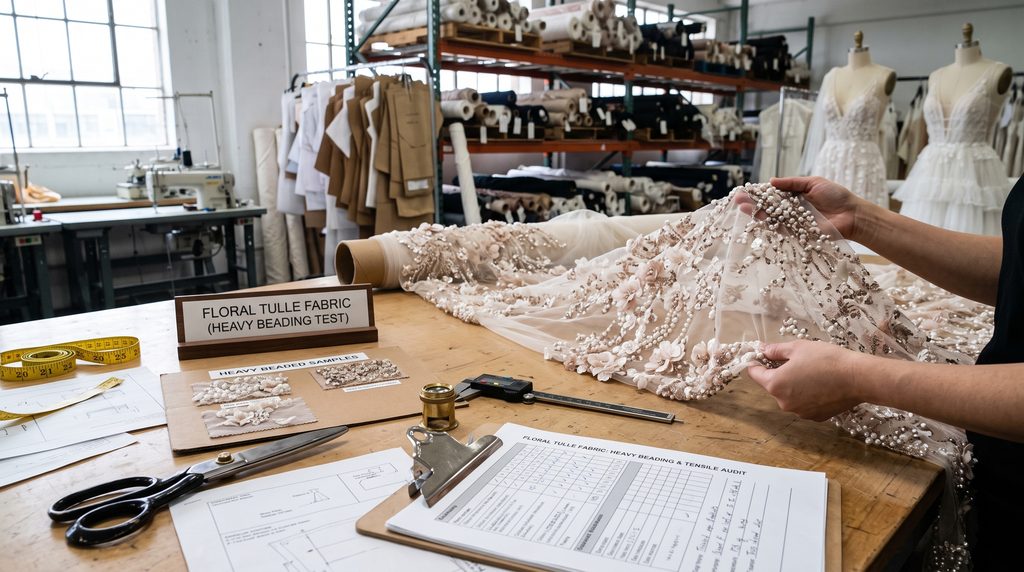
Floral tulle fabric handles heavy beading securely when knitted with high-tenacity warp yarns that resist mechanical sagging under dense decorative embellishments. Glass seed beads, pearls, and metallic sequins place heavy downward strain across sheer netting grounds. Substandard knit meshes stretch out of shape, causing embroidered flower motifs to sag and distort finished dress lines. Reviewing the tensile strength of floral tulle fabric ensures your embellished gowns maintain their tailored proportions.
How Does Dense Beading Affect Substrate Stretch?
Heavy glass beads and metallic threads pull sheer knit loops downward, creating permanent vertical elongation along unsupported garment panels. High-tenacity synthetic yarns distribute this gravitational load across interlocking stitches, preserving panel shape.
Here is the deal:
Heavy embellishments require balanced yarn tension to prevent hem sagging.
- High-tenacity netting threads prevent stitch distortion beneath beaded flowers.
- Reinforced warp chains stop vertical elongation across fitted bodices.
- Balanced knit matrices maintain horizontal stretch recovery around waistlines.
Can Tensile Testing Stop Heavy Mesh Distortion?
Laboratory tensile testers apply calibrated pulling force across embellished fabric swatches to measure maximum load capacity and elastic recovery. Numerical tensile data confirms whether delicate netting can support beaded floral motifs without tearing during dry cleaning.
Look:
You verify load tolerances before attaching heavy beadwork to sheer panels.
The Key Takeaway for couture pattern drafters: selecting high-tenacity mesh substrates prevents heavy glass beadwork from stretching sheer gown panels out of shape.
| Embellishment Load Level | Added Surface Mass | Substrate Strength Target | Structural Failure Prevented |
| Light Corded Thread | 10 to 20 GSM | Standard Warp Knitted Mesh | Basic shape distortion |
| Medium Pearl Clusters | 40 to 60 GSM | Reinforced Polyamide Base | Loop stretching along seams |
| Heavy Beaded Rhinestones | 80 to 120+ GSM | High-Tenacity Dual-Bar Net | Severe fabric tearing and sagging |
Tensile resistance metrics verify that reinforced warp-knitted bases hold heavy decorative beadwork securely without permanent stretching.
Can Industrial Needles Sew Floral Tulle Fabric?
Industrial needles sew floral tulle fabric cleanly when technicians install slender ballpoint needles and balance thread tension to prevent cutting fragile synthetic filaments. High-speed sewing friction heats needles up to temperatures that melt delicate synthetic yarn loops. Sharp needle points slice through thin knitted yarns, causing microscopic runs that widen into tears along fitted seams. Conducting stitching trials on floral tulle fabric helps sewing room supervisors configure proper machine gauges, thread tensions, and stitch lengths.
Why Do Dull Needles Shatter Knitted Netting?
Dull or burred sewing needles strike synthetic filaments with blunt force rather than gliding cleanly between knitted loops. This impact fractures synthetic fibers and pushes broken filaments into the feed dog, jamming sewing lines.
Here is why:
Using fresh, slender ballpoint needles protects sheer mesh loops during assembly.
- Ballpoint tips slip smoothly between knit loops without severing yarns.
- Fine needle shanks reduce penetration friction at high machine speeds.
- Polished needle eyes prevent delicate thread from fraying during fast passes.
How Do Pull Tests Verify Seam Strength?
Calibrated seam testing clamps joined netting panels and applies continuous lateral force to check for stitch slippage or seam rupture. High-grade netting stretches with flexible thread loops, maintaining seam strength under active body movement.
Look:
You confirm that delicate bodice seams will hold up through active wedding dancing.
The Key Takeaway for sewing room managers: running stitch trials on sample netting identifies needle cutting problems early and prevents seam failures during garment assembly.
| Stitching Parameter | Factory Setting Target | Substandard Setting | Seaming Failure Prevented |
| Machine Needle Type | 65/9 or 70/10 Ballpoint | 90/14 Sharp Chisel Tip | Prevents yarn snapping and holes |
| Thread Selection | Tex 16 to 20 Poly-Wrapped | Coarse Spun Cotton Thread | Eliminates seam bulk and breaks |
| Machine Stitch Pitch | 2.0 mm to 2.5 mm Pitch | Under 1.5 mm Dense Pitch | Stops seam perforation tears |
Needle penetration trials confirm that slender ballpoint tips and balanced stitch spacing prevent yarn breaks along sheer seams.
How to Steam Floral Tulle Fabric Without Damage?
You steam floral tulle fabric without damage by directing gentle vertical vapor across hanging garments to release transit wrinkles without touching hot iron plates to delicate synthetic petals. Flat iron soleplates transfer concentrated heat that softens synthetic polymers within seconds. Direct heat contact melts delicate three-dimensional petals into hard, shiny plastic residue. Applying gentle vertical steam to floral tulle fabric smooths packaging creases while preserving the crisp, lifelike dimension of decorative motifs.
Why Does Iron Heat Melt Synthetic Floral Net?
Direct soleplate contact transfers intense heat that quickly exceeds the softening point of fine synthetic fibers. Softened filaments fuse together instantly, turning delicate lace and mesh into glossy, ruined patches.
Think about it:
One careless pass of a flat iron can ruin an entire custom ballgown right before delivery.
- Excessive soleplate heat melts delicate 3D petals into stiff sheets.
- Dry iron heat causes synthetic fibers to become brittle and snap.
- Direct pressure crushes raised embroidery ridges flat against the mesh.
Can Vertical Steam Smooth 3D Petal Creases?
Vertical steaming releases moist, diffuse vapor that relaxes packaging wrinkles without pressing down on delicate raised surfaces. The warm moisture softens fiber tension, allowing folded flower petals to bloom back into full shape.
Ready for the good part?
Indirect vertical steaming removes transit wrinkles safely without risking melted fibers.
The Key Takeaway for finishing departments: establishing safe steaming guidelines protects netting volume and prevents melted fibers during final garment pressing.
| Decorative Element Fiber | Safe Steaming Temp | Max Soleplate Temp | Thermal Failure Symptom |
| Polyamide Base Mesh | 110°C (Low Steam) | 120°C (With Cloth) | Melts into brittle glassy holes |
| Polyester 3D Appliques | 125°C (Medium Steam) | 135°C (With Cloth) | Petal edges curl and stiffen |
| Metallic Floral Threads | 100°C (Indirect Only) | Zero Direct Contact | Foil coating peels and discolors |
Thermal testing confirms that indirect vertical steaming smooths out transit creases safely without melting delicate decorative embellishments.
How to Inspect Floral Tulle Fabric Over Glass?
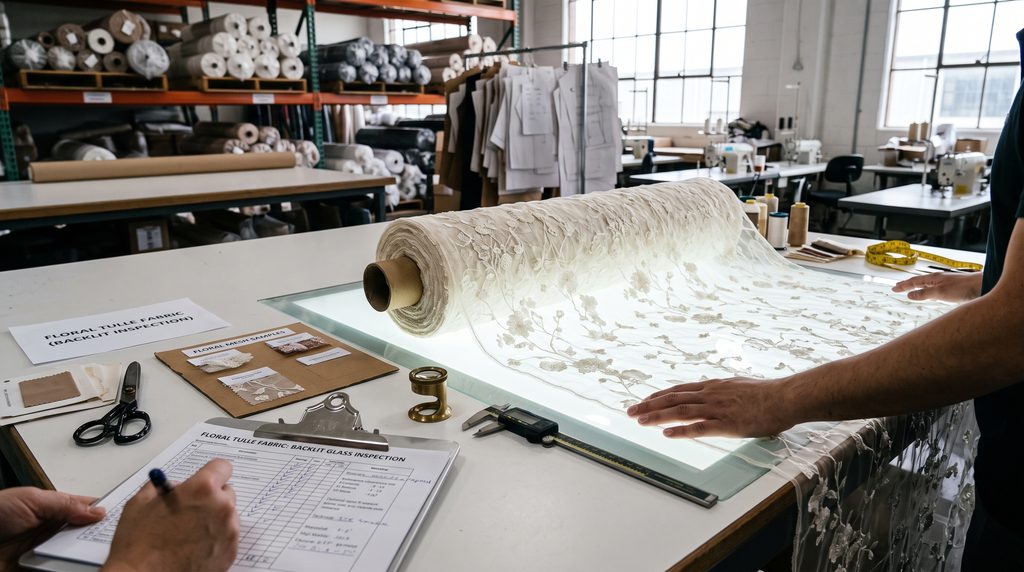
You inspect floral tulle fabric over glass by advancing continuous yardage across illuminated inspection tables to pinpoint broken embroidery loops, yarn slubs, and mechanical flaws. Small cut swatches can easily hide repetitive loom errors that recur across full manufacturing rolls. Passing yardage over illuminated glass tables exposes skipped embroidery stitches, uneven borders, and loose threads before cutting panels. Insisting on backlit inspection data for floral tulle fabric guarantees that your supplier delivers dependable, defect-free bolts.
How Do Backlit Glass Tables Reveal Flaws?
Backlit inspection frames shine diffuse light upward through translucent netting, highlighting flaws that remain invisible under standard ceiling lamps. Broken knit loops and yarn slubs appear as dark spots against the glowing glass background.
This is what happens:
Your inspection team isolates defective fabric sections before rolls reach cutting tables.
- Transmitted light exposes faint machine oil spots before heat-setting occurs.
- Dropped stitches show up as distinct light gaps along fabric courses.
- Uneven roll winding tension becomes obvious across wide fabric margins.
Why Apply Four-Point Scoring on Bulk Rolls?
The ASTM D5430 four-point inspection system assigns penalty points to visual defects based on their measured physical size. Totaling penalty points per hundred square yards yields an objective numerical score for accepting or rejecting lots.
What is the real story?
Standardized defect scores eliminate subjective arguments between your buyers and factory suppliers.
The Key Takeaway for quality control directors: establishing backlit table audits and four-point scoring stops flawed yardage from entering your garment production lines.
| Defect Measurement Range | Assigned Demerit Points | Quality Acceptance Action | Production Impact |
| Flaws Under 3 Inches (75mm) | 1 Penalty Point | Acceptable within normal allowance | Minor trim waste during cutting |
| Flaws 3 to 6 Inches (150mm) | 2 Penalty Points | Logged across full roll yardage | Repositioning of pattern pieces |
| Flaws Over 9 Inches (230mm) | 4 Penalty Points | Triggers immediate roll rejection | Severe panel destruction averted |
Standardized ASTM four-point evaluations deliver objective data that verifies shipment quality before warehouse intake.
When to Scale Floral Tulle Fabric for Production?
You scale floral tulle fabric for production after pilot yardage successfully passes marker layout, automated cutting, seam stress evaluations, and prototype wear testing. Moving to volume purchasing without pilot testing risks receiving non-compliant rolls that tie up operating cash in unsellable stock. Reputable knitting mills document standard operating procedures and provide transparent inspection logs with every shipment. Scaling your purchases of floral tulle fabric methodically establishes dependable supply channels for seasonal brand expansions.
How Does a Golden Swatch Stop Sourcing Claims?
A golden swatch represents the mutually approved physical yardage cut that embodies all agreed technical specifications, color values, and hand feel attributes. Splitting a verified sample provides an undisputed standard for resolving shipment disputes.
Here is the deal:
You hold clear physical proof if delivered bulk rolls deviate from approved quality standards.
- Golden swatches establish binding contractual standards for mass density and width.
- Reference samples settle color tolerance disagreements under laboratory light booths.
- Signed benchmark swatches prevent unauthorized yarn substitutions by overseas mills.
What Milestones Protect Bulk Delivery Dates?
Professional textile mills provide detailed production schedules tracking yarn spinning, greige knitting, dye lot approvals, and final packaging. Monitoring these milestones helps your procurement team identify potential delays before shipping deadlines pass.
This is what happens:
Your brand maintains dependable delivery dates across wholesale and retail sales channels.
The Key Takeaway for apparel sourcing executives: anchoring bulk production purchase orders to signed golden swatches ensures delivered goods match your approved prototypes.
| Production Phase Milestone | Scope of Milestone Audit | Milestone Approval Standard | Supply Chain Protection |
| Golden Swatch Sign-Off | Signed Master Fabric Cut | Full Tech Pack Compliance | Establishes binding quality baseline |
| Pilot Sampling Run | 50m to 100m Pilot Yardage | Factory Assembly Line Success | Validates loom setup under volume conditions |
| Bulk Shipment Dispatch | Certified Production Rolls | ASTM 4-Point QC Pass | Guarantees defect-free fabric delivery |
Establishing clear production milestones and signed reference swatches protects your brand investment and holds suppliers accountable.
Strategic Sourcing and Application of Floral Tulle Fabric
Selecting premium botanical netting requires balancing decorative beauty, substrate tensile strength, breathable comfort, and reliable sewing durability. This sourcing guide addressed your primary questions regarding yarn deniers, multi-light evaluations, ventilation ratings, and factory quality control protocols. Our manufacturing facility produces precision warp-knitted meshes, ultra-soft bridal illusion grounds, and dimensional botanical nettings tailored to strict international performance standards. To secure certified materials customized to your exact floral density, stiffness, and colorway requirements, contact us today to speak with textile engineers and order development sample swatches. We believe exceptional formalwear begins with disciplined textile engineering, and our team stands ready to supply dependable textiles for your collections.
FAQ Section
- Q1: Can I sew floral tulle fabric directly against skin without a lining?
No, raised embroidery knots and stiff monofilament thread tails can cause scratchy skin redness along delicate body zones. You should back sheer embroidered panels with soft silk habotai, rayon jersey, or smooth illusion tulle to provide a comfortable tactile barrier. - Q2: What’s the best needle size for sewing beaded floral tulle fabric?
A slender 65/9 or 70/10 ballpoint needle works best for sewing delicate mesh panels without cutting the base knit loops. When stitching through heavily beaded floral borders, clear beads away from the seam allowance to avoid needle strikes and thread breaks. - Q3: How do I know if floral tulle fabric provides adequate airflow?
Measure the material’s air permeability using Frazier differential pressure testing instruments in an accredited textile testing laboratory. High-performance decorative meshes should achieve between four hundred and seven hundred cubic feet per minute to allow natural body heat dissipation. - Q4: Can I steam 3D floral tulle fabric using a standard flat iron?
No, pressing a hot metal soleplate directly onto synthetic netting transfers excessive heat that melts delicate petal appliques into flat, shiny plastic. Always hang the garment vertically and apply gentle steam from a distance of two to three inches without touching the fabric. - Q5: What’s the best way to clean garments made with floral tulle fabric?
Professional spot cleaning or gentle hand washing in cool water preserves the dimensional shape of embroidered floral appliques. Never tumble dry or wring out embellished tulle garments, as machine heat and agitation can distort delicate petal outlines and break fine threads.