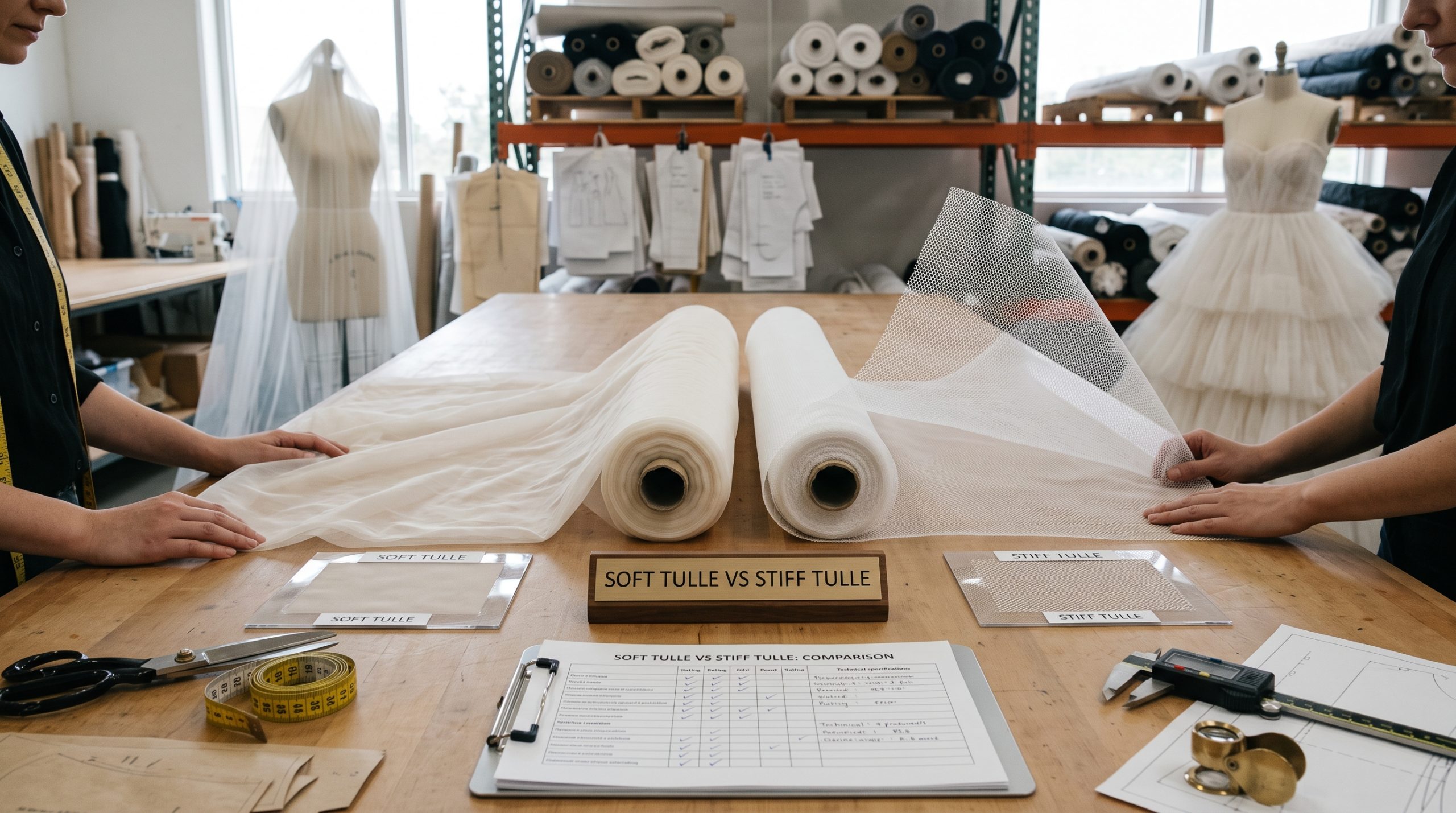
Soft tulle vs stiff tulle defines the technical choice between fluid illusion netting and rigid crinoline mesh engineered for wedding gowns, theatrical petticoats, and dance apparel. Sourcing sheer yardage without reviewing rigidity metrics often leads to flat skirts or abrasive surfaces that scratch bare skin. Flattened skirt hems ruin delicate bridal silhouettes, trigger expensive remakes, and frustrate discerning couture clients. Procuring certified soft tulle vs stiff tulle resolves these structural failures by matching fiber stiffness, drape fluidness, and open-cell breathability to your exact garment requirements.
Why Compare Soft Tulle vs Stiff Tulle for Gowns?
Comparing soft tulle vs stiff tulle allows garment developers to balance surface draping softness against internal structural lift across formal skirt designs. Selecting overly supple netting causes heavy satin overlays to collapse under gravitational pull. Coarse structural netting creates magnificent volume yet produces prickly surface abrasion against bare legs. Atelier pattern cutters blend both textiles into balanced tiers to build durable garments that maintain their flare through evening events.
What Denier Dictates Soft Tulle vs Stiff Tulle?
Filament denier defines the physical diameter of individual synthetic yarns, dictating flexural resistance. Fine multi-filament strands yield flowing softness, while thick monofilament yarns generate rigid outward projection.
Here is the deal:
Selecting the right yarn thickness determines whether your skirt flows or flares outward.
- Fine filaments under twenty denier drape smoothly along sweeping bridal trains.
- Coarse monofilaments over forty denier hold crisp horizontal pleats under heavy satins.
- Intermediate yarns provide balanced bounce across tiered prom ruffles.
How Does Weight Impact Layering and Gown Flare?
Layering lightweight illusion mesh requires dozens of gathered tiers to generate moderate skirt loft. Coarse structural netting builds immense volume with minimal yardage, reducing overall garment weight.
Look:
You reduce dress mass significantly by placing firm netting beneath lightweight outer overlays.
The Key Takeaway for bridal designers: combining dense structural netting inside core under-layers reduces fabric weight while preserving full ballgown proportions.
| Mesh Type Category | Base Yarn Denier | Average Areal Weight | Primary Garment Application |
| Ultra-Fine Illusion | 10 to 15 Denier | 16 to 22 GSM | Sheer sleeves, illusion necklines, cathedral veils |
| Medium Ballet Mesh | 20 to 30 Denier | 26 to 34 GSM | Romantic tiered tutus, ruffled fashion petticoats |
| Structural Crinoline Net | 40 to 60 Denier | 42 to 58 GSM | Ballgown understructures, classical pancake tutus |
Fiber diameter calculations verify coarse monofilament nettings deliver high structural lift with minimal fabric layers.
How Does Soft Tulle vs Stiff Tulle Build Skirt Shape?
Soft tulle vs stiff tulle builds skirt shape through contrasting yarn bending resistance and gathered perimeter spring forces. Pliant micro-meshes yield downward under gravity, forming fluid vertical folds that hug body curves. Heat-set crinoline nettings resist flexural bending, converting gathered waistband tension into outward horizontal lift. Blending both textiles allows apparel makers to engineer self-supporting skirt architecture without incorporating heavy metal hoops.
Which Fiber Holds Volume in Bridal Underskirts?
Warp-knitted polyester and polyamide monofilaments receive specialized finishing baths that lock hexagonal yarn loops into rigid geometric forms. Heat-stabilized netting snaps back when compressed under luggage during boutique shipping.
Think about it:
Untreated synthetic nets collapse into limp folds after brief storage inside shipping cartons.
- Thermally stabilized cell loops resist permanent compression creasing during warehouse transit.
- High tensile strength prevents skirt hems from dragging across ballroom floors.
- Cross-linked finishing resins preserve vertical stiffness throughout humid summer weddings.
Can Tiered Gather Ratios Create Dramatic Bounce?
Tight gathering along waistband seams packs thousands of resilient monofilament loops into tight spaces. Packed yarn loops push outward against adjacent stitches, generating high cantilever resistance.
Ready for the good part?
You control skirt flare by adjusting gathering ratios along structural petticoat bands.
The Key Takeaway for apparel technicians: calibrating gathering ratios on firm netting establishes predictable skirt projection without adding rigid steel wire cages.
| Gathering Density Ratio | Outward Projection Angle | Mechanical Spring Modulus | Resulting Silhouette Shape |
| 2 to 1 Yardage Ratio | 15 to 25 Degrees | Supple, fluid fall | Subtle A-line wedding skirts |
| 4 to 1 Yardage Ratio | 40 to 55 Degrees | Moderate spring rebound | Flared princess ballgowns |
| 6 to 1 Yardage Ratio | 75 to 90 Degrees | Rigid horizontal lift | Classical stage performance tutus |
Gathering ratio metrics confirm concentrated monofilament tiers generate high horizontal projection while conserving inner skirt volume.
Can Soft Tulle vs Stiff Tulle Deliver Direct Comfort?
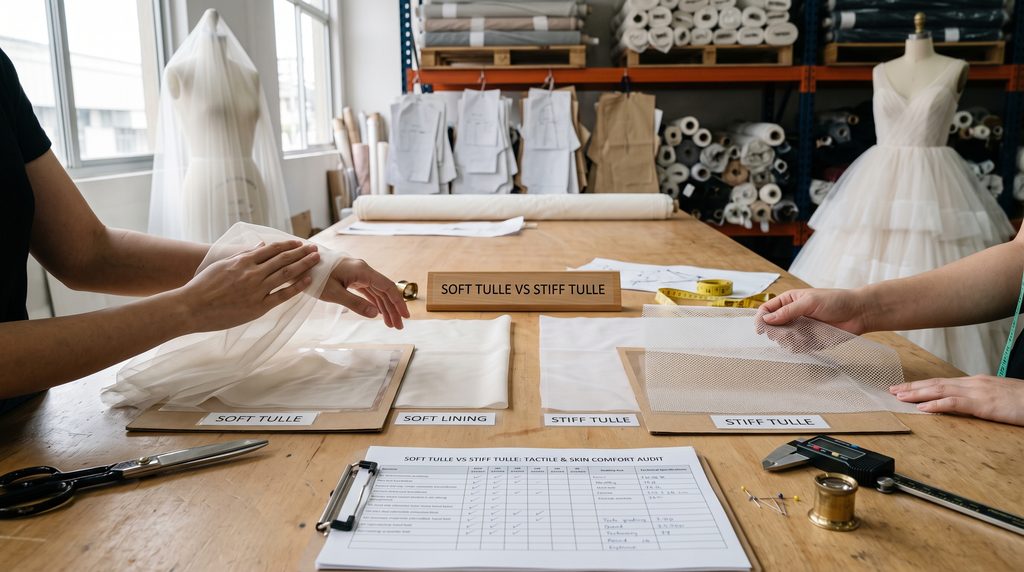
Soft tulle delivers pleasant skin contact through fine microfibers, while soft tulle vs stiff tulle requires protective barrier linings to prevent surface friction. Microfiber illusion meshes flex smoothly over collarbones and shoulders without irritating sensitive epidermal tissue. Coarse structural netting has sharp monofilament ends that cause chafing when positioned against bare skin. Professional ateliers isolate firm structural nets behind smooth lining panels to maintain wearer comfort.
Why Does Filament Thickness Cause Skin Chafing?
Thick monofilament cut ends act like tiny needles against bare skin when gathered into tight seams. Fine multi-filament yarns feature rounded fiber bundles that glide softly across sensitive contours.
What is the real story?
Direct contact with untreated structural netting causes redness and irritation during dancing.
- Microfiber yarns flex gently over sensitive necklines without causing friction marks.
- Coarse monofilament edges scratch thighs when left exposed inside unlined skirts.
- Soft knit linings shield sensitive skin while outer nets maintain skirt volume.
How Do Protective Linings Shield Bare Legs?
Underlining coarse structural tiers with smooth silk habotai or rayon jersey creates a tactile shield. Sealing netting hems with satin ribbon or horsehair braid encloses sharp filament edges.
This is what happens:
Your clients enjoy voluminous ballroom gowns without experiencing itchy skin rashes.
The Key Takeaway for bridal designers: enclosing firm netting between soft linings and smooth edge trims prevents skin irritation while preserving skirt volume.
| Textile Placement Tier | Monofilament Diameter | Tactile Surface Sensation | Recommended Construction Technique |
| Direct Neckline Contact | Under 12 Denier | Weightless, silky contact | Raw-edge illusion panels, unlined yokes |
| Core Skirt Support | Over 45 Denier | Firm, scratchy, abrasive | Enclosed intermediate petticoat tiers |
| Direct Leg Contact | Multi-filament Jersey | Smooth, frictionless touch | Continuous inner slip lining barrier |
Tactile friction evaluations show enclosing firm netting behind smooth lining fabrics protects sensitive skin from surface abrasion.
Does Soft Tulle vs Stiff Tulle Provide High Airflow?
Both soft tulle vs stiff tulle provide high airflow through warp-knitted open hexagonal cell structures that disperse body heat. Solid plain-weave petticoats trap warm moisture beneath full skirts, leaving wearers clammy and uncomfortable. Open netting apertures promote continuous air circulation, venting body warmth away from moving legs. Specifying open-cell mesh guarantees your bridal wear maintains wearer comfort during warm outdoor ceremonies.
How Do Open Hexagonal Pores Circulate Fresh Air?
Moving legs generate heat that accumulates beneath dense garment layers, producing unwanted perspiration. Wide hexagonal mesh apertures function like ventilation channels, directing fresh air across lower limbs.
Here is why:
Open hexagonal pores keep brides comfortable beneath multi-layered wedding skirts.
- Open knit apertures release rising moisture vapor during vigorous walking.
- Hexagonal pore geometry maintains open pathways under moderate fabric tension.
- Convective air movement keeps body temperatures balanced during outdoor events.
Can Frazier Permeability Tests Verify Cooling?
Frazier air testing instruments pull calibrated air currents through fabric swatches to measure throughput volume per square foot. Objective cubic-feet-per-minute data replaces ambiguous descriptions like breathable or airy.
Look:
You review verified airflow data before placing volume orders for summer collections.
The Key Takeaway for formalwear manufacturers: choosing verified open-aperture meshes prevents heat buildup beneath layered bridal petticoats.
| Mesh Construction Style | Average Aperture Width | Measured Frazier Rating | Thermal Comfort Performance |
| Compact Illusion Sheer | 0.8 mm to 1.2 mm | 340 to 480 CFM | Moderate cooling across bodice panels |
| Standard Bridal Net | 1.8 mm to 2.4 mm | 620 to 860 CFM | Continuous air exchange through skirt tiers |
| Open Coarse Crinoline | 3.2 mm to 4.5 mm | Over 1100 CFM | Maximum ventilation in full petticoats |
Air permeability measurements prove open hexagonal meshes release trapped heat significantly faster than solid woven linings.
How to Audit Soft Tulle vs Stiff Tulle Under Lights?
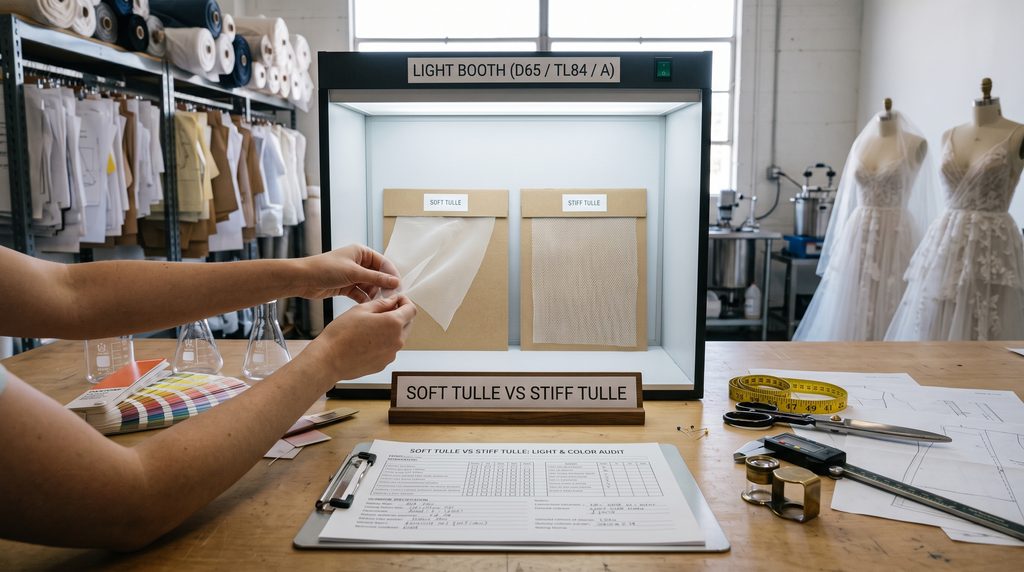
You audit soft tulle vs stiff tulle under lights by mounting fabric swatches inside multi-illuminant color chambers to detect metameric shade shifts. Synthetic fibers absorb dye baths differently based on filament thickness and chemical recipes. Inconsistent dyeing creates obvious tone mismatches between delicate illusion bodices and coarse skirt ruffles. Standardizing color audits protects your brand from customer complaints over mismatched bridal sets.
Why Do Multi-Light Booths Expose Color Flaws?
Metamerism makes dyed netting match matching satin under showroom lamps while appearing mismatched outdoors. Checking fabric swatches under multiple calibrated bulbs reveals unstable dye recipes before bulk production begins.
Think about it:
Bridal skirts must match their bodices inside churches, outdoor gardens, and evening ballrooms.
- Calibrated daylight tubes expose subtle yellowing across bridal ivory swatches.
- Store fluorescent bulbs reveal green undertones beneath boutique display racks.
- Incandescent bulbs expose red shade deviations during evening wedding banquets.
How Do Crock Tests Check Dark Dyestuff Rubbing?
Rotary crock testing instruments rub dry and wet cotton pads across dyed mesh under controlled mechanical pressure. Loose pigments transfer onto rubbing cloths, exposing weak chemical dye bonds on coarse monofilaments.
Ready for the good part?
Identifying weak dye bonds early prompts finishing mills to run corrective rinse cycles.
The Key Takeaway for color technicians: conducting multi-light color audits and mechanical crocking checks prevents dye transfer and mismatched tones across sheer garments.
| Inspection Light Standard | Correlated Color Temp | Evaluation Target | Color Defect Prevented |
| Artificial Daylight (D65) | 6500 Kelvin | True outdoor color balance | Off-shade bridal panels under sunlight |
| Store Fluorescent (TL84) | 4000 Kelvin | Retail boutique illumination | Shaded panels beneath shop spotlights |
| Warm Incandescent (Ill A) | 2856 Kelvin | Residential ballroom setting | Unwanted color casts during receptions |
Calibrated light booth audits confirm dyed sheer textiles maintain consistent color across changing ambient light conditions.
Why Sourcing Soft Tulle vs Stiff Tulle Needs Low MOQs?
Sourcing soft tulle vs stiff tulle with low order minimums protects your cash reserves while you test fresh seasonal dress concepts. Large textile brokers mandate huge order volumes that tie up operating funds in excess inventory. Agile knitting mills offering trial yardage allow design studios to prototype new collections with minimal financial exposure. Partnering with flexible suppliers keeps your brand nimble as bridal trends shift.
Why Do Bulk Wholesalers Strain Working Capital?
Brokers enforce massive yardage minimums because their business models rely on bulk volume instead of designer partnerships. Purchasing thousands of meters for unproven styles locks up cash that belongs in pattern development and marketing.
Here is the deal:
Surplus bolts sitting in warehouses lose value while fashion silhouettes evolve.
- High purchasing thresholds force independent labels to gamble operating cash.
- Extended lead times at mass mills delay runway sample production runs.
- Storing excess fabric rolls generates recurring warehouse fees each quarter.
Can Flexible Mills Provide Fast Sample Swatches?
Agile warp-knitting factories offer trial sampling runs starting around one hundred meters per custom color. Sourcing smaller trial lots preserves working capital while you present prototypes to boutique buyers.
Look:
You validate retail demand with production prototypes before purchasing bulk yardage.
The Key Takeaway for apparel founders: partnering with manufacturers offering flexible minimums protects operating funds and shortens development timelines.
| Textile Sourcing Channel | Minimum Order Size | Production Lead Time | Cash Flow Risk Exposure |
| Mass Wholesaler Broker | 3000m to 5000m per hue | 10 to 14 weeks | Severe capital lockup in inventory |
| Agile Warp-Knit Mill | 100m to 250m per hue | 2 to 4 weeks | Minimal risk with fast prototyping |
| Retail Jobber Showroom | 1m to 10m spot cuts | Immediate off-shelf | High unit cost, inconsistent inventory |
Flexible minimum order volumes protect operating cash while giving design teams freedom to test new garment concepts.
How Does Soft Tulle vs Stiff Tulle Handle Needles?
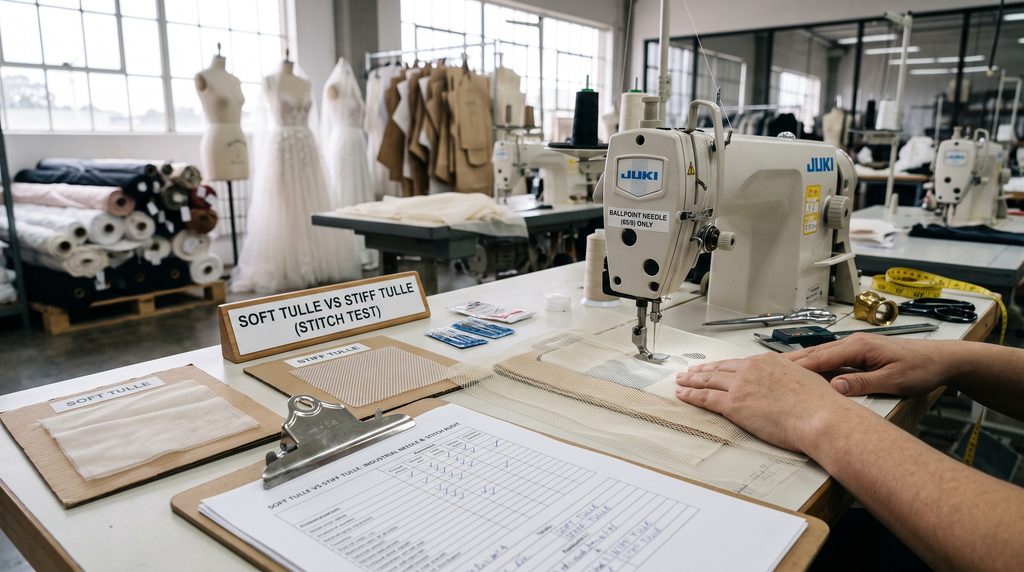
Soft tulle vs stiff tulle handles industrial sewing needles smoothly when operators install slender ballpoint needles and calibrate stitch tension. High-speed sewing generates friction heat that can melt delicate synthetic net intersections. Sharp needle tips slice through fine monofilaments, causing runs that widen into tears along stressed seams. Running sewing trials helps machine supervisors configure appropriate needle sizes, thread tensions, and stitch lengths.
Why Do High-Speed Needles Melt Synthetic Mesh?
Rapid needle penetration generates localized friction heat exceeding the softening thresholds of synthetic polymers. Overheated filaments fuse into hard plastic beads that puncture nearby knit loops and cause puckering.
Here is why:
Using slender ballpoint needles prevents thermal damage during high-speed sewing runs.
- Slender ballpoint tips slide past knit loops without cutting yarn filaments.
- Balanced thread tension eliminates puckering across sheer panel seams.
- Lubricated polyester threads reduce mechanical friction inside needle eyes.
Can Ballpoint Needles Stop Seam Perforation Tears?
Chisel-point needles pierce synthetic strands, creating perforation lines that tear open under tension. Rounded ballpoint tips push yarns aside, preserving loop strength along fitted bodice seams.
Look:
You ensure structural under-layers withstand active wear without seam separation.
The Key Takeaway for sewing room managers: installing fine ballpoint needles and moderating stitch spacing prevents needle cuts along sheer garment seams.
| Sewing Machine Setup | Recommended Factory Standard | Incorrect Machine Setting | Production Failure Prevented |
| Machine Needle Type | 65/9 or 70/10 Ballpoint | 90/14 Sharp Chisel Tip | Prevents yarn severance and runs |
| Thread Specification | Tex 16 to 24 Poly-Core | Heavy Spun Cotton Thread | Stops bulky seams and thread breaks |
| Stitch Density Pitch | 2.0 mm to 2.5 mm Pitch | Under 1.5 mm Dense Pitch | Prevents perforation cuts along seams |
Stitching trials confirm fine ballpoint needles and controlled stitch spacing prevent yarn breaks along sheer assembly seams.
Can Steam Finish Soft Tulle vs Stiff Tulle Safely?
You can finish soft tulle vs stiff tulle safely by applying indirect vertical steam without pressing heated metal iron surfaces against synthetic meshes. Direct iron contact transfers concentrated heat exceeding the melting threshold of fine polymers. Touching hot iron plates directly to structural netting collapses open pores into stiff, damaged plastic patches. Applying gentle vertical steam smooths packaging wrinkles while preserving structural bounce.
Why Does Direct Iron Soleplate Heat Ruin Netting?
Conductive heat transfers directly from metal iron plates into fine synthetic strands, softening polymers within seconds. Softened strands fuse together, permanently ruining open mesh geometry and flexural recovery.
Think about it:
One careless pass of a flat iron ruins a bespoke wedding gown right before delivery.
- High soleplate heat melts open hexagonal cells into flat plastic sheets.
- Dry iron heat makes synthetic fibers brittle and prone to cracking.
- Direct pressure crushes raised petticoat ruffles flat against inner slips.
Can Vertical Steam Remove Transit Creases Safely?
Vertical steaming releases moist, diffuse vapor that relaxes packaging wrinkles without pressing down on delicate raised surfaces. Gentle warmth softens fiber tension, allowing folded netting loops to expand into full shape.
Ready for the good part?
Indirect vertical steaming smooths transit creases safely without melting delicate fibers.
The Key Takeaway for finishing departments: establishing safe steaming guidelines protects netting volume and prevents melted fibers during final garment pressing.
| Synthetic Fiber Polymer | Safe Steaming Temp | Max Soleplate Temp | Thermal Failure Symptom |
| Polyamide Illusion Net | 110°C (Low Steam) | 120°C (With Cloth) | Melts into brittle glassy holes |
| Polyester Structural Net | 125°C (Medium Steam) | 135°C (With Cloth) | Puckers, shrinks, and loses elasticity |
| Resin-Finished Stiff Mesh | 100°C (Indirect Only) | Zero Direct Contact | Binders melt into sticky residue |
Thermal exposure tests prove indirect vertical steaming removes packaging wrinkles safely without damaging synthetic netting fibers.
How to Inspect Soft Tulle vs Stiff Tulle Over Glass?
You inspect soft tulle vs stiff tulle over glass by feeding continuous rolls across illuminated inspection panels to detect dropped stitches and yarn slubs. Small cut swatches hide repetitive knitting errors that recur across entire production bolts. Passing continuous yardage over illuminated glass tables exposes skipped stitches, tension streaks, and oil spots before cutting panels. Insisting on backlit inspection records verifies your supplier delivers defect-free fabric rolls.
How Do Backlit Glass Tables Reveal Weave Flaws?
Backlit glass panels direct diffuse light upward through translucent netting, exposing flaws invisible under ceiling lamps. Broken knit loops and yarn slubs appear as dark blemishes against illuminated backgrounds.
This is what happens:
Your quality control team isolates defective yardage before rolls reach cutting tables.
- Transmitted light exposes faint machine oil spots before heat setting.
- Dropped stitches show up as distinct light gaps along fabric courses.
- Uneven roll tension becomes obvious across wide fabric margins.
Why Use ASTM Four-Point Grading on Bulk Bolts?
The ASTM D5430 inspection system assigns penalty points to visual defects based on their measured physical dimensions. Totaling penalty points per hundred square yards yields an objective score for evaluating fabric shipments.
What is the real story?
Standardized defect scoring eliminates subjective arguments between your procurement team and overseas mills.
The Key Takeaway for quality directors: establishing backlit table audits and four-point scoring stops flawed yardage from entering your garment production lines.
| Defect Dimension Range | Demerit Penalty Points | Quality Action Taken | Production Impact Prevented |
| Defect Under 3 Inches (75mm) | 1 Penalty Point | Permitted within allowance | Minor trim waste during cutting |
| Defect 3 to 6 Inches (150mm) | 2 Penalty Points | Logged across full roll | Repositioning of pattern pieces |
| Defect Over 9 Inches (230mm) | 4 Penalty Points | Triggers roll rejection | Severe panel destruction averted |
Standardized ASTM four-point evaluations provide objective data verifying shipment quality before warehouse intake.
When to Scale Soft Tulle vs Stiff Tulle Production?
You scale soft tulle vs stiff tulle production once approved pilot yardage passes automated spreading, seam stress testing, and prototype fitting trials. Ordering bulk yardage before verifying trial lots risks receiving non-compliant rolls that tie up operating funds in unusable stock. Reputable knitting mills document manufacturing procedures and provide transparent inspection records with every shipment. Scaling procurement methodically establishes dependable material pipelines for seasonal brand collections.
How Does a Signed Golden Swatch Stop Disputes?
A signed golden swatch represents the approved physical fabric cut embodying all agreed technical specifications, color values, and tactile properties. Retaining benchmark samples provides an undisputed standard for resolving shipment disputes.
Here is the deal:
You hold clear physical proof if delivered bulk rolls deviate from approved quality standards.
- Golden swatches establish binding contractual standards for weight and width.
- Reference samples settle color tolerance disagreements under laboratory light booths.
- Signed benchmark swatches prevent unauthorized yarn substitutions by overseas mills.
What Production Milestones Guarantee Timely Shipments?
Professional textile mills supply production tracking schedules detailing yarn spinning, greige knitting, dye lot checks, and packing. Monitoring these milestones helps your sourcing team spot potential delays before shipping deadlines pass.
This is what happens:
Your brand maintains dependable delivery schedules across wholesale and boutique retail channels.
The Key Takeaway for apparel sourcing executives: anchoring bulk production purchase orders to signed golden swatches ensures delivered goods match your approved prototypes.
| Manufacturing Phase | Milestone Audit Scope | Approval Requirement | Supply Chain Protection |
| Master Swatch Approval | Signed Golden Sample Cut | Full Tech Pack Compliance | Establishes binding quality baseline |
| Pilot Production Batch | 100m Trial Run | Cutting Line Verification | Validates loom setup under volume runs |
| Bulk Roll Dispatch | Full Container Shipment | ASTM 4-Point QC Pass | Guarantees defect-free fabric delivery |
Establishing clear production milestones and signed reference swatches protects your brand investment and holds suppliers accountable.
Strategic Sourcing and Selection of Soft vs Stiff Tulle
Balancing flowing aesthetic softness against resilient structural volume defines successful formalwear engineering. This sourcing guide answered your primary questions regarding fiber deniers, multi-light color audits, ventilation ratings, and factory quality control protocols. Our manufacturing facility produces precision warp-knitted meshes, ultra-soft bridal illusion tulles, and firm crinoline nettings tailored to strict international performance standards. To secure certified materials customized to your exact stiffness, density, and colorway requirements, contact us today to speak with textile engineers and order development sample swatches. We believe exceptional formalwear begins with disciplined textile engineering, and our team stands ready to supply dependable textiles for your collections.
FAQ Section
- Q1: Can I use stiff tulle directly against skin without a lining?
No, coarse monofilament cut ends and heat-set finishes cause scratchy skin irritation along sensitive body contours. You should position structural netting within interior skirt tiers and face direct skin contact areas with smooth silk, cotton, or jersey linings. - Q2: What’s the best needle size for sewing soft and stiff tulle?
A slender 65/9 or 70/10 ballpoint needle provides the proper balance of penetration and fiber safety for structured and illusion netting. Slender ballpoints slide between knitted loops without cutting synthetic filaments, preventing skipped stitches and puckered seams. - Q3: How do I know if stiff netting has adequate elastic recovery?
Perform a quick crumple test by compressing a sample swatch in your closed fist for ten seconds and releasing it onto a table. Premium heat-set structural mesh rebounds into its original shape within two seconds without showing permanent creasing lines. - Q4: Can I press wrinkled soft tulle with a standard household iron?
No, pressing a hot metal soleplate directly onto synthetic netting transfers excessive heat that melts open pores into flat plastic sheets. Always hang the garment vertically and apply gentle steam from a distance of two to three inches without touching the fabric. - Q5: What’s the best way to wash gowns made with soft and stiff tulle?
Spot clean or gently hand wash formal garments in cool water using mild detergent to preserve the heat-set resin finish. Never wring out or tumble dry structured netting garments, as mechanical heat and agitation soften stabilizing resins and collapse skirt volume.