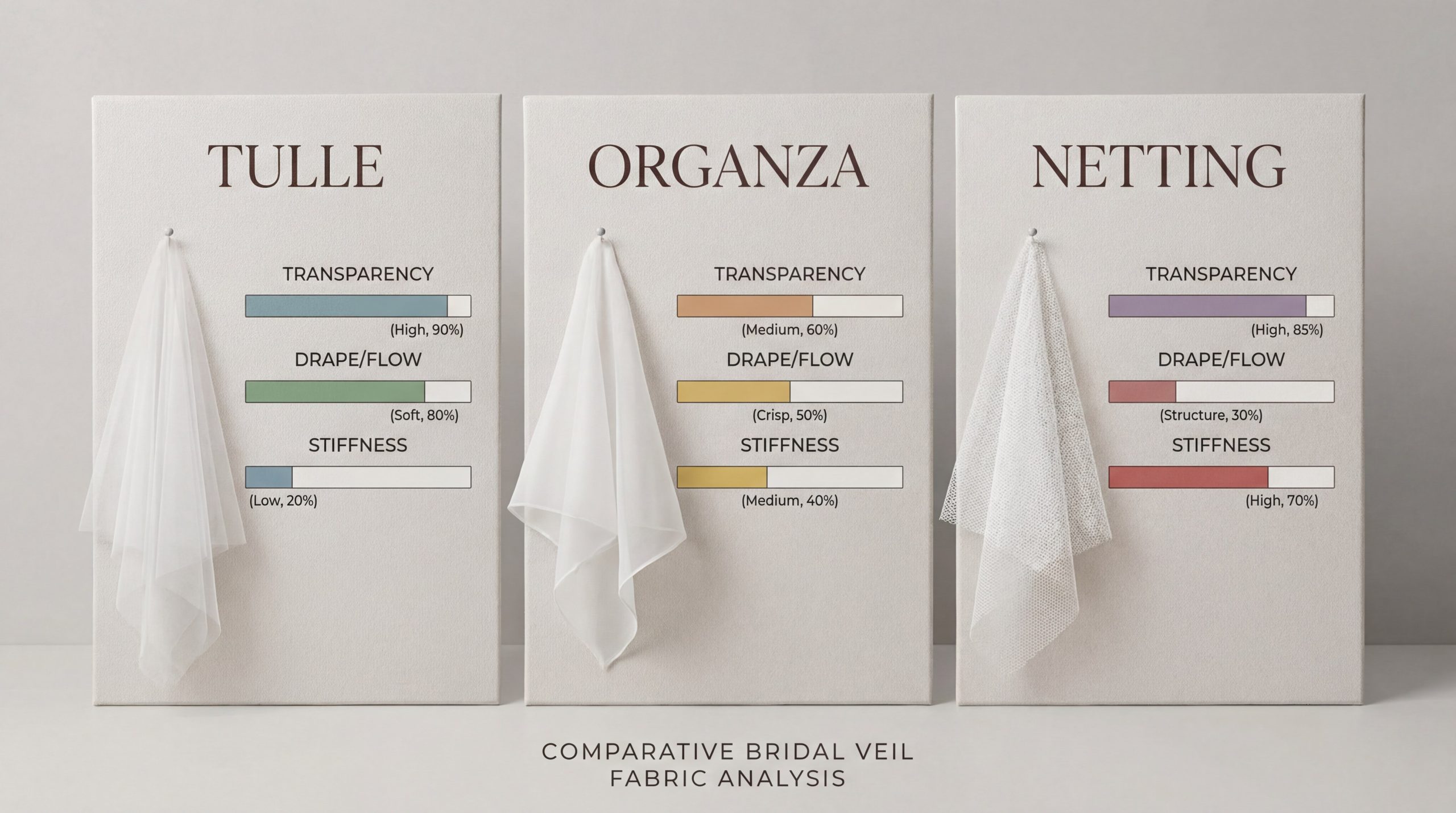
Microtex needles, fine polyester thread, and ultra-sharp fabric shears are the primary tools required for working with bridal veil fabric. Finding the perfect balance between a delicate touch and professional precision can be frustrating when you are crafting your own wedding accessories. One wrong move with a blunt pin or a heavy-duty needle can leave permanent holes in your expensive materials, ruining months of planning in a single second. Equipping your workspace with the right specialized tools ensures a seamless sewing experience and a flawless finish for your big day.
Which sewing tools work best for bridal veil fabric?
Using microtex needles and fine polyester thread ensures you don’t snag your bridal veil fabric during the assembly process. These tools are designed to glide through fine mesh without catching the delicate fibers.
Which thread is invisible on bridal veil fabric?
Look: Choosing a thread that vanishes into the mesh is the secret to a professional look. Clear monofilament or extra-fine 100wt polyester threads are the most popular choices for this task.
- Monofilament nylon (smoke or clear)
- 100wt Silk thread
- Fine polyester embroidery thread
- Translucent bobbin thread
Do I need silk pins for bridal veil fabric?
The truth is: Standard sewing pins are often too thick and will leave visible puncture marks in your netting. Silk pins or extra-fine glass head pins are necessary because they have a much smaller diameter.
- 0.5mm Silk pins
- Stainless steel entomology pins
- Fine-point appliqué pins
- Magnetic pin cushions for safety
How to choose a needle for bridal veil fabric?
Best part? A size 60/8 or 70/10 Microtex needle features a slim, sharp point that pierces the mesh cleanly. If you notice skipped stitches, it is usually a sign that your needle is too dull or too large for the weave.
- Size 60/8 Microtex
- Size 70/10 Universal (for thicker lace)
- Ballpoint needles (only for stretchy mesh)
- New needle for every project
| Tool Category | Recommended Item | Purpose | |
|---|---|---|---|
| Needle | Microtex 60/8 | Clean piercing without snags | |
| Pin | Fine Silk Pins | Securing layers without holes | |
| Thread | 100wt Polyester | Invisible seaming |
The right tools transform a difficult task into a manageable craft.
Key Takeaway: Investing in specialized needles and pins prevents irreversible damage to your delicate mesh, ensuring a professional and clean aesthetic.
What are the top types of bridal veil fabric?
Selecting the right variety of bridal veil fabric is essential for achieving the specific volume or softness your wedding vision requires. Different weaves provide varying levels of transparency and “poof” once gathered.
Is English tulle a soft bridal veil fabric?
Think about it: English tulle is prized for its honeycomb structure and incredibly soft, liquid-like drape. It is less stiff than standard netting, making it perfect for boho-style veils that flow behind the bride.
- Cotton-based blends
- Durable honeycomb weave
- Matte finish
- Low-volume drape
What defines a silk bridal veil fabric?
Wait, there’s more: Pure silk tulle is the height of luxury, offering a weightless feel and a delicate, natural luster. While it is significantly more expensive, the way it moves in the wind is unmatched by synthetic alternatives.
- 100% Mulberry silk fibers
- Ultra-fine mesh density
- Fragile construction
- High-end price point
Is Italian mesh a premium bridal veil fabric?
Now: Italian mesh is often considered a premium choice because it combines the softness of silk with the durability of high-quality nylon. It provides a sophisticated look that holds its shape slightly better than English styles.
- Superior clarity
- Soft-touch finish
- Polyester or Nylon blend
- Resistant to wrinkling
| Fabric Type | Texture | Best Use | |
|---|---|---|---|
| English Tulle | Soft/Drapey | Boho & Floor-length | |
| Silk Tulle | Weightless/Luxury | Royal & Cathedral veils | |
| Italian Mesh | Smooth/Clear | Modern & Minimalist |
Understanding material characteristics helps you match the fabric to your dress style.
Key Takeaway: Choose English tulle for a romantic flow, silk for ultimate luxury, or Italian mesh for a modern, high-clarity appearance.
How to add lace trims to bridal veil fabric?
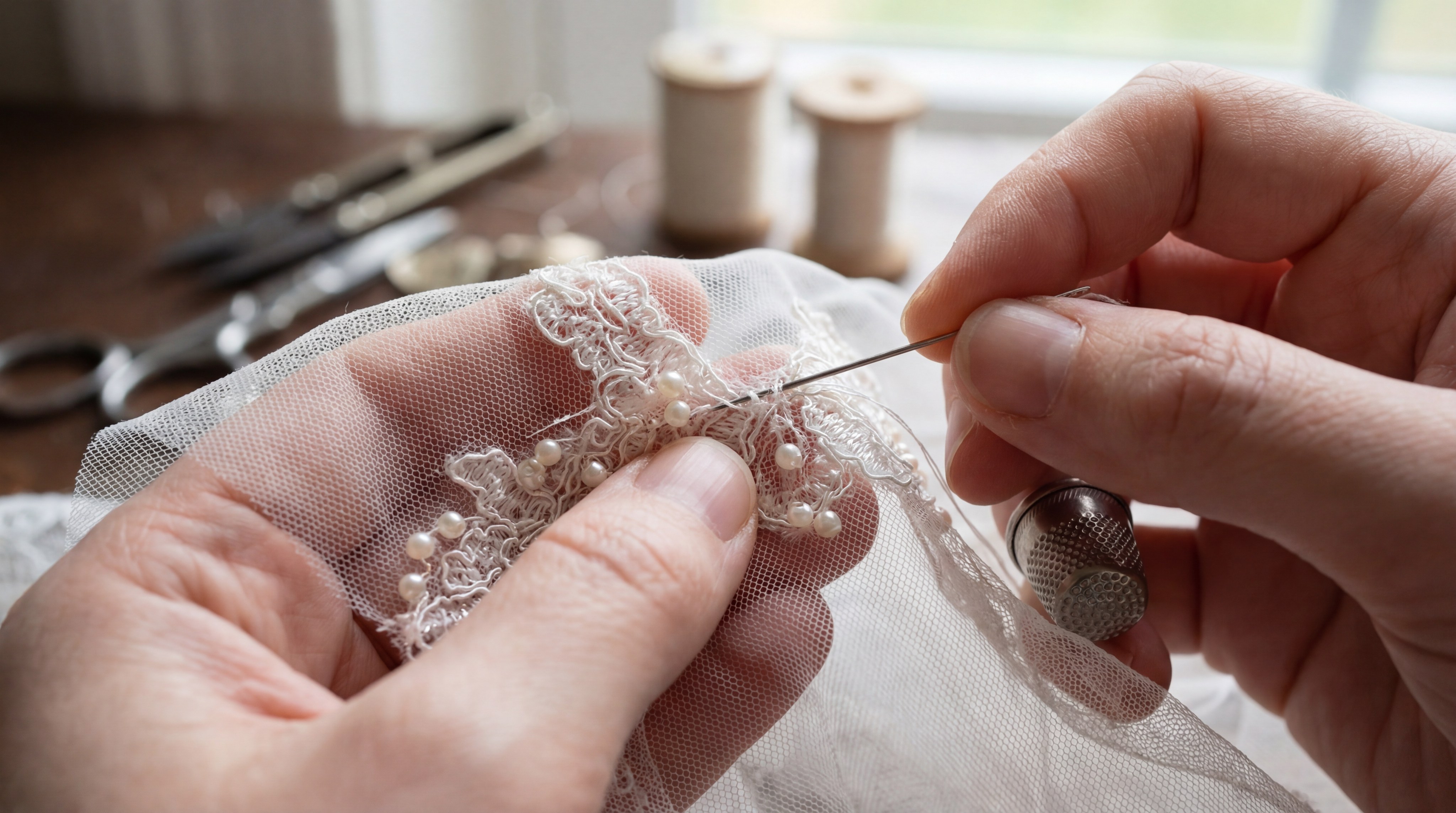
Hand-stitching is the most reliable method for attaching heavy ornaments or lace fabric to your bridal veil fabric without causing ripples. This allows you to control the tension and hide your knots within the lace pattern.
Will heavy lace tear bridal veil fabric?
Let’s face it: Applying heavy Venise lace to a single layer of very fine illusion tulle can cause the fabric to sag or tear. You should always test a small swatch or consider adding a second layer of mesh for structural support.
- Venise lace weight
- Alençon lace borders
- Fabric stabilizer use
- Tension testing
How to hand-sew beads on bridal veil fabric?
Bottom line: Beading requires a very fine beading needle and a “stop-start” technique to prevent the thread from pulling the mesh. Placing a velvet board underneath your work can keep the beads from rolling away while you sew.
- Size 12 beading needles
- Nymo beading thread
- Seed beads and pearls
- Backstitching for security
Can I machine-sew lace to bridal veil fabric?
Check this out: You can use a sewing machine if you select a wide zig-zag stitch and use water-soluble stabilizer. The stabilizer prevents the machine’s feed dogs from “eating” the delicate netting during the process.
- Wide zig-zag setting
- Water-soluble stabilizer strips
- Walking foot attachment
- Slow sewing speed
| Attachment Method | Best For | Level of Difficulty | |
|---|---|---|---|
| Hand-Stitched | Intricate lace & pearls | High (Time-intensive) | |
| Machine Zig-Zag | Wide lace borders | Medium | |
| Fabric Glue | Small flatback crystals | Low (Use sparingly) |
Selecting the right attachment technique ensures your embellishments stay secure throughout the ceremony.
Key Takeaway: Hand-sewing remains the gold standard for luxury veils, providing the best structural integrity for heavy lace and delicate beadwork.
How to attach combs to your bridal veil fabric?
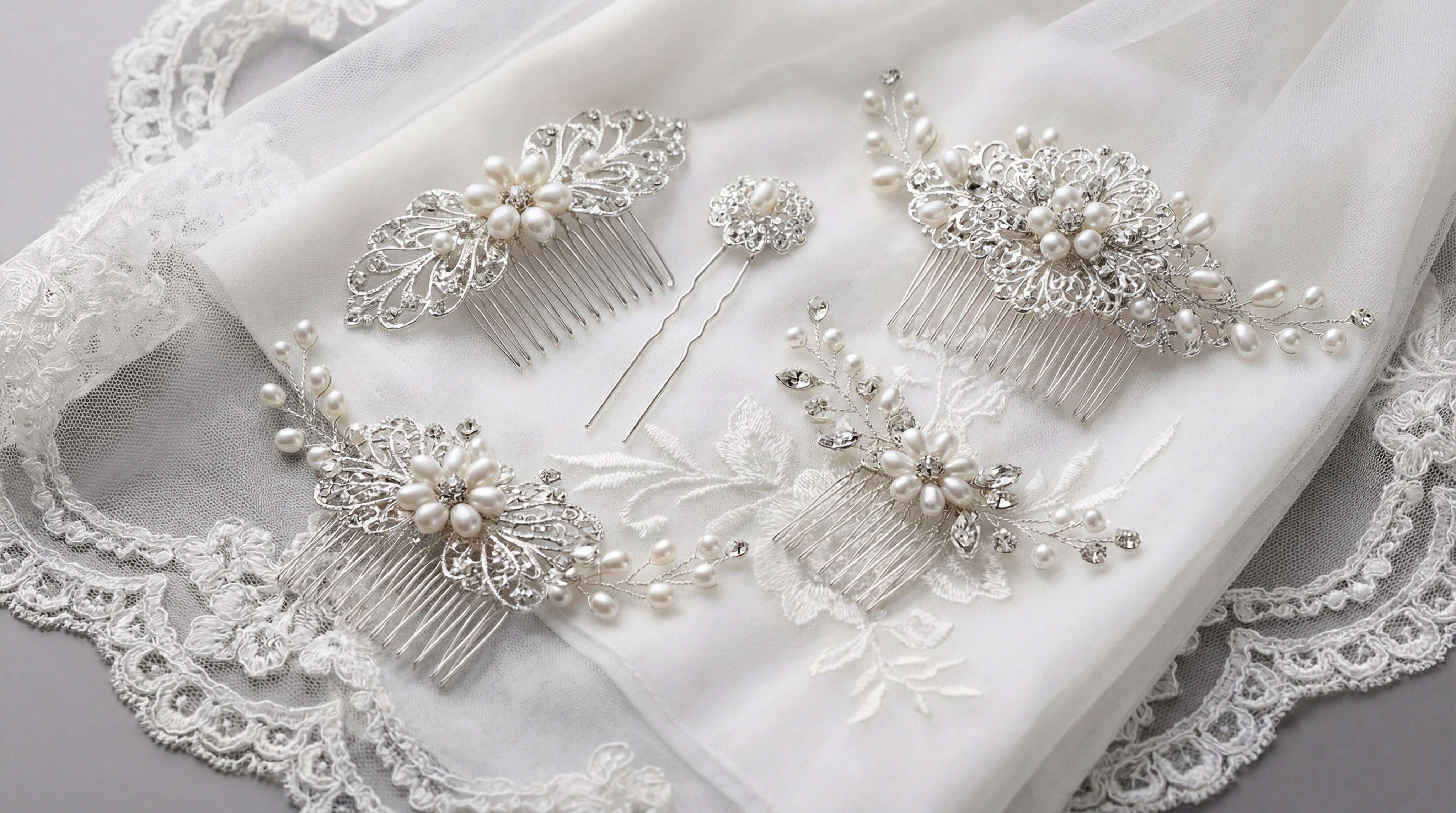
Gathering the top edge of your bridal veil fabric before sewing it to a metal or plastic comb creates the classic “puffed” look. A secure attachment is vital to prevent the veil from sliding out of your hair during your walk down the aisle.
Should I use metal combs for bridal veil fabric?
It’s true: Metal combs are generally preferred over plastic because they are thinner, more durable, and can be bent to contour the shape of the bride’s head. They provide a much stronger grip for heavy, multi-tier veils.
- Silver-plated brass
- Rose gold finishes
- Wire-bound teeth
- Contoured head shape
How to hide hair pins in bridal veil fabric?
Believe it or not: You can create small “loops” of thread on the underside of the veil to act as anchor points for bobby pins. This allows you to pin the veil directly into an updo without showing any bulky hardware.
- Invisible thread loops
- Criss-cross pinning
- Matching pin colors
- Strategic fold placement
Does a velcro closure work for bridal veil fabric?
Here is the deal: Velcro is rarely used for high-end veils because the hook side can easily snag and ruin the delicate mesh. However, it is a quick-change option for theatrical or costume-grade veils that need to be removed instantly.
- Hook and loop sets
- Low-profile adhesive
- Risk of snagging
- Snap alternatives
| Comb Material | Pros | Cons | |
|---|---|---|---|
| Metal | Strong, bendable | Heavier than plastic | |
| Plastic | Lightweight, cheap | Can snap under pressure | |
| Clear Resin | Discrete | Slippery in fine hair |
The hardware you choose dictates how comfortably the veil sits on your head for hours.
Key Takeaway: Metal wire combs offer the most secure and customizable fit, ensuring your veil remains perfectly positioned regardless of its weight.
What are the DIY basics for bridal veil fabric?
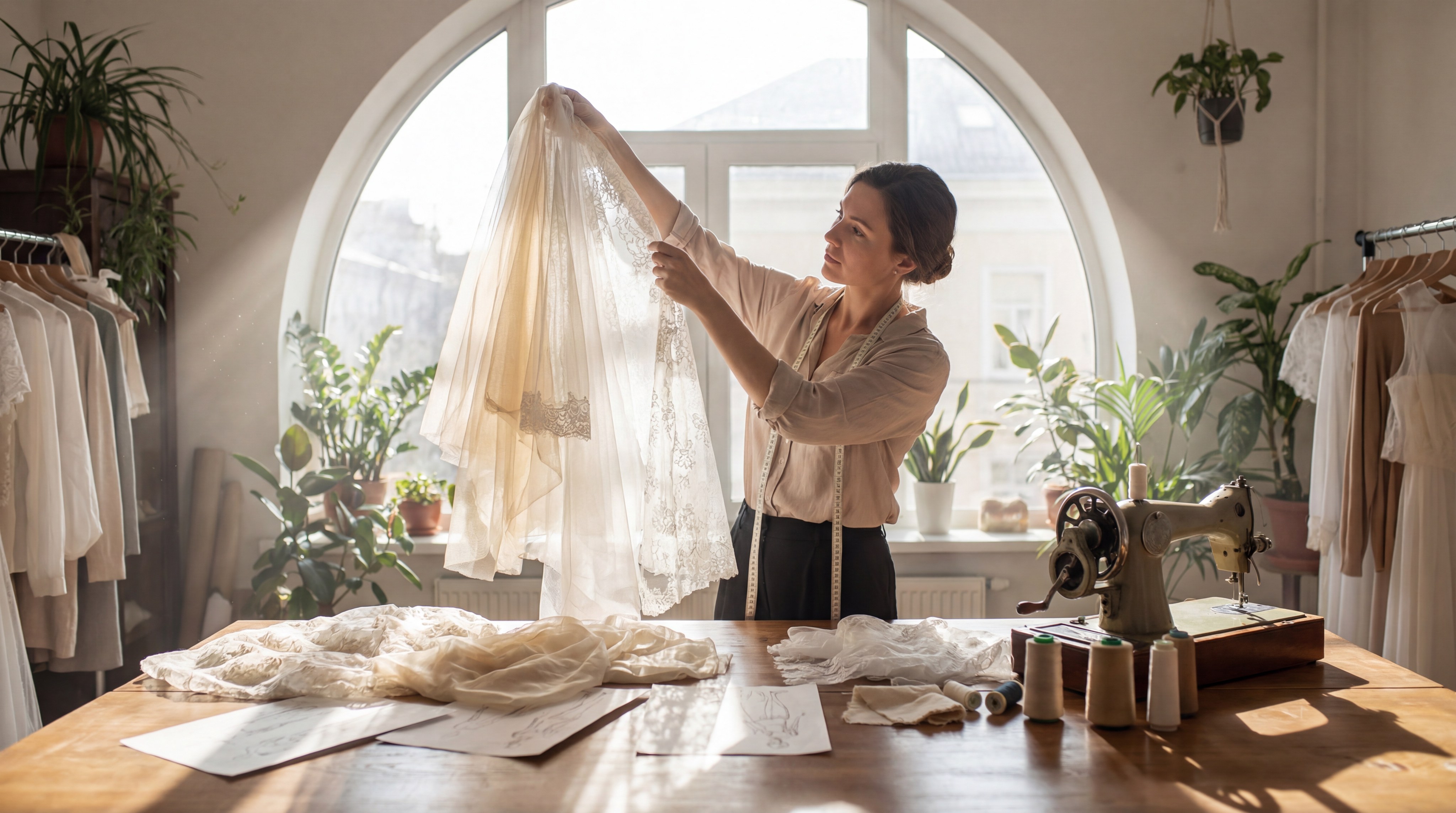
Learning the fundamentals of handling bridal veil fabric allows you to create a custom piece that matches your gown at a fraction of the retail cost. Most DIY projects focus on the “Illusion” style, which is the industry standard for clarity.
Where can I buy bulk bridal veil fabric?
Interestingly: Wholesale suppliers and specialized online textile retailers are the best places to find 108-inch wide bolts. Buying in bulk is significantly cheaper if you plan on making multiple veils or a very long cathedral-length piece.
- Wholesale textile websites
- Bridal supply shops
- Fabric district outlets
- Custom mill orders
How much bridal veil fabric should I order?
Don’t forget: Always order at least 10% more fabric than your calculated measurements to account for cutting errors or uneven edges. A standard cathedral veil usually requires about 3 to 4 yards of extra-wide mesh.
- Elbow length: 1 yard
- Fingertip length: 2 yards
- Cathedral length: 4 yards
- Wastage allowance
Is nylon mesh a cheap bridal veil fabric?
Actually: Nylon mesh is the most affordable option, but “cheap” doesn’t mean low quality; it is the industry standard for its strength and transparency. It holds a crisp shape better than polyester and is easier to dye.
- High tensile strength
- Excellent clarity
- Dye-receptive fibers
- Standard 108″ width
| Length Style | Yardage Needed | Width Needed | |
|---|---|---|---|
| Shoulder | 0.5 – 1 Yard | 54″ or 72″ | |
| Chapel | 2.5 – 3 Yards | 72″ or 108″ | |
| Cathedral | 3.5 – 4+ Yards | 108″ |
Planning your yardage accurately prevents mid-project shortages and unnecessary shipping costs.
Key Takeaway: Nylon “Bridal Illusion” is the most cost-effective and reliable fabric for DIY projects, offering professional clarity and ease of use.
Is tulle the same as bridal veil fabric?
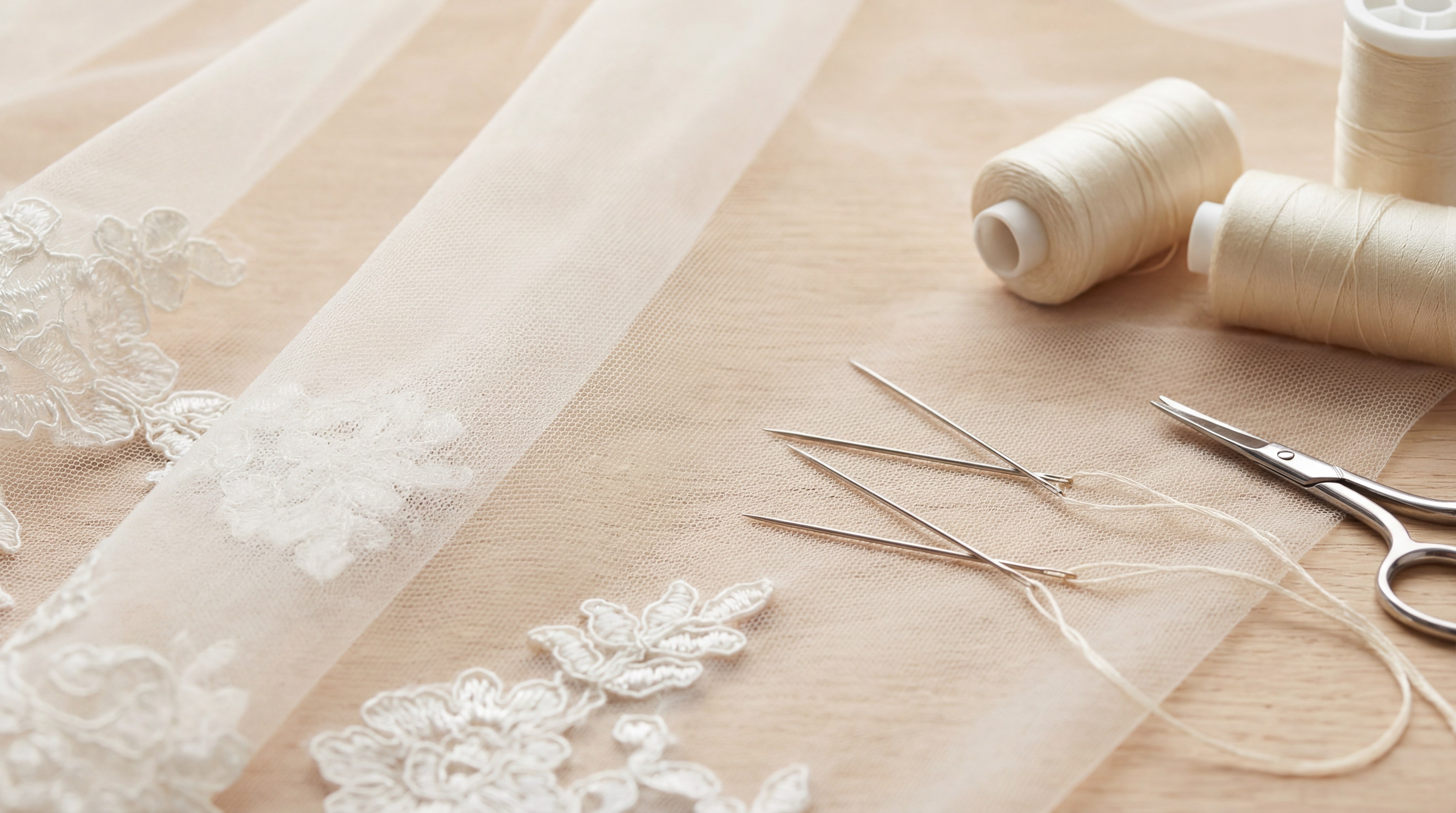
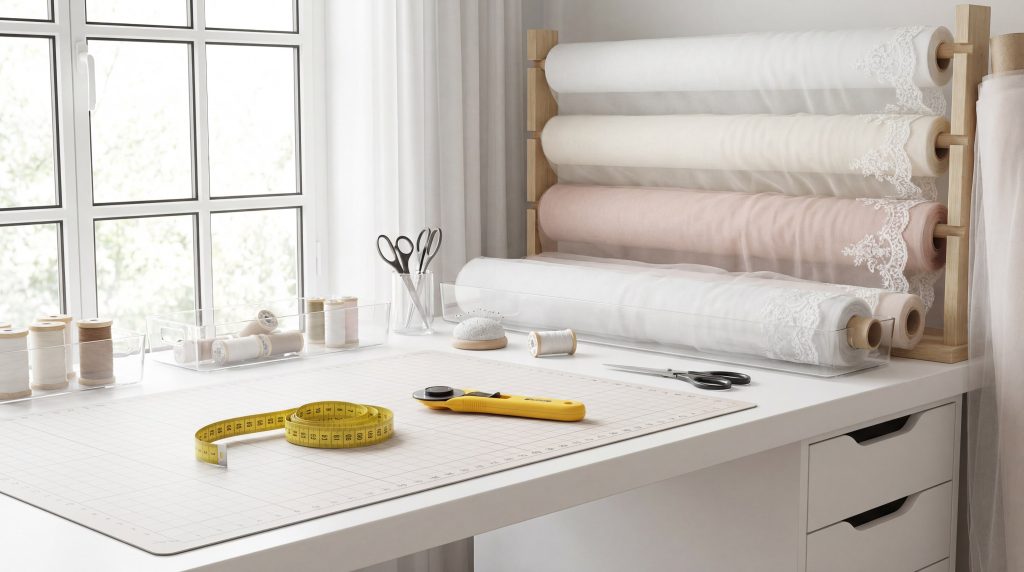
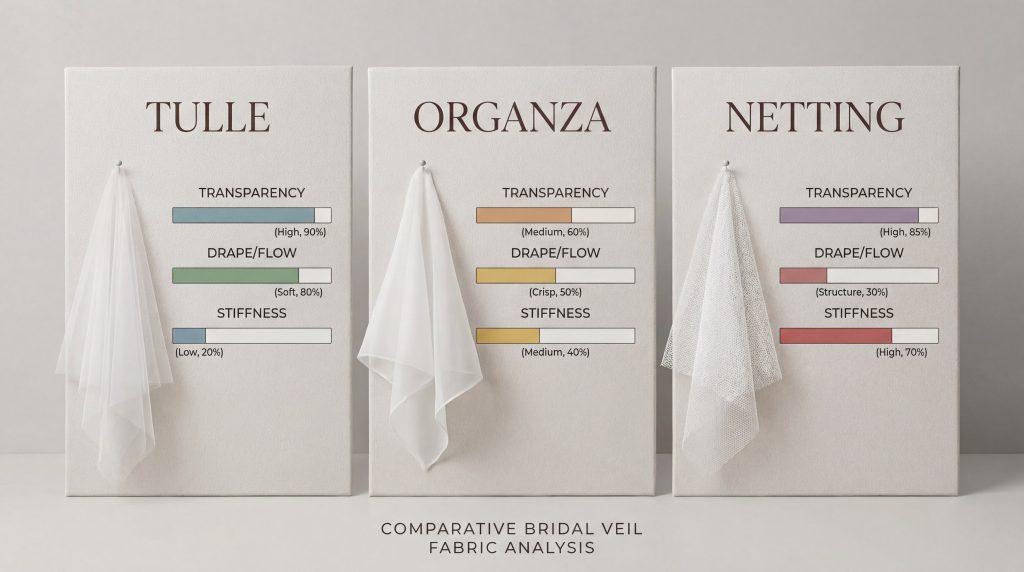
While people often use the terms interchangeably, “tulle” is a broad category that includes many different weights and textures of bridal veil fabric . Identifying the specific type of mesh is the key to achieving the desired drape.
Is illusion netting a bridal veil fabric?
You should know: Bridal illusion is a specific type of tulle characterized by its extremely fine hexagonal holes and high transparency. It is the most common material used in modern bridal fashion because it disappears against the skin.
- Fine hexagonal mesh
- Diamond hole netting
- Standard nylon base
- Sheer finish
Why does bridal veil fabric vary in price?
Look: The price difference usually stems from the fiber content, the country of origin, and the softness of the finish. Silk and French-made laces command premium prices, while standard nylon netting remains budget-friendly.
- Fiber (Silk vs Nylon)
- Manufacturing locale
- Softening treatments
- Width of the bolt
Can organza be used as bridal veil fabric?
In fact: Organza is a popular alternative for brides who want a solid, semi-opaque look with a lot of structural “body.” It doesn’t have the holes of a mesh, providing a more formal and crisp aesthetic.
- Plain weave structure
- Crisp hand-feel
- Semi-transparent
- High-shine options
| Material | Opacity | Stiffness | |
|---|---|---|---|
| Illusion Tulle | High Clarity | Medium | |
| English Mesh | Semi-Sheer | Low/Soft | |
| Silk Organza | Opaque/Sheer | High/Crisp |
Choosing between these options depends on whether you want a traditional “cloud” effect or a structured silhouette.
Key Takeaway: Tulle is the general family, but Bridal Illusion is the specific “invisible” mesh most brides recognize as the standard veil material.
Which color matches your bridal veil fabric?
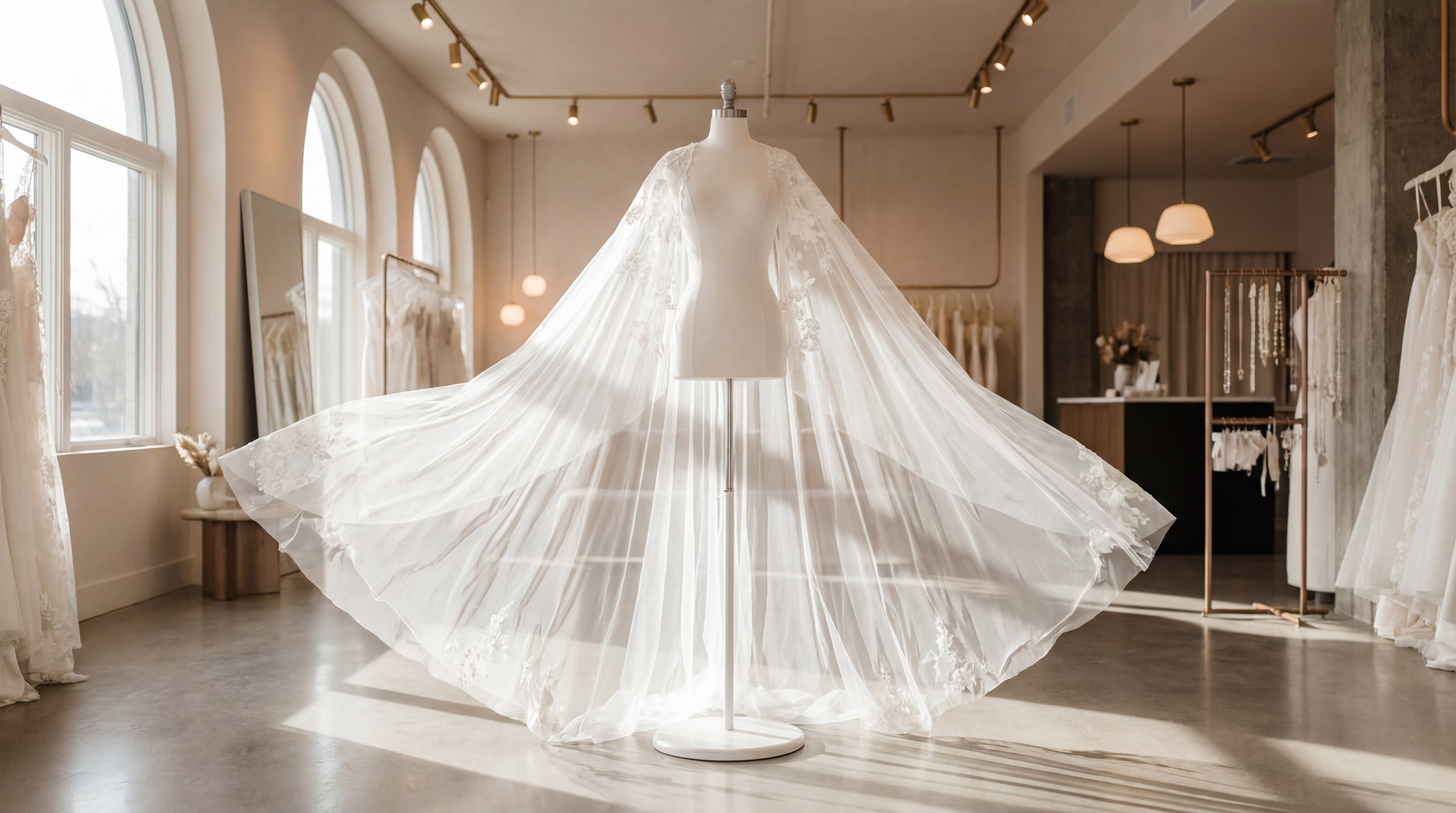
Matching the hue of your bridal veil fabric to your wedding gown is critical, as even a slight mismatch can look “dirty” or “clashing” in professional photos. Lighting plays a huge role in how these colors appear on the wedding day.
Is ivory the best shade for bridal veil fabric?
Truth be told: Ivory is the most popular shade because most modern wedding dresses are not a stark “optical” white. Ivory has a warm undertone that complements most skin tones and looks rich in natural sunlight.
- Warm yellow undertones
- Soft cream finish
- Standard for lace
- Skin-flattering
How to layer colors of bridal veil fabric?
Surprisingly: You can layer a blush-colored mesh under an ivory top layer to create a subtle, romantic “glow” that changes as you move. This technique adds depth and can help tie in other colors from your bridal bouquet.
- Two-tone effects
- Blush and Nude bases
- Depth creation
- Ombre possibilities
Does diamond white suit bridal veil fabric?
Basically: Diamond white (also known as “silk white”) is a midway point between stark white and ivory. It is the perfect match for silk gowns that have a natural, cool luster without the yellowish tint of true ivory.
- Neutral/Cool tone
- No yellow hues
- Matches silk satin
- Bright but soft
| Gown Color | Best Veil Match | Vibe | |
|---|---|---|---|
| Pure White | Optical White | Modern/High-Contrast | |
| Silk/Off-White | Diamond White | Sophisticated/Natural | |
| Cream/Champagne | Ivory or Latte | Vintage/Warm |
Testing swatches against your dress in outdoor light is the only way to ensure a perfect match.
Key Takeaway: Always match your veil color to the gown’s undertones, opting for Ivory for warmth or Diamond White for a neutral, high-end look.
How to cut raw edges on bridal veil fabric?
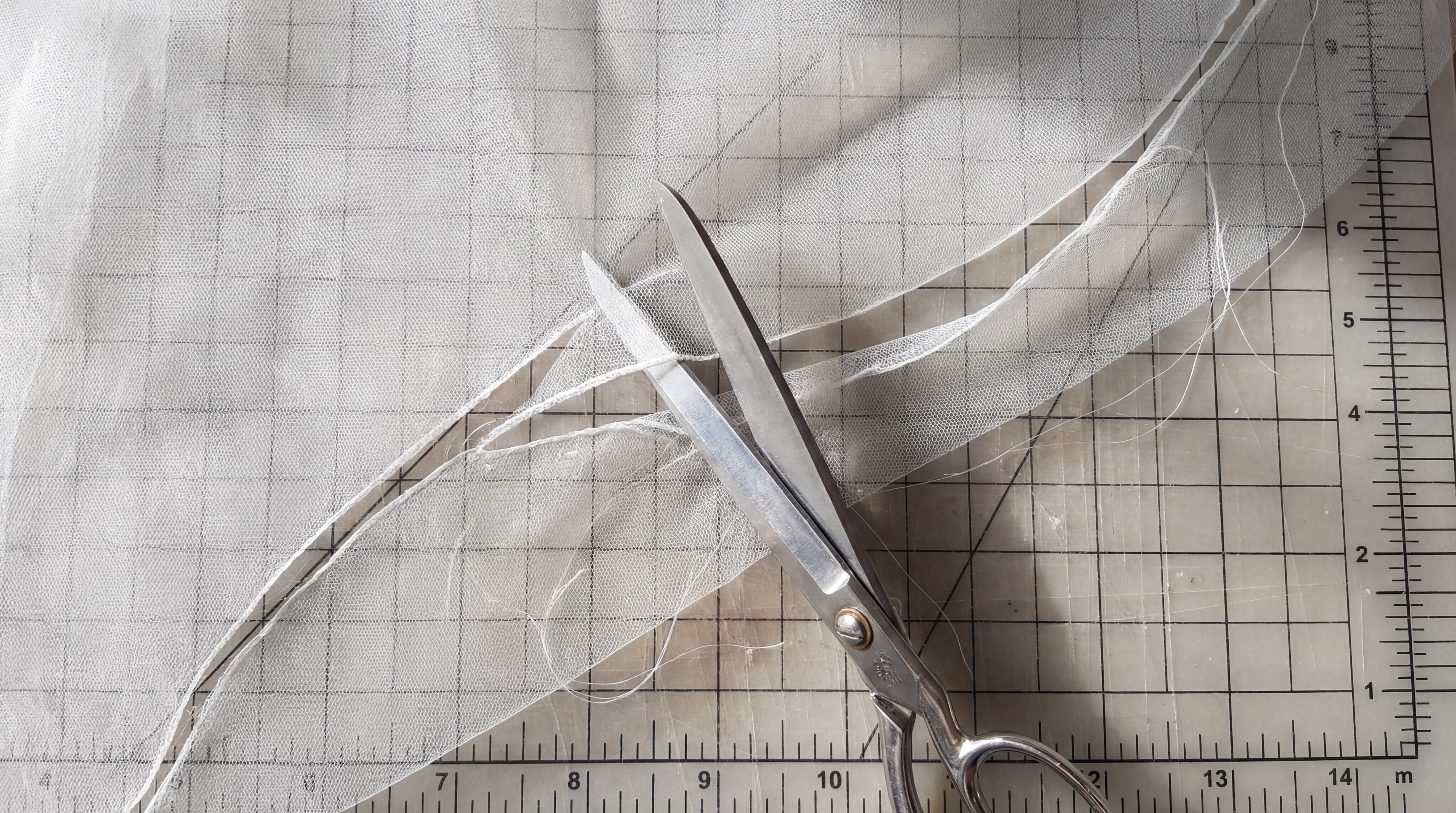
Using a rotary cutter and a self-healing mat is the most effective way to get a perfectly smooth edge on bridal veil fabric . Unlike traditional scissors, a rotary blade applies even pressure, preventing the mesh from shifting or snagging.
Should I use a template for bridal veil fabric?
Listen: A cardboard or plastic template ensures your curves are symmetrical on both sides of the veil. For a circular or “drop” veil, a simple string-and-pencil compass method works best for marking your cut line.
- Cardboard curves
- Plate edges for corners
- String compass tool
- Symmetry checking
How to prevent fraying on bridal veil fabric?
Good news: True nylon bridal illusion does not fray because it is a knit mesh rather than a woven fabric. You can leave the edges raw for a “disappearing” look, provided your cut is perfectly clean and free of jagged nicks.
- Raw edge finishes
- No-hem requirement
- Rotary blade precision
- Micro-snip cleanup
Are specialized shears needed for this fabric?
To be honest: If you prefer scissors, you must use 8-inch dressmaking shears that are professionally sharpened. Dull scissors will “chew” the edge of the mesh, leaving a visible and messy white line along the cut.
- Forged steel blades
- Bent-handle design
- Thread snips for detail
- Fabric-only usage
| Cutting Tool | Pros | Cons | |
|---|---|---|---|
| Rotary Cutter | Perfectly smooth curves | Needs a large mat | |
| Dressmaking Shears | Portable/Classic | Can cause jagged edges | |
| Pinking Shears | Decorative edge | Not for traditional veils |
Precise cutting is the difference between a high-end custom veil and a craft-store project.
Key Takeaway: A rotary cutter on a flat surface is the best way to achieve the clean, “invisible” raw edge that defines modern bridal veils.
Does the weight of bridal veil fabric matter?
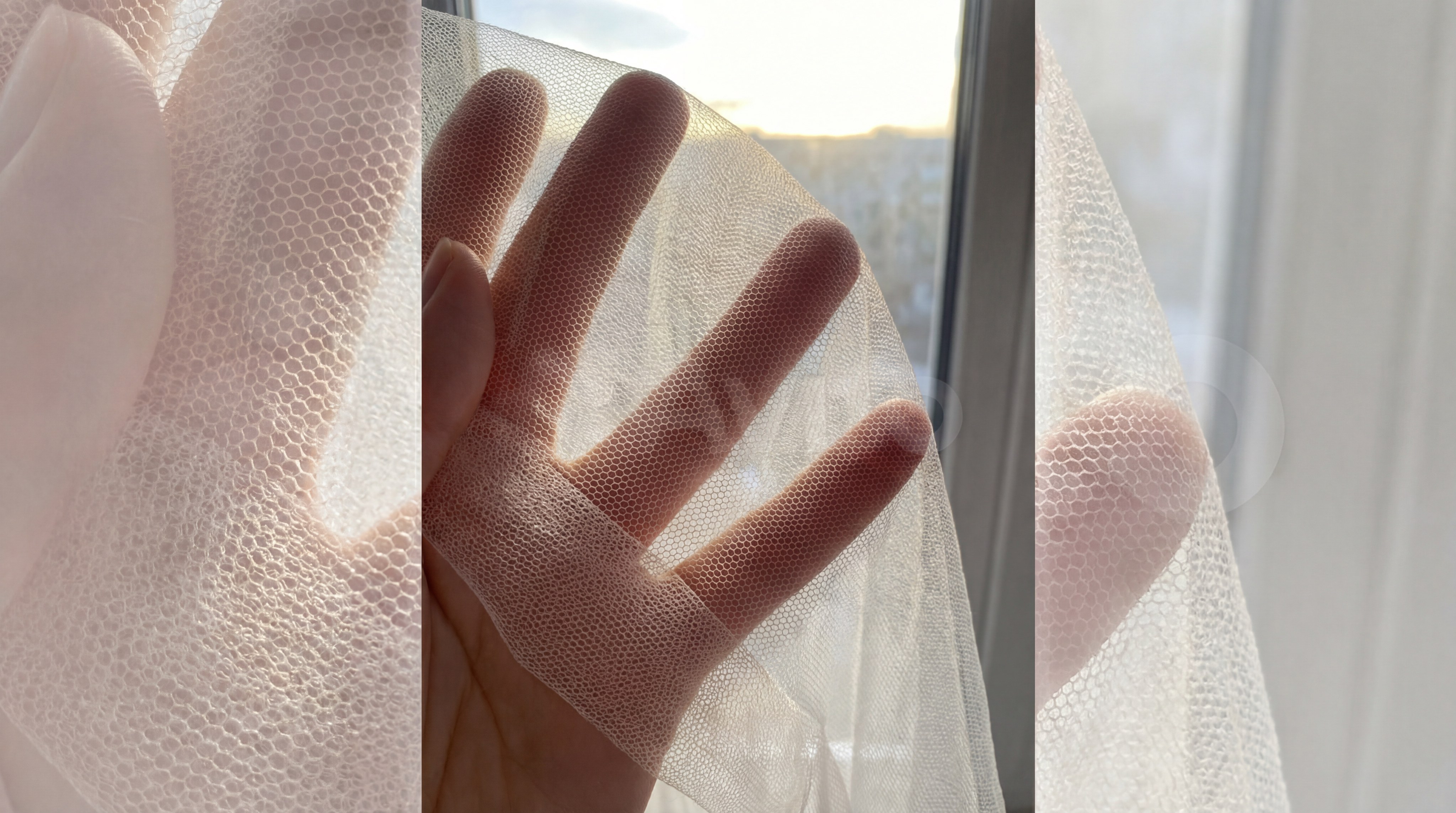
The weight of your bridal veil fabric directly affects the “loft” and movement, determining whether it floats behind you or clings to your dress. Heavier weights provide more structure but can be cumbersome for long-term wear.
How does bridal veil fabric drape naturally?
Simply put: Lightweight silk or English tulles have a “dead” drape, meaning they fall straight down in elegant, narrow columns. In contrast, stiffer nylon netting has “memory” and will stand away from the body, creating more volume.
- Vertical column drape
- Bouffant volume
- Wind-reactive movement
- Softness vs. Stiffness
Is a heavy bridal veil fabric harder to wear?
Consider this: Cathedral-length veils made of heavy organza or densely beaded mesh can weigh several pounds and pull on the bride’s hairstyle. It is essential to use extra hair pins or a reinforced comb to distribute the weight safely.
- Neck strain risks
- Comb reinforcement
- Multi-layer weight
- Beading density
| Fabric Weight | Movement | Best Style | |
|---|---|---|---|
| Ultra-Light | Floating/Airy | Outdoor/Beach | |
| Medium | Structured/Poof | Classic Ballgown | |
| Heavy | Dramatic/Static | Formal/Royal |
The weight of the material should complement both your hairstyle and the silhouette of your gown.
Key Takeaway: Choose lightweight fabrics for a floating effect and heavier, stiffer options if you want the veil to hold a specific architectural shape.
How should you store your bridal veil fabric?
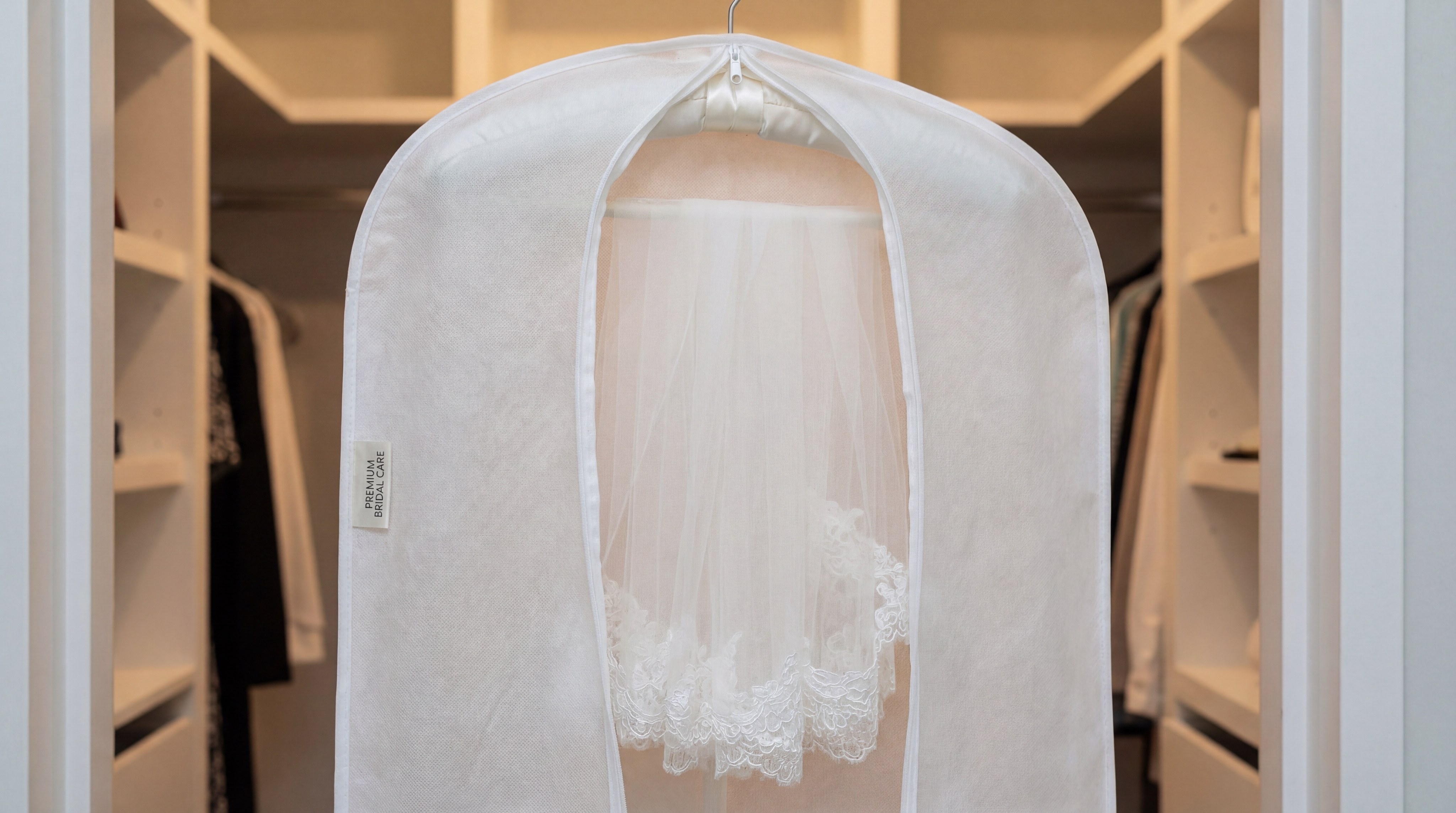
Hanging your bridal veil fabric in a cool, dry place inside a breathable garment bag is the best way to prevent permanent creasing. Avoid plastic bags, as they can trap moisture and cause synthetic fibers to yellow over time.
Can you steam or iron bridal veil fabric?
Warning: Never use a traditional iron directly on nylon mesh, as it will melt instantly and ruin the fabric. A handheld steamer is the only safe way to remove wrinkles while the veil is hanging.
- Handheld steamer only
- No direct iron contact
- Distilled water use
- Keep 6 inches away
How to remove wrinkles from bridal veil fabric?
Try this: The simplest way to remove minor wrinkles is to hang the veil in a bathroom while you take a hot shower. The gentle steam will relax the fibers naturally without any risk of heat damage.
- Bathroom steam method
- Gravity stretching
- Mist and hang
- Professional pressing
Should I hang or fold my bridal veil fabric?
Actually: Folding should only be done for short-term transport in an acid-free tissue-lined box. For long-term preservation, hanging it on a padded clip hanger ensures that no sharp fold lines become permanent.
- Padded clip hangers
- Acid-free tissue paper
- Breathable cotton bags
- Dark storage area
| Storage Method | Duration | Risk Level | |
|---|---|---|---|
| Hanging | Long-term | Low (Best) | |
| Boxed (Tissue) | Travel/Archive | Medium | |
| Folded (Plastic) | Never | High (Yellowing) |
Proper storage ensures the fabric remains as pristine as the day it was cut.
Key Takeaway: Always hang your veil in a breathable bag and use steam—never an iron—to maintain its delicate, wrinkle-free structure.
Frequently Asked Questions
Can I wash my finished bridal veil fabric at home?Most synthetic bridal fabrics should only be spot-cleaned with cool water and mild detergent. Silk versions require professional dry cleaning to maintain their delicate structure and sheen.
Can I use a regular sewing machine for this project?Yes, you can use a standard home machine. It is recommended to use a walking foot or a zig-zag stitch to prevent the fabric from being pulled into the needle plate.
Can I dye bridal veil fabric to match my dress?Nylon and polyester fabrics require specialized synthetic dyes and high heat, which can damage the mesh. Silk and cotton-based fabrics are much easier to tint with standard fabric dyes.
Can I mix different types of tulle in one veil?Mixing textures can create beautiful depth. Combining a stiffer bridal illusion tulle with a softer English netting can provide both structure and a romantic, flowing drape.
Can I use fabric glue on lace and tulle?While fabric glue is an option for small embellishments, it can often seep through the holes of the mesh or create stiff spots. Hand-stitching is always the preferred method for a professional finish.
Creating your own heirloom piece is a journey of precision and passion. Now that you understand the nuances of weight, color, and technique, you have everything you need to begin your design. We are dedicated to providing the finest textiles to help you realize your bridal dreams with confidence and grace. To find the perfect materials for your vision, contact us today and let our experts guide your selection.