
12-Month Batch Program Zero Rejections
How we delivered monthly shipments of identical glitter tulle to a German OEM manufacturer—maintaining batch-to-batch consistency that kept their production line running without disruption or brand-client complaints.
A German OEM Where Precision Is Non-Negotiable
This large German manufacturer operates with the kind of production discipline that defines world-class OEM operations. Their assembly lines run on tight schedules, standardized inputs, and zero tolerance for deviation. Every component—including decorative fabrics—must integrate seamlessly into their workflow.
They serve demanding brand clients who expect consistency in every finished product. For them, any variation in material appearance or behavior isn't just an inconvenience—it becomes a systemic cost multiplier that ripples through quality control, customer relations, and delivery timelines.
"When you serve brand clients who audit every detail, consistency isn't a preference—it's survival. One batch that looks different can trigger weeks of explanations and remediation."
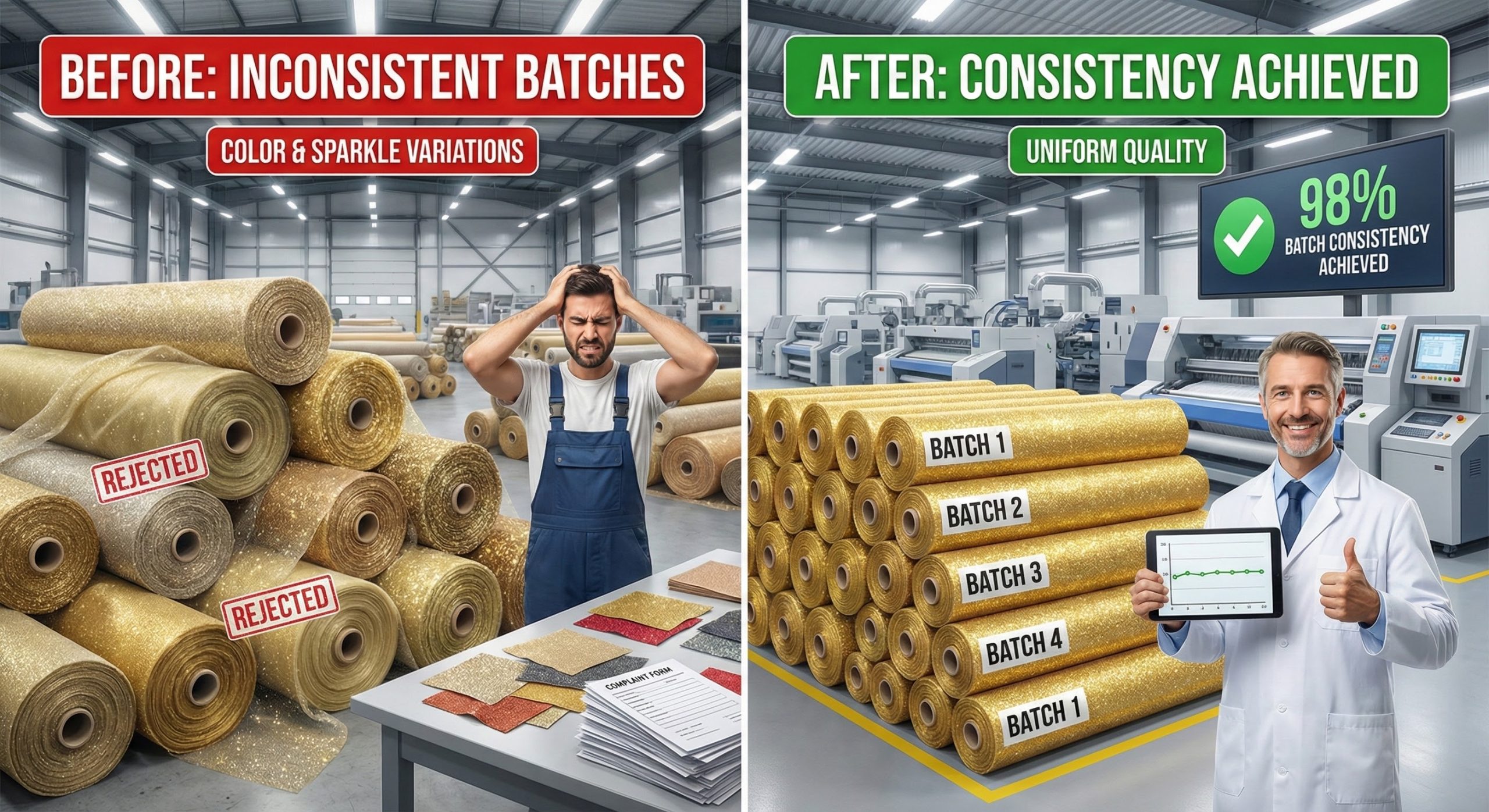
Why Batch Consistency Determines Success or Failure
For an OEM production line, every incoming shipment must match the approved sample exactly. The stakes are higher with glitter tulle, where surface treatments and visual effects amplify even minor variations.
Approved Sample Matching
Each monthly delivery must align precisely with the pre-approved reference—matching visual appearance, sparkle intensity, hand feel, and glitter adhesion. Any deviation triggers inspection delays and potential rejection.
Assembly Line Disruption
Even small differences force line adjustments—recalibrating cutting patterns, modifying handling procedures, or pausing production for quality reviews. Unplanned stops cascade into missed deadlines and excess labor costs.
Brand-Client Complaints
The OEM's brand clients conduct their own inspections. Any visible inconsistency in finished products—sparkle tone, glitter density, fabric drape—directly impacts the OEM's reputation and can jeopardize future orders.
Rework and Returns
Non-conforming materials mean either costly rework or outright returns. For a 12-month program, one problematic batch can undermine months of smooth operation and strain the supplier relationship.
Why glitter tulle is especially challenging: Unlike solid-color fabrics, glitter tulle involves surface coating processes that are more susceptible to batch-to-batch variation. Sparkle uniformity, glitter particle distribution, adhesion stability, and base tulle tension all require active control to maintain consistency across production runs.
The Batch Consistency System That Made Zero Rejections Possible
We built a systematic approach that transforms batch consistency from an aspiration into a repeatable, verifiable process. Each step creates accountability and traceability from reference lock-in through final shipment.
Reference Standard Lock-In
Before production begins, we establish a formal reference baseline that becomes the benchmark for every subsequent batch.
- Approved sample archived and protected
- Retain samples stored under controlled conditions
- Reference swatches created for production floor comparison
- Customer-confirmed acceptance criteria documented
Batch-to-Batch Control Points
Each production batch is measured against specific quality dimensions that matter for OEM integration.
- Sparkle uniformity across the roll width
- Hand feel consistency (drape, stiffness, softness)
- Shedding stability under handling stress
- Base tulle tension and structural integrity
- Color tone alignment with reference
Traceability & Documentation
Every batch carries a complete history that can be traced back to raw materials and production conditions.
- Unique batch ID assigned to each production run
- Inspection records linked to batch ID
- Sample-to-bulk mapping for quality correlation
- Production parameter documentation
Pre-Shipment Verification
Before any batch leaves our facility, it undergoes final comparison against the original reference under standardized conditions.
- Side-by-side comparison with reference swatch
- Standardized lighting conditions for visual inspection
- Physical handling test for shedding behavior
- Final approval sign-off before shipment release
How the 12-Month Supply Program Operates
This isn't a sequence of individual orders—it's a coordinated system where production scheduling, quality alignment, and exception handling work together to maintain uninterrupted supply.
Monthly Scheduling Coordination
Production slots are aligned with the customer's receiving schedule. We coordinate lead times, shipping windows, and delivery confirmations to ensure materials arrive when the production line needs them.
Incoming QC Alignment
We understand the customer's incoming inspection process and pre-align our quality checks to match their acceptance criteria. This reduces inspection surprises and speeds up material clearance.
Exception Handling Protocol
When deviations occur—and in a 12-month program, they can—we have rapid-response protocols to identify root causes, implement corrections, and communicate clearly with the customer before issues escalate.
This is system-level cooperation, not transactional ordering. Each month builds on the last, with continuous refinement of processes and deepening alignment between our production capability and customer expectations.
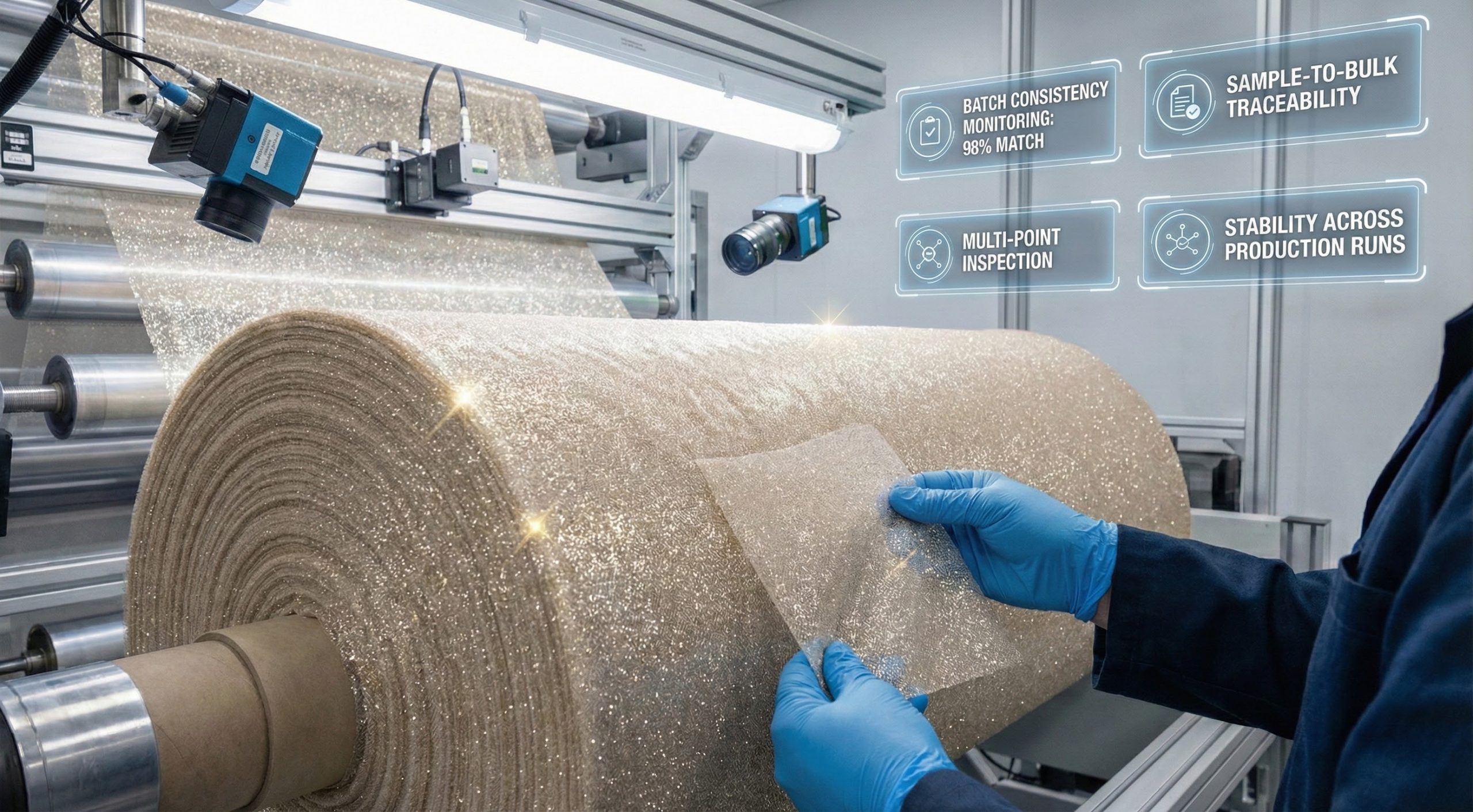
How Consistency Becomes Verifiable Acceptance
Abstract consistency claims mean nothing without measurable criteria. These are the specific dimensions against which each batch is evaluated—both by us before shipment and by the customer upon receipt.
- Visual sparkle uniformity under standard lighting conditions—no dark spots, no over-concentrated glitter zones
- Hand feel consistency—no unexpected stiffness, no texture variation from reference sample
- Shedding behavior within agreed tolerance—glitter stays intact through cutting, handling, and processing
- Roll-to-roll repeatability—consistency maintained not just batch-to-batch but within each batch
Customer-side validation: These criteria are verified through incoming inspection upon delivery, production line trials during integration, and periodic spot checks throughout the program duration.
The Result: Zero Rejections
Across 12 months of monthly shipments, the program achieved its target outcome: stable, consistent supply that integrated seamlessly into the customer's production workflow without quality incidents or delivery disruptions.
Zero Rejections
Program-level outcome achieved through systematic consistency control
Reduced Line Disruption
Fewer interruptions for quality reviews, material adjustments, or unplanned stops
Brand-Client Stability
Consistent finished products supported stronger downstream relationships
When each shipment matches the one before, production planning becomes predictable. No firefighting, no emergency substitutions, no quality escalations—just materials that work the way they're supposed to, month after month.
Why This Case Matters for OEM Buyers
Batch Consistency Drives Production Efficiency
For OEM operations, consistency isn't about aesthetics—it's about process stability. When incoming materials behave predictably, assembly lines run smoother, quality costs drop, and delivery timelines become reliable.
Glitter Tulle Requires Systematic Control
Surface-treated fabrics like glitter tulle present inherent consistency challenges. Without active batch management, variation is the default. Achieving repeatability requires deliberate process design and quality infrastructure.
Long-Term Programs Prove Supplier Capability
Anyone can deliver one good batch. A 12-month program tests whether consistency is sustainable. It reveals whether a supplier has the systems, discipline, and commitment to perform reliably over time.
Explore More Glitter Tulle Cases
Related Resources
Quality & Stability Solutions
Explore our full range of quality assurance capabilities for glitter tulle—from anti-shedding technology to batch traceability systems.
Industry Guide: Why Bulk Consistency Is Hard
Understand the technical and operational challenges that make batch-to-batch consistency difficult for surface-treated fabrics.
Popular Visual Options
Browse our most requested glitter tulle styles—from subtle shimmer to high-impact sparkle, with options for various applications.
Ready to Discuss Your Batch Program?
If you're planning a multi-month supply program and need consistent glitter tulle that integrates reliably into your production line, let's talk about how we can support your requirements.